Cricket Ball Gauges: The Tiny Tools That Keep the Game Fair
In cricket, fairness and accuracy are everything. From bowlers delivering within the crease to batters staying inside the line, every detail is regulated to maintain balance. But there’s one tiny tool that rarely gets attention yet plays a massive role in ensuring fair play — the cricket ball gauge.
It doesn’t roar like a fast bowler or shine like a new bat, but without it, the game would lack the structure and consistency we take for granted. In this blog, we’ll explore what cricket ball gauges are, how they work, their history, and why they’re crucial for the game’s integrity.
1. What is a Cricket Ball Gauge?
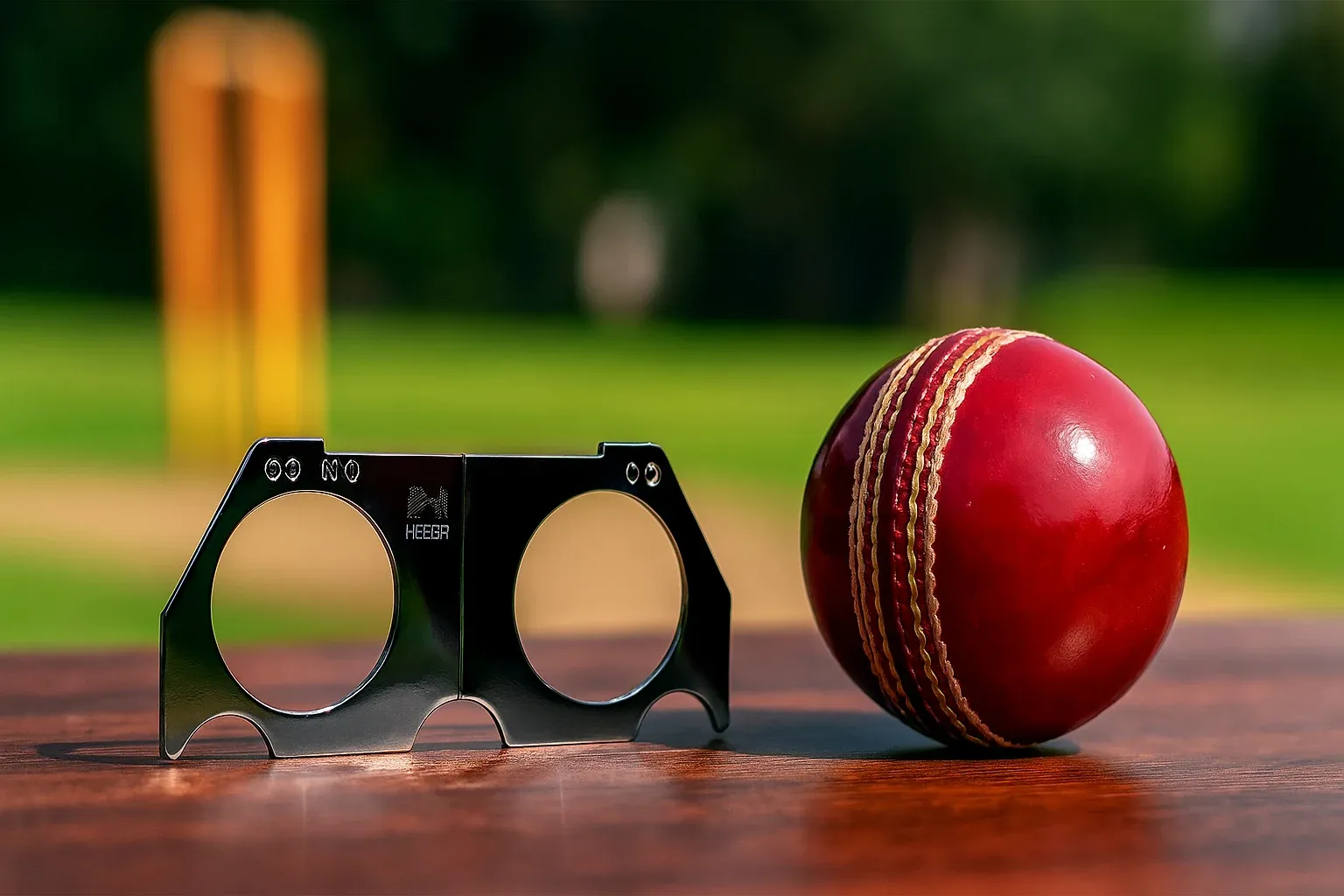
A cricket ball gauge is a small measuring device used by umpires to check whether a cricket ball is within the legal size limits set by the International Cricket Council (ICC).
- It usually has two circular holes:
- Go Hole: The ball must fit through this hole.
- No-Go Hole: The ball must not pass through this smaller hole.
This quick test ensures the ball is neither too large nor too small, keeping the contest fair for bowlers and batters alike.
2. ICC Regulations on Cricket Ball Size
According to ICC rules:
- Men’s Cricket: 8.81 to 9 inches in circumference (22.4–22.9 cm).
- Women’s Cricket: 8.25 to 8.88 inches in circumference (21–22.5 cm).
- Junior Cricket: Slightly smaller, depending on the age group.
A gauge is the simplest way to test these measurements instantly on the field.
3. Why Ball Gauges Are So Important
3.1 Ensuring Fair Competition
If a ball is too small, bowlers get unfair swing and grip advantages. If it’s too large, it becomes harder for batters to hit cleanly. The gauge ensures balance between bat and ball.
3.2 Preventing Ball Tampering Issues
Sometimes, constant play or poor quality may distort a ball’s shape. A gauge detects when a ball is out of round, which can cause unusual movement. This allows umpires to replace it fairly.
3.3 Upholding the Spirit of Cricket
Cricket prides itself on fairness. A small tool like the gauge helps uphold the game’s reputation by keeping equipment in check.
4. History of Cricket Ball Gauges
The use of gauges dates back to the late 19th and early 20th centuries when standardized rules for cricket balls became necessary. Before that, different manufacturers often produced balls of varying sizes, leading to inconsistent play.
Today, every international match referee and umpire carries a ball gauge, making it a standard part of the officiating toolkit.
5. How Umpires Use a Ball Gauge
The process is simple yet effective:
- Umpire places the ball in the Go Hole → If it passes through, size is legal.
- Umpire checks the No-Go Hole → If the ball passes through, it’s too small and unfit for play.
This takes just a few seconds but ensures accuracy throughout the game.
6. Ball Gauges Beyond Size: Multi-Functional Tools
Modern cricket gauges often serve multiple purposes:
- Checking Bat Width – Ensuring bats comply with ICC’s maximum 108 mm rule.
- Stump Alignment – Used to check stump gaps before a match.
- Leather Ball Shape – Identifying when the ball has gone out of round.
This versatility makes the gauge a true all-in-one tool for umpires.
7. Famous Incidents Involving Ball Gauges
- Ashes 2019: During one of the Tests, umpires checked the ball multiple times with a gauge after noticing abnormal swing. Eventually, it had to be replaced.
- World Cup Matches: Several games have seen ball replacements mid-innings after failing the gauge test, proving how vital this tool is in big tournaments.
8. The Science Behind Ball Gauges
Ball gauges are designed with precision engineering:
- Made of durable stainless steel or aluminum.
- Designed with perfectly measured circular cutouts matching ICC standards.
- Lightweight and portable, fitting easily in the umpire’s pocket.
Despite their simplicity, they represent scientific accuracy in cricket regulation.
9. Types of Ball Gauges
- Standard Dual-Hole Gauge – Traditional “Go/No-Go” design.
- Multi-Gauge Tools – Include bat width, stump gap, and ball size all in one.
- Digital Gauges (Experimental) – Rare but being tested for high-tech cricket environments.
10. Why Players Should Care About Ball Gauges
Even though players don’t use them directly, gauges impact their game:
- Bowlers rely on fairly sized balls for consistent swing and grip.
- Batters need the ball to behave predictably.
- Fielders benefit from a consistent bounce off the ball’s surface.
Without gauges, cricket could easily tilt unfairly in favor of one side.
11. Buying a Cricket Ball Gauge
For coaches, umpires, and even passionate players, owning a ball gauge can be a game-changer during practice. Things to look for:
- Material: Stainless steel for long life.
- Accuracy: Must follow ICC size standards.
- Extras: Multi-purpose features for bats and stumps.
At Heega Sports, our premium cricket ball gauges are designed for accuracy, durability, and professional use.
Conclusion
Small but mighty, the cricket ball gauge is one of the game’s most underappreciated tools. While fans celebrate sixes, wickets, and centuries, it’s the quiet check of a ball through a tiny metal ring that keeps cricket fair and balanced.
From preventing tampered balls to ensuring ICC standards, ball gauges truly are the tiny tools that keep the game fair.
Shop Now
Looking for professional cricket ball gauges that ensure accuracy and fairness?
[Shop Now with Heega Sports]
Related posts
 How Kids Learn to Read a Cricket Ball: Understanding Line, Length, Bounce and Shot SelectionLearn how kids can read a cricket ball by understanding line, length, bounce and shot selection to develop better batting skills and confidence.
 Batting Gloves Explained: How Padding Placement and Finger Protection Help Manage Ball ImpactLearn how batting glove padding placement, finger protection, and fit help manage ball impact. Find practical tips for choosing cricket batting gloves.
 Leather Ball Cricket Explained: How Ball Condition, Seam and Swing Influence BowlingLearn how leather ball cricket works and how ball condition, seam position, shine, and swing influence bowling accuracy, movement, and performance.