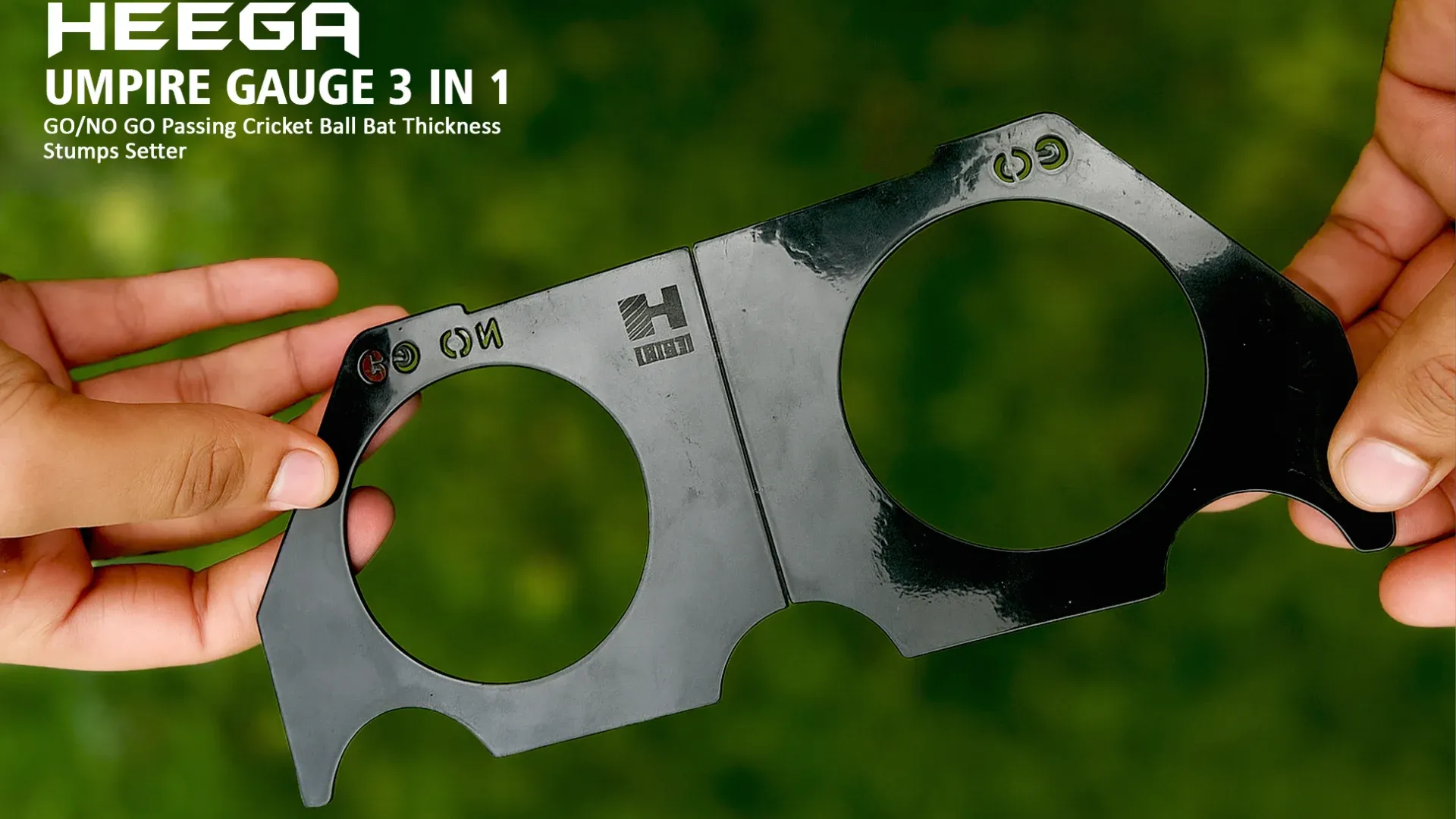
Cricket is a sport built on fine margins. A single no-ball, a wrongly sized bat, or a misjudged delivery can alter the outcome of a match. While fans celebrate sixes and wickets, few notice the small but powerful tools that silently keep the game fair. One of these unsung heroes is the cricket ball gauge.
It may look like a simple metal frame, but its role is vital—it ensures that the cricket ball used during play stays within the official size and shape regulations. Without it, cricket could lose its accuracy, balance, and fairness.
In this blog, we’ll uncover the hidden role of ball gauges, how they work, their importance in professional cricket, and why they deserve far more attention than they receive.
1. What is a Cricket Ball Gauge?
A ball gauge is a measuring tool used by umpires to check whether a cricket ball meets the size and roundness standards defined by the ICC (International Cricket Council).
It typically comes in two pieces:
- Maximum size gauge → ensures the ball isn’t too large.
- Minimum size gauge → ensures the ball isn’t too small.
If the ball doesn’t pass through the gauges, it is declared unfit for play. This prevents any unfair advantage from using altered or deformed balls.
2. Why Are Ball Gauges Needed?
Cricket balls undergo extreme wear and tear during matches. Constant impact with bats, the ground, and fielders means:
- The ball can lose its round shape.
- It may shrink slightly from repeated impact.
- Overuse can make it lighter or heavier depending on conditions.
If left unchecked, these changes can alter swing, bounce, and seam movement—giving either batsmen or bowlers an unfair edge.
The ball gauge ensures the ball remains accurate, fair, and legal throughout the game.
3. ICC Regulations for Cricket Balls
According to Law 4 of the MCC Laws of Cricket, a ball must:
- Have a circumference between 8.81 inches (22.4 cm) and 9 inches (22.9 cm).
- Weigh between 155.9 g – 163 g (for men’s cricket).
- Be spherical in shape.
If a ball becomes misshapen and fails the ball gauge test, it must be immediately replaced with a ball of similar wear.
4. How Does a Ball Gauge Work?
The process is straightforward:
- The umpire takes out the ball gauge ring.
- The ball is passed through the maximum gauge → if it doesn’t fit, it’s too big.
- The ball is then passed through the minimum gauge → if it slips through, it’s too small.
- If it passes both, the ball is approved for use.
This process usually takes just seconds but plays a critical role in ensuring match accuracy.
5. Ball Gauge vs Bat Gauge
Both tools are designed to maintain fairness:
- Bat Gauge → checks bats don’t exceed size regulations.
- Ball Gauge → ensures balls remain within legal size and roundness.
Together, they balance the battle between bat and ball, keeping cricket competitive and authentic.
6. Historical Importance of Ball Gauges
The use of ball gauges became common in international cricket in the mid-20th century when bowlers began exploiting worn balls for reverse swing and unfair movement.
To ensure legality:
- Umpires were given ball gauges.
- Strict rules were introduced on ball replacement.
- Fielding teams were warned against ball tampering.
Today, every international match uses ball gauges, proving how central they are to cricket’s fairness.
7. When Are Ball Gauges Used During a Match?
Ball gauges are typically used when:
- A ball is suspected of being out of shape.
- Players complain about the ball’s behavior.
- Umpires notice irregular bounce or swing.
- A ball is hit into the stands and returned in poor condition.
By checking with the gauge, umpires decide whether to replace the ball.
8. How Ball Gauges Maintain Accuracy
Accuracy in cricket depends heavily on the ball. If the ball is irregular:
- Batsmen may face unpredictable bounce.
- Bowlers may exploit unfair swing.
- Fielders may misjudge trajectories.
Ball gauges restore fairness by ensuring the ball remains within exact dimensions, keeping both teams on equal footing.
9. Famous Incidents Involving Ball Gauges
There have been multiple occasions when ball gauges have influenced big games:
- Ashes series tests: Umpires have replaced misshapen balls, changing the game’s flow.
- ODIs & T20s: In shorter formats, where every run counts, a ball replacement can shift momentum.
- Domestic cricket: Local umpires often catch poorly made or damaged balls, preventing unfair play.
These stories highlight that even though unnoticed by fans, the ball gauge is a game-changer behind the scenes.
10. Ball Gauges and the Spirit of Cricket
The spirit of cricket is about fairness and equal competition. Ball gauges protect this spirit by:
- Preventing ball tampering advantages.
- Stopping illegal or poor-quality balls from use.
- Ensuring both teams face the same conditions.
Without ball gauges, the game could easily tilt in favor of one side.
11. The Science Behind Ball Shape
The roundness of a ball is essential because:
- A perfectly round ball swings consistently.
- A deformed ball can cut, dip, or bounce irregularly.
- Accuracy of bowlers depends on predictable aerodynamics.
The ball gauge ensures that cricket remains a battle of skill, not equipment irregularities.
12. How Ball Gauges Help Bowlers and Batsmen
- For Bowlers: It ensures they use legal, round balls—rewarding skill rather than luck.
- For Batsmen: They face predictable swing and bounce, improving fairness.
- For Umpires: Provides a clear, unbiased tool for decision-making.
13. Challenges with Ball Gauges
Despite their usefulness, ball gauges face challenges:
- Wear and tear of gauges themselves may affect accuracy.
- Subjectivity in deciding when to test a ball.
- Different conditions (heat, moisture) may shrink or expand the ball temporarily.
Still, they remain the most reliable tool available.
14. Future of Ball Gauges
With technology advancing, the future may bring:
- Digital ball gauges with sensors.
- 3D ball scanning for precise roundness detection.
- Smart cricket balls that self-report shape and size.
Even then, the principle will remain—balls must stay within legal limits.
15. Lessons for Young Cricketers
Ball gauges teach young players an important lesson:
The game must be fair, no matter what.
By respecting equipment rules, young cricketers learn to rely on skill, not loopholes, to win matches.
Conclusion
The cricket ball gauge may not get airtime during matches, but its role is vital. By ensuring every ball remains within size and shape limits, it keeps the game accurate, fair, and balanced.
Without it, cricket would risk losing its credibility. So next time you watch a match, remember: while the players shine on the field, tools like the ball gauge are silently working in the background to protect the spirit of cricket.
Play True, Play Fair with Heega
At Heega Sports, we ensure all our cricket balls meet international standards for size, seam, and durability. Accuracy starts with the right ball.