Cricket bat handle binding: where the twine sits and why it matters
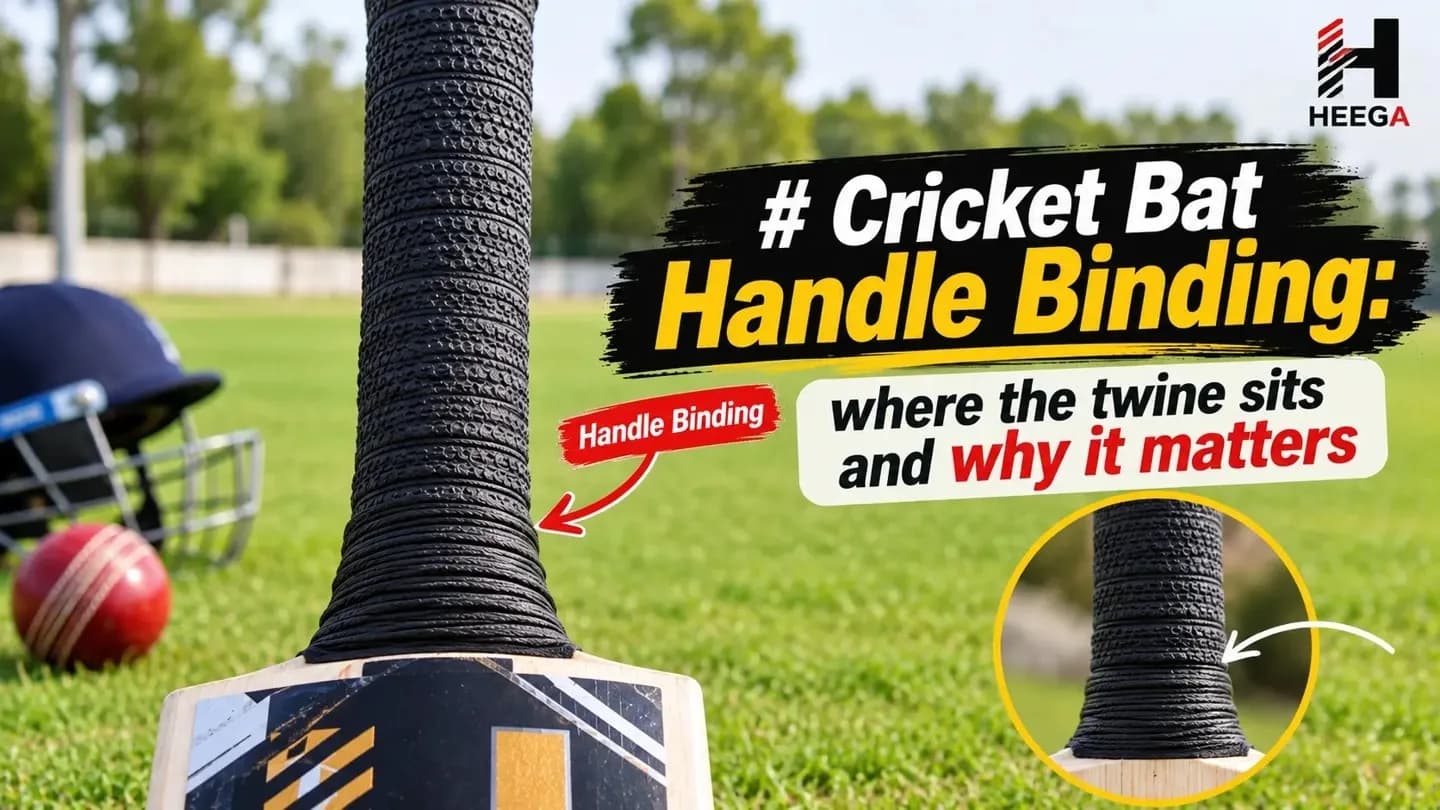
What cricket bat handle binding is
Pull the rubber grip off any proper bat and you will not find bare cane. You will find twine, wound round and round the handle in tight, close turns, stiff with glue. That is the cricket bat handle binding. Most players never see it. They only find out it exists when it fails.
A bat handle is not one piece of wood. It is strips of cane glued together, with thin layers of rubber set between them. The rubber takes some of the sting out of a hard hit. The cane gives the spring. But strips that are glued side by side want to move apart a little every time the ball hits the blade. The binding is what stops them. It squeezes the whole handle from the outside, like a hoop on a barrel.
So the twine is not decoration, and it is not there to make the grip feel thicker. It is part of how the handle holds together.
Where the twine sits
In our workshop the binding goes on after the handle has been fitted into the blade and the glue in the splice has set. The splice is the V-shaped joint where the handle goes down into the shoulders of the bat.
The twine starts low, just above the shoulders, and runs up the handle. It stops a short way below the top, where the grip will be rolled over it. On a full-size bat that is most of the handle's length.
The part that matters most is the bottom few inches. That is where the handle meets the blade, and that is where the handle bends most when you hit the ball. If the binding is going to work loose, it nearly always starts there.
How many turns, and how tight
The turns sit side by side with no gap between them. You should not be able to see cane through the twine anywhere. On a well-bound handle you can count roughly 8 to 10 turns to the inch, depending on how thick the twine is.
Tension is the real skill. The twine is pulled hard as it is wound, so each turn bites into the glue and the handle. Too loose and it does nothing. Wound unevenly, it leaves ridges you can feel through a thin grip.
We use a glue that soaks into the twine and dries hard. Once it sets, the twine and the handle behave like one piece. If you press a fingernail into a good binding, it does not give.
The glue line you can see
Take the grip off and look at the bottom end of the binding, just above the shoulders. You should see a neat edge where the twine stops and a thin, dry line of glue along it. No gaps, no loose tail, no twine lifting away.
Now look a little lower, at the shoulders. On each side of the handle you will see the splice line: a thin dark line in a V shape where the handle meets the blade. That line should be fine and even. A splice line that has opened up, or that shows a crack running from it, is a different problem from loose binding. It means the joint itself is moving, and that is a job for a workshop, not a home fix.
If you want to see how the handle, splice and binding come together on a new bat, we show the steps on how a bat is made here.
What a loose binding feels like
A bat with loose binding tells you before you see anything. Here is what players usually notice first.
The handle clicks. You feel or hear a small tick in the handle when you play a firm shot, or even when you flex the bat against your leg.
The handle feels soft. Through the grip, the bottom of the handle seems to give a little when you squeeze it, as if there is something spongy under the rubber.
The pick-up changes. The bat starts to feel slightly whippy, or the blade seems to arrive late. Many players blame their timing for weeks before they check the handle.
The grip moves. A grip that twists on the handle often has loose twine under it, because the twine no longer has a firm surface for the rubber to hold.
Any one of these is a reason to take the grip off and look.
Checking it yourself
This takes about ten minutes. Roll the grip off from the bottom upward. If it is old and tight, it may tear. That is fine, because you will want a fresh one anyway.
Run your thumb along the twine from the shoulders up. Feel for turns that move, a gap that opens when you flex the bat, or a raised loose end. Then flex the bat gently with the toe on the floor and watch the bottom of the binding.
If the twine is tight all the way and the glue line is clean, the binding is fine. Look elsewhere for the click, often at the splice or a crack in the blade.
Fixing a few loose turns
If only a few turns near the bottom have lifted, and the cane under them is sound, the fix is simple.
Unwind the loose turns back to where the twine is firm. Do not cut it. Work wood glue into the bare cane and into the twine you unwound. Then wind it back on, pulling each turn hard and laying it tight against the last. Tuck the end under the final turn and press it flat. Leave it for a full day before you put a grip back on.
Fit the new grip with a cone, so you do not drag it over the fresh binding by hand. The rubber bat grips we sell go on over a cone in a couple of minutes.
When it is more than binding
If the twine is loose along most of the handle, or the cane under it has a crack, or the strips have come apart, rewinding will not hold for long. The handle needs replacing. That means taking the old handle out of the splice, fitting a new one, letting the splice glue set, and binding it from scratch. It is a workshop job, and on a bat you like it is usually worth doing.
A handle replacement also lets you choose again. Some players take the chance to go from a round handle to an oval one, or to a slightly different length.
Looking after the binding
The binding lasts longest when the grip over it is in good shape. A worn grip lets sweat and rain reach the twine, and wet twine slowly lets go of its glue. Change the grip when it goes shiny or starts to split, and dry the bat handle-down after a wet session so water does not sit at the shoulders.
If your bat needs a new handle, our replacement cane bat handles are listed on the handle page, or write to the workshop and we will tell you what the job involves.
Related posts
 Cricket Bat Handle Types Explained: Choosing the Right Handle for Comfort and Control.Understand cricket bat handle types and learn how handle construction, flexibility, shape, grip, and comfort affect control, timing, and performance.
 How Parents Can Help Young Cricketers Handle Match-Day PressureLearn how parents can help young cricketers handle match-day pressure, manage nerves, build confidence, and enjoy competitive cricket without unnecessary stress.
 Why Cricket Bat Handles Matter for Better Control.Learn why cricket bat handles matter for control, comfort, and shot-making, plus how handle shape, grip, flexibility, and construction affect performance.