Cricket bat stock for a sports shop: sizes, seasons, re-orders

Start with the size, not the willow
A shop that plans its cricket bat stock by willow grade first often ends up with the wrong sizes on the wall. The sale is decided at the size. A parent walks in with a ten-year-old. If there is no size 5 on the hook, no grade of willow will save that sale.
So we ask every new dealer the same thing before we talk about willow. Who comes through your door, and in which month. A shop next to two schools needs a different shelf from a shop on a market road, where grown men buy for the Sunday tennis-ball match.
What follows is how we would build that shelf from the workshop side. It is a starting point. After one full season, your own sales book should overrule it.
The sizes and who they fit
Our Kashmir willow bats run from size 3 to size 6, then Harrow, then SH and LH. SH is short handle, the full adult size. LH is the long handle, for tall players. Our English willow bats come in 5, 6, Harrow, SH and LH.
As a rough guide, size 3 fits a child of six or seven. Size 5 fits a child of about ten. Size 6 fits eleven and twelve. Harrow suits a tall twelve-year-old up to about fifteen. Height matters more than age, so measure the child, not the birthday.
SH is the bat most adult buyers want. In any shop that sells to adults, SH will be the biggest single line on the wall, and by a wide margin. LH is a small line. Keep two, because a tall player who finds none will not come back.
Tennis against season
In much of north India, more club and street cricket is played with a tennis ball or a taped ball than with a season ball. A shop that stocks only leather-ball bats misses the gully, the colony ground and most Sunday games.
The two bats are built for different work. A season-ball bat is pressed so the face can take a hard leather ball, and it needs knocking before use. A tennis-ball bat is lighter in the pickup, often with thick edges, and made to swing hard at a soft ball. The tennis-ball bats we make are shaped for that game. A buyer who plays it feels the difference the moment he picks one up.
For a shop on a market road, start at about two tennis-ball bats for every season bat in adult sizes. For a shop near schools and academies, turn that around. Coaches send children for season-ball bats in junior sizes, because that is what they face in the nets.
Most of a mixed shelf will be Kashmir willow. Keep English willow to a few SH and Harrow bats for the club player who walks in asking for it by name.
A first order of forty bats
Say your wall has room for forty bats. For a mixed shop, one that sells to both families and adult players, this is the split we would suggest.
Six bats in sizes 3 and 4 together. These move slowly, so do not overbuy them. Eight in sizes 5 and 6, because this is where most school children sit. Six Harrow. Eighteen SH, of which twelve are tennis-ball bats and six are season bats. Two LH season bats.
That is forty. Of the season bats, put three or four English willow SH on the wall and leave the rest Kashmir willow.
A school-side shop would move about ten bats out of the tennis SH line and into sizes 5, 6 and Harrow. A market-road shop would do the opposite and cut the size 3 and 4 hooks to two or three bats.
When the bats arrive, weigh each one and write the weight on the sleeve to the nearest ten grams. Adult SH bats usually sit somewhere between about 1,100 and 1,250 grams. Tennis-ball bats tend to be lighter. A buyer who can read the weight picks faster, and a shop that shows weights looks like it knows its bats.
Which sizes sell in which month
April to June is school holidays and summer camps. Junior sizes move, and so do tennis-ball bats, because the evenings are long and every lane has a game going.
July to September is the monsoon. Grounds are wet and the outdoor game slows. Sales drop. This is your counting time, not your selling time.
October to February is the season-ball stretch. School and club tournaments start, and SH season bats and Harrow move. Diwali brings gift buying, and a junior bat for a child is a common gift. March ends most tournaments, and tennis-ball games pick up again into the summer.
Read your own year against this. A shop in a hill town or on the coast will see the months shift, but the pattern of junior bats in the holidays and season bats in the winter holds in most places we supply.
The September re-order
This is the one job worth putting in the diary. On 1 September, count every bat still on the wall and in the back room. Count by size and by type, so tennis SH and season SH are two separate lines.
Put each count beside what you opened that line with last October. Then follow one rule. Re-order every line back up to its opening count, except a line that still has more than three-quarters of its stock left. That line gets nothing this round, and next year you open it with a quarter fewer bats.
The rule does two things. It refills what sold, and it stops you paying twice for a size that sits.
September matters for a plain reason. October is when the season starts, and it is also when most shops place their order. A bat is not cut on the day you call. We grade the willow, shape the blade, press it, fit the handle and finish it. Bats ordered in September are on your wall before the first school tournament. Bats ordered at the end of October may arrive after it.
What to send us
When you write to the workshop, tell us three things. Where the shop is, who mostly buys from you, and your size-by-size count from 1 September. With that, we can suggest a split for your wall rather than a general one.
To order bats for your shop, send your counts through the dealer and bulk orders page.
Related posts
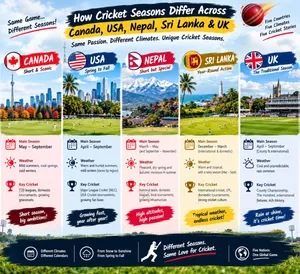 How Cricket Seasons Differ Across Canada, USA, Nepal, Sri Lanka and UKLearn how cricket seasons differ across Canada, USA, Nepal, Sri Lanka and UK, including playing months, weather, training needs and equipment tips.
 The Global Cricket Calendar: Major Tournaments, Domestic Seasons, and International Cricket ExplainedDiscover how the global cricket calendar works. Learn about major ICC tournaments, domestic leagues, franchise competitions, bilateral series, and cricket seasons across Nepal, Germany, USA, Canada, the Netherlands, and the UK.
 How Cricket Is Bringing Communities Together Beyond BordersDiscover how cricket is bringing communities together across Nepal, Germany, USA, Canada, the Netherlands, and the UK. Learn how the sport promotes inclusion, friendship, cultural exchange, and global unity.