How Cricket Seasons Differ Across Canada, USA, Nepal, Sri Lanka and UK
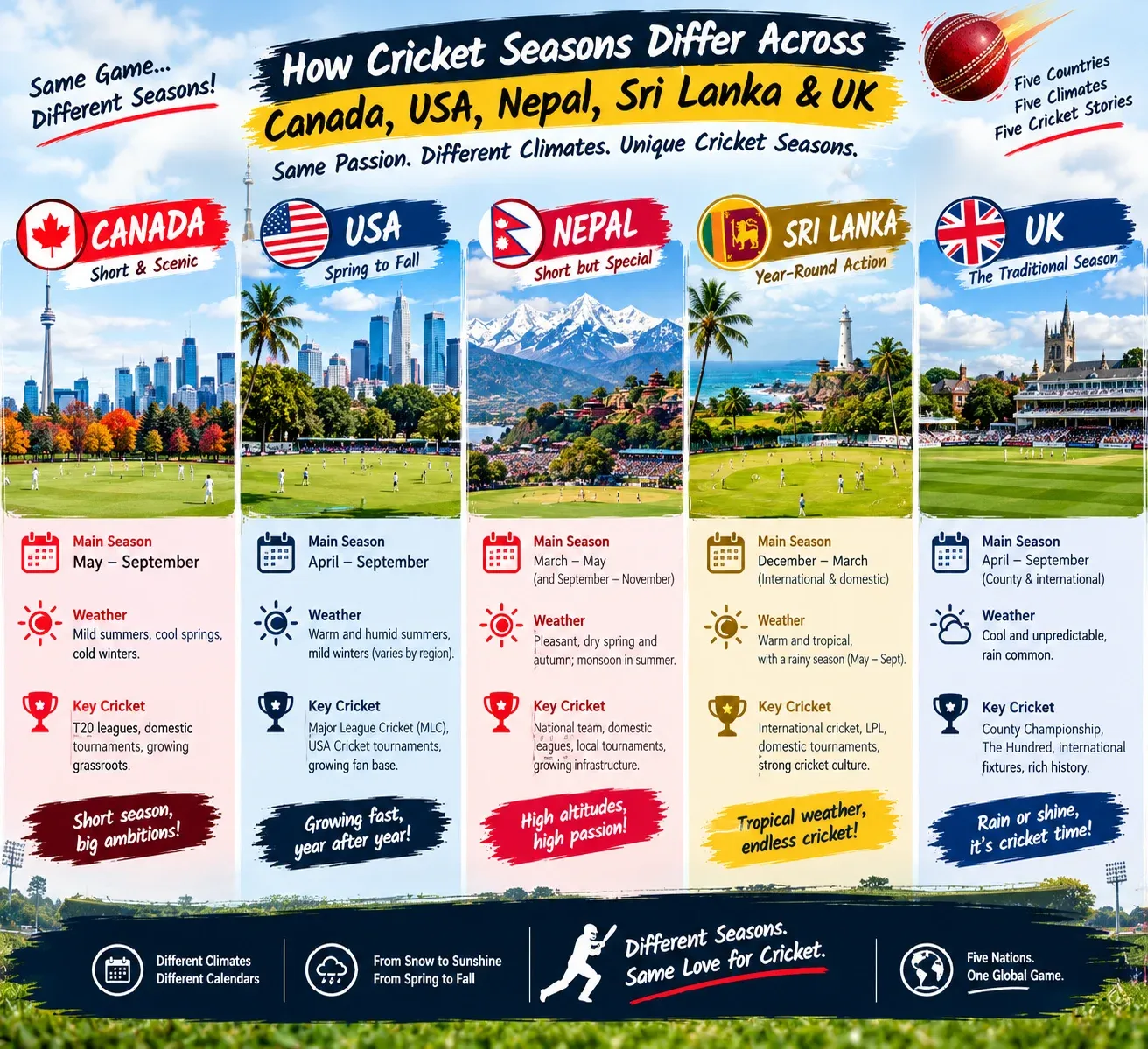
Cricket may follow the same basic rules around the world, but the experience of playing it can be very different from one country to another. In Canada, outdoor cricket is concentrated in the warmer months. In the United Kingdom, traditional club cricket takes place mainly during spring and summer. Nepal's cricket calendar must account for monsoon rainfall and differences in altitude, while Sri Lanka's tropical climate allows cricket across much of the year, depending on regional weather and competition schedules.
The United States presents another interesting case. Its large geography means that cricket seasons vary by state, with some leagues concentrating on spring and summer while others organize competitions during different parts of the year.
These differences affect more than match dates. They influence how players prepare physically, when clubs organize competitions, how much indoor practice is needed, and what equipment cricketers should carry throughout the season.
Understanding local cricket seasons is useful for beginners, club players, coaches, parents, and travelling cricketers. It helps players plan training, protect their equipment, and adjust to conditions when playing in another country.
This guide explores how cricket seasons differ across Canada, the USA, Nepal, Sri Lanka, and the UK, including the typical playing calendar, weather-related challenges, preparation strategies, and opportunities for year-round development.
1. What Determines a Cricket Season?
A cricket season is the period when organized matches and outdoor training are most practical in a particular location. It is shaped by several environmental and sporting factors.
Weather and temperature
Cricket is generally easier to organize when temperatures allow players to spend several hours outdoors. Very cold conditions can make outdoor training uncomfortable and may affect the availability of suitable pitches. Extreme heat can create different challenges, including dehydration and fatigue.
Rainfall and monsoon patterns
Rain can interrupt matches, delay pitch preparation, and affect ground conditions. Countries with distinct wet and dry seasons often arrange competitions around the periods when grounds are more suitable for play.
Daylight hours
Longer summer days allow clubs to schedule evening training and matches. In places where winter days are short, outdoor cricket becomes harder to organize after work or school.
School and domestic competitions
Cricket seasons are also influenced by the structure of local sport. School championships, club leagues, domestic tournaments, and international fixtures must fit into available playing windows.
Indoor facilities
Indoor nets and training centres help players continue working on their skills when outdoor conditions are unsuitable. However, indoor practice cannot always replace full outdoor matches, especially when players need experience with natural pitches, changing weather, and larger playing areas.
The exact season can vary within a country, so the months discussed below should be treated as general patterns rather than fixed dates for every league.
2. Cricket Season in Canada: A Short Outdoor Window
<AsyncImage query="outdoor cricket club match Canada summer green cricket field" aspectRatio="16:9" width="100%" />
Canada's cricket season is strongly influenced by its long winters and relatively short outdoor summer. In many regions, organized outdoor cricket takes place from approximately May to September, although local schedules depend on temperatures, ground availability, and regional conditions.
For example, the Manitoba Cricket Association identifies May to September as its main outdoor league period, with indoor competitions filling parts of the colder months.
Typical cricket season in Canada
- April: Some clubs begin preparing grounds and organizing training, depending on local weather.
- May: Outdoor leagues and regular club matches commonly begin.
- June to August: The main period for outdoor training, league cricket, and tournaments.
- September: Many leagues approach the end of their outdoor season.
- October to March: Indoor cricket, fitness training, technical practice, and off-season preparation become more important.
These months are approximate. Conditions in southern British Columbia may differ from those in Manitoba or other colder regions.
Why Canada's season is different
The biggest challenge is the weather. Winter temperatures can make outdoor cricket impractical for extended periods, meaning players may have fewer opportunities to practise on natural pitches before competitions begin.
This can create a compressed preparation period. Players often need to build fitness, refine their technique, and get used to outdoor conditions within a relatively short window.
Indoor nets are valuable during winter, particularly for batting technique, bowling rhythm, and fitness. However, players should gradually adapt to outdoor conditions when the season begins.
How players can prepare for Canada's cricket season
During winter:
- Maintain general fitness and mobility.
- Practise batting and bowling in suitable indoor facilities.
- Work on strength, balance, and injury prevention.
- Review previous performances and identify areas for improvement.
Before the outdoor season:
- Increase training intensity gradually.
- Check bats, grips, gloves, pads, and footwear.
- Practise fielding and running between wickets outdoors.
- Allow time to adjust to natural pitches and changing weather.
During the season:
- Maintain recovery routines between matches.
- Carry appropriate layers for changing temperatures.
- Inspect equipment regularly, especially after damp conditions.
Canada's short outdoor season makes preparation particularly important. Players who use the colder months effectively can enter the summer with a stronger technical and physical foundation.
3. Cricket Season in the USA: Different Calendars Across a Large Country
<AsyncImage query="community cricket league match United States outdoor cricket ground summer" aspectRatio="16:9" width="100%" />
The United States does not have one uniform cricket season. Its large geographic area includes cold northern states, warm southern regions, dry areas, humid coastal locations, and places where weather changes significantly throughout the year.
As a result, the timing of outdoor cricket depends heavily on the state, city, league, and available facilities.
Typical cricket season in the USA
In many regions, local outdoor leagues operate mainly during spring and summer. Some competitions also extend into early autumn, while warmer locations may support a broader playing window.
A simplified guide looks like this:
- March to April: Outdoor training and league activity may begin in suitable regions.
- May to August: A common period for outdoor club cricket and local competitions.
- September to October: Some leagues continue playing, and certain competitions may be scheduled during this period.
- Winter months: Indoor practice and fitness work become more important in colder regions, while outdoor cricket may remain possible in warmer areas.
These dates are not universal. The calendar of a league in Texas or Florida may look different from one in a colder northern state.
Why regional differences matter
A player in a cold-weather region may have to stop outdoor cricket for several months. A player in a warmer location may be able to train outside for much longer.
Rainfall, humidity, heat, and local ground availability also affect scheduling. In very hot conditions, matches and training sessions may need to be timed carefully to reduce heat-related risks.
The USA's growing domestic cricket structure also includes competitions that do not necessarily follow the same calendar as community leagues. For example, the 2026 Minor League Cricket season was scheduled to begin in September, demonstrating that professional and regional competition windows can differ from the main outdoor season in a particular locality.
How players can prepare in the USA
Players should begin by checking the schedule of their local league rather than relying on a national calendar.
For colder regions, winter can be used for indoor batting, bowling drills, strength training, and technical analysis. In warmer regions, players may need to focus more on hydration, heat management, recovery, and protecting themselves from prolonged sun exposure.
Players moving between states should also prepare for differences in pitch surfaces and weather. A bat or pair of shoes that works well in one environment may not feel exactly the same in another.
The main advantage of the USA's varied climate is that cricket can take place at different times in different regions. The challenge is coordinating competitions and providing facilities that support players throughout the year.
4. Cricket Season in Nepal: Monsoon Rain and Regional Climate
<AsyncImage query="Nepal domestic cricket match cricket ground Himalayan foothills green field" aspectRatio="16:9" width="100%" />
Nepal's cricket season is influenced by its monsoon climate, geography, and differences in elevation. The country includes the hot southern plains, temperate hill regions, and colder mountainous areas, so playing conditions can vary considerably.
The Nepal Tourism Board identifies June to September as the main monsoon period, when a large share of the country's annual rainfall occurs. This has important implications for outdoor cricket, particularly where grounds are vulnerable to heavy rain or slow drainage.
Typical cricket calendar in Nepal
There is no single season that applies to every tournament, but the following pattern helps explain the weather-related challenges:
- February to May: Spring conditions can provide useful opportunities for outdoor training and competition, depending on the location.
- June to September: Monsoon rainfall can disrupt matches and make ground conditions difficult.
- October to November: The period after the main monsoon often offers favourable outdoor conditions in many areas.
- December to January: Cooler weather can influence training and playing conditions, particularly in hill and mountain regions.
National and domestic competitions may be scheduled outside these broad patterns according to tournament requirements, venue availability, and international fixtures.
How monsoon weather affects cricket
Rain can delay matches, interrupt training, and affect the condition of pitches and outfields. Wet ground may reduce traction and make movement more difficult, while repeated rainfall can limit the number of uninterrupted training sessions.
The monsoon also creates planning challenges for coaches and tournament organizers. Fixture flexibility, ground drainage, weather monitoring, and suitable backup arrangements can all help reduce disruption.
Opportunities for cricket development in Nepal
Nepal's passionate cricket following creates opportunities to develop school competitions, local clubs, regional tournaments, and youth programmes. Planning these activities around local weather can help players get more consistent match experience.
Coaches can use wetter periods for indoor technical work, fitness training, tactical learning, and video analysis where facilities are available. As conditions improve, players can return to outdoor sessions and work on skills that require natural pitches and full-field practice.
How players can prepare for Nepal's season
- Check local weather forecasts before training and matches.
- Use suitable footwear for the actual ground conditions.
- Keep gloves, clothing, and other equipment dry after wet sessions.
- Build a training plan that can adapt to postponed matches.
- Use indoor sessions to maintain fitness and technique when outdoor play is interrupted.
In Nepal, effective seasonal planning is not only about choosing the right months. It is also about building a flexible cricket routine that can adapt to rainfall and regional differences.
5. Cricket Season in Sri Lanka: A Tropical Climate and Varied Playing Conditions
<AsyncImage query="Sri Lanka school cricket match traditional cricket ground palm trees" aspectRatio="16:9" width="100%" />
Sri Lanka has a well-established cricket culture, supported by school competitions, clubs, domestic tournaments, and international cricket. Its tropical climate allows cricket to take place across much of the year, but rainfall patterns can make conditions very different from one region to another.
Unlike Canada or the UK, Sri Lanka does not rely on a single short summer window for outdoor cricket. Instead, schedules need to account for regional rain patterns, ground conditions, and the demands of school and domestic competitions.
Typical cricket season in Sri Lanka
The cricket calendar varies by competition, so these are broad seasonal considerations rather than fixed start and end dates:
- January to March: Many locations experience useful opportunities for outdoor cricket, although local rainfall still matters.
- April to June: Weather conditions vary by region, and some areas experience significant rainfall.
- July to September: Cricket continues, but local conditions and ground availability can affect fixtures.
- October to December: The later part of the year can bring additional rainfall in many areas, requiring flexible scheduling.
Sri Lanka's two monsoon systems affect different parts of the island at different times. As a result, the best period for outdoor cricket depends on the venue and the competition calendar rather than simply the month.
The importance of school cricket
School cricket is an important part of Sri Lanka's development system. Young players gain match experience through organized competitions, and the school calendar influences when teams train and compete.
Longer-format school matches can help players develop concentration, patience, bowling discipline, and tactical awareness. Shorter formats also provide opportunities to practise quick decision-making and aggressive stroke play.
Because school and club competitions may follow different schedules, players often need to balance cricket with education, examinations, and other responsibilities.
Preparing for tropical playing conditions
Warm and humid conditions can increase fluid loss during training and matches. Players should plan hydration, recovery, and rest carefully, particularly during long innings or extended bowling spells.
Rain can also affect pitch behaviour and outfield conditions. Teams should check the expected weather and follow local ground and match guidance.
Useful preparation steps include:
- Carry sufficient drinking water and follow a sensible hydration plan.
- Use breathable clothing appropriate for the conditions.
- Dry equipment properly after wet matches.
- Check the grip and condition of the bat handle regularly.
- Adapt training intensity to heat, humidity, and recovery needs.
Sri Lanka's climate can support a broad cricket calendar, but successful planning still requires attention to local weather and the specific demands of each competition.
6. Cricket Season in the UK: A Traditional Spring and Summer Game
<AsyncImage query="English village cricket club match green cricket ground summer pavilion" aspectRatio="16:9" width="100%" />
In England and Wales, the main outdoor cricket season traditionally runs from spring into early autumn. Professional county competitions, recreational club leagues, school cricket, and local tournaments all contribute to a busy summer calendar.
The England and Wales Cricket Board's 2026 County Championship schedule, for example, spans several blocks from the spring through September, reflecting the established summer structure of English domestic cricket.
Typical cricket season in the UK
- March to April: Clubs prepare grounds, organize teams, and begin pre-season training as weather permits.
- April to May: Many outdoor competitions start, although exact opening dates vary.
- June to August: The main summer period brings regular club matches, school fixtures, and professional cricket.
- September: Many competitions approach their final rounds.
- October to February: Indoor nets, strength training, fitness work, and technical practice become more important.
Some clubs and competitions start earlier or finish later depending on local conditions and the format being played.
Why weather matters in the UK
The UK does not experience the same extreme winter conditions as much of Canada, but cold temperatures, rain, damp ground, and shorter daylight hours can make outdoor cricket difficult during winter.
Rain is a particular concern because it can interrupt matches even during the main season. Ground staff play an important role in preparing pitches and maintaining outfields, while clubs must sometimes adjust fixtures when conditions are unsuitable.
The importance of club cricket
The UK's extensive club network gives players regular opportunities to compete at different levels. A player may progress from junior cricket to adult club teams, league cricket, county age-group programmes, and potentially professional pathways.
The season also creates a rhythm for training and development. Players often build their fitness before the first matches, improve through regular competition during the summer, and review their performances at the end of the season.
How players can prepare for the UK season
Before the outdoor season begins, players can work on general fitness, bowling workload, batting technique, and mobility. When matches start, they should be ready for changing temperatures and occasional rain.
Useful equipment considerations include:
- Suitable footwear for the pitch and outfield.
- Layers that can be added or removed as temperatures change.
- Towels and protective covers for equipment.
- Regular checks of bat grips, gloves, pads, and shoes.
- A sensible indoor training plan for the off-season.
The UK's seasonal pattern makes structured preparation valuable. Players who maintain their fitness and technique during winter can return to outdoor cricket with a stronger foundation.
7. Comparing Cricket Seasons Across All Five Countries
The table below summarizes the broad seasonal patterns. Actual dates vary by region, competition, and year.
CountryTypical outdoor patternMain weather considerationOff-season or scheduling challenge
Canada
Often May to September
Cold winters and short summers
Indoor training and compressed preparation
USA
Commonly spring to early autumn in many regions
Strong regional differences, heat, rain, and winter cold
Local calendars differ by state and league
Nepal
Often favourable in spring and after the monsoon
Heavy monsoon rainfall and elevation differences
Match disruption and variable regional conditions
Sri Lanka
Cricket takes place across much of the year
Regional monsoons, heat, and humidity
Scheduling around local rainfall and competition demands
UK
Commonly April to September
Rain, cool temperatures, and limited winter daylight
Indoor training and winter fitness maintenance
The comparison highlights an important point: a cricket season is shaped by local conditions, not just by a country's cricketing traditions.
Two players in different regions of the same country may have different training opportunities. Similarly, a player moving from the UK to Sri Lanka may need to adjust to humidity and rainfall rather than simply change the dates of their training plan.
8. How Cricket Seasons Affect Training and Player Development
Seasonal differences influence how cricketers should organize their practice throughout the year.
Pre-season: Build a foundation
Pre-season is the period before regular competitive matches begin. Players can use this time to improve fitness, practise core skills, and prepare equipment.
Batters may focus on timing, footwork, and shot selection. Bowlers can gradually build their workload and refine their run-up and delivery rhythm. Fielders can work on catching, throwing, agility, and reaction time.
It is important to increase training intensity progressively, particularly after a long break from outdoor cricket.
In-season: Maintain consistency
Once the competition begins, training should support match performance rather than create unnecessary fatigue.
Players can review their performances, work on specific weaknesses, and maintain strength and mobility. Recovery between matches is especially important for fast bowlers and players involved in frequent fixtures.
Off-season: Improve weaknesses
The off-season offers an opportunity to focus on skills that may be difficult to develop during a busy competition schedule.
Depending on available facilities, players can work on:
- Batting technique and controlled repetitions.
- Bowling mechanics and appropriate workload management.
- Strength, mobility, and aerobic fitness.
- Tactical awareness and decision-making.
- Match analysis and goal setting.
Indoor practice can be particularly useful in countries with long winters, while players in warmer climates may still need to adjust training around rainfall or heat.
9. Choosing Cricket Equipment for Different Seasons
The equipment a player needs depends on the conditions, format, and level of cricket being played. Seasonal planning helps players keep their gear ready rather than discovering problems just before a match.
Cricket bats
Willow bats should be stored in a suitable environment and protected from excessive moisture, heat, and prolonged direct sunlight. After a wet match, allow the bat to dry naturally and inspect it before storing it.
Players should also follow the manufacturer's guidance on knocking-in and preparation before using a new bat with a hard cricket ball.
Protective equipment
Helmets, batting gloves, pads, and other protective equipment should fit properly and be checked regularly. Gloves and pads should be allowed to dry after use, and damaged protective gear should be assessed or replaced when necessary.
Cricket shoes
Footwear should suit the surface and conditions. Wet grass, firm artificial surfaces, and natural pitches may require different traction characteristics. Check the manufacturer's recommendations rather than assuming one type of shoe is ideal everywhere.
Clothing and accessories
Players in cooler countries may need additional layers, while cricketers in warmer or more humid environments should consider breathable clothing and hydration.
A practical kit bag should include the equipment required for the player's role, along with useful extras such as socks, a towel, water, and weather-appropriate clothing.
10. Tips for Players Moving Between Countries
Cricketers who travel, study abroad, or move for work may need to adjust to a different cricket calendar. A few simple steps can make the transition easier.
Research the local league. Check registration dates, match formats, training schedules, and the expected start of the season.
Arrive prepared. If possible, begin fitness and technical preparation before the first competitive match.
Adapt to local conditions. Humidity, cold weather, rain, pitch pace, and outfield conditions can all affect performance.
Check equipment requirements. Local leagues may have specific rules about protective gear, clothing, or playing equipment.
Keep a flexible training plan. Weather disruptions are common in many cricket environments. Indoor practice, fitness sessions, and tactical work can help maintain progress when matches are postponed.
Allow time for recovery. Travelling and changing climates can affect sleep, hydration, and physical readiness. Build recovery into the schedule instead of trying to make up every missed session at once.
The goal is not simply to fit into another country's calendar. It is to adjust training and match preparation to the conditions in which cricket is actually played.
Frequently Asked Questions
1. Which country has the shortest outdoor cricket season?
Canada generally has a short outdoor season in many regions because of its long winters. The exact playing window varies by province and city, and indoor leagues can provide additional opportunities during colder months.
2. When does cricket season usually start in Canada?
Outdoor cricket often begins around May and continues into September in many areas. Local dates depend on weather, ground conditions, and league schedules.
3. Does the USA have a year-round cricket season?
Some regions can support outdoor cricket for much of the year, while colder areas rely more on spring and summer leagues. Indoor facilities also allow training to continue when outdoor conditions are unsuitable.
4. How does the monsoon affect cricket in Nepal?
Heavy rainfall during the monsoon can disrupt outdoor training and matches, affect outfields, and create scheduling challenges. The impact varies according to location, drainage, and ground conditions.
5. Can cricket be played throughout the year in Sri Lanka?
Cricket can take place during much of the year, but rainfall, humidity, regional monsoon patterns, and competition schedules affect when and where matches are organized.
6. When does the cricket season start in the UK?
Many outdoor competitions begin in April or May and continue through September. Exact dates depend on the competition, club, and local weather.
7. Why is indoor cricket training important?
Indoor training helps players maintain technique, fitness, and bowling rhythm when rain, cold weather, or limited daylight prevents outdoor practice. It can support development, although it does not fully replace outdoor match experience.
8. How should players prepare for a new cricket season?
Players should build fitness gradually, practise role-specific skills, check their equipment, review previous performances, and understand the conditions expected during the competition.
9. Does weather affect cricket equipment?
Yes. Excessive moisture, extreme heat, and poor storage can affect equipment condition. Players should follow care instructions, dry their gear appropriately, and inspect bats and protective equipment regularly.
10. What should travelling cricketers check before joining a new league?
They should confirm the season dates, match formats, registration requirements, training facilities, equipment rules, and typical weather conditions. This helps them prepare for both the competition schedule and the local playing environment.
Final Thoughts
Cricket seasons differ across Canada, the USA, Nepal, Sri Lanka, and the UK because each country has its own combination of climate, geography, rainfall, daylight, and competition structures.
Canada's short summer makes off-season preparation especially important. The USA requires a more regional approach because conditions differ widely across the country. Nepal's monsoon can affect match scheduling, while Sri Lanka's tropical climate supports cricket across much of the year but still requires careful attention to rainfall and humidity. In the UK, spring and summer remain central to the traditional outdoor club season.
For players, understanding these differences makes it easier to plan training, manage recovery, prepare equipment, and adapt when moving between cricket environments.
A well-planned season is about more than turning up for matches. It means building fitness before competition, practising consistently, maintaining equipment, and adjusting to the conditions in which the game is played.
Prepare for Your Next Cricket Season with Heega Sports
Whether you play in a Canadian summer league, compete in the USA, train in Nepal, take part in Sri Lankan school cricket, or join a UK club, suitable equipment is an important part of your preparation.
Heega Sports supports cricketers with equipment for different playing roles and skill levels. Choose gear that suits your needs, check it before the season begins, and maintain it throughout the year.
Explore cricket equipment at www.Heegasports.com and get ready for your next cricket season.
Related posts
 The Growth of Cricket in Canada, USA, Nepal, Sri Lanka and UKExplore cricket's growth in Canada, USA, Nepal, Sri Lanka and UK, from grassroots clubs and youth development to professional leagues and global competitions.
 Cricket Development in Canada, USA, Nepal, Sri Lanka and UKExplore cricket development in Canada, USA, Nepal, Sri Lanka and UK, including grassroots growth, youth pathways, professional leagues and future opportunities.
 Cricket Grounds in Canada, USA, Nepal, Sri Lanka and UK.Explore cricket grounds in Canada, USA, Nepal, Sri Lanka and UK, and discover how pitch conditions, weather, facilities and playing surfaces influence cricket.