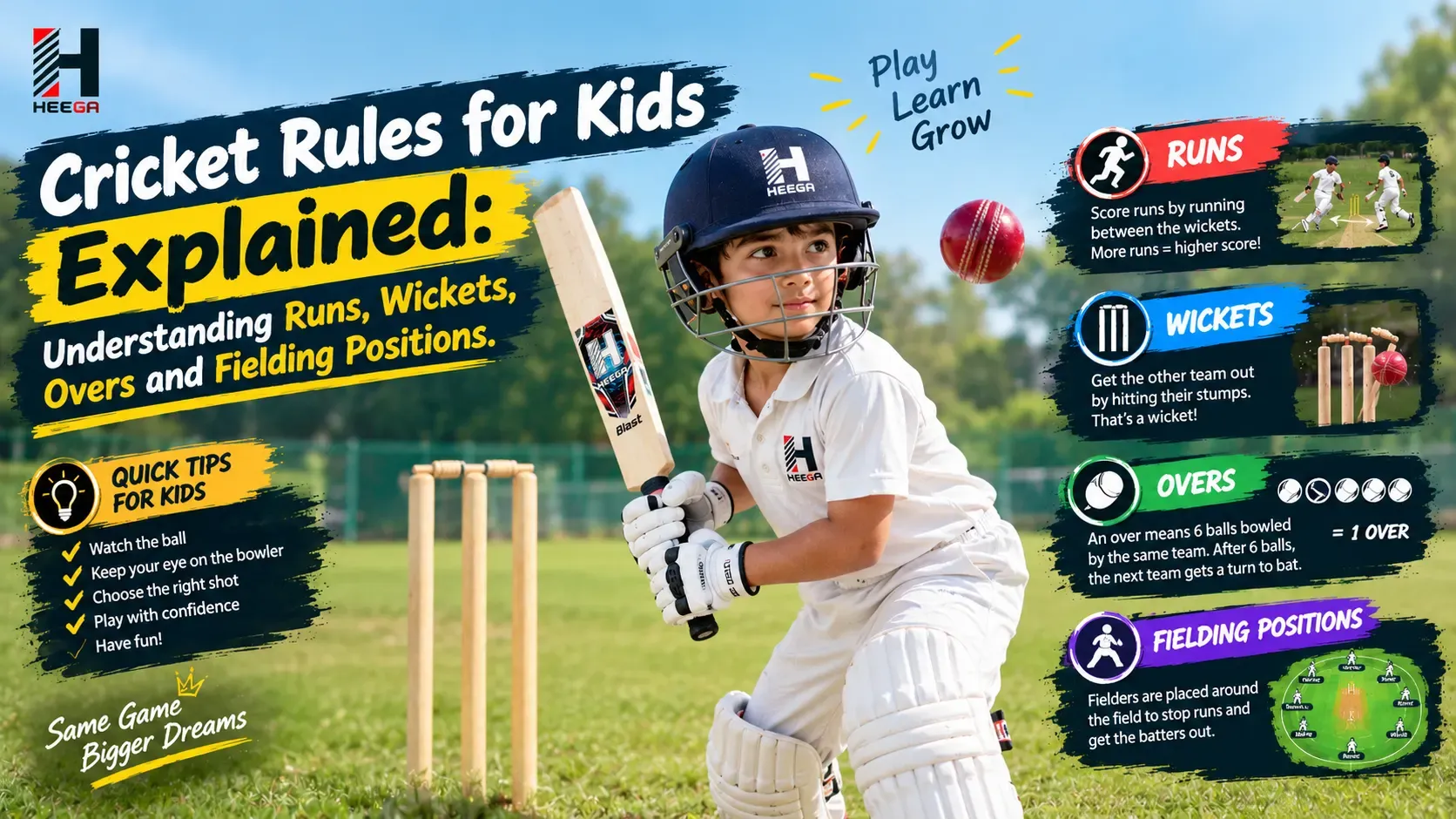
Cricket Rules for Kids Explained: Understanding Runs, Wickets, Overs and Fielding Positions.
Introduction: Understanding Cricket Starts With the Basics
Cricket is an exciting sport that combines batting, bowling, fielding, teamwork, and smart decision-making. Children often enjoy hitting the ball, running between the wickets, and trying to catch it. However, when they first start playing, understanding the rules can sometimes feel confusing.
What is a run? Why does a batter get out? How many balls are there in an over? Why do fielders stand in different positions? And how does a team win a cricket match?
These are some of the most common questions beginners ask.
The good news is that children do not need to learn every cricket rule at once. Once they understand a few basic ideas, the game becomes much easier to follow and enjoy.
This guide explains the essential cricket rules for kids in simple language, helping young players understand scoring, wickets, overs, fielding positions, and the basic structure of a match.
Whether a child is learning cricket at school, joining an academy, playing with friends, or watching a match with family, these fundamentals can help them build confidence and develop a stronger understanding of the sport.
1. What Is Cricket?
Cricket is a team sport played between two teams. In a traditional match, each team has 11 players.
The two teams take turns batting and bowling.
- The batting team tries to score as many runs as possible.
- The bowling and fielding team tries to limit those runs and get the batters out.
- After the innings changes, the teams switch roles according to the match format.
- The team with the better result under the match rules wins.
An innings is the period when a team bats. Depending on the format, a team may have one or two innings.
For example, in many limited-overs matches, each team gets one innings with a set number of overs. In traditional Test cricket, teams can have two innings each.
The main objective is simple: score runs while trying to get the opposing batters out.
2. Understanding the Cricket Ground
A cricket ground is usually a large oval-shaped or circular playing area. The boundary marks the outer edge of the field of play.
Near the centre is a rectangular strip called the pitch.
The pitch is where the bowler delivers the ball to the batter. It contains a set of stumps at each end.
The main parts children should know are:
- Pitch: The central strip where most batting and bowling action takes place.
- Stumps: Three vertical wooden posts at each end of the pitch.
- Bails: Small wooden pieces placed on top of the stumps.
- Crease: Marked lines around the wickets that help determine whether a batter or bowler is safely positioned.
- Boundary: The edge of the playing area.
- Wickets: A term that can refer to the stumps and bails, or to a batter being dismissed, depending on the context.
Understanding these parts helps children follow the action and learn the rules more easily.
3. How Do Players Score Runs?
Runs are the points a batting team collects during its innings.
There are several ways to score runs in cricket.
Running Between the Wickets
One of the most common ways to score is by running between the two ends of the pitch.
After hitting the ball, the batter and their partner can run to the opposite ends. Each completed run adds one run to the team's score.
For example, if the batters complete three runs before the fielding team returns the ball, the batting team scores three runs.
Both batters must reach the opposite ends safely for each run to count.
Scoring a Four
A batter scores four runs when the ball reaches or crosses the boundary after touching the ground inside the field of play, provided the boundary rules for that delivery are satisfied.
The batter does not need to run four times.
The team receives four runs automatically.
Scoring a Six
A batter scores six runs when the ball crosses the boundary without touching the ground inside the field of play, provided it is a valid scoring shot under the rules.
Sixes are exciting because they usually involve powerful hitting.
Extras
Sometimes the batting team receives runs that are not credited to an individual batter.
These are called extras.
Common examples include:
- Wide: A delivery that is too far from the batter to be a fair ball to hit, according to the applicable rules.
- No-ball: An illegal delivery, such as certain types of overstepping by the bowler.
- Bye: A run scored when the ball passes the batter without touching the bat or body and the batters run.
- Leg bye: A run scored after the ball makes contact with the batter's body rather than the bat, when the rules allow it.
Extras are added to the team's total.
Children can remember one important point: not every run comes from hitting the ball with the bat.
4. What Is a Wicket?
In cricket, the word wicket has more than one meaning. It can refer to the stumps and bails, or it can describe a batter being dismissed.
When people say a team has lost a wicket, they mean one of its batters has been out.
The bowling team tries to take wickets because dismissing batters makes it harder for the opposition to build a big score.
Here are some common ways a batter can get out.
Bowled
A batter is bowled when a valid delivery hits the stumps and dislodges at least one bail, unless another rule changes the outcome.
This often happens when the batter misses the ball.
Caught
A batter is caught when a fielder catches the ball directly after it has touched the bat or the batter's hand holding the bat, before the ball touches the ground.
A successful catch means the batter is out.
Run Out
A batter can be run out when they are outside their ground and the fielding team fairly breaks the relevant wicket while the ball is in play and the batter is liable to be dismissed.
This often happens when batters try to complete a run but fail to reach the crease in time.
Leg Before Wicket (LBW)
LBW is one of cricket's more complicated rules.
In simple terms, a batter may be out LBW if a legal delivery hits their body rather than the bat and the conditions of the LBW law are satisfied.
The decision depends on factors such as where the ball pitched, where it struck the batter, and whether it would have hit the stumps.
Children can learn the basic idea first and understand the detailed conditions as they gain experience.
Stumped
A batter may be stumped when they are outside their ground, are not attempting a run, and the wicketkeeper fairly breaks the wicket while the ball is live and the relevant conditions are met.
This often happens when a batter steps forward to play a spinner and misses the ball.
Hit Wicket
A batter can be out hit wicket if they accidentally break their own wicket with their body or equipment while playing or immediately setting off for a run, under the conditions specified by the laws.
These are some of the most common dismissals children encounter when learning cricket.
5. What Happens When a Batter Gets Out?
When a batter is dismissed, another eligible batter comes in to take their place, provided the team has another batter available.
In a standard team of 11 players, two batters are on the field at a time. One faces the bowler, while the other waits at the opposite end.
The innings continues until the relevant innings-ending condition is reached.
Depending on the format, an innings might end when:
- The team loses all but one of its available batters.
- The allotted overs are completed.
- The team reaches its target.
- A declaration or another format-specific condition ends the innings.
In many limited-overs matches, teams have a fixed number of overs to score as many runs as possible.
6. What Is an Over in Cricket?
An over is a set of six valid balls bowled by one bowler from one end of the pitch.
After completing an over, another bowler usually delivers the next over from the opposite end.
There are six valid deliveries in a standard over. Wides and no-balls do not count as valid balls toward the six-ball total, so an over can contain more than six deliveries.
For example, if a bowler delivers six valid balls, the over is complete. If one of the deliveries is a no-ball, another delivery is required to complete the over.
How Many Overs Are Played?
The number of overs depends on the format.
- T20 cricket: Each team usually has 20 overs.
- One Day International (ODI) cricket: Each team usually has 50 overs.
- Test cricket: There is no fixed innings limit of 20 or 50 overs; play is organised across scheduled days, subject to the match rules.
Junior matches may use shorter formats with fewer overs so children can learn the game in a manageable amount of time.
Why Are Overs Important?
Overs help determine how much time and opportunity a batting team has to score runs.
They also help captains manage their bowlers and plan fielding strategies.
For example, a team batting in a 20-over match must think carefully about how to score runs throughout its available overs.
7. What Do Cricket Scores Mean?
A cricket score often shows the number of runs and wickets lost.
For example, a score of 120/4 means the team has scored 120 runs and lost four wickets.
The score may also be displayed with the number of overs completed.
For example, 120/4 after 15 overs means the team has scored 120 runs and lost four wickets after 15 overs.
Children may also hear commentators discuss the run rate. Run rate means the average number of runs scored per over.
For example, if a team scores 30 runs in five overs, its run rate is six runs per over.
Understanding the score makes it easier to follow a match and see which team is in a stronger position.
8. What Is the Difference Between Batting and Bowling?
Batting and bowling are the two main skills that drive the game.
Batting
The batter tries to score runs while avoiding dismissal.
Good batting involves:
- Watching the ball carefully.
- Choosing the right shot.
- Moving the feet into position.
- Keeping balance.
- Running safely between the wickets.
- Communicating with the batting partner.
Children should learn that batting is not only about hitting the ball hard. Timing, control, and smart decisions are equally important.
Bowling
The bowler delivers the ball toward the batter, trying to limit scoring opportunities and take wickets.
Bowlers work on:
- Accuracy.
- Line and length.
- Speed or spin.
- Consistency.
- Controlling wides and no-balls.
- Understanding the batter's strengths and weaknesses.
A good bowler does not always need to bowl the fastest delivery. Accuracy and smart variation can be just as valuable.
9. What Is Fielding?
Fielding is the work performed by the team that is not batting.
Fielders try to stop the ball, prevent runs, take catches, and run batters out.
Good fielding can change the direction of a match. A clean catch or a quick throw can prevent runs and create a wicket.
Fielding skills include:
- Catching the ball safely.
- Stopping the ball on the ground.
- Throwing accurately.
- Moving quickly into position.
- Communicating with teammates.
- Backing up throws and supporting other fielders.
Children should practise fielding regularly because it gives every player an opportunity to contribute, even when they are not batting or bowling.
10. Understanding Basic Fielding Positions
Fielders stand in different places around the ground depending on the captain's plan, the batter's style, the bowler's delivery, and the match situation.
At first, the names can sound confusing. Children can start by learning a few common positions.
Wicketkeeper
The wicketkeeper stands behind the stumps at the batter's end.
Their main job is to collect deliveries that the batter misses or edges, take catches, and help create stumpings and run-out opportunities.
Wicketkeepers need quick reactions, good footwork, and safe catching technique.
Slip
Slip fielders stand beside the wicketkeeper, usually on the off side of the batter.
They are positioned to catch edges that fly away from the bat.
Gully
Gully is a catching position near the slips, usually farther out from the batter.
A gully fielder may catch balls that travel through the area between the slips and point.
Point
Point is a position on the off side, roughly square of the wicket.
The fielder often tries to stop cuts and other shots played toward that region.
Cover
Cover is another off-side position, generally in front of point and toward the bowler's side.
Cover fielders often stop drives and other shots hit through the off side.
Mid-Off and Mid-On
Mid-off stands on the off side, generally in front of the batter.
Mid-on stands in a similar area on the leg side.
Both positions can help stop straight drives and support the bowler.
Square Leg
Square leg is positioned on the leg side, roughly level with the batter's wicket.
The fielder may stop pulls, sweeps, and other shots hit toward that area.
Fine Leg
Fine leg is positioned behind square on the leg side, closer to the boundary in many field settings.
This fielder can stop balls that travel fine off the batter's legs or bat.
Third Man
Third man is usually positioned behind the batter on the off side, often near the boundary.
This position can help stop edges that travel past the slips.
Long-On and Long-Off
These positions are near the boundary, generally on either side of the straight line between the batter and the bowler.
They are often used to defend against lofted shots.
Children do not need to memorise every position immediately. They can begin by learning where the wicketkeeper, slips, point, cover, mid-on, mid-off, and boundary fielders stand.
11. What Are the Off Side and Leg Side?
The cricket field is commonly divided into two sides from the batter's perspective.
- Off side: The side associated with the front of the batter's body when they take their stance.
- Leg side (or on side): The side behind or toward the batter's legs.
The exact orientation depends on whether the batter is right-handed or left-handed.
This distinction helps explain fielding positions and shot names. For example, cover is an off-side position, while square leg is on the leg side.
12. What Is a Boundary?
The boundary is the outer edge of the playing area.
When a ball reaches the boundary, the number of runs awarded depends on how it gets there.
- If the ball touches the ground inside the field before crossing the boundary, the batting team generally receives four runs.
- If the ball crosses the boundary without touching the ground inside the field, the batting team generally receives six runs.
Boundary rules can be more detailed in certain situations, such as when a fielder touches the boundary while handling the ball. Children can begin with the basic distinction and learn the exceptions as they progress.
13. What Are Wides and No-Balls?
Wides and no-balls are important because they can give the batting team extra runs and affect the over.
Wide Ball
A wide is a delivery that is judged too far from the batter to be a fair ball to hit, under the applicable rules.
The batting team receives an extra, and the delivery does not count toward the six valid balls in the over.
No-Ball
A no-ball is an illegal delivery under the laws or competition rules. One common example is a bowler overstepping the popping crease when delivering the ball.
A no-ball normally gives the batting team an extra run, and the delivery does not count as one of the six valid balls in the over. Additional scoring rules may also apply.
For young bowlers, the important lesson is to focus on a controlled action, accurate delivery, and staying within the crease.
14. How Does a Team Win a Cricket Match?
The result depends on the format and the situation.
In a limited-overs match, one team usually bats first and sets a target. The other team then tries to reach that target within its available overs and wickets.
For example:
- Team A scores 100 runs.
- Team B needs 101 runs to win.
- If Team B reaches 101 under the match rules, it wins.
- If Team B finishes short of the target, Team A may win.
If the chasing team reaches the target while losing fewer wickets than it has available, the result is commonly described in wickets. If it fails to reach the target, the result may be described in runs.
Some matches can end in a tie or no result, depending on the scores, conditions, and competition rules. In some competitions, a tie may be followed by a Super Over or another tie-break procedure.
15. Why Teamwork Matters in Cricket
Cricket is not just an individual sport.
Even though a batter faces the bowler one delivery at a time, the whole team contributes to the result.
Batters must communicate when deciding whether to run. Bowlers and fielders work together to create pressure. Captains arrange the field and choose strategies. Teammates encourage one another after mistakes.
Children can develop important habits through cricket:
- Listening to teammates.
- Communicating clearly.
- Supporting others.
- Respecting opponents.
- Following the umpire's decisions.
- Learning from mistakes.
These habits help young players become better teammates as well as better cricketers.
16. Simple Cricket Rules Children Should Remember
When children are first learning the game, it helps to focus on a short list of basic rules.
- Two teams compete, taking turns batting and fielding.
- The batting team tries to score runs.
- The fielding team tries to prevent runs and take wickets.
- Batters can score by running between the wickets or hitting boundaries.
- A standard over contains six valid deliveries.
- A batter can be dismissed in several ways, including bowled, caught, run out, LBW, and stumped.
- The wicketkeeper stands behind the batter's stumps.
- Fielders occupy different positions to stop runs and create dismissals.
- Wides and no-balls can give the batting team extra runs.
- Players should follow the umpire's decisions and respect the spirit of the game.
These fundamentals are enough to help most beginners understand the flow of a simple cricket match.
17. Fun Ways to Teach Cricket Rules to Kids
Children often learn faster when rules are connected to practical activities instead of long explanations.
Parents, teachers, and coaches can use simple games to introduce the basics.
Run-Scoring Game
Set up two sets of stumps a safe distance apart.
Let children practise running between the wickets and calling “Yes,” “No,” or “Wait” to communicate with their partner.
This teaches running, communication, and the importance of completing a run safely.
Boundary Challenge
Create a safe playing area using cones.
Ask children to hit or roll the ball into different zones. Explain which zones would represent a four or a six in a real match, depending on whether the ball bounced before reaching the boundary.
This introduces scoring in an enjoyable way.
Catching Practice
Use an age-appropriate soft practice ball and begin with gentle underarm throws.
As children improve, gradually introduce higher catches and different angles.
Explain how catches can dismiss batters and why fielders need to watch the ball carefully.
Fielding Position Game
Place cones around a practice area to represent positions such as wicketkeeper, point, cover, mid-off, and square leg.
Call out a position and ask the children to move to the correct cone.
This makes fielding terminology easier to remember.
Mini Cricket Match
Organise a short match with a small number of players and a limited number of overs.
Before starting, explain how runs, wickets, and overs work.
Keep the rules suitable for the children's age and ability, and use the match to reinforce learning.
18. Common Mistakes Beginners Make
It is normal for young players to make mistakes while learning cricket. These are opportunities to improve.
Some common misunderstandings include:
- Thinking that every ball must be hit to score runs.
- Forgetting that batters must complete a run to receive it.
- Assuming every ball that reaches the boundary is automatically a six.
- Confusing the number of overs with the number of valid deliveries.
- Forgetting to communicate before running.
- Not understanding why fielders stand in different positions.
- Believing that only batters and bowlers contribute to a team.
- Becoming discouraged after getting out.
Parents and coaches should correct mistakes patiently. Children are more likely to learn when they feel comfortable asking questions and trying again.
19. The Role of Cricket Equipment in Learning
The right equipment can make learning cricket safer and more comfortable.
Children should use equipment that suits their size, strength, experience, and the type of cricket they are playing.
Useful beginner equipment may include:
- A correctly sized junior cricket bat.
- Age-appropriate practice balls.
- Batting gloves.
- Batting pads.
- A properly fitted cricket helmet when required.
- Stumps and bails.
- Cones or other simple training markers.
- A cricket kit bag for carrying equipment.
For beginners, a soft practice ball can be useful during introductory drills. As children progress to harder balls, training should take place with suitable protective equipment and qualified supervision.
Equipment should support learning rather than make the game unnecessarily difficult. A bat that is too heavy or protective gear that does not fit properly can restrict movement and make practice less comfortable.
20. How Heega Sports Supports Young Cricketers
At Heega Sports, we believe that every young cricketer deserves the opportunity to learn, practise, and enjoy the game with suitable equipment.
A child's cricket journey may begin with simple backyard practice and gradually progress to school competitions, club cricket, or academy training.
Having the right equipment for each stage can help make those experiences more comfortable and organised.
Heega Sports offers a range of cricket products for developing players, including junior cricket bats, Kashmir Willow bats, practice balls, leather cricket balls, batting gloves, batting pads, helmets, kit bags, practice nets, and training accessories.
Whether children are learning how to score their first runs, practising their first catches, or preparing for a team match, the goal is to support their progress with equipment suited to their needs.
Explore the available range at Heega Sports.
Final Thoughts: Learn the Rules, Enjoy the Game
Understanding cricket becomes much easier when children learn the basics step by step.
Runs explain how teams score. Wickets explain how batters are dismissed. Overs show how bowling deliveries are organised. Fielding positions explain how players work together to stop runs and create opportunities.
Once children understand these fundamentals, they can follow matches more confidently and participate more effectively in their own games.
They do not need to memorise every law of cricket before they begin playing. They can start with the essentials, practise regularly, ask questions, and gradually learn the more detailed rules.
Most importantly, cricket should remain enjoyable. Every practice session is an opportunity to improve a skill, learn something new, support a teammate, and develop confidence.
From a child's first run between the wickets to their first successful catch, small moments can create lasting memories.
With patient coaching, regular practice, suitable equipment, and a positive attitude, young players can build a strong foundation for a lifelong love of cricket.
Start Your Cricket Journey With Heega Sports
Explore cricket bats, junior bats, practice balls, leather cricket balls, batting gloves, pads, helmets, kit bags, practice nets, and training accessories for players at different stages of development.
Shop Now: https://heegasports.com
Heega Sports – Supporting Young Players as They Learn, Practise, and Enjoy Cricket.
Related posts
 Why Cricket Fielders Stand in Different Positions: The Strategy Behind Every Fielding SpotLearn why cricket fielders stand in different positions and how fielding positions, catching areas, bowlers, and match situations influence field placement.
 Why Running Between the Wickets Can Win Close Cricket Matches.Learn why running between the wickets matters in cricket and how speed, communication, awareness, and smart running can help win close matches.
 How Cricket Fielding Drills Improve Reaction Speed and Catching.Learn how cricket fielding drills improve reaction speed, catching, throwing, agility, footwork, and confidence for players at every level.