How a Cricket Bat Is Made in Meerut: From Cleft to Bat
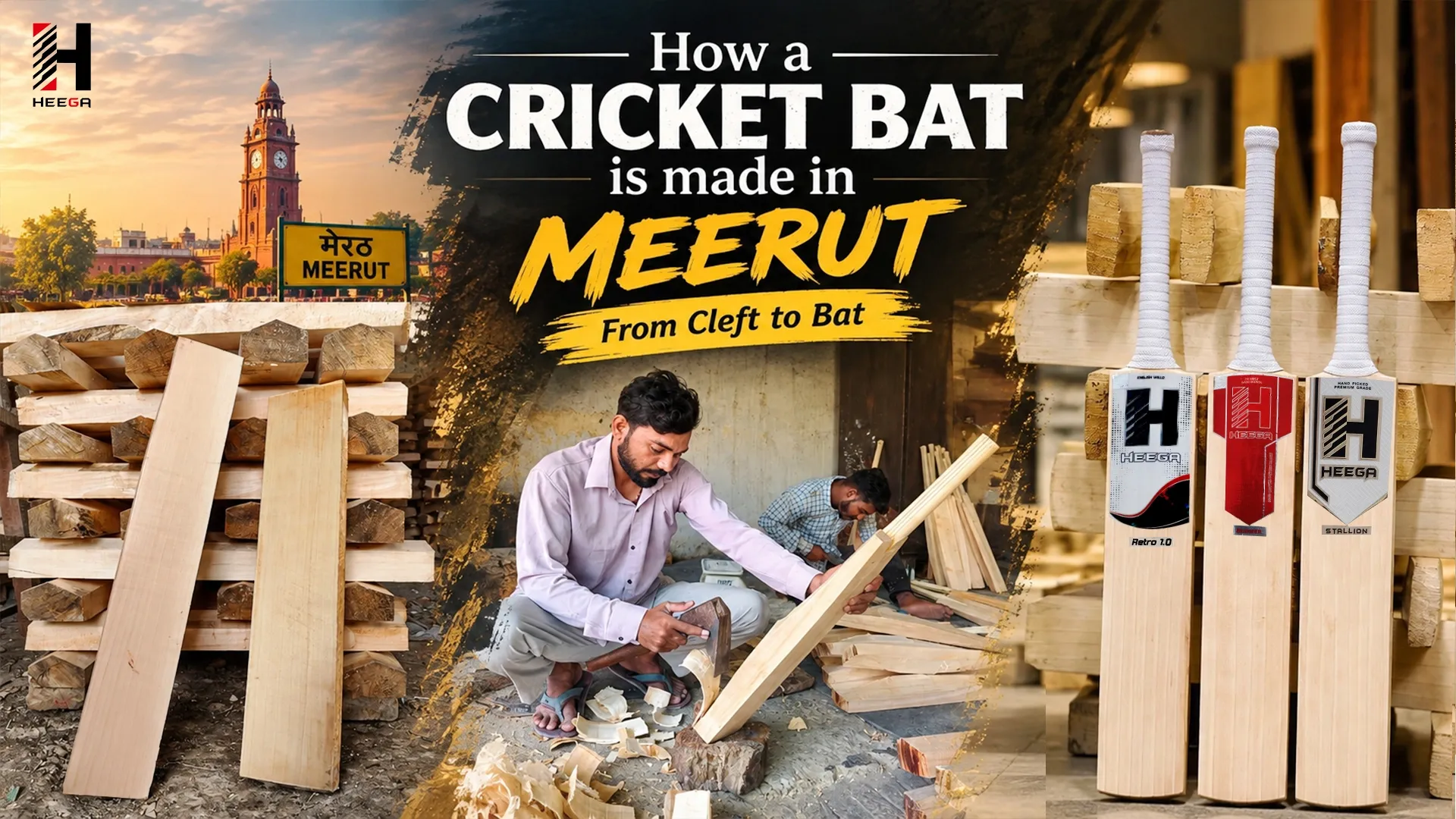
How a cricket bat is made in Meerut, in order
A bat in our workshop goes through seven steps. The hands-on work adds up to about a working day. The waiting adds up to weeks.
When people ask how a cricket bat is made in Meerut, they picture the shaping, with shavings curling onto the floor. That part is real. It is also the shortest part of the bat's time with us.
This post walks one bat through the workshop in the order we work. At each step there is something you can check on your own bat today. You can read more about the people and the place on our about page.
Step one: the cleft arrives wet
A cleft is a wedge of willow split from a round of the trunk. It comes in rough, much heavier than any bat, and still holding water from the tree. Wet willow does not shape well. It tears under the blade, and it keeps moving as it dries.
So the first thing we do is nothing. The clefts are stacked with gaps between them so air reaches every face. The ends are sealed with wax so they do not split as they dry. Then they wait.
Air-drying takes weeks. It takes longer in the monsoon months, when the air in Meerut sits heavy and damp. A cleft is ready when its weight stops falling from one check to the next.
This is where a bat waits longest. A rushed cleft makes a bat that keeps drying on your shelf, changes weight and loses its feel.
Step two: grading by the face
Once dry, each cleft is planed on the face so the grain shows. Then someone counts.
Grains are the straight lines running down the face of the blade. Each one is a year of the tree's growth. We count them across the face. We look for knots, for red heartwood near the edge, and for specks and stains.
Grading takes a few minutes a cleft, but it decides everything after it. A face with straight, evenly spaced grains and clean colour goes to the higher grades. A few marks or wavy grain drop it a grade. Those marks do not make a bat weak. They make it look less clean.
Check your own bat. Turn it face-up in good light and count the lines across the widest part of the blade. Six to twelve is common on a good English willow face. Straight and parallel matters more than the number. (More grains is not always better, by the way. Very tight grain can mean a harder bat that takes longer to play in.)
Step three: the press
Raw willow is soft. A hard ball would dent it straight away. So the face and edges go under a roller, which squeezes the fibres closer together near the surface.
Pressing is quick, well under an hour for one blade. It is still a judgement call. Too little and the face dents easily. Too much and the bat feels dead off the middle. We press a soft cleft harder and a dense cleft lighter.
What you can see: a slight sheen on the face and edges, and a smoother feel there than on the back. That is the pressed layer.
Step four: the splice
The handle is made separately. Ours are Singapore cane, built from strips with thin rubber layers between them to take some of the jar out of a mistimed shot.
The top of the blade gets a V cut into it. This is the splice. The handle is shaped to fit that V exactly, then glued and clamped.
Then the bat waits again, overnight at the least, so the glue cures before anyone puts a tool near it. Shaping a bat on a fresh splice is how handles work loose later.
What you can see: the V on the back of the shoulders, just below the grip. A tight, clean line there means a good fit. A gap opening along that line is a reason to put the bat aside and have it looked at.
Step five: shaping
This is the part people imagine. The rough blade is brought to shape with a drawknife first, then spokeshaves and planes. The maker sets the spine, the edges, the toe and the shoulders, and places the weight where the player will feel it.
A skilled maker spends a couple of hours on one bat here. Between cuts, the bat goes on the scale and gets picked up, again and again.
Two bats at the same weight can feel very different. Pickup depends on where the wood sits. A higher spine and a thinner toe make a bat feel lighter in the hands than the scale says.
What you can see: the line of the spine down the back, the thickness of the edges, the shape of the toe. Hold your bat by the grip and let the blade hang. If it pulls hard toward the toe, the weight sits low.
Step six: sanding and finishing
The shaped bat is sanded through finer and finer papers until the face is smooth. The handle is bound with twine and glue. A rubber grip is rolled on over a cone. The face may get a light coat of oil or a protective sheet. Stickers go on last.
This is a few hours of work spread over a day or more, because each coat needs time to dry before the next step.
Step seven: the final check
Before a bat leaves us, it is tapped along the face to listen for dead spots. The splice is checked. The handle is flexed. The bat is weighed and the weight is written down. A custom order is checked against its spec sheet, line by line.
Where the time goes
Add it up and the pattern is plain. Drying the cleft: weeks. Curing the splice: a night. Finishing and drying: a day or more. Hands-on work across grading, pressing, shaping and finishing: about one working day.
That is why a bat built to a player's spec takes longer than one off the shelf. If a dry, graded cleft is already waiting, shaping can start the day the order comes in. The drying cannot be hurried. When we quote a time for a custom cricket bat, that waiting is most of it.
Reading your own bat
Next time you pick up your bat, read it in the same order we made it. The face tells you the grade. The sheen tells you it was pressed. The V at the shoulders tells you how the handle was fitted. The spine and toe tell you where the maker put the weight.
None of this needs tools. A bit of light and a minute is enough to know more about your bat than most shop labels say.
Every bat on our cricket bats page is made this way in the Meerut workshop, and you can order any of them there.
Related posts
 The Science of Willow Pressing: How Cleft Density Shapes Bat Power and LongevityLearn how willow pressing and cleft density affect cricket bat power, rebound, durability, pickup, and longevity, and understand what to look for when buying a bat.
 From Cleft to Crease: The Craft Behind Heega Cricket BatsDiscover the complete craft behind Heega cricket bats — from selecting premium willow clefts to expert shaping, pressing, and finishing. Learn how Heega transforms raw wood into match-winning cricket bats.
 The Growth of Cricket in Canada, USA, Nepal, Sri Lanka and UKExplore cricket's growth in Canada, USA, Nepal, Sri Lanka and UK, from grassroots clubs and youth development to professional leagues and global competitions.