The Science of Willow Pressing: How Cleft Density Shapes Bat Power and Longevity
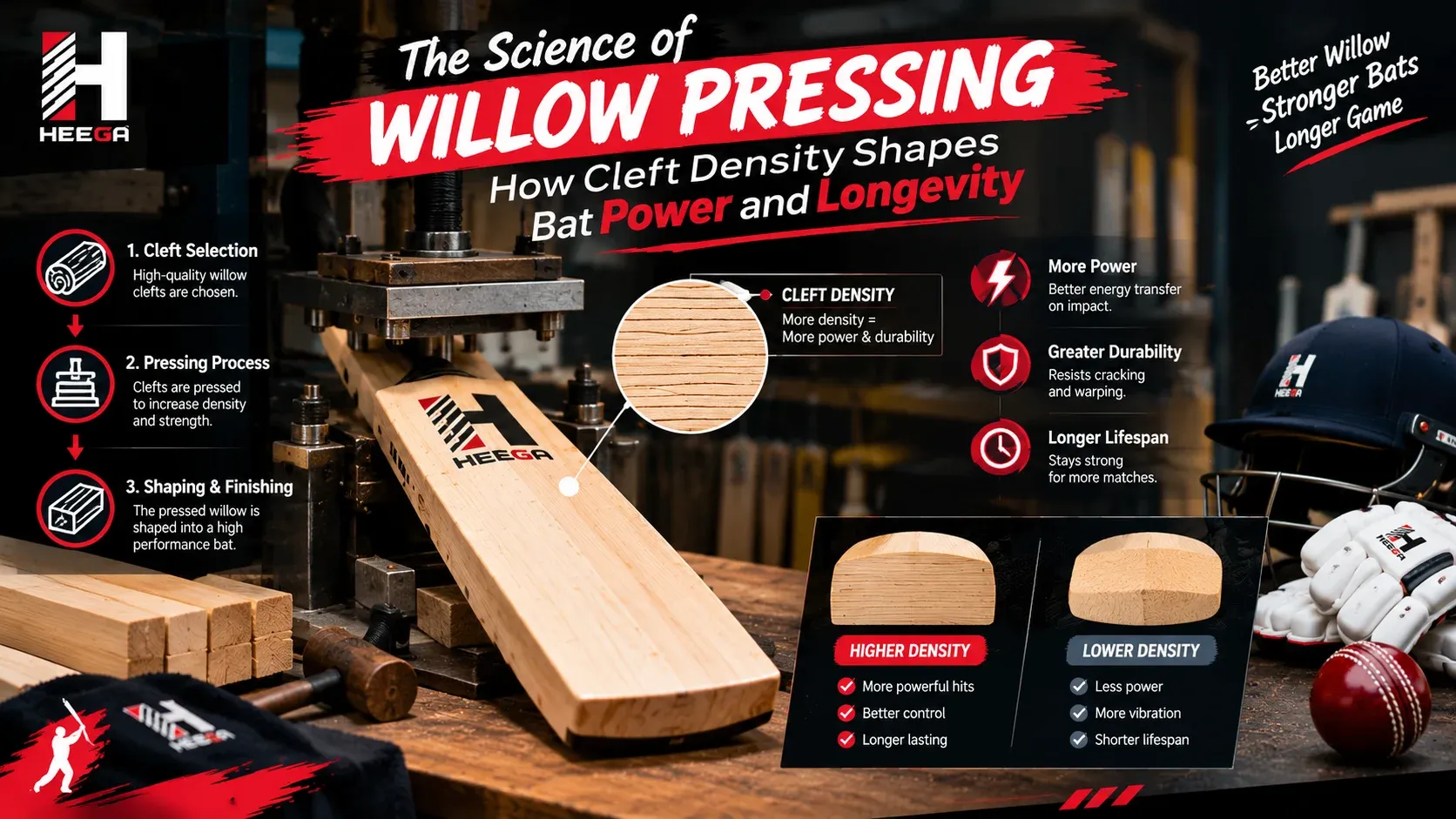
Introduction: Why Willow Pressing Matters in a Cricket Bat
When players shop for a cricket bat, they often focus on willow type, grain count, weight, edges, and overall appearance.
But there is another part of bat manufacturing that has a major influence on how the willow behaves: pressing.
Willow pressing is one of the processes used by bat manufacturers to prepare the cleft for conversion into a cricket bat. It affects how the timber responds to repeated impacts from the cricket ball and plays a role in finding the right balance between rebound, surface resilience, and durability.
This is where things become interesting.
A bat that is too lightly pressed may feel lively but can be more vulnerable to dents and damage. A bat that is pressed too aggressively may have a firmer surface but can potentially sacrifice some of the natural response players expect from good willow.
The goal is not simply to press the willow as much as possible.
The goal is to achieve the right level of compression for the characteristics of the particular cleft and the intended bat.
For beginners, this may sound technical. For professional and experienced cricketers, it can help explain why two bats made from apparently similar willow can feel completely different in the hands.
What Is Willow Pressing?
Willow pressing is a manufacturing process in which controlled pressure is applied to the willow cleft.
The purpose is to compress and consolidate the wood fibres so the blade can withstand repeated ball impacts while retaining suitable playing characteristics.
A cricket bat is not simply a piece of willow cut into shape.
Before the final bat is produced, the cleft goes through several stages of selection, shaping, pressing, profiling, and finishing.
Pressing is one of the stages where the manufacturer can influence how the timber behaves.
The process needs to be controlled carefully because willow is a natural material.
Every cleft is different.
What Is a Willow Cleft?
A cleft is essentially the piece of willow timber from which the cricket bat is manufactured.
It is selected, shaped, and processed before becoming the finished bat.
Clefts can vary in:
- Density
- Moisture content
- Fibre structure
- Grain appearance
- Weight
- Natural characteristics
- Overall hardness
This variation is one reason why two bats from the same willow category can have different playing characteristics.
A manufacturer must work with the timber that is available rather than treating every piece of willow as identical.
What Does Cleft Density Mean?
Cleft density refers broadly to how much wood material is present within a given volume of the cleft.
In simple terms, density relates to the relationship between mass and volume.
A denser cleft generally contains more wood mass for a similar volume, while a less dense cleft may contain less.
However, density should not be interpreted as a simple ranking system where higher density automatically means a better cricket bat.
A cricket bat is a balance of several characteristics.
The manufacturer's job is to work with the cleft and create a finished bat that provides an appropriate combination of:
- Performance
- Durability
- Weight
- Pickup
- Balance
- Feel
- Rebound
Why Cleft Density Matters
Density can influence how the willow behaves under impact.
A denser piece of timber may have a firmer feel and can offer strong resistance to surface damage.
A less dense cleft may allow manufacturers to produce a lighter bat with a responsive feel, depending on the quality and structure of the willow.
But density is only one variable.
Two clefts with similar density can still produce bats with different characteristics because of differences in grain structure, moisture, pressing, profile, and construction.
This is why experienced bat makers do not judge a cleft using one measurement alone.
How Pressing Changes the Willow
The purpose of pressing is not simply to make the willow harder.
It is about controlling the surface and structure of the blade so that it can handle the repeated impact of cricket.
During the process, pressure is applied to the cleft.
This can:
- Compress the surface fibres
- Improve resistance to impact
- Reduce excessive denting
- Prepare the willow for ball contact
- Help create a more consistent playing surface
The amount and method of pressing need to be appropriate for the individual cleft.
Too little pressing can leave the surface more vulnerable.
Too much pressing can produce a bat that feels overly hard or less responsive.
Under-Pressed Willow: What Does It Mean?
An under-pressed bat has not received enough compression for the characteristics of its willow.
The exact effect can vary, but an under-pressed surface may be more susceptible to:
- Deeper ball marks
- Surface dents
- Excessive fibre movement
- Premature wear
Some players may describe such a bat as feeling very lively.
However, a lively response is not enough on its own.
A cricket bat needs to survive repeated impacts as well as provide good rebound.
This is why pressing requires balance.
Over-Pressed Willow: What Does It Mean?
Over-pressing occurs when the willow receives more compression than is appropriate.
A heavily pressed bat may have a firmer surface and stronger resistance to visible denting.
But excessive pressing can affect the natural response of the timber.
A player may notice:
- A harder feel
- Less lively response
- Different sound at impact
- A less forgiving sensation
- Reduced perceived rebound
Again, the exact result depends on the particular willow and manufacturing process.
There is no single pressing level that works perfectly for every cleft.
The Relationship Between Pressing and Ball Rebound
Rebound is one of the characteristics players notice most when hitting a cricket ball.
A well-made bat should transfer energy efficiently when the ball strikes the sweet spot.
Pressing can influence how the surface responds to impact.
The challenge for a manufacturer is to find the right balance between:
surface resilience + compression + rebound + durability
If the surface is too soft, it may suffer excessive denting.
If it is excessively compressed, the bat may feel harder and less responsive.
Good pressing aims to create a practical compromise.
Does More Pressing Mean More Power?
Not necessarily.
This is an important misconception.
It may sound logical to assume:
More pressing = harder willow = more power
But cricket bat performance is not that simple.
Power depends on multiple factors, including:
- Willow characteristics
- Bat speed
- Weight
- Pickup
- Balance
- Sweet-spot position
- Blade profile
- Handle construction
- Impact location
- Ball speed
Pressing influences the behaviour of the willow, but it does not independently determine how powerful a bat will be.
Sweet Spot and Willow Pressing
The sweet spot is the part of the bat where impact generally feels most efficient and comfortable.
When the ball meets the sweet spot, players often experience:
- Strong rebound
- Less unpleasant vibration
- A solid sound
- Efficient energy transfer
- A satisfying feel
Pressing contributes to the behaviour of the blade, but the location and characteristics of the sweet spot are also influenced by the bat's overall profile.
That means you cannot judge pressing quality simply by looking at where the sweet spot sits.
How Pressing Affects Bat Feel
Two bats with the same weight can feel completely different.
One may feel lively and responsive.
Another may feel firm and solid.
The difference can come from a combination of:
- Willow density
- Pressing
- Balance
- Profile
- Handle
- Sweet-spot position
- Overall construction
This is why pickup and feel are so important when choosing a cricket bat.
Specifications tell you what the bat weighs.
They do not tell you exactly how it will feel when you play a cover drive or defend a fast delivery.
Pressing, Weight, and Pickup
Players sometimes assume that a lighter bat will always have better pickup.
That is not necessarily true.
A bat's pickup depends heavily on how its mass is distributed.
A slightly heavier bat can sometimes feel easier to move than a lighter bat if the balance suits the player.
Similarly, a denser cleft does not automatically mean a bat will feel heavy.
The manufacturer can shape and balance the bat to influence its overall feel.
Therefore, pressing should always be considered alongside weight and balance rather than separately.
How Willow Density Can Influence Bat Weight
Density naturally has a relationship with weight.
If two pieces of timber occupy a similar volume but one is denser, the denser piece will generally weigh more.
This creates a challenge for bat makers.
They want enough material to provide a strong and durable blade while keeping the final bat manageable for the player.
This is why bat manufacturing involves careful cleft selection and shaping.
A professional player may have a very specific weight preference, while a beginner may benefit from a lighter, easier-to-control bat.
Does Higher Density Mean a More Durable Cricket Bat?
Not automatically.
Density can contribute to how timber behaves under impact, but durability depends on much more than density alone.
Other factors include:
- Willow structure
- Pressing
- Bat profile
- Preparation
- Ball type
- Playing conditions
- Batting technique
- Frequency of use
- Maintenance
- Toe protection
- Storage
A dense cleft that has been poorly manufactured or badly maintained can still suffer damage.
Likewise, a well-made bat from a suitable cleft can perform reliably when properly cared for.
Pressing and English Willow
English Willow is commonly used in premium cricket bats and is valued for its performance characteristics.
Because the timber can be relatively soft and responsive, pressing becomes an important part of preparing it for repeated impact.
A manufacturer has to balance:
- Rebound
- Surface resilience
- Weight
- Feel
- Durability
The objective is not to remove the natural response of the willow.
Instead, pressing should prepare the timber while preserving the characteristics that make it attractive for cricket bats.
Pressing and Kashmir Willow
Kashmir Willow generally has a denser and firmer character than English Willow.
This means its natural characteristics are different before pressing even begins.
Manufacturers still need to process and press the cleft appropriately.
A Kashmir Willow bat should not simply be pressed as hard as possible because it is already relatively dense.
The same principle applies:
The pressing process should suit the individual cleft.
Why the Same Willow Type Can Produce Different Bats
This is one of the most interesting parts of cricket bat manufacturing.
Suppose two bats are both labelled as English Willow.
They can still differ in:
- Grain structure
- Cleft density
- Pressing
- Weight
- Balance
- Profile
- Sweet spot
- Handle
- Pickup
- Overall feel
The willow category gives you useful information, but it does not tell the entire story.
This is why experienced players often focus on the individual bat rather than the label alone.
How Bat Makers Decide the Pressing Level
Professional bat making involves experience and judgement.
The manufacturer considers the characteristics of the cleft before deciding how it should be processed.
Important considerations can include:
- Density
- Fibre structure
- Moisture condition
- Intended bat weight
- Desired performance characteristics
- Expected usage
- Blade profile
The objective is to create a finished bat that can withstand cricket while maintaining a useful playing response.
This is not a simple one-setting manufacturing process.
Pressing and Cricket Bat Longevity
A cricket bat's lifespan is influenced by how well it has been manufactured and how it is treated afterward.
Appropriate pressing can help create a surface capable of handling repeated impacts.
But pressing alone cannot guarantee a long-lasting bat.
Longevity also depends on:
- Proper knocking-in
- Suitable cricket balls
- Playing conditions
- Storage
- Moisture management
- Frequency of use
- Repairs
- Player technique
A well-pressed bat can still be damaged by careless use.
Pressing vs Knocking-In: What Is the Difference?
These two processes are sometimes confused.
Pressing is part of the manufacturing process.
It is performed by the bat maker while preparing the willow cleft.
Knocking-in is a preparation process performed after the bat has been manufactured, either by the manufacturer or player depending on the product.
Knocking-in gradually prepares the finished blade for repeated ball impact.
In simple terms:
Pressing prepares the timber during manufacturing.
Knocking-in prepares the finished bat for use.
Both have different purposes.
Can Knocking-In Fix Poor Pressing?
No.
Knocking-in cannot transform a poorly manufactured bat into a perfectly pressed one.
If a bat has inappropriate pressing, severe structural problems, or manufacturing defects, additional knocking-in is not a solution.
This is why the manufacturing stage matters.
Players should purchase bats from reputable manufacturers and follow the recommended preparation instructions.
How Pressing Affects Different Areas of the Bat
Not every part of the bat experiences impact in exactly the same way.
The main areas include:
Sweet Spot
Receives repeated ball impact and needs an appropriate combination of rebound and resilience.
Edges
Need careful treatment because they can be vulnerable to mishits.
Toe
Experiences ground contact and low deliveries.
Shoulders
Need to maintain structural integrity around the transition between blade and handle.
The finished bat must function as a complete structure rather than simply having a strong centre.
Pressing and Bat Profile
The blade profile also influences performance.
Manufacturers can create different profiles featuring:
- Large sweet spots
- Thick edges
- Mid or low sweet spots
- Different spine heights
- Different toe shapes
The pressing process needs to work with the final design.
A manufacturer cannot look at pressing in isolation from the profile.
The objective is to create a finished bat where the timber and geometry work together.
Can Players See Whether a Bat Is Properly Pressed?
Usually, not with certainty.
A player can inspect the bat and look for signs of quality, but pressing is primarily a manufacturing characteristic.
You may notice clues through:
- Surface response
- Sound
- Feel
- Denting behaviour
- Rebound
But none of these alone can prove exactly how the bat was pressed.
This is why manufacturer reputation and quality control matter.
Do not believe claims that you can determine precise pressing quality simply by looking at the number of grains.
What Does a Well-Pressed Bat Feel Like?
There is no single feel that applies to every player.
However, a well-made bat should generally provide a sensible balance between:
- Solid contact
- Rebound
- Controlled vibration
- Surface resilience
- Manageable weight
- Good pickup
Some players prefer a softer, livelier sensation.
Others prefer a firmer, more solid feel.
The right bat depends on individual preference.
Does Pressing Affect the Sound of a Cricket Bat?
Sound can sometimes provide a useful clue about the way a bat feels at impact.
A well-struck ball may produce a crisp, satisfying sound.
However, sound alone is not a scientific test of bat quality.
The sound can also be affected by:
- Willow characteristics
- Bat profile
- Ball type
- Impact location
- Surface condition
- Construction
Never choose a bat solely because it makes a particular sound.
How Pressing Relates to Bat Performance
A useful way to think about the process is:
Cleft characteristics → pressing → bat construction → preparation → playing performance
Each stage contributes something different.
The cleft provides the raw material.
Pressing prepares the timber.
Construction determines the final geometry.
Knocking-in prepares the bat for use.
The player then adds bat speed, timing, technique, and control.
No single stage creates performance by itself.
Common Myths About Willow Pressing
Myth 1: Harder Pressing Always Means a Better Bat
Not necessarily.
Excessive compression can change the feel and response of the willow.
Myth 2: More Dense Willow Always Produces More Power
Power depends on several factors, including bat speed, balance, profile, and impact quality.
Myth 3: Pressing Makes a Bat Indestructible
It does not.
Every cricket bat has limits.
Myth 4: Knocking-In Can Correct Any Manufacturing Problem
It cannot.
Knocking-in is not a replacement for proper manufacturing.
Myth 5: Grain Count Tells You How a Bat Was Pressed
It does not.
Grain appearance and pressing are separate characteristics.
Myth 6: The Hardest Bat Is the Longest-Lasting Bat
Durability depends on many factors beyond surface hardness.
What Beginners Should Know About Willow Pressing
Beginners do not need to understand every technical detail of bat manufacturing.
However, knowing the basics can help prevent unrealistic expectations.
When buying a bat:
- Do not choose based only on grain count.
- Do not assume the hardest bat is automatically the best.
- Check the weight.
- Test the pickup where possible.
- Ask about preparation.
- Buy from a reputable manufacturer.
- Follow the recommended knocking-in process.
The best beginner bat is one that is comfortable, appropriate for the player's strength, and suitable for the cricket being played.
What Club Players Should Look For
Club players often need a balance between performance and durability.
Look for:
- Comfortable pickup
- Suitable weight
- Good balance
- Appropriate sweet spot
- Quality willow
- Reliable construction
- Proper preparation
- Suitable pressing
Do not get distracted by appearance alone.
A beautiful grain pattern does not guarantee that the bat will suit your technique.
What Professional Players Should Look For
Professional players generally have more specific requirements.
They may already know the exact characteristics they prefer.
For example:
- Preferred bat weight
- Sweet-spot location
- Edge profile
- Spine height
- Handle shape
- Pickup
- Balance
- Willow feel
For them, pressing is one part of a much larger performance equation.
The individual cleft becomes particularly important because small differences in timber can affect how the finished bat feels.
How to Evaluate a Cricket Bat Before Buying
When possible, use this checklist.
1. Pick It Up
Do not judge the bat only by its listed weight.
2. Check the Balance
Make sure the weight distribution suits your style.
3. Examine the Willow
Look at the overall grain and surface structure.
4. Ask About Preparation
Find out whether the bat has already been prepared.
5. Understand the Warranty
Know what manufacturing issues are covered.
6. Ask About the Construction
Understand what the manufacturer has designed the bat for.
7. Consider Your Level
A professional specification may not be necessary for a beginner.
8. Think About Your Playing Conditions
The best bat for indoor practice may not be the same as the best bat for competitive leather-ball cricket.
How Maintenance Protects the Benefits of Good Pressing
Even excellent pressing can only do so much.
Players must protect the bat afterward.
Good maintenance includes:
- Proper knocking-in
- Suitable ball selection
- Avoiding wet conditions where possible
- Drying the bat correctly
- Protecting the toe
- Checking edges
- Storing the bat properly
- Repairing damage early
If the bat is neglected, the advantages of good manufacturing can quickly be reduced.
Pressing and Overseas Cricket
For overseas cricketers, understanding pressing is useful because playing conditions can vary considerably.
A player may use the same bat in:
- Humid conditions
- Dry conditions
- Cold weather
- Hot weather
- Hard pitches
- Soft pitches
- Indoor nets
- Outdoor matches
Pressing does not eliminate the need for climate-specific maintenance.
Players should still manage:
- Moisture
- Temperature
- Storage
- Transportation
- Ball selection
The manufacturing quality and the player's maintenance routine work together.
How Pressing Fits Into Modern Cricket Bat Manufacturing
Modern bat manufacturing combines traditional craftsmanship with increasingly controlled production methods.
Manufacturers can use careful cleft selection, machinery, measurement, and experienced craftsmanship to produce bats with specific characteristics.
However, natural willow still varies from cleft to cleft.
This is why cricket bat manufacturing remains partly dependent on skilled judgement.
Machines can provide consistency.
Experienced bat makers provide interpretation.
The best results come from understanding both.
A Simple Guide to Willow Pressing and Bat Performance
FactorMain Influence
Cleft density
Weight, feel, timber characteristics
Pressing
Surface resilience and impact response
Bat profile
Sweet spot, power and balance
Weight
Bat speed and stability
Pickup
Perceived ease of movement
Handle
Feel and vibration management
Knocking-in
Preparation for regular ball impact
Maintenance
Long-term condition
Playing conditions
Wear and durability
This table shows why no single specification can tell you everything about a cricket bat.
Final Thoughts
Willow pressing is one of the less visible but important parts of cricket bat manufacturing.
Players see the finished bat, but the characteristics of that bat begin much earlier with the selection and preparation of the willow cleft.
Cleft density, fibre structure, pressing, profile, weight, balance, and preparation all interact to influence how a cricket bat performs.
The goal of pressing is not simply to make willow harder.
It is to prepare the timber so that the finished bat can provide a practical balance of rebound, resilience, feel, and durability.
For beginners, this knowledge can make bat shopping less confusing.
For club players, it helps explain why apparently similar bats can feel different.
For professional cricketers, it highlights why individual cleft selection and manufacturing quality matter so much.
Ultimately, the best cricket bat is not necessarily the hardest, lightest, heaviest, or most attractive one.
It is the bat where the willow, pressing, profile, balance, and construction come together to suit the player.
FAQs About Willow Pressing and Cricket Bat Performance
What is willow pressing in cricket bats?
Willow pressing is a manufacturing process in which controlled pressure is applied to the willow cleft to prepare the timber for use as a cricket bat.
Does pressing make a cricket bat stronger?
Appropriate pressing can improve the bat's resistance to impact and surface damage, but it does not make the bat indestructible.
Does more pressing mean more power?
No. Bat power depends on many factors, including willow characteristics, bat speed, balance, profile, sweet spot, and impact quality.
What happens if a cricket bat is under-pressed?
An under-pressed bat may be more susceptible to surface denting and damage. However, the exact effect depends on the individual willow and manufacturing process.
What happens if a cricket bat is over-pressed?
Excessive pressing can produce a harder feel and may reduce some of the natural response of the willow. The correct level depends on the individual cleft.
Does cleft density affect cricket bat weight?
Yes. Density has a relationship with mass for a given volume, although the final bat weight also depends on the dimensions and amount of material used.
Is denser willow always better?
No. Density is only one characteristic. A cricket bat also needs suitable weight, balance, profile, response, construction, and durability.
Does English Willow need pressing?
Pressing is part of the manufacturing process for cricket bats, and the exact approach depends on the characteristics of the cleft and the manufacturer's process.
Is Kashmir Willow pressed differently from English Willow?
The characteristics of the two timbers can differ, so the manufacturer may adjust the processing accordingly. There is no single pressing method that applies identically to every cleft.
Can knocking-in improve a poorly pressed bat?
No. Knocking-in prepares the finished bat for ball impact but cannot correct inappropriate manufacturing or pressing.
Can I tell if a bat has been properly pressed by looking at its grains?
No. Grain appearance does not tell you precisely how the willow was pressed.
Does pressing affect bat durability?
It can contribute to the bat's resistance to repeated impact, but durability also depends on willow quality, construction, preparation, playing conditions, and maintenance.
What should I look for when buying a pressed cricket bat?
Focus on the overall bat rather than pressing alone. Consider willow quality, weight, pickup, balance, profile, construction, preparation, and how the bat feels in your hands.
Explore Cricket Bats and Equipment at Heega Sports
A cricket bat is the result of many carefully controlled decisions, from willow selection and cleft preparation to pressing, shaping, balancing, and finishing.
Explore cricket bats, cricket balls, protective equipment, kit bags, and other cricket essentials from Heega Sports.
Related posts
 English Willow Cricket Bats Explained: How Bat Pressing, Grain Structure and Blade Compression Influence PerformanceLearn how English willow bat pressing, grain structure, and blade compression influence performance, durability, shot response, and bat selection.
 Kashmir Willow Cricket Bats: How Wood Density, Grain Patterns and Moisture Affect PerformanceDiscover how Kashmir Willow cricket bat density, grain patterns and moisture affect bat weight, balance, durability, and batting performance.
 English Willow Cricket Bats: How Bat Shaping and Pressing Influence PerformanceDiscover how English Willow cricket bat shaping and pressing influence blade structure, rebound, balance, durability, and batting performance.