English Willow Cricket Bats: How Bat Shaping and Pressing Influence Performance
Introduction: What Makes an English Willow Cricket Bat Perform Well?
When a batter picks up an English Willow cricket bat, the first things they usually notice are its weight, shape, grains, and overall appearance.
Some bats have thick edges and pronounced spines. Others have a slimmer profile with a different balance and pickup. Even two bats made from English Willow can feel remarkably different when lifted or used in the nets.
These differences are not accidental. They are influenced by the way the willow is selected, prepared, pressed, shaped, and finished during manufacturing.
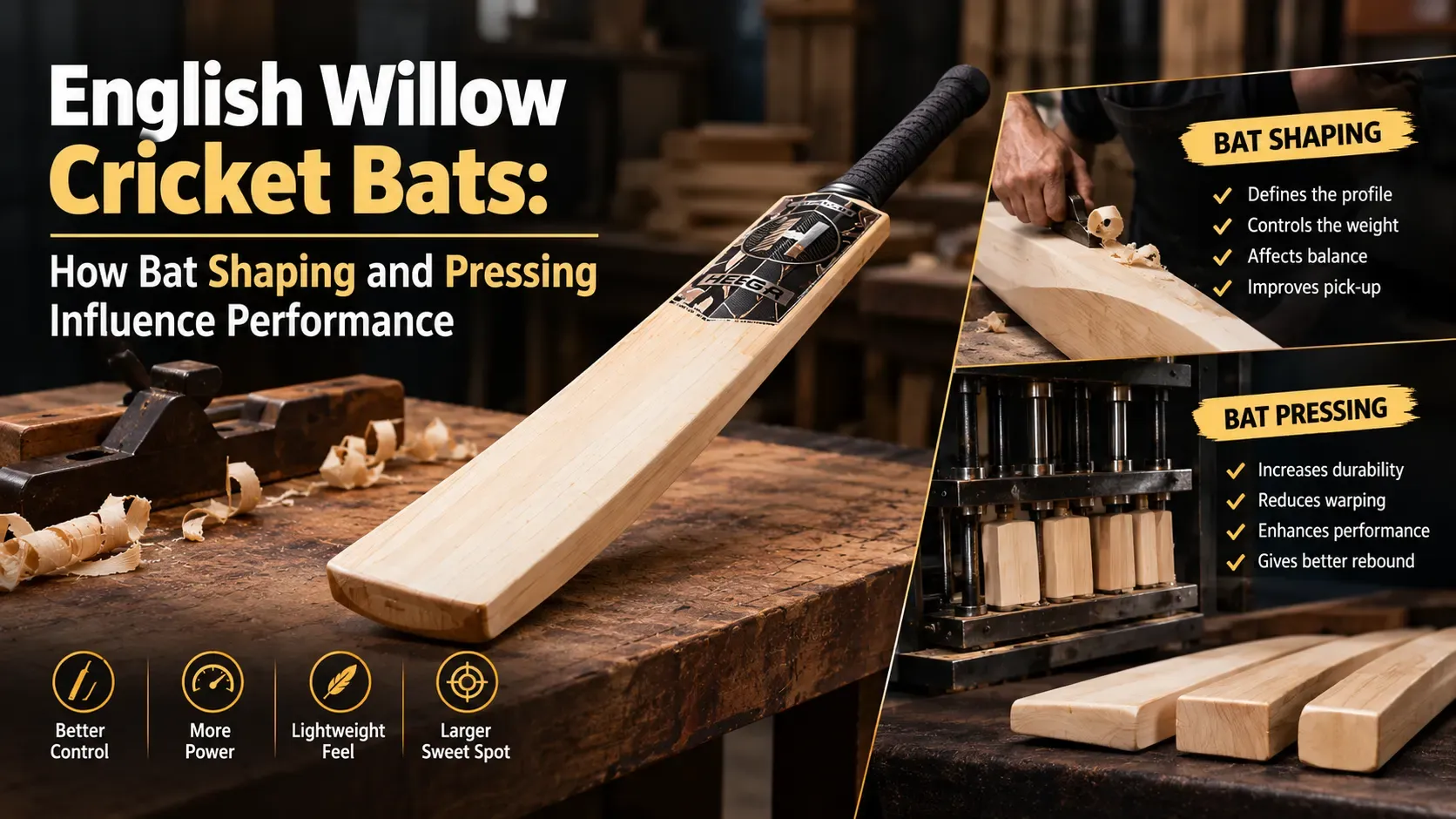
Bat shaping and pressing are two important stages in cricket bat production. Pressing helps prepare the willow for the repeated impact involved in batting, while shaping determines the blade's profile, weight distribution, spine, edges, and overall feel.
However, neither process works in isolation. Willow characteristics, manufacturing quality, bat dimensions, preparation, and the player's technique all contribute to the final result.
Understanding these processes helps players make more informed decisions when choosing an English Willow cricket bat. It also explains why a bat's appearance alone cannot tell you exactly how it will perform.
In this guide, we will explore how English Willow bats are manufactured, what pressing does, how shaping affects the blade, and which features players should evaluate before buying their next bat.
What Is English Willow?
English Willow is a type of willow wood widely used in cricket bat manufacturing because it can provide a useful combination of relatively low weight, responsiveness, and suitability for shaping into a bat blade.
The quality of the finished bat depends partly on the characteristics of the individual piece of willow.
Natural differences can include:
- Grain appearance
- Wood density
- Colour variation
- Natural blemishes
- Moisture condition
- Structural characteristics
This means that two English Willow bats may differ even when they belong to the same grade.
The manufacturing process helps turn the selected willow into a usable cricket bat, but it cannot make every piece of wood identical.
The objective is to produce a blade with suitable dimensions, a practical balance, and appropriate characteristics for cricket.
How an English Willow Cricket Bat Is Made
Cricket bat manufacturing involves several stages, although the exact process varies between manufacturers.
A simplified production sequence includes:
- Selecting suitable willow.
- Preparing the willow cleft.
- Drying and conditioning the wood appropriately.
- Pressing the blade.
- Shaping the profile and spine.
- Forming the edges and toe.
- Preparing the handle and splice.
- Finishing the blade.
- Fitting the grip and checking the final product.
Each stage contributes to the finished bat.
For example, selecting the willow determines the starting material, pressing influences the blade's surface and structure, and shaping determines how the wood is distributed throughout the bat.
The quality of the final product depends on how well these stages work together.
What Is Cricket Bat Pressing?
Cricket bat pressing is a manufacturing process in which the willow blade is compressed using specialised equipment.
The purpose is to prepare the blade for the repeated impacts it will experience when striking a cricket ball.
Pressing is an important part of bat production because willow is a natural material. Its structure and response can vary depending on the piece of wood and how it is processed.
The manufacturer must apply an appropriate pressing process for the particular willow and intended bat construction.
Pressing is not simply about making the wood as hard as possible. Excessive or unsuitable processing may compromise the characteristics the manufacturer wants to preserve.
Why Is English Willow Pressed?
A cricket bat repeatedly experiences impact during practice and matches.
The willow must be prepared so the blade can handle those impacts while retaining useful playing characteristics.
Appropriate pressing can help establish a suitable surface and impact response. The exact result depends on the wood, the equipment, and the manufacturer's process.
Several factors are relevant.
1. Preparing the Blade for Ball Impact
Pressing helps prepare the willow for the repeated contact associated with batting.
A properly manufactured blade should be suitable for its intended use, although pressing alone cannot guarantee that a bat will never crack or split.
2. Influencing the Surface and Impact Response
The way willow responds to a ball is affected by its natural structure and the manufacturing process.
Pressing can influence the blade's characteristics, but the final impact response also depends on the wood itself, the bat's dimensions, and its preparation.
3. Supporting Consistency in Manufacturing
Controlled manufacturing processes help bat makers work toward consistent product specifications.
However, because willow is natural, finished bats will still vary in appearance, feel, weight, and response.
4. Balancing Performance and Structural Integrity
The aim is not to create the hardest possible blade.
Instead, the manufacturer needs to prepare the wood appropriately while preserving the characteristics that make it suitable for cricket bat production.
The precise process is a manufacturing decision based on the willow and the intended design.
Does More Pressing Always Mean a Better Cricket Bat?
No.
It is easy to assume that a more heavily pressed bat must be more durable or powerful, but the relationship is not that simple.
Pressing needs to be appropriate for the willow and the manufacturing process.
The finished bat's characteristics also depend on:
- Willow quality
- Blade dimensions
- Profile and weight distribution
- Manufacturing precision
- Moisture condition
- Preparation before use
- How the player uses and maintains the bat
A bat should not be judged by an unsupported claim that it has been pressed more than another model.
For buyers, the more useful approach is to assess the actual bat's specifications, construction, condition, and suitability.
What Is Bat Shaping?
Bat shaping is the process of forming the willow blade into its final design.
This includes developing the spine, edges, face, shoulders, toe, and overall profile.
The shape influences how much wood is distributed across different parts of the blade.
That distribution can affect the bat's weight, balance, pickup, and feel during the swing.
Shaping is one reason two bats with similar actual weights can feel completely different in a player's hands.
How the Spine Influences Bat Design
The spine is the raised central section running along the back of the bat.
Its height and distribution vary between designs.
A pronounced spine may allow the manufacturer to distribute more wood through particular areas of the blade while shaping other sections to achieve the desired overall weight and balance.
The effect depends on the complete profile, not simply the maximum spine height.
When assessing a bat, players should consider whether the spine design contributes to a comfortable pickup and a profile that suits their technique.
A taller spine does not automatically mean a better bat.
Why Cricket Bat Edges Matter
The edges are the sides of the blade.
Modern bats can feature substantial edges, while other designs use a more traditional or slimmer profile.
Edge thickness influences how the manufacturer distributes wood across the blade.
However, larger edges alone do not guarantee superior performance.
Players should also consider:
- Total bat weight
- Pickup
- Spine design
- Sweet-spot position
- Blade balance
- Comfort during the swing
A bat with thick edges may suit one player, while another may prefer a lighter-feeling design.
The most useful choice is the one that matches the player's requirements.
Understanding the Sweet Spot
The sweet spot is the area of the bat where contact can feel particularly clean and efficient.
Its position and size are influenced by the blade's design and the underlying wood characteristics.
Manufacturers may design bats with lower, middle, or higher sweet spots to suit different playing conditions and preferences.
Low Sweet Spot
A lower sweet spot may appeal to players who frequently encounter lower-bouncing pitches or prefer a particular style of front-foot strokeplay.
Mid Sweet Spot
A middle-positioned sweet spot offers a versatile option for players who face varied conditions.
High Sweet Spot
A higher sweet spot may suit players whose playing conditions and shot selection favour contact higher up the blade.
These are general considerations, not fixed rules. The ideal sweet spot depends on the individual batter and the conditions they regularly play in.
How Bat Shaping Influences Weight
The final weight of a cricket bat is affected by the density of the willow and the amount of wood retained during shaping.
Two blades made from different pieces of willow may weigh differently even when their external dimensions are similar.
Likewise, two bats with similar scale weights may feel different because their wood is distributed differently.
Manufacturers can adjust the profile to create different combinations of:
- Blade thickness
- Spine height
- Edge size
- Toe shape
- Overall weight
- Balance
The aim is to create a bat with a suitable combination of specifications rather than maximising every dimension.
Bat Weight vs Pickup
Actual weight and perceived weight are different concepts.
A bat's pickup describes how it feels when the player lifts and moves it into position.
A bat with comfortable balance may feel easier to swing than another bat with the same actual weight.
This is why players should not choose a cricket bat based solely on the number on the scale.
When comparing English Willow bats, lift each one using your normal grip and practise a few familiar movements.
Ask yourself:
- Does the backlift feel natural?
- Can I move the blade quickly enough?
- Does the bat feel balanced?
- Can I control it without excessive effort?
- Does the profile suit my normal shots?
These questions help reveal whether the shaping works for your game.
Can Bat Shaping Increase Batting Power?
Shaping can influence how a bat feels and how its mass is distributed, but it does not independently determine how powerful a player will hit the ball.
Powerful batting depends on several factors, including:
- Bat speed
- Timing
- Contact quality
- Technique
- Body movement
- Strength
- Ball speed and impact conditions
A particular profile may suit a player because it provides comfortable pickup and allows them to swing naturally.
However, a bat with a larger spine or thicker edges will not automatically produce harder shots.
The player must still make effective contact with the ball.
Pressing, Shaping, and Durability: Understanding the Difference
Pressing and shaping contribute to different aspects of manufacturing.
Pressing is concerned with preparing the willow blade through compression.
Shaping determines the blade's final dimensions and distribution of wood.
Durability depends on more than either process alone.
The following factors can also influence how long a cricket bat remains usable:
- The condition and characteristics of the willow
- Manufacturing quality
- Knocking-in and preparation where required
- The type of ball used
- Frequency and intensity of play
- Moisture exposure
- Storage conditions
- Maintenance and repairs
Even a well-manufactured bat can develop damage if it is used in unsuitable conditions or not maintained properly.
Likewise, a particular shaping style or pressing claim should not be treated as a guarantee of long-term durability.
Does Every English Willow Bat Need Knocking-In?
Many traditional wooden cricket bats require preparation before they are used with hard leather balls.
Knocking-in is intended to help prepare the blade for repeated impact. The appropriate method depends on the bat and the manufacturer's instructions.
Some bats may receive factory preparation, while others require additional work before match use.
Players should check the guidance supplied with their particular bat instead of assuming that every English Willow model needs the same process.
Important points include:
- Follow the manufacturer's preparation instructions.
- Use an appropriate bat mallet if knocking-in is required.
- Avoid uncontrolled or excessively forceful impacts.
- Inspect the face and edges during preparation.
- Do not use a new bat with hard balls until it is ready according to the manufacturer's guidance.
Knocking-in does not correct poor manufacturing, and it cannot guarantee that the bat will never crack.
How Bat Profile Influences Different Playing Styles
The right shape depends partly on how a player bats.
Timing-Based Batters
Players who rely on placement, timing, and quick movement may prioritise comfortable pickup and manoeuvrability.
A balanced profile may help them maintain a natural swing.
Power Hitters
Players who prefer aggressive strokeplay may look for a profile that provides the desired feel and mass distribution.
However, the bat must still be manageable enough to generate bat speed.
Players Facing Fast Bowling
A responsive pickup may be useful for batters who need to react quickly to faster deliveries.
A bat that feels too heavy can make rapid adjustments more difficult.
Players Who Prefer Spin-Friendly Strokeplay
Batters who frequently move forward, back, or across the crease may prioritise control and manoeuvrability.
In every case, there is no single profile that works best for all players.
English Willow Bat Grades and Manufacturing
English Willow bats are often sold under grade labels such as Grade 1, Grade 2, and Grade 3.
These labels generally reflect the manufacturer's willow-selection criteria, including appearance and natural markings.
However, grade and manufacturing process are separate considerations.
A high-grade label does not automatically guarantee ideal pressing, shaping, balance, or pickup.
Similarly, a lower-grade bat may have a profile that suits a particular player extremely well.
When choosing a bat, assess the complete product rather than relying on the grade alone.
Common Myths About English Willow Bat Manufacturing
Myth 1: A Bigger Spine Always Means More Power
A larger spine changes the blade profile, but power depends on bat speed, contact, weight distribution, and technique.
Myth 2: More Pressing Always Makes a Bat Better
Pressing must be appropriate for the willow and the intended construction. More pressing is not automatically better.
Myth 3: Thick Edges Guarantee Better Performance
Thick edges are only one part of the design. Pickup, balance, profile, and player comfort matter too.
Myth 4: Every English Willow Bat Is Made the Same Way
Manufacturers use different equipment, techniques, specifications, and quality-control procedures.
Myth 5: The Most Expensive Bat Is Always the Best
A higher price does not guarantee that a particular bat will match the player's strength, technique, or preferences.
Myth 6: Good Shaping Eliminates the Need for Maintenance
Every wooden cricket bat needs appropriate care. Manufacturing quality cannot eliminate the effects of poor storage, moisture, or repeated impact.
How to Inspect an English Willow Cricket Bat Before Buying
Understanding manufacturing is useful, but inspecting the actual bat is equally important.
Before buying, examine the following features.
1. Willow Condition
Look at the face, edges, shoulders, and toe.
Natural colour variation is normal, but significant cracks or structural damage deserve closer inspection.
2. Profile
Check the spine, edges, and overall blade shape.
Decide whether the design matches your preferences and playing style.
3. Weight
Make sure the bat is comfortable to lift and swing.
Do not assume that a particular grade or profile automatically means the bat will have the right weight.
4. Pickup
Practise your backlift and a few shadow shots.
The bat should feel manageable without forcing you to change your natural technique.
5. Handle and Grip
Check that the handle feels secure and comfortable.
The grip should provide a suitable hold without causing discomfort.
6. Preparation Requirements
Ask whether the bat needs knocking-in, oiling, or other preparation.
Follow the manufacturer's recommendations before using it with a hard ball.
7. Product Information
Check the willow type, size, weight, and other specifications.
If the seller describes a particular pressing or manufacturing process, ask what that claim means rather than assuming it guarantees a certain level of performance.
How to Maintain an English Willow Cricket Bat
Good maintenance helps preserve the condition of the bat after purchase.
Keep the Bat Dry
Wipe away moisture after playing and allow the bat to dry naturally.
Avoid leaving it in damp kit bags or on wet ground.
Store It Properly
Keep the bat in a cool, dry environment away from prolonged direct sunlight and excessive heat.
Inspect the Toe and Edges
The toe and edges can experience wear during regular use.
Check them periodically for cracks, splintering, or other damage.
Follow Oiling Instructions
Only oil the bat if its manufacturer recommends it.
Use the appropriate product and amount, and avoid applying oil indiscriminately to the handle, splice, or finished surfaces.
Monitor the Handle
If the handle becomes loose or the bat develops a substantial crack, seek professional advice.
Do not assume that cosmetic repairs will solve structural problems.
How Heega Sports Supports Your Cricket Journey
At Heega Sports, we understand that selecting a cricket bat involves more than choosing an attractive blade.
Players need equipment that suits their technique, comfort, playing conditions, and level of experience.
Our cricket range includes:
- Kashmir Willow cricket bats
- Junior cricket bats
- Batting gloves
- Batting pads
- Cricket helmets
- Leather cricket balls
- Practice balls
- Cricket kit bags
- Cricket shoes
- Practice nets
- Training accessories
Whether you are choosing your first serious bat or comparing specifications for competitive cricket, understanding willow, pressing, shaping, weight, and pickup can help you make a more informed choice.
Explore the available cricket equipment at Heega Sports.
Final Thoughts: The Best Bat Is the Result of More Than One Process
English Willow cricket bat performance begins with the wood, but it does not end there.
Willow selection determines the starting material. Pressing helps prepare the blade, while shaping establishes the profile and distribution of wood. Finishing, handle construction, preparation, and maintenance all contribute to the final product.
These processes influence the bat's feel, but none independently guarantees superior performance.
A pronounced spine does not automatically create more power. More pressing does not automatically mean greater durability. A premium grade does not guarantee the best pickup for every batter.
The right choice depends on the complete bat and the player using it.
Before buying your next English Willow cricket bat, look beyond the grains and price. Check the weight, balance, profile, handle, and preparation requirements. If possible, test the pickup and choose a model that allows you to play comfortably and confidently.
A well-designed bat should complement your technique rather than force you to change it.
Ultimately, good bat manufacturing combines suitable willow, appropriate preparation, thoughtful shaping, and careful finishing. When those elements match the player's needs, the result can be a much more satisfying cricketing experience.
🏏 Find the Right Cricket Equipment for Your Game with Heega Sports
Explore cricket bats, batting equipment, cricket balls, kit bags, practice nets, and training accessories at Heega Sports.
Shop Now
Heega Sports – Helping Every Cricketer Make Smarter Equipment Choices.
Related posts
 English Willow Cricket Bats Explained: How Bat Pressing, Grain Structure and Blade Compression Influence PerformanceLearn how English willow bat pressing, grain structure, and blade compression influence performance, durability, shot response, and bat selection.
 English Willow Cricket Bats: How to Identify Quality, Check Bat Balance and Avoid Buying MistakesLearn how to identify a quality English willow cricket bat, check its balance and pickup, understand grain patterns, and avoid common buying mistakes.
 Leather Ball Cricket Explained: How Ball Condition, Seam and Swing Influence BowlingLearn how leather ball cricket works and how ball condition, seam position, shine, and swing influence bowling accuracy, movement, and performance.