English Willow Cricket Bats: How to Identify Quality, Check Bat Balance and Avoid Buying Mistakes
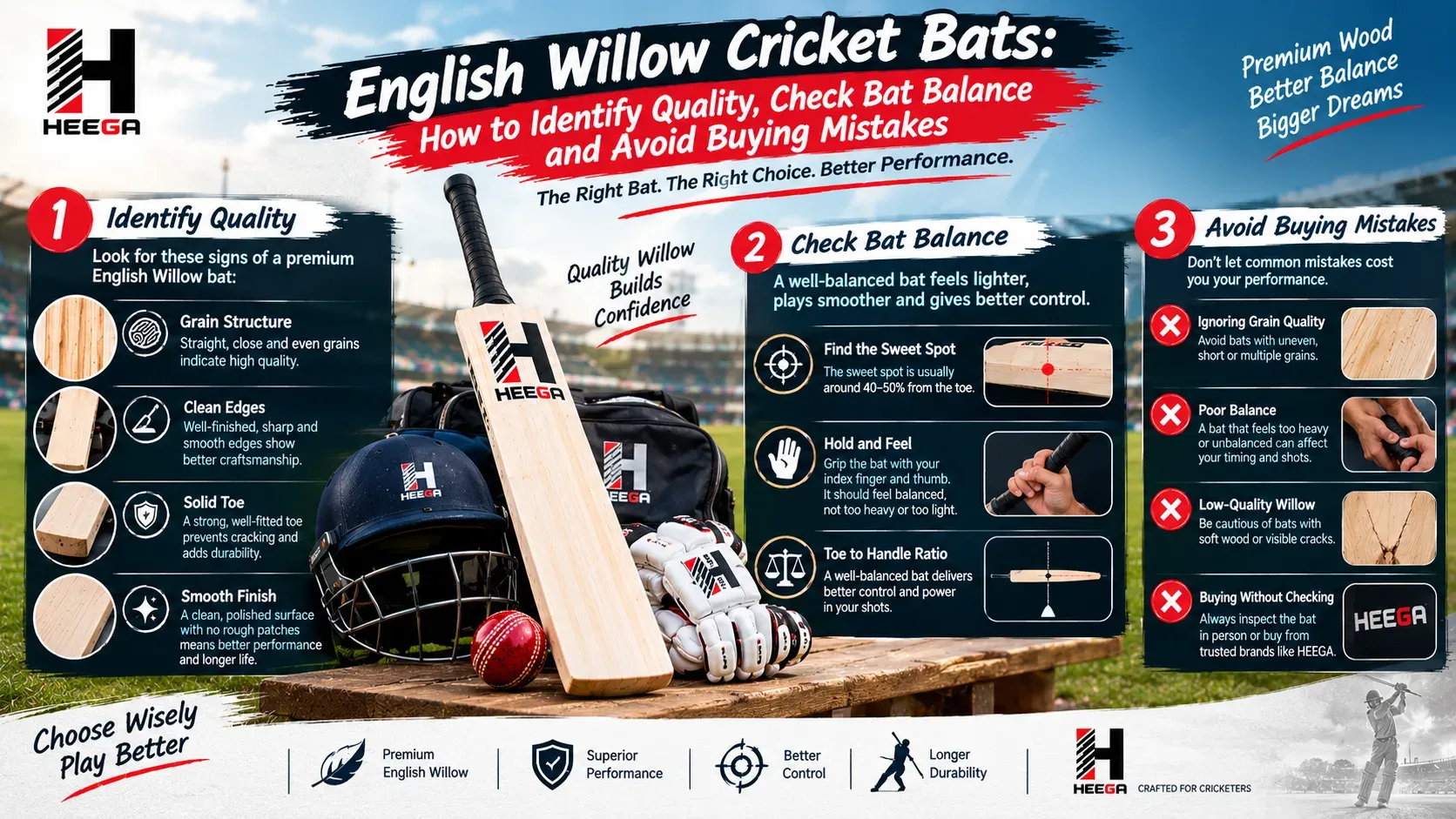
Introduction: What Makes an English Willow Cricket Bat Worth Buying?
Choosing an English willow cricket bat can be exciting, especially when you are looking for a bat that feels right in your hands and supports your style of batting. However, with so many shapes, grades, weights, and price points available, deciding which bat offers the right combination of quality and performance is not always easy.
Two bats may look almost identical but feel completely different when you pick them up. One may feel light and easy to control, while another may feel heavier despite having a similar listed weight. A bat with straight grains may attract attention, but grain appearance alone cannot tell you everything about its quality or how it will perform.
The important thing is to look at the complete bat rather than judging it by one feature.
English willow cricket bats are made from natural wood, so variation is normal. The cleft, grain structure, blade profile, pressing, handle, weight distribution, and manufacturing quality all contribute to the finished product.
In this guide, you will learn how to identify potential signs of quality, assess bat balance and pickup, understand grades and grain patterns, and avoid common mistakes when buying an English willow cricket bat.
What Is an English Willow Cricket Bat?
English willow is a type of willow widely used in cricket bat manufacturing. It is valued by many players for its combination of wood characteristics, feel, and suitability for shaping into a cricket bat.
English willow bats are available in a wide range of grades and designs. Some are intended for recreational and developing players, while others are made for experienced club and competitive cricketers.
However, the term English willow does not automatically mean that every bat will have the same quality or performance.
The wood is only one part of the finished product. Bat profile, weight, balance, pressing, handle construction, and preparation also matter.
A good buying decision begins with understanding these factors and matching them to your own game.
1. How to Identify Quality in an English Willow Cricket Bat
When inspecting an English willow bat, start by looking at its overall construction. Avoid relying entirely on the price tag, brand name, grain count, or visual appearance.
A quality bat should be well made, suitable for your intended use, and comfortable enough for you to control during a batting movement.
Check the Overall Finish
Look at the blade from the face, back, edges, and toe.
Check for:
- Obvious cracks or structural damage
- Uneven finishing
- Loose or poorly fitted components
- Damaged edges or toe
- Signs of poor storage or moisture damage
- A handle that feels loose or unstable
Natural wood can contain marks and colour variations. Not every mark is a defect, and not every visible imperfection means the bat is unsuitable.
If you notice a feature that concerns you, ask the seller whether it is a natural characteristic, a cosmetic mark, or a structural issue.
Assess the Construction
The blade should have a shape that looks consistent with the manufacturer's design. The handle should be securely fitted, and the overall bat should feel properly assembled.
Construction quality is important because even attractive willow can be let down by poor shaping, pressing, or handle fitting.
If possible, compare multiple bats rather than choosing the first one that looks good.
2. Understanding English Willow Grades
English willow bats are often sold using grade labels. These commonly describe aspects of the wood's appearance and selection, but grading systems can vary between manufacturers and retailers.
A grade label should therefore be treated as a guide, not a universal guarantee of performance.
Higher-Graded English Willow
Higher grades often have a cleaner, more uniform appearance, with grain patterns that many buyers find attractive.
These bats may also command a higher price.
However, a higher visual grade does not automatically mean a better pickup, a larger sweet spot, or longer life. Those characteristics depend on the individual bat and how it has been manufactured.
Mid-Range English Willow
Mid-range options can be practical for regular club players who want a balance between appearance, usability, and budget.
They may have more visible variation in grain spacing or colour than higher-graded models.
Such variation does not, by itself, determine how well the bat will perform.
Entry-Level English Willow
Entry-level bats can suit players who want to try English willow without spending as much as they might on a premium model.
They may have more visible natural marks or less uniform grain patterns.
The important thing is to check construction, suitability, weight, pickup, and intended use rather than assuming that an entry-level bat cannot perform well.
Remember: Grades Are Not a Complete Performance Rating
Before buying, ask the seller how the grade is defined. Do not assume that every brand uses the same grading criteria.
A well-balanced bat that suits your technique may be a better choice than a more expensive bat whose weight or profile feels uncomfortable.
3. Grain Patterns: What Should You Look For?
The lines visible along the face of a cricket bat are commonly called grains. They reflect aspects of the wood's growth structure.
Grains are often discussed when players compare English willow bats, but they should not be treated as a complete measure of quality.
When inspecting the grains, consider:
- Their general direction
- How evenly they run along the blade
- Whether there are obvious irregularities
- The overall condition of the face
- How the bat feels when picked up
Straight, relatively consistent grains are often preferred for their appearance. However, grain count alone cannot reliably predict the bat's power, durability, or playing life.
Are More Grains Always Better?
No. A higher grain count does not automatically mean a better bat, and fewer grains do not automatically indicate poor quality.
Grain count is only one visible feature of a natural material. It does not reveal all the wood's structural properties, the pressing process, or the quality of the finished bat.
What About Grain Spacing?
Some bats have closely spaced grains, while others have wider spacing.
Players may use this as one point of comparison, but there is no simple rule that one spacing pattern guarantees better performance.
Look at the entire bat and combine visual inspection with a practical assessment of weight, pickup, profile, and construction.
4. Bat Balance Explained: Why It Matters More Than You Think
Balance affects how a cricket bat feels when you hold it and move it through a shot.
A bat's actual weight tells you how much it weighs. Its balance and weight distribution influence how that weight feels during movement.
This is why two bats with the same listed weight can feel noticeably different.
A bat may feel easy to lift into the backswing but become difficult to control during a fast shot. Another may feel stable and manageable throughout the movement.
The best balance depends on the player, not just the bat's specifications.
What Influences Bat Balance?
Several factors contribute to a bat's balance:
- Distribution of wood throughout the blade
- Blade profile and spine
- Edge thickness
- Toe shape
- Handle construction
- Overall weight
- The player's grip and strength
A change in blade shape can alter how the bat feels even when its overall weight changes very little.
5. Understanding Bat Pickup
Pickup describes how heavy or light a bat feels when you lift it and move it through a batting action.
It is a subjective but useful part of bat selection.
A bat with comfortable pickup may feel easier to control during the backswing, forward defence, drives, cuts, and pulls.
A bat that feels too heavy for your strength may slow your movement or make it difficult to adjust to a delivery.
Why Actual Weight Is Not Enough
Imagine comparing two bats that both weigh the same.
One has more of its mass concentrated toward the toe. The other distributes the wood differently along the blade.
They can feel different when lifted or swung because the mass is positioned differently.
This means that a bat's weight on a scale should be considered alongside its pickup.
How to Check Pickup Before Buying
Use this simple process:
- Hold the bat with your usual grip.
- Lift it into your normal batting stance.
- Move it through a controlled backswing.
- Practise several shadow shots.
- Check whether you can change direction comfortably.
- Repeat the movement with another bat of similar size.
Pay attention to whether the bat feels manageable through the entire swing, rather than only when you first pick it up.
6. Choosing the Right Bat Weight
There is no single bat weight that is right for every player.
Your ideal weight depends on your strength, height, technique, preferred shots, and the length of time you need to use the bat during an innings.
A bat that feels comfortable for a few practice swings may become tiring after a long session.
Lighter-Feeling Bats
A lighter-feeling bat may help a player:
- Move the bat quickly
- Adjust to changing deliveries
- Play controlled strokes
- Reduce unnecessary effort during the swing
However, lighter is not automatically better. The bat still needs to feel stable and suitable for the player's preferred shots.
Heavier-Feeling Bats
A heavier-feeling bat may suit a player who is comfortable handling more mass and prefers a substantial feel through contact.
But if the bat reduces swing speed or makes timing difficult, the extra weight may work against the player's technique.
The Practical Rule
Choose a bat that you can control repeatedly without forcing the swing. Comfortable movement and consistent timing matter more than choosing a particular weight category.
7. Blade Profile and Sweet Spot
The blade profile describes the bat's shape, including its spine, edges, back profile, toe, and thickness.
The profile can influence pickup, the distribution of wood, and the way the bat feels through a shot.
The sweet spot is the part of the blade where a well-timed contact can produce a particularly satisfying response.
Low Sweet Spot
A lower sweet spot is often considered by players who favour shots through the front of the bat or regularly play on slower, lower-bouncing surfaces.
Mid Sweet Spot
A mid-positioned sweet spot can be a versatile option for players who use a broad range of strokes.
High Sweet Spot
A higher sweet spot may suit players who prefer a profile designed around a higher contact area.
These are general descriptions rather than strict rules. The best profile depends on the individual bat, the player's technique, the pitch, and the ball being used.
Do Thick Edges Guarantee Better Performance?
No. Thick edges can add material to parts of the blade, but they do not automatically guarantee a larger sweet spot or more powerful shots.
The complete profile, weight distribution, pressing, and contact quality all contribute to performance.
8. Handle Quality and Comfort
The handle is the connection between your hands and the blade. Its fit, shape, and construction influence how comfortably you grip and control the bat.
A well-fitted handle should feel secure without twisting or moving independently of the blade.
When checking a handle, consider:
- Grip comfort
- Handle shape
- Overall stability
- Condition of the grip
- Signs of looseness or damage
The grip should provide a secure hold without forcing you to squeeze excessively.
If the handle feels loose, cracked, or unstable, ask the seller to inspect it before purchase.
9. Pressing and Preparation: Important Factors Behind Bat Performance
English willow is a natural material, but the finished bat is also the result of manufacturing choices.
Pressing, shaping, handle fitting, and preparation can all influence how a bat performs.
What Is Willow Pressing?
Pressing is a manufacturing process used to prepare the blade face and influence how the wood responds to impact.
The process must be suitable for the individual cleft. Manufacturing quality and consistency matter because natural wood can vary from one bat to another.
A buyer usually cannot determine the exact pressing quality simply by counting grains or examining the face.
Does Every English Willow Bat Need Knocking-In?
Not every bat has identical preparation requirements. The correct approach depends on the model and the manufacturer's guidance.
Some bats require knocking-in before use with a hard ball. Others may have undergone a particular preparation process, but you should not assume that this removes every need for further care.
Check the instructions provided with the bat. Using a bat against a hard ball before the required preparation may increase the risk of damage.
10. How to Check an English Willow Bat Before Buying
A careful inspection can help you avoid purchasing a bat that does not suit your needs.
Step 1: Inspect the Face
Look for obvious cracks, concerning damage, or defects that the seller cannot explain.
Natural colour variations and small surface marks are not automatically structural problems.
Step 2: Check the Edges and Toe
Inspect these areas for damage, splitting, or signs of poor condition.
Step 3: Examine the Handle
Make sure it feels secure and does not appear loose or damaged.
Step 4: Assess the Weight
If possible, check the actual weight rather than relying only on a label.
Step 5: Test the Pickup
Move the bat through your usual batting action. Notice whether it feels comfortable and controlled.
Step 6: Consider the Profile
Check whether the shape suits your batting style and the conditions in which you normally play.
Step 7: Ask About Preparation
Confirm whether the bat requires knocking-in, oiling, or other preparation before use.
Step 8: Clarify the Grade
Ask how the seller defines the grade and what it means for the specific product.
Step 9: Check the Intended Use
Make sure the bat is suitable for your ball type and level of cricket.
Step 10: Compare Before Deciding
If you have several options, compare them side by side. The most attractive bat may not have the best pickup for you.
11. Common Mistakes to Avoid When Buying an English Willow Bat
Many players focus on a single feature and overlook the rest of the bat.
Here are some mistakes worth avoiding.
Buying Only by Grain Count
Grain count is not a reliable standalone measure of performance or durability.
Choosing the Heaviest Bat
A heavier bat may feel substantial, but it is not useful if it slows your swing or makes control difficult.
Assuming a Higher Grade Guarantees Better Performance
Grade labels can describe appearance and selection, but they do not guarantee the ideal balance, pickup, or sweet spot for every player.
Ignoring the Handle
A good blade cannot compensate for a handle that feels unstable or uncomfortable.
Buying Based on Appearance Alone
Visual appeal is subjective. The bat still needs to fit your technique and intended use.
Skipping the Pickup Test
A quick lift may not reveal how the bat feels through a complete swing.
Forgetting Preparation
Using a bat without following the manufacturer's preparation guidance may lead to avoidable damage.
Ignoring the Seller's Information
Ask about grading, preparation, intended ball type, and the product's condition. Clear information can help you make a more informed decision.
12. Which English Willow Bat Is Right for Your Playing Level?
Different players have different priorities.
Player TypeWhat to PrioritizeWhat to Avoid
Beginner
Correct size, manageable weight, comfortable grip
A bat that is difficult to control
Academy player
Consistent pickup, suitable profile, construction quality
Choosing only by appearance
Club cricketer
Balance, durability, feel, and value
Assuming price guarantees performance
Advanced player
Specific pickup, profile, handle feel, and shot requirements
Buying without testing the bat
Power-focused batter
Stable feel and manageable swing weight
Choosing a bat that slows the swing
Stroke-play batter
Quick control and comfortable pickup
A profile that feels cumbersome
These are starting points, not fixed rules. Players at every level can have different preferences.
13. English Willow vs Kashmir Willow: Does the Buying Process Change?
Both English willow and Kashmir willow bats require careful assessment.
The materials may differ in their typical characteristics and market positioning, but neither label tells you everything about an individual bat.
When comparing the two, consider:
- Overall construction
- Actual weight
- Pickup and balance
- Blade profile
- Intended use
- Price and budget
- Preparation requirements
- Manufacturer guidance
English willow is often selected by players seeking particular feel and performance characteristics, while Kashmir willow can be an appealing option for players looking for practical value.
However, the right choice depends on the actual bat and the player's needs. A well-suited bat is more useful than one chosen only because of its material name.
14. English Willow Bat Maintenance Tips
After buying a bat, proper care helps you monitor its condition and follow the manufacturer's recommendations.
Follow Preparation Instructions
Check the guidance supplied with the bat before using it against a hard ball.
Inspect It Regularly
Look over the face, edges, toe, and handle for changes or damage.
Store It Carefully
Avoid leaving the bat in a very hot vehicle or a damp storage area for long periods.
Keep It Clean
Remove surface dirt gently and avoid soaking the blade.
Check the Handle and Grip
A loose handle or badly worn grip can affect control and should be addressed.
Take Damage Seriously
Natural wear can occur with use, but significant cracks or structural damage should be assessed before continuing to play.
Maintenance cannot guarantee that a bat will never crack, but it helps you understand its condition and care for it appropriately.
Why Choose Your English Willow Bat Carefully?
An English willow cricket bat is a personal piece of equipment. Its value is not determined by the wood label, grade, or price alone.
The grain pattern may catch your eye, but the bat's weight, pickup, profile, handle, pressing, and overall construction are what you need to assess together.
A bat that is too heavy can make timing difficult. A bat with an unsuitable profile may not feel natural during your preferred shots. A high-grade bat may still be a poor match if its pickup does not suit you.
Take the time to compare the available options, ask clear questions, and test the bat's movement wherever possible.
The aim is to find a bat that feels comfortable, suits your style, and is appropriate for the cricket you play.
Heega Sports: Find an English Willow Bat That Fits Your Game
At Heega Sports, choosing cricket equipment starts with understanding what the player needs.
Whether you are a beginner buying your first English willow bat, a club cricketer preparing for a new season, or an experienced player looking for a specific pickup and profile, focus on the features that matter to your game.
Compare the bat's weight, balance, construction, handle, and intended use rather than relying on grain count or grade alone.
Explore cricket equipment at Heega Sports and make your next bat purchase with a clearer understanding of what to look for.
Frequently Asked Questions About English Willow Cricket Bats
1. How can I identify a quality English willow cricket bat?
Check its construction, blade condition, handle, weight, pickup, profile, and suitability for your level of cricket. Grain appearance and grade labels can help with comparison, but neither guarantees performance.
2. How many grains should a good English willow bat have?
There is no single grain count that guarantees quality. Grain count is one visible characteristic of natural wood and should be considered alongside construction, pickup, and overall condition.
3. Does a higher-grade English willow bat perform better?
Not necessarily. Higher grades often emphasize appearance or wood selection, but performance also depends on the individual cleft, manufacturing, profile, weight distribution, and player suitability.
4. What is the difference between bat weight and pickup?
Weight is the bat's actual mass. Pickup describes how heavy or light it feels when lifted and moved through a batting action. Two bats with similar weights can have different pickup.
5. Is a lighter English willow bat always better?
No. A lighter-feeling bat may help with quick movement, but the best choice depends on the player's strength, technique, and preferred style. Comfort and control are more important than choosing the lightest option.
6. How do I check a bat's balance?
Hold the bat in your normal stance and practise controlled shadow shots. Assess how it feels through the backswing and downswing rather than judging it by a brief lift.
7. Does a thick edge mean the bat will hit harder?
Not automatically. Edge thickness is one part of the profile. Bat speed, timing, contact quality, wood distribution, and manufacturing also affect shot performance.
8. Should I knock in an English willow cricket bat before use?
Follow the preparation instructions supplied by the manufacturer. Some bats require knocking-in before hard-ball use, and you should not assume that every model is ready to use immediately.
9. Can a beginner buy an English willow bat?
Yes. Beginners can choose English willow if the bat's size, weight, pickup, and price suit their needs. The most important thing is to select a bat they can control comfortably.
10. What is the biggest mistake when buying an English willow bat?
Judging the bat by one feature, such as price, grain count, or grade. A better decision comes from assessing the complete bat and checking whether it suits your game.
Final Thoughts
Buying an English willow cricket bat becomes easier when you know which characteristics deserve your attention.
Start with the overall construction, then look at the grain pattern and grade as parts of the bigger picture. Check the weight, test the pickup, assess the blade profile, and make sure the handle feels secure.
Avoid assuming that a higher price, more grains, or thicker edges automatically mean better performance. Every bat is different, and the right choice depends on your technique, strength, playing conditions, and budget.
A good bat is not simply the one that looks best on the shelf. It is the one you can control comfortably and trust as part of your game.
Shop Cricket Equipment at Heega Sports
Looking for an English willow cricket bat that suits your playing style?
Explore the cricket equipment available at Heega Sports and choose your next bat with confidence.
Shop Now: www.Heegasports.com
Related posts
 English Willow Cricket Bats Explained: How Bat Pressing, Grain Structure and Blade Compression Influence PerformanceLearn how English willow bat pressing, grain structure, and blade compression influence performance, durability, shot response, and bat selection.
 English Willow Cricket Bats: How Bat Shaping and Pressing Influence PerformanceDiscover how English Willow cricket bat shaping and pressing influence blade structure, rebound, balance, durability, and batting performance.
 English Willow Cricket Bat Grades Explained: What Separates Grade 1, Grade 2 & Grade 3 Bats?Learn the differences between Grade 1, Grade 2, and Grade 3 English Willow cricket bats, including grains, appearance, performance, durability, and value.