English Willow Cricket Bats Explained: How Bat Pressing, Grain Structure and Blade Compression Influence Performance
Introduction
English willow cricket bats are popular among cricketers because of their lightweight feel, responsive performance, and ability to deliver a satisfying response when the ball meets the sweet spot. However, the quality of a bat depends on more than the name of the wood or the number of visible grains on its blade.
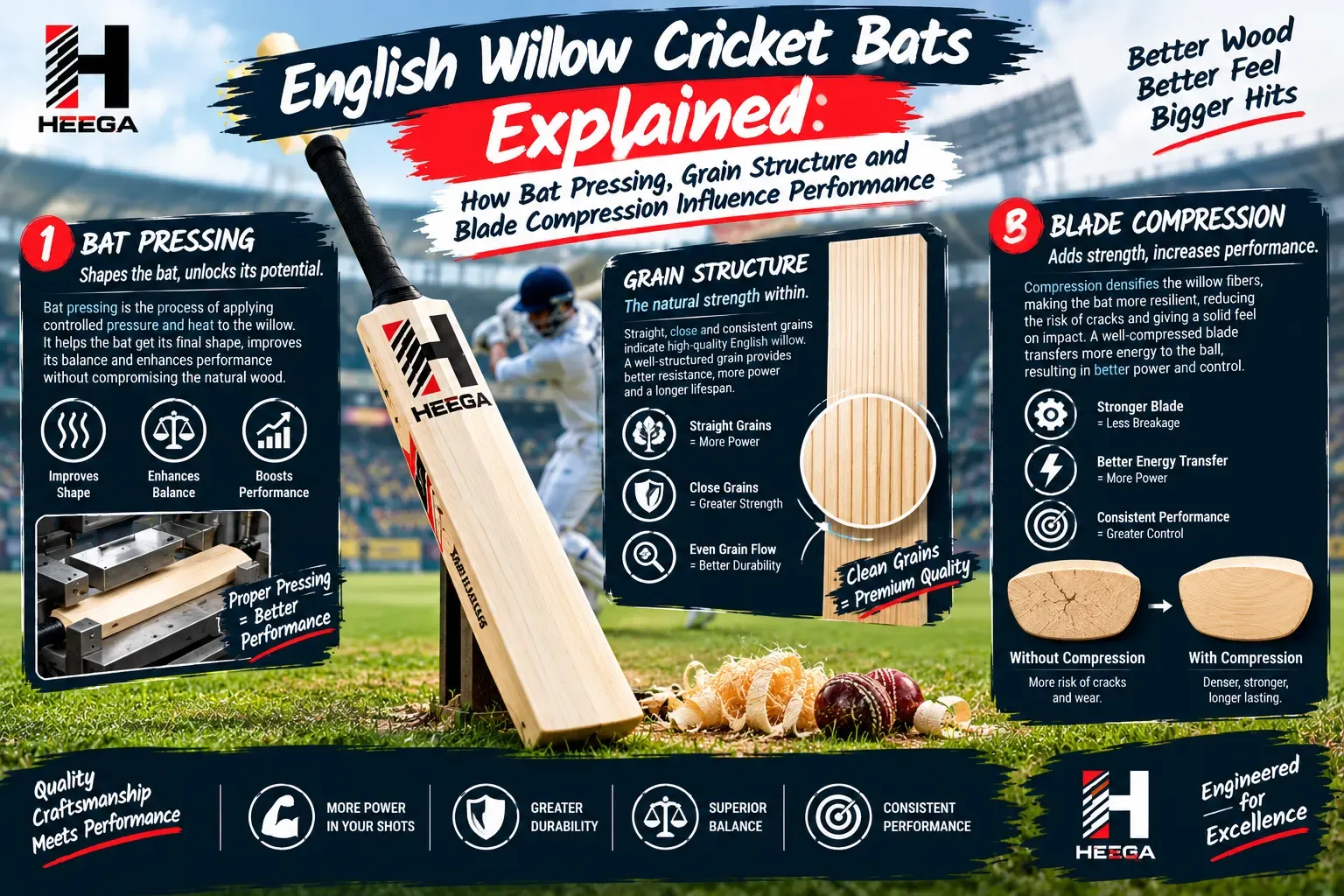
The way the willow is selected, dried, pressed, shaped, and finished can influence how the bat performs on the field. Three factors deserve particular attention: grain structure, bat pressing, and blade compression. Although these characteristics are closely related, each plays a different role in the finished product.
Grain structure provides clues about the willow's growth and consistency. Pressing affects the surface fibres and how the blade responds to impact. Blade compression describes the degree to which the willow fibres are compacted during manufacturing, although manufacturers may use this term differently.
Understanding these factors can help players make better buying decisions, compare bats more realistically, and choose equipment that suits their playing style. It also helps explain why two English willow bats with similar profiles and weights can feel noticeably different at the crease.
1. What Makes English Willow Suitable for Cricket Bats?
English willow, commonly associated with Salix alba var. caerulea, is valued in cricket bat manufacturing for its combination of relatively low weight, workable structure, and useful impact response.
A well-made willow blade can provide a combination of pickup, rebound, and control without requiring excessive mass. This is particularly useful for players who need to react quickly against pace bowling or adjust their shots against changing lines and lengths.
However, not every cleft of English willow has identical characteristics. Natural variations in density, moisture content, grain structure, and defects mean that individual pieces of timber can behave differently.
Important characteristics of English willow
- Relatively low weight: Can help manufacturers produce bats with manageable pickup.
- Natural grain structure: The visible grain lines provide information about the willow's growth pattern.
- Impact response: A suitable combination of timber properties and pressing can create a responsive blade.
- Workability: Willow can be shaped into different profiles, edges, spines, and sweet-spot positions.
- Natural variation: Each cleft is different, so two bats made from the same type of willow may not perform identically.
The important point is that English willow is not automatically excellent simply because of its timber type. The quality of the cleft, manufacturing process, final construction, and suitability for the player all matter.
2. Understanding Grain Structure in English Willow Cricket Bats
Grain structure is one of the first things buyers notice when inspecting an English willow bat. The blade usually displays a series of lines running along its length. These lines reflect the growth structure of the wood.
Grains are useful for visual inspection, but they should not be treated as a complete quality rating. Their number, spacing, straightness, and consistency can provide clues about the timber, yet none of these factors alone guarantees power or durability.
What do cricket bat grains indicate?
The visible lines often help buyers assess the general appearance and consistency of a blade. Straight, reasonably even grains are commonly preferred because they create a clean visual pattern and can indicate a relatively consistent piece of timber.
However, grain appearance cannot reveal every internal characteristic of the willow. A bat with attractive grains may still have an unsuitable weight distribution or poor pressing, while a bat with fewer visible grains may perform very well.
Grain count: Are more grains always better?
Not necessarily.
Some players prefer bats with a higher grain count because they associate finer grains with certain timber characteristics. Others prefer a lower grain count. Neither preference should replace an assessment of the actual bat.
Grain characteristicWhat it may tell youWhat it cannot guarantee
Higher grain count
A finer visible growth pattern
Better rebound or greater power
Lower grain count
A broader visible growth pattern
Longer lifespan or superior durability
Straight grains
A relatively consistent visible pattern
Perfect internal structure
Uneven or irregular grains
Natural variation that deserves closer inspection
That the bat is automatically defective
Clean-looking blade
An attractive external finish
Correct pressing or ideal balance
The most useful approach is to assess grain structure alongside weight, pickup, profile, pressing quality, and the condition of the blade.
Grain spacing and consistency
Grain spacing refers to the distance between visible growth lines. A blade with reasonably consistent grains may be visually appealing, but spacing varies naturally between clefts.
Cricketers should avoid assuming that widely spaced grains always indicate softness or that tightly spaced grains always indicate toughness. Such conclusions are too simplistic because the visible pattern is only one part of the wood's structure.
For a practical inspection, look for a generally consistent pattern and examine any unusual marks, prominent defects, or areas that appear damaged. Then test the bat's pickup and feel rather than making a decision based on appearance alone.
3. What Is Bat Pressing?
Bat pressing is a manufacturing process in which controlled pressure is applied to the willow blade to influence the condition of its surface fibres and its response to ball impact.
After the willow cleft has been selected and shaped, pressing helps prepare the blade for use. The process needs to be controlled because willow is a natural material, and different clefts may respond differently to the same treatment.
Pressing is not simply about making the wood harder. The aim is to achieve a suitable balance between responsiveness and the ability to withstand repeated impacts.
Why is pressing important?
The pressing process can influence how the blade responds when a cricket ball strikes it. A properly prepared blade may offer a useful combination of rebound, feel, and resistance to surface damage.
Pressing can also affect how the finished bat feels in practice, although the result depends on the willow itself and the complete manufacturing process.
Key considerations include:
- Pressure applied: The degree of pressure must suit the characteristics of the willow.
- Duration and consistency: The pressing process needs to be controlled rather than treated as a one-size-fits-all procedure.
- Timber condition: Moisture content, density, and the natural structure of the cleft influence how it responds.
- Blade preparation: Pressing is only one part of the manufacturing process and cannot compensate for every underlying timber defect.
There is no single pressing setting that guarantees the best result for every cleft. Experienced manufacturers adjust their approach according to the wood and their production methods.
4. Under-Pressed vs Over-Pressed Willow
Pressing requires a balance. Too little or too much pressure can affect the final blade differently, depending on the willow and manufacturing conditions.
The terms under-pressed and over-pressed are often used in cricket bat discussions, but they are not universal laboratory classifications. They are best understood as descriptions of a blade that may not have received an appropriate level of pressing for its particular characteristics.
Under-pressed willow
If a blade is insufficiently prepared, its surface may be more vulnerable to indentations and damage during use. The bat may also feel different from what the manufacturer intended.
However, surface softness alone does not prove that a bat is under-pressed. Willow density, moisture content, ball condition, and impact location can also affect the marks left on the blade.
Over-pressed willow
Excessive pressing may reduce the blade's desirable response or make it feel less lively. In some cases, an overly compressed surface may be associated with a harder feel and less satisfying rebound.
The effect is not identical for every piece of willow, and it is difficult for a buyer to confirm over-pressing by sight alone.
Finding the right balance
Pressing conditionPossible effectWhat buyers should remember
Insufficient pressing
Greater susceptibility to surface marking in some cases
Marks alone are not definitive proof
Suitable pressing
Balanced response and practical surface resistance
Performance still depends on the cleft and bat design
Excessive pressing
Potentially reduced responsiveness or a harder feel
Visual inspection alone may not confirm it
A good bat maker aims to prepare the willow without unnecessarily compromising its natural playing characteristics.
5. What Is Blade Compression?
Blade compression refers broadly to the compacting of willow fibres under pressure. In cricket bat manufacturing, the term is closely associated with pressing, but it is not always used consistently by manufacturers.
It is helpful to distinguish the concepts:
- Grain structure is a feature of the natural timber.
- Pressing is a manufacturing process applied to the blade.
- Blade compression describes the resulting compaction of the wood fibres, or the degree of compaction being discussed.
These factors interact, but they are not interchangeable. A blade's natural structure influences how it responds to pressing, while the pressing process can affect the finished blade's surface and impact response.
How compression may influence performance
When the willow is compressed appropriately, the blade may develop a useful combination of surface resistance and ball response. If the process is unsuitable for the particular cleft, the bat may not deliver the intended feel.
Compression should not be confused with making the blade uniformly dense from front to back. Natural willow has variation, and the finished bat's behaviour also depends on its profile, thickness, weight distribution, handle construction, and the location of ball impact.
It is also important not to treat compression as a direct measure of power. A heavily compressed blade is not automatically more powerful, and a less dense blade is not automatically more responsive. Performance depends on how the entire bat is constructed and how it suits the player.
6. How Grain Structure, Pressing and Compression Work Together
These three factors are best understood as parts of one manufacturing picture.
The grain structure is present in the raw willow before the bat maker begins shaping the blade. Pressing is then applied to prepare the willow, while compression describes the fibre compaction associated with that process.
The interaction matters because every cleft has its own characteristics. A pressing approach that works well for one piece of willow may not produce the same result with another.
A simple example
Imagine two English willow bats with similar weights, profiles, and grain counts.
The first bat is made from a cleft that responds well to the manufacturer's pressing process. Its blade offers a satisfying feel and responds consistently during practice.
The second bat has a similar appearance but comes from a different cleft and has been prepared differently. It may feel harder, less responsive, or simply different at impact.
This does not mean the second bat is necessarily poor quality. It illustrates why appearance and specifications cannot fully predict performance.
The relationship at a glance
FactorMain rolePossible effect on the finished bat
Grain structure
Describes the natural growth pattern of the willow
Helps with visual assessment but does not predict performance alone
Bat pressing
Applies controlled pressure during manufacturing
Influences surface preparation and impact response
Blade compression
Describes fibre compaction associated with pressing
May contribute to the blade's feel and response
Bat profile
Determines blade shape and material distribution
Influences the sweet spot, edges, and weight distribution
Overall pickup
Reflects how the bat's mass is distributed and perceived
Affects manoeuvrability and shot control
The strongest buying decisions come from evaluating these characteristics together instead of choosing a bat based on a single feature.
7. How These Factors Affect Power Hitting
Power hitting requires more than a thick blade or a particular type of willow. Bat speed, timing, impact location, technique, and the bat's design all contribute to the result.
Grain structure, pressing, and compression may influence the way the blade responds when the ball strikes it, but they cannot replace correct technique or guarantee longer hitting distance.
The importance of clean contact
When a batter strikes the ball near the bat's effective sweet spot, the impact generally feels more controlled and efficient. Off-centre contact can feel less comfortable and produce a different result.
A well-prepared blade may offer a pleasing response on good contact, but the quality of the shot also depends on the player's timing and the speed of the bat.
Why thicker edges are not the whole answer
Thicker edges can contribute to a particular blade profile and may help maintain useful material in certain areas. However, edge thickness alone does not determine rebound or hitting power.
A bat with thick edges may feel cumbersome if its weight distribution does not suit the player. A more moderate profile may allow another batter to swing faster and make more consistent contact.
Balance matters as much as the blade
A bat that feels manageable through the downswing can help a batter time shots more effectively. This is one reason pickup should be assessed alongside pressing and timber characteristics.
When choosing a bat for power hitting, consider:
- Whether the bat can be swung comfortably at match speed.
- Whether the sweet spot suits the pitches and shots you commonly play.
- Whether the bat feels responsive during controlled practice.
- Whether the blade profile matches your preferred stroke play.
- Whether the overall weight and pickup remain manageable across a long innings.
The best bat for power hitting is the one that allows you to combine reliable contact with the bat speed and control your technique requires.
8. How Pressing and Compression Relate to Durability
Durability is another reason buyers pay attention to pressing. A cricket bat must withstand repeated ball impacts, but willow is a natural wood and will develop marks through normal use.
Suitable pressing can help prepare the blade for repeated impacts. However, durability also depends on the quality of the cleft, the presence of defects, the bat's construction, the condition of the ball, and how the player uses and maintains the bat.
Common factors that influence bat durability
1. Natural willow quality
The cleft's structure and condition influence the finished bat. Pressing cannot reliably correct every natural weakness or defect.
2. Manufacturing quality
Shaping, pressing, handle fitting, and finishing all contribute to the finished product. Consistency throughout the process matters.
3. Preparation before match use
Many new willow bats require appropriate knocking-in and preparation, according to the manufacturer's instructions. Pressing during manufacture should not automatically be treated as proof that a bat is ready for unrestricted match use.
4. Playing conditions
Repeated impacts from hard balls, poor-quality balls, and contact near vulnerable areas can increase wear. Toe impacts and edges may be particularly demanding.
5. Maintenance and storage
Excessive moisture, extreme dryness, poor storage, and neglect can affect a bat over time. Regular inspection and appropriate care help identify problems early.
A well-pressed bat can still crack, while a bat that develops surface marks is not necessarily defective. The aim is to choose a suitable product and maintain it correctly rather than expect the manufacturing process to eliminate all damage.
9. How to Inspect an English Willow Bat Before Buying
Most players cannot measure the exact compression level or pressing pressure used during manufacturing. For this reason, it is better to combine a visual inspection with practical testing and clear questions for the seller.
Step 1: Examine the grain pattern
Look for a generally consistent grain structure and inspect the blade for unusual defects, deep marks, or signs of damage. Do not reject a bat solely because it has fewer grains than another model.
Step 2: Check the blade surface
Inspect the face, edges, shoulders, and toe. Look for cracks, deep indentations, or damage that may need clarification from the retailer.
Small cosmetic variations are normal in natural timber, so distinguish between ordinary wood characteristics and signs of possible damage.
Step 3: Assess weight and pickup
Hold the bat as you would at the crease. If possible, practise a few controlled shadow strokes. Notice whether the bat feels easy to manoeuvre and whether the pickup suits your style.
A bat's stated weight does not tell the whole story because the distribution of that weight also affects how it feels in motion.
Step 4: Ask about pressing and preparation
A reputable retailer should be able to explain its manufacturing standards and provide guidance on whether the bat needs knocking-in before match use.
Avoid relying on vague claims such as “perfect compression” unless the seller can explain what the claim means in practical terms.
Step 5: Test the feel safely
If the retailer permits it, test the bat using the recommended method and suitable equipment. Do not strike a hard ball against the blade aggressively just to judge its response.
Pay attention to comfort, control, and consistency rather than expecting one test to reveal every aspect of performance.
Step 6: Match the bat to your playing conditions
Consider the pitches you play on, the balls used in your matches, your batting position, and the shots you rely on most often.
A bat chosen for regular club cricket should balance response with manageable pickup and practical durability.
10. Common Mistakes Buyers Make
Even experienced players can be influenced by marketing language or assumptions about willow quality. Avoid these common mistakes when comparing English willow bats.
Mistake 1: Choosing the bat with the most grains
Grain count is visible, so it is easy to compare. But more grains do not automatically mean more power, better rebound, or longer life.
Mistake 2: Assuming harder means better
A hard-feeling blade is not necessarily more responsive. The objective is a suitable balance between impact response and resistance to normal wear.
Mistake 3: Treating pressing as a guarantee of quality
Pressing is important, but it cannot compensate for every problem in the original cleft or finished construction.
Mistake 4: Ignoring pickup
A bat may have an attractive blade and impressive edges yet feel difficult to manoeuvre. If the pickup slows your swing or makes timing uncomfortable, the specifications may not suit you.
Mistake 5: Confusing compression with power
Compression is only one part of the manufacturing process. Shot distance depends on the bat's complete design, the impact point, swing speed, timing, and playing technique.
Mistake 6: Skipping preparation and maintenance
Even a professionally manufactured bat needs appropriate care. Follow the manufacturer's guidance on knocking-in, moisture exposure, storage, and routine inspection.
11. Choosing the Right English Willow Bat for Your Level
Different players may prioritise different features. The right choice depends on how often you play, your experience, and the conditions in which you use the bat.
Player typeWhat to prioritisePractical buying advice
Beginner
Manageable weight, comfortable grip, and easy pickup
Avoid paying extra based only on grain count or technical claims
Developing club player
Balanced pickup, suitable profile, and consistent feel
Compare several bats and ask about preparation requirements
Regular competitive player
Response, balance, build quality, and fit with batting style
Test pickup and contact feel rather than relying only on appearance
Power hitter
Bat speed, appropriate profile, effective sweet spot, and control
Choose a bat that supports fast, repeatable swings
Technically focused batter
Control, manoeuvrability, and predictable response
Prioritise comfort and shot placement as well as power
There is no single combination of grain count, pressing, or compression that suits every player. A well-chosen bat should complement the batter's technique and provide a dependable feel during practice and matches.
12. Does English Willow Grade Tell You About Pressing Quality?
Willow grades are used by different manufacturers and retailers to communicate aspects of timber appearance and product positioning. However, grading systems can vary, and a grade label does not necessarily provide a complete explanation of pressing quality or compression.
A higher grade should not be assumed to guarantee a better-performing bat in every situation. Two bats with similar grade labels can still differ in weight, balance, profile, and individual timber characteristics.
When comparing products, ask the seller what the grade represents and whether it refers mainly to appearance, timber selection, or a broader manufacturing standard.
A useful evaluation should consider:
- The condition and appearance of the willow.
- The bat's actual weight and pickup.
- The profile and sweet-spot position.
- The manufacturer's approach to pressing and preparation.
- The suitability of the bat for your playing style.
- The retailer's advice on care, knocking-in, and warranty coverage.
Clear product information is more useful than a grade label without context.
13. How to Maintain an English Willow Bat After Purchase
Good maintenance helps preserve the bat's condition and makes it easier to spot developing problems.
Follow the recommended knocking-in process. Check the manufacturer's instructions before using a new bat with a hard cricket ball. Factory pressing does not necessarily mean the blade is fully prepared for match conditions.
Use suitable balls during preparation. Follow the recommended progression rather than moving straight into demanding match use.
Inspect the blade regularly. Check the face, edges, toe, and handle area for new cracks, loose components, or unusual changes.
Keep the bat dry. Avoid leaving it in wet conditions or exposing it to unnecessary moisture. If it becomes damp, allow it to dry naturally in a suitable environment.
Store it sensibly. Keep the bat away from excessive heat and prolonged direct sunlight. Avoid conditions that may cause rapid changes in moisture content.
Address damage early. Small surface marks can be part of normal use, but structural cracks or a loose handle may require professional assessment.
Maintenance cannot prevent every crack, but it can help you understand the bat's condition and extend its useful service life.
Frequently Asked Questions
1. What is pressing in an English willow cricket bat?
Pressing is a manufacturing process that applies controlled pressure to the willow blade. It helps prepare the surface fibres and can influence the blade's impact response and resistance to surface marking.
2. Does a higher grain count mean a better cricket bat?
No. Grain count is one visual characteristic, not a complete measure of quality. Weight, pickup, pressing, profile, timber condition, and suitability for the player also matter.
3. What does blade compression mean?
Blade compression generally refers to the compaction of willow fibres associated with pressure applied during manufacturing. The exact meaning may vary between manufacturers, so buyers should ask how the term is being used.
4. Can over-pressing reduce bat performance?
Excessive pressing may affect the feel and responsiveness of a blade, depending on the timber and process. However, it is difficult to diagnose over-pressing from appearance alone.
5. Is a harder English willow bat more powerful?
Not necessarily. A harder feel does not automatically mean better rebound or greater hitting distance. Performance depends on the blade, the bat's overall construction, impact location, and the player's technique.
6. Can you identify pressing quality by looking at the grains?
No. Grain structure is useful for visual inspection, but it cannot reveal the exact pressing process or guarantee the bat's response. Practical assessment and reliable manufacturing information are also important.
7. Does pressing make a cricket bat crack-proof?
No. Pressing can contribute to the blade's preparation, but natural timber variation, ball impact, playing conditions, and maintenance all affect durability. No pressing method can guarantee that a bat will never crack.
8. Does a new English willow bat still need knocking-in?
Many new bats require knocking-in or other preparation before unrestricted use with a hard cricket ball. Always follow the specific manufacturer's instructions, as preparation requirements can vary.
9. Can two bats with the same weight perform differently?
Yes. Differences in weight distribution, profile, handle, willow characteristics, and pressing can make two bats feel and respond differently, even when their stated weights are similar.
10. What should I prioritise when buying an English willow bat?
Start with comfortable pickup, suitable weight, an appropriate profile, good construction, and a blade that feels right for your batting style. Consider grain structure and pressing as part of the overall assessment rather than using either as the only deciding factor.
Final Thoughts
English willow cricket bat performance is shaped by several connected factors, and grain structure, pressing, and blade compression are among the characteristics worth understanding. Grains provide clues about the natural timber, pressing influences how the blade is prepared, and compression describes the fibre compaction associated with that process.
None of these factors guarantees power, durability, or a perfect response on its own. The finished bat's profile, pickup, construction, preparation, and suitability for the player all contribute to how it performs.
When choosing an English willow bat, look beyond attractive grains and technical claims. Inspect the blade, assess the pickup, ask clear questions about manufacturing and preparation, and choose a bat that feels comfortable and controlled in your hands.
Find Your Cricket Bat with Heega Sports
At Heega Sports, we understand that every player needs equipment that suits their technique, playing conditions, and performance goals. Whether you're developing your game or competing regularly, focus on a cricket bat that offers a suitable balance of feel, control, and construction quality.
Explore our cricket equipment range and find options for your next practice session or match.
Visit www.Heegasports.com to explore Heega Sports cricket equipment.
Related posts
 English Willow Cricket Bats: How Bat Shaping and Pressing Influence PerformanceDiscover how English Willow cricket bat shaping and pressing influence blade structure, rebound, balance, durability, and batting performance.
 Leather Ball Cricket Explained: How Ball Condition, Seam and Swing Influence BowlingLearn how leather ball cricket works and how ball condition, seam position, shine, and swing influence bowling accuracy, movement, and performance.
 Kashmir Willow Cricket Bats Explained: How Wood Characteristics Influence Bat Feel and PerformanceDiscover how Kashmir willow characteristics affect cricket bat feel, pickup, shot response, durability, and value, with tips for choosing the right bat.