Leather Ball Cricket Explained: How Ball Condition, Seam and Swing Influence Bowling
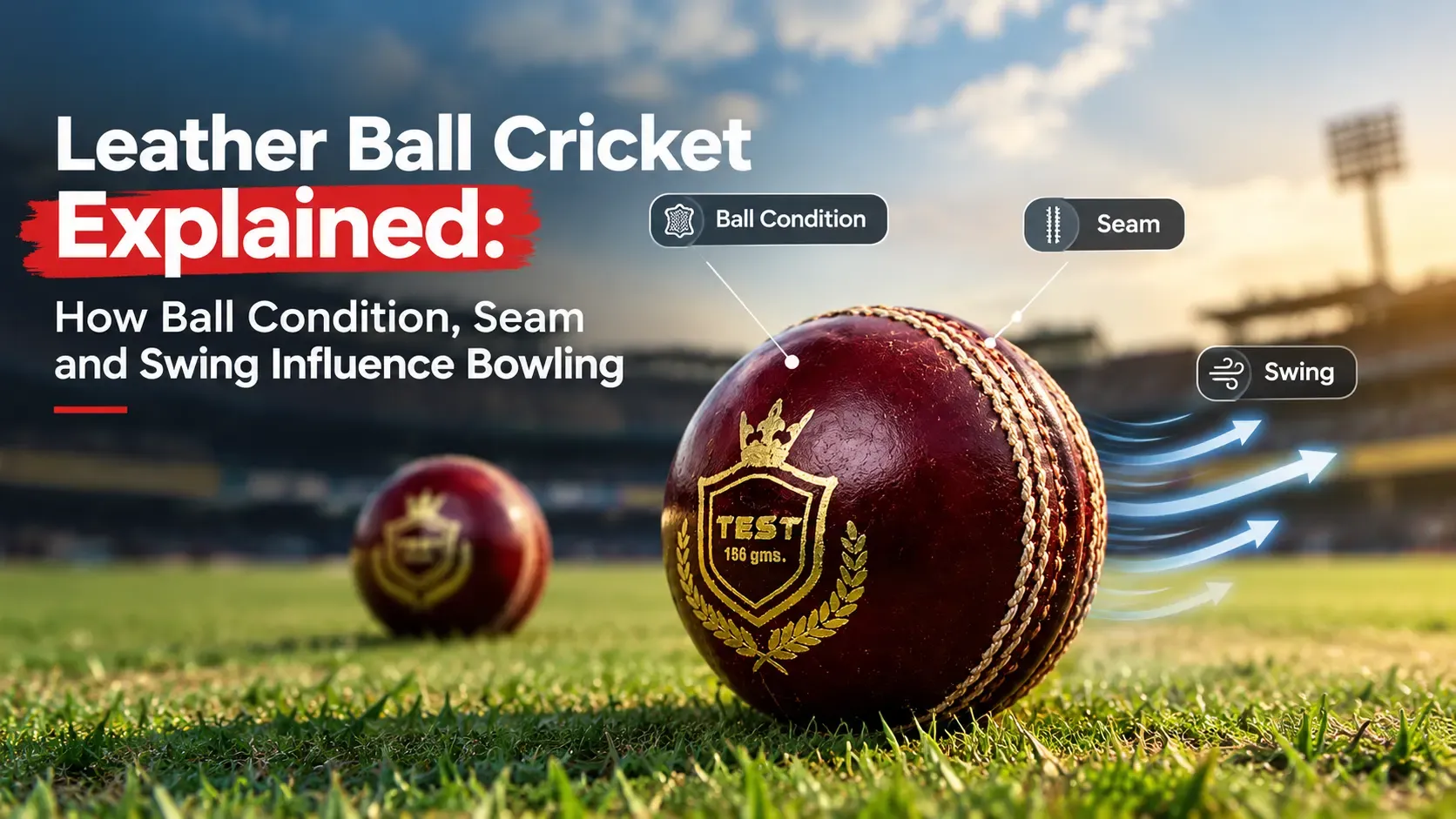
Introduction: Why the Leather Cricket Ball Matters
In cricket, a delivery can look simple from the boundary. A bowler runs in, releases the ball, and watches the batter react. Yet behind that moment lies a combination of technique, physics, preparation, and equipment.
One of the most important parts of this process is the leather cricket ball.
Unlike many synthetic practice balls, a traditional leather cricket ball has a layered construction, a stitched seam, and a surface that changes as the match progresses. These characteristics influence how the ball travels through the air, interacts with the pitch, and reaches the batter.
For bowlers, understanding the ball can create a valuable advantage. A fast bowler may use seam position and wrist alignment to encourage movement off the pitch. Another may maintain one side of the ball to create conventional swing. A skilled bowler may also vary pace, trajectory, and release to make the batter uncertain.
However, the ball does not produce these results on its own. Bowling action, release position, speed, atmospheric conditions, pitch characteristics, and the condition of the ball all contribute to the outcome.
Whether you play club cricket, academy cricket, school cricket, or competitive matches, learning how a leather cricket ball behaves can help you train with greater purpose.
This guide explains the main characteristics of a leather cricket ball, how seam movement and swing work, why ball maintenance matters, and what players should consider when selecting equipment for practice and match day.
What Is a Leather Cricket Ball?
A leather cricket ball is a traditional cricket ball designed for formal cricket matches and structured training. It generally features a leather outer covering, a raised stitched seam, and a layered internal core.
The precise construction varies by manufacturer, ball type, and playing standard.
Leather balls are commonly used in longer-format cricket, club competitions, academy sessions, and many limited-overs matches. They are designed to provide a more realistic match experience than most soft synthetic practice balls.
Their characteristics make them suitable for developing several important cricket skills.
The Main Components of a Leather Cricket Ball
A traditional leather cricket ball has three important features.
1. The Outer Leather Cover
The outer cover provides the ball's playing surface.
Its condition affects how the ball feels in the hand and how the surface interacts with the air. During a match, repeated impacts with the pitch, bat, ground, and fielding equipment gradually change the cover's condition.
A relatively new ball generally has a firmer, more uniform surface. As it becomes older, scuffing and wear can create differences between its two sides.
2. The Stitched Seam
The seam is the raised line of stitching around the ball.
It helps hold the ball's construction together and gives bowlers a reference point for grip and release. Bowlers use seam orientation to help control the ball's rotation and presentation.
The seam can also influence movement when the ball pitches, particularly when the bowler releases it with a relatively upright seam.
3. The Internal Core
The internal core provides much of the ball's mass, structure, and rebound characteristics.
The exact materials and construction depend on the manufacturer and product specification.
Together, the core, leather cover, and stitching determine important aspects of the ball's weight, feel, durability, and behaviour.
Why Leather Balls Behave Differently From Synthetic Balls
Synthetic balls are useful for beginners, recreational cricket, and certain practice environments. They can be easier to handle and may be more suitable for casual play, depending on their design.
Leather balls are generally used when players need to practise under conditions closer to formal cricket.
The differences include:
- Weight and feel: Leather balls have a distinct weight and feel that players must learn to manage.
- Seam characteristics: The raised stitched seam provides a reference for seam bowling and grip.
- Surface changes: Leather surfaces develop wear during use, which can affect the ball's condition.
- Bounce and pace: The response depends on the ball's construction, condition, pitch, and impact speed.
- Protective equipment requirements: Leather-ball cricket demands suitable protective equipment, especially for batters, wicketkeepers, and close fielders.
Players should use equipment appropriate to their age, skill level, and playing environment. Beginners should learn under suitable supervision before progressing to harder match balls.
Understanding the Seam: A Bowler's Point of Control
The seam is one of the most recognisable features of a leather cricket ball. For seam bowlers, it is also an important technical reference.
A bowler's grip, wrist position, finger pressure, and release determine how the seam is presented as the ball travels toward the batter.
The objective is not simply to point the seam in a particular direction. The bowler must also release the ball consistently while maintaining an effective line and length.
What Is Seam Bowling?
Seam bowling involves attempting to use the ball's seam and its interaction with the pitch to create movement after pitching.
When the ball lands, small differences in the surface, seam contact, and angle of impact can influence its direction. A well-presented seam may help create more predictable or pronounced movement under suitable conditions.
For example, a right-arm fast bowler may release a delivery with an upright seam and a stable wrist position. If the seam contacts the pitch at an appropriate angle, the ball may deviate after landing.
However, seam movement is not guaranteed. The pitch surface, moisture, grass coverage, ball condition, release angle, and pace all matter.
Why an Upright Seam Can Help
An upright seam gives the bowler a consistent reference point at release.
It can help with:
- Repeating the bowling action.
- Maintaining a stable wrist position.
- Controlling the ball's orientation.
- Creating conditions for seam contact with the pitch.
- Developing consistent line and length.
A bowler should not assume that an upright seam always produces movement. Its main value is that it supports a repeatable release and may improve the chance of useful seam interaction.
Seam Position and Wrist Alignment
The wrist plays an important role in seam presentation.
If the wrist collapses or rotates inconsistently during release, the seam may wobble or point in an unintended direction.
This can make it harder for the bowler to repeat the same delivery.
To improve consistency, bowlers can work on:
- Keeping the wrist firm but not excessively tense.
- Holding the ball comfortably rather than squeezing it too hard.
- Aligning the fingers consistently with the seam.
- Releasing the ball from a repeatable position.
- Reviewing the action with a qualified coach.
The ideal grip varies between bowlers. Hand size, bowling style, flexibility, and experience can all influence what feels comfortable.
What Is Swing Bowling?
Swing bowling refers to the sideways movement of a cricket ball through the air before it reaches the batter.
Unlike seam movement, which is associated with the ball's interaction with the pitch, swing develops while the ball is travelling through the air.
Swing is influenced by the ball's surface condition, seam orientation, speed, and airflow around the ball.
Two commonly discussed forms are conventional swing and reverse swing.
Conventional Swing
Conventional swing is often associated with a ball that has one relatively smooth, polished side and another side that is rougher.
The bowler presents the seam at an appropriate angle and releases the ball with controlled wrist and finger positioning. Under suitable conditions, differences in airflow around the ball can create sideways movement.
Conventional swing is often easier to pursue with a relatively new ball, although the amount of movement depends on the ball, delivery speed, atmospheric conditions, and the bowler's technique.
Reverse Swing
Reverse swing is a different aerodynamic behaviour that is often associated with an older ball travelling at relatively high speed.
In reverse swing, the ball can move in a direction opposite to what a bowler might expect from conventional swing based on the orientation of the seam.
Its development depends on several factors, including ball speed, surface roughness, seam orientation, and airflow. There is no single speed or ball age that guarantees reverse swing in every situation.
Reverse swing requires considerable skill and is not simply a matter of making one side rougher.
Seam Movement vs Swing: What Is the Difference?
Although both can make a delivery move away from a straight path, seam movement and swing occur at different stages.
Swing happens while the ball is travelling through the air.
Seam movement occurs when the ball interacts with the pitch after pitching.
A bowler may use either method independently or combine them. For instance, a delivery may swing slightly in the air before deviating again after pitching.
This combination can make it more difficult for the batter to predict the ball's final path.
Understanding the distinction helps bowlers practise specific skills instead of treating every moving delivery as the same type of movement.
How Ball Condition Influences Bowling
A leather cricket ball does not remain in the same condition throughout a match.
Its surface changes as it strikes the pitch, makes contact with the bat, lands in the field, and passes between players.
These changes can influence how the ball behaves, although the effect varies with the type and extent of wear.
The Importance of a New Ball
A new leather ball generally has a more uniform outer surface and a clearly defined seam.
Fast bowlers may use it to develop:
- Conventional swing.
- Seam presentation.
- Consistent bounce.
- Accurate line and length.
- Pressure through pace and movement.
The new ball can be especially important in the opening overs of an innings, when bowlers attempt to make use of its condition.
However, a new ball does not automatically swing. The bowler still needs appropriate technique and suitable playing conditions.
What Happens as the Ball Gets Older?
As the innings progresses, the ball may develop scuff marks, scratches, and other signs of wear.
Its seam may also become less pronounced through repeated use.
These changes can affect grip, surface condition, and the ball's aerodynamic behaviour.
Depending on the format and playing conditions, bowlers may need to adjust their strategy.
For example, a bowler who initially focused on conventional swing may later concentrate more on seam movement, variations in pace, accuracy, or reverse swing if the conditions and ball behaviour support it.
The key is to observe the ball rather than assume that every older ball will behave in the same way.
Why Shine Matters in Leather Ball Cricket
Maintaining the ball's surface is a familiar part of traditional cricket.
Under the applicable playing conditions, fielding teams may polish the ball to preserve the condition of one side.
This can help maintain a difference between the two sides, which may be relevant to conventional swing.
How Players Maintain the Ball
During a match, players may use an approved cloth or the permitted method of polishing to keep one side relatively smooth.
Good ball care involves:
- Following the competition's playing conditions.
- Using only permitted polishing methods.
- Avoiding unauthorised substances or treatments.
- Keeping the ball dry when required by the rules.
- Handling the ball consistently and carefully.
Players should always follow the applicable Laws of Cricket and competition regulations. Ball tampering, unauthorised substances, and deliberate alteration of the ball's surface are not acceptable.
Does More Shine Always Mean More Swing?
No.
A shiny surface alone does not guarantee swing.
The ball's speed, seam orientation, release technique, atmospheric conditions, and overall surface condition all influence its movement.
Polishing can help preserve the condition of one side, but the bowler must still deliver the ball effectively.
This is why good bowlers combine ball awareness with technical skill rather than relying on shine alone.
Weather and Atmospheric Conditions Can Affect Swing
Cricket is played in many different environments, from cool and cloudy conditions to hot, dry afternoons.
Atmospheric conditions can influence swing, but the relationship is more complicated than the common belief that cloudy weather always makes the ball swing.
Humidity, air temperature, wind, air pressure, ball speed, and surface condition can all affect the delivery's behaviour in different ways.
Does Cloud Cover Help Swing Bowlers?
Cloud cover is often associated with conditions in which swing bowling becomes prominent. However, clouds themselves do not automatically make a cricket ball swing.
The ball's aerodynamic behaviour depends on the airflow around it and the characteristics of the delivery.
A bowler may find favourable swing conditions on a cloudy day, but similar movement can occur in other weather conditions too.
Wind and Bowling Strategy
Wind can influence the flight of a cricket ball and may affect how a bowler approaches a particular end.
Bowlers can discuss conditions with their captain and observe whether the wind affects their run-up, trajectory, or control.
Rather than making assumptions, players should assess how the ball behaves during warm-ups and the opening deliveries.
The Role of Bowling Speed
Speed is an important factor in both swing and seam bowling.
It influences how long the ball spends in the air, how it interacts with the pitch, and how airflow develops around its surface.
However, maximum speed is not the only goal.
A bowler who can combine pace with control, an effective release, and good tactical awareness may be more difficult to face than someone who bowls quickly but inconsistently.
Why Consistency Matters
Repeatable deliveries help bowlers compare results and identify which techniques work.
If the grip, wrist position, and release point change substantially from ball to ball, it becomes harder to determine why a delivery moved.
Bowlers should therefore practise controlled repetition before attempting complex variations.
Line and Length Still Matter Most
Movement is useful, but it must be supported by accurate bowling.
A delivery that swings significantly but finishes too far outside the batter's reach may not create the intended opportunity. Similarly, a ball that seams away from the batter can be ineffective if its length gives the batter too much time.
Line and length help the bowler create pressure and force decisions.
For many developing players, improving accuracy is a more reliable starting point than trying to produce dramatic swing.
Building Pressure Through Good Areas
Bowlers can develop pressure by consistently targeting useful areas around the batter's off stump or by adjusting their line according to the batter's strengths and weaknesses.
The best target depends on the match situation, pitch, format, field placement, and bowling style.
A well-directed ball that moves only slightly can be more effective than a delivery with significant movement but poor control.
How Bowlers Can Practise Seam Position
Seam presentation can be developed through simple, structured drills.
The goal is to improve awareness and consistency without placing unnecessary strain on the bowling arm.
Drill 1: Seam-Position Release Practice
Under a coach's supervision, a bowler can begin with gentle releases over a short distance.
The focus should be on presenting the seam consistently rather than generating maximum pace.
Players can gradually increase the distance as their control improves.
Drill 2: Target Bowling
Place a target on a safe practice surface and ask the bowler to aim for a defined line and length.
After each delivery, review:
- Seam presentation.
- Wrist position.
- Release point.
- Landing area.
- Ball behaviour after pitching.
This helps connect technique with the result.
Drill 3: Video Review
A side-on or front-on recording can help the bowler and coach assess the release.
Video may reveal whether the wrist remains stable, whether the seam is wobbling, or whether the release point changes between deliveries.
The objective is to identify useful adjustments, not to force every bowler into the same action.
How to Practise Swing Bowling
Swing bowling requires a combination of seam presentation, wrist control, release consistency, and an understanding of ball condition.
Players should learn the basics with a coach before attempting advanced techniques.
Start With a Consistent Grip
Hold the ball comfortably, using the seam as a reference point.
Avoid excessive tension in the fingers and wrist. Too much squeezing can interfere with a smooth release.
Work on Wrist Position
A stable wrist can help the bowler present the seam consistently.
Practise a controlled action at moderate pace before increasing intensity.
Observe the Flight
During practice, pay attention to the ball's path through the air.
Try to distinguish between movement in flight and deviation after pitching.
This observation helps bowlers understand whether their technique is producing the intended result.
Change One Variable at a Time
When experimenting with swing, avoid changing grip, wrist position, run-up, and release angle simultaneously.
Make one controlled adjustment, then observe what happens.
This approach makes training more useful and helps the bowler develop a clearer understanding of their technique.
Common Mistakes in Leather Ball Bowling
Players learning seam and swing bowling often make a few predictable mistakes.
Trying to Swing Every Delivery
Not every ball needs to move through the air.
Bowlers should first develop a reliable stock delivery and use swing when the conditions and tactical situation make it appropriate.
Changing the Grip Too Often
Constantly changing the grip can make it difficult to establish a repeatable release.
Work with a coach to find a comfortable grip and practise it consistently before making adjustments.
Focusing Only on the Seam
The seam matters, but it is only one part of the delivery.
Run-up rhythm, balance, wrist position, release point, speed, and accuracy all contribute to the outcome.
Ignoring Ball Condition
A bowler who does not pay attention to the ball may miss useful information about its wear and surface condition.
Regular observation helps players adjust their approach as the innings develops.
Chasing Speed Too Early
Attempting to bowl at maximum pace before developing control can make technique inconsistent and may increase physical strain.
Build pace progressively, follow an appropriate training plan, and seek qualified coaching when working on fast bowling.
Selecting the Right Leather Cricket Ball
Not every leather cricket ball is designed for exactly the same purpose.
Before purchasing one, consider the intended format, playing level, competition requirements, and training environment.
Match Balls
Match balls should comply with the relevant competition's specifications.
Depending on the format and playing standard, requirements may cover the ball's size, weight, colour, construction, and approval.
Always check the competition rules before buying a ball for an official match.
Practice Balls
Practice balls are used for structured training and skill development.
A suitable training ball should match the intended practice environment and provide an appropriate level of durability and performance.
If players are preparing for leather-ball matches, practising with an appropriate leather ball can help them become familiar with its weight, seam, and response.
Choosing for Club and Academy Cricket
Clubs and academies should consider how frequently the ball will be used, the age and experience of the players, and whether the session is intended for batting, bowling, or fielding.
The right choice depends on the purpose of the session, not simply the price.
Safety Matters When Playing With a Leather Ball
Leather-ball cricket involves a hard ball that can travel at high speed. Suitable protective equipment and safe training practices are essential.
Batters should wear appropriate protection, including a properly fitted helmet, batting pads, gloves, and other protective gear required for their playing level.
Wicketkeepers and close fielders should use equipment appropriate to their role and the session.
Coaches should also ensure that:
- Players understand the drill before it begins.
- Nets and practice areas are suitable for the session.
- Batters and bowlers take turns safely.
- Players remain clear of active hitting areas.
- Equipment is checked for damage.
- Training intensity matches the players' experience.
Young or inexperienced players should learn leather-ball skills under suitable supervision. Protective equipment should fit properly and meet the relevant safety standards.
Caring for a Leather Cricket Ball
Appropriate care can help preserve a leather ball's useful life.
The right maintenance routine depends on whether the ball is being used during a match or stored between training sessions.
Keep the Ball Dry
Moisture can affect the leather surface and may alter the ball's feel. Follow the competition's rules for managing a wet ball during play, and allow a training ball to dry naturally when appropriate.
Store It Correctly
After practice, store the ball in a clean, dry place away from excessive moisture and direct heat.
Avoid leaving it in conditions that may damage the leather or stitching.
Inspect the Seam and Cover
Check the ball regularly for significant seam damage, loose stitching, cuts, or other defects.
A damaged ball may not behave consistently and may be unsuitable for continued use.
Use the Ball for Its Intended Purpose
A match ball used on an unsuitable surface may wear out more quickly.
Use the appropriate ball for the training environment and replace it when its condition no longer meets the needs of the session or the relevant playing rules.
How Batters Can Read the Leather Ball
Understanding the ball is not only important for bowlers. Batters can also benefit from observing its condition and movement.
A batter who recognises a bowler's release, seam orientation, wrist position, and likely length may be better prepared to respond.
However, no visual cue guarantees what the ball will do.
Batters should watch the ball closely and make decisions based on its actual flight and bounce rather than relying entirely on assumptions.
Watch the Release Point
The bowler's wrist, fingers, and release position can offer clues about the intended delivery.
With practice, batters can become more comfortable recognising different bowling styles.
Respond to the Ball, Not Just the Bowler
A batter should avoid committing too early to a shot.
Swing, seam movement, bounce, and pace can all differ from what the batter expects.
Good decision-making involves reading the delivery while maintaining balance and preparing to adjust.
How Heega Sports Supports Leather Ball Cricket
At Heega Sports, we understand that suitable cricket equipment plays an important role in practice and match preparation.
Players need equipment that fits their level, training objectives, and playing environment. From developing bowling skills to preparing for competitive cricket, selecting the right products can help create a more organised training experience.
Our cricket equipment range includes cricket bats, Kashmir Willow bats, batting gloves, batting pads, protective equipment, cricket kit bags, practice nets, and training accessories.
For players and clubs looking for leather cricket balls, it is important to select a product that matches the intended format and applicable competition specifications.
Explore the cricket equipment range at Heega Sports to find products suited to your cricket journey.
The Future of Leather Ball Cricket
Although cricket continues to adopt new technologies, the leather ball remains central to the traditional contest between bat and ball.
Video analysis can help bowlers review their release. Performance data can reveal patterns in line and length. Coaching tools can help players assess consistency.
Yet the essential skills remain familiar: a repeatable action, good seam presentation, accurate bowling, intelligent tactics, and an understanding of changing conditions.
As players develop, the ability to read the ball and adapt their strategy can become just as valuable as raw pace.
The most effective bowlers do not depend on one delivery or one condition. They learn to work with the ball they have, the pitch they face, and the batter standing at the crease.
Final Thoughts: Master the Ball to Improve Your Bowling
Leather ball cricket brings together technique, physics, observation, and decision-making.
The ball's leather cover, stitched seam, and internal construction influence its feel and behaviour. As the ball wears, its condition changes. Bowlers can use seam presentation, surface awareness, and controlled release techniques to pursue swing and movement.
But no single feature guarantees success.
Swing depends on airflow and delivery characteristics. Seam movement depends on the ball's interaction with the pitch. Accuracy, pace, tactical awareness, and repeatability remain essential throughout.
For developing cricketers, the best approach is to learn the fundamentals first, practise with purpose, maintain equipment correctly, and make adjustments based on observation rather than guesswork.
A leather cricket ball may look simple, but understanding its behaviour can open up a deeper appreciation of bowling.
The more a player learns to read the ball, the better prepared they can become to use it effectively.
🏏 Prepare for Your Next Session With Heega Sports
Explore cricket bats, protective equipment, kit bags, practice nets, and training accessories designed to support players as they develop their skills.
Shop Now: https://heegasports.com
Heega Sports – Supporting Better Training and Better Cricket.
Related posts
 English Willow Cricket Bats Explained: How Bat Pressing, Grain Structure and Blade Compression Influence PerformanceLearn how English willow bat pressing, grain structure, and blade compression influence performance, durability, shot response, and bat selection.
 Cricket Shoes for Fast Bowlers: How Ankle Support, Heel Stability and Traction Affect the Bowling ActionLearn how cricket shoes for fast bowlers affect ankle support, heel stability, traction, and landing control. Find the right fit for your bowling action.
 Kashmir Willow Cricket Bats Explained: How Wood Characteristics Influence Bat Feel and PerformanceDiscover how Kashmir willow characteristics affect cricket bat feel, pickup, shot response, durability, and value, with tips for choosing the right bat.