Kashmir Willow Cricket Bats: How Wood Density, Grain Patterns and Moisture Affect Performance
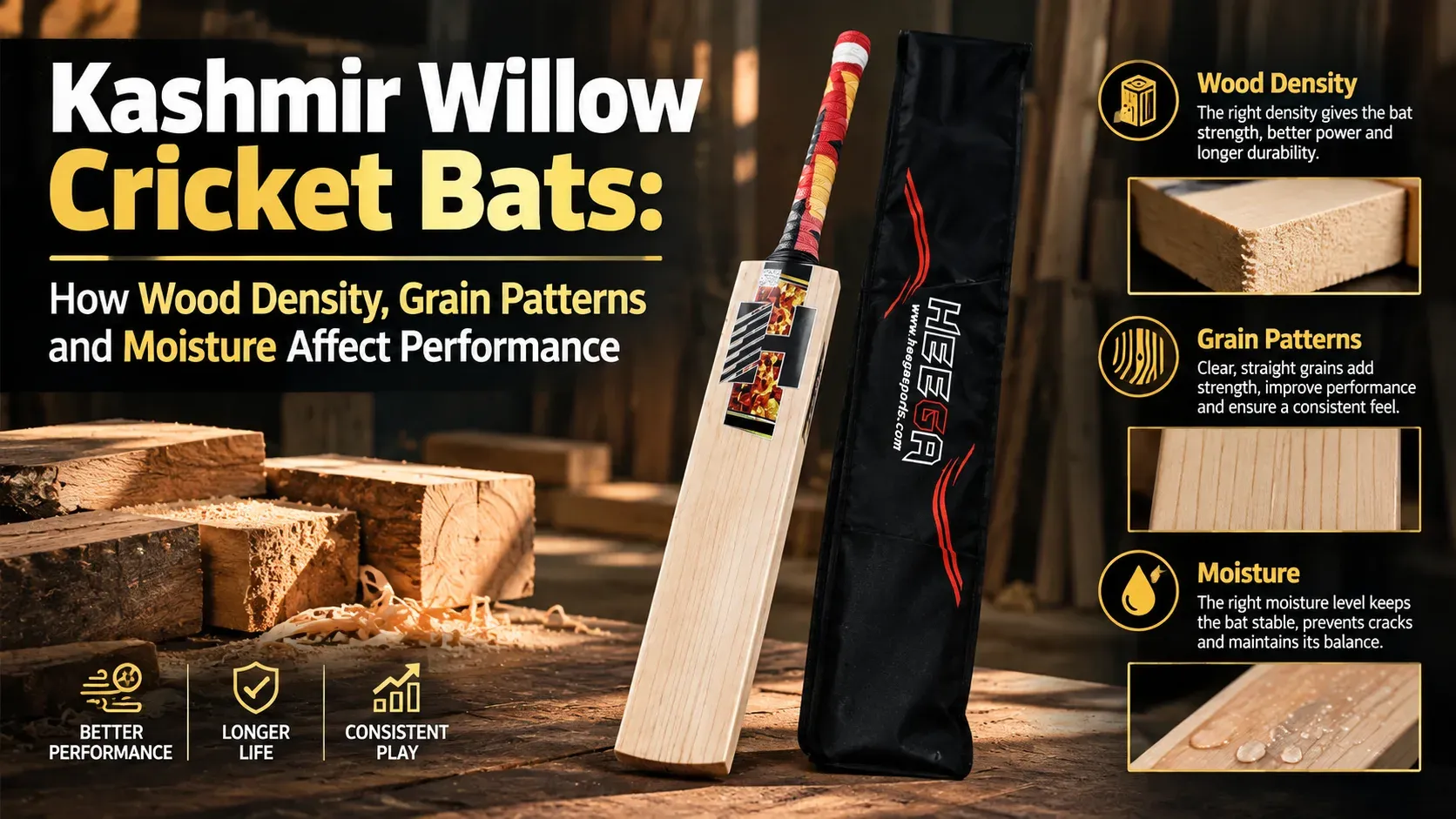
Introduction: What Makes Every Kashmir Willow Cricket Bat Different?
Two Kashmir Willow cricket bats can look almost identical on a shop shelf but feel completely different when picked up and swung.
One may feel light and well balanced, while another of the same listed weight may feel heavier in the hands. One may have straight, clearly visible grains, while another may display a different grain pattern. Even when both bats are manufactured from Kashmir Willow, their playing characteristics can vary.
Why does this happen?
The answer begins with the natural properties of wood.
Kashmir Willow is widely used in cricket bats because it provides a practical combination of strength, affordability and performance for recreational players, developing cricketers and many club-level applications. However, willow is a natural material, and no two pieces of wood are exactly alike.
Its density, grain structure, moisture content, pressing, shaping and finishing can all influence the final bat.
Understanding these characteristics helps players make more informed buying decisions. Instead of choosing a bat only because of its appearance or price, they can evaluate how its construction relates to their playing style and requirements.
In this guide, we will explore the science behind Kashmir Willow cricket bats, explain the role of wood density and grain patterns, discuss why moisture matters, and show how players can assess a bat before purchasing it.
What Is Kashmir Willow?
Kashmir Willow is a type of willow wood used to manufacture cricket bats. It is associated with willow grown in the Kashmir region of the Indian subcontinent and is commonly used in bats designed for training, recreational cricket and competitive play at various levels.
Like other natural woods, Kashmir Willow has a cellular structure made up of fibres and pores. These characteristics influence its density, strength, response to impact and interaction with moisture.
The performance of a finished cricket bat depends on more than the name of the wood. Manufacturing quality, the specific piece of timber, bat profile, pressing, weight distribution and preparation all contribute to the result.
Why Kashmir Willow Is Popular
Kashmir Willow cricket bats appeal to many players for several reasons.
- Practical value: They offer options across a range of budgets.
- Versatility: They are available in junior and adult sizes, with different profiles and weights.
- Training suitability: Many models are suitable for regular practice and developing batting skills.
- Product variety: Players can choose between traditional profiles, scooped designs and different blade shapes.
The best choice depends on the player's needs, the type of ball being used and the quality of the individual bat.
It is important to remember that not every Kashmir Willow bat will have the same performance characteristics. The quality of the timber and the manufacturing process matter considerably.
Understanding Wood Density in Kashmir Willow Bats
Wood density refers to the amount of wood material contained within a given volume. In simple terms, it describes how much mass a particular volume of wood has.
Density is one factor that can influence the weight and feel of a cricket bat.
However, density alone does not determine whether a bat is good or bad. The distribution of that mass throughout the blade, the bat's dimensions and the way the wood has been prepared are also important.
How Density Affects Bat Weight
Consider two Kashmir Willow bat blades manufactured to similar dimensions.
If one piece of willow has a higher density than the other, it may weigh more, assuming other factors are comparable.
This matters because the player must move the bat quickly and accurately while responding to a delivery.
A bat that is too heavy for the player may make it harder to maintain bat speed, especially when reacting to fast bowling or playing shots that require quick adjustments.
A comfortable bat allows the player to control the backlift, swing through the ball and recover their position without unnecessary strain.
Does Higher Density Mean Better Quality?
Not necessarily.
A common misconception is that denser wood automatically produces a more powerful cricket bat.
In reality, performance depends on several interacting factors, including:
- Wood structure and quality.
- Bat weight and dimensions.
- Balance and pickup.
- Blade profile.
- Pressing and preparation.
- The point of contact between the ball and bat.
- The player's technique and timing.
A denser bat may provide a particular feel that some players prefer, but it can also be heavier or more demanding to swing.
Likewise, a less dense bat is not automatically superior. Its structural quality, construction and suitability for the player still matter.
The objective is to find a bat with an appropriate combination of weight, pickup, durability and playing characteristics.
Why Pickup Matters as Much as Actual Weight
Pickup describes how heavy a bat feels when a player lifts and swings it.
Two bats may have the same measured weight but feel different because their mass is distributed differently.
For example, a bat with more mass concentrated toward the lower part of the blade may feel different from one with a more handle-oriented balance.
The spine, edges, shoulders, toe and handle can all affect the overall feel.
This is why experienced players often test a bat in their hands instead of relying only on the weight printed on its label.
Practical tip: When comparing Kashmir Willow bats, hold each one in the same position and perform a few controlled shadow shots. Choose the bat that allows you to maintain a natural backlift and comfortable swing without sacrificing control.
The Role of Grain Patterns in Kashmir Willow Cricket Bats
Grain patterns are among the most noticeable features of a cricket bat.
When you examine the face of a willow blade, you may see lines running approximately from the shoulders toward the toe. These lines reflect aspects of the wood's growth structure.
Players frequently use grain appearance as one of several indicators when comparing bats. However, grains should not be treated as a complete measure of quality or performance.
What Do Straight Grains Indicate?
Relatively straight grains can suggest a more regular grain orientation along the visible face of the bat.
For many buyers, a straight grain pattern is visually appealing because it creates a traditional cricket-bat appearance.
However, the visible face reveals only part of the wood's structure. It cannot tell you everything about internal consistency, density, hidden defects or how the bat has been manufactured.
A bat with attractive grains can still be poorly balanced or unsuitable for a particular player.
Similarly, a bat with less visually uniform grains may perform well if the timber is sound and the bat has been made correctly.
Does Grain Count Determine Bat Performance?
Grain count is often discussed when players compare cricket bats, but it should not be used as a standalone performance rating.
A higher grain count does not automatically mean that a Kashmir Willow bat is better, more powerful or more durable.
The number and appearance of the visible grains must be considered alongside the wood's condition, blade construction, pressing, weight, pickup and intended use.
This is especially important when comparing products from different manufacturers, because grading and selection practices can vary.
What About Wide or Uneven Grains?
Grain spacing varies naturally between pieces of wood.
Some bats display narrow, closely spaced lines, while others have wider spacing or a less uniform pattern.
These differences can reflect the wood's growth characteristics, but the appearance alone does not establish the bat's expected lifespan or performance.
When assessing a bat, look beyond the grain pattern. Check for obvious cracks, suspicious surface defects, poor finishing or other visible problems.
If you are unsure about a particular bat, ask the seller or manufacturer about the wood selection and product grading process.
Understanding Grain Orientation and Wood Strength
The direction of the wood fibres is important because wood behaves differently along and across its grain.
Cricket bats experience repeated impacts, so the relationship between the wood fibres and the blade's construction matters.
Why Fibre Direction Matters
Wood is an anisotropic material, which means its physical properties vary depending on the direction in which force is applied.
The alignment of fibres influences how wood responds to bending, impact and splitting forces.
In a cricket bat, the blade's design and the direction of the wood structure help determine how it handles repeated contact with the ball.
However, the visible grains on the face do not provide a complete picture of the internal fibre structure.
This is one reason why careful timber selection and appropriate manufacturing techniques are important.
Grain Appearance Is Only One Part of Quality
A well-made bat requires more than attractive grains.
Players should also consider:
- Whether the blade has obvious cracks or defects.
- Whether the handle feels secure.
- Whether the bat has a comfortable pickup.
- Whether the weight suits their strength.
- Whether the profile matches their style.
- Whether the manufacturer provides clear product specifications.
A sensible purchase decision combines visual inspection with a practical assessment of how the bat feels.
Moisture Content: Why It Matters in Willow Wood
Moisture content is an important property of natural wood.
Wood absorbs and releases moisture depending on its environment. Its moisture content can affect its weight, dimensions, stability and mechanical behaviour.
For Kashmir Willow cricket bats, appropriate timber preparation helps manufacturers produce blades with more consistent characteristics.
What Is Moisture Content?
Moisture content describes the amount of water present in wood relative to its dry mass under a specified measurement method.
Freshly cut wood generally contains more moisture than properly seasoned timber prepared for manufacturing.
As wood dries, its moisture content decreases. This process can also cause dimensional changes, and drying that is too rapid or poorly controlled can contribute to defects such as checking, cracking or warping.
The appropriate preparation process depends on the timber and the intended product.
Why Seasoning Is Important
Seasoning is the process of reducing and managing the moisture content of wood before it is used.
Properly managed seasoning helps manufacturers prepare timber for shaping and finishing.
Potential benefits include:
- Improved dimensional stability.
- Reduced risk of excessive movement after manufacture.
- More predictable handling characteristics.
- Better control during the manufacturing process.
Seasoning does not make every piece of wood identical. Natural variation remains, and the quality of the final bat still depends on timber selection and manufacturing.
Can Moisture Make a Bat Heavier?
Yes. Water contributes to the mass of wood.
If two otherwise comparable pieces of wood have different moisture contents, the wetter piece will generally weigh more.
This is one reason moisture management matters when preparing cricket-bat timber.
However, players should not assume that a bat that feels heavy must contain excess moisture. The blade's dimensions, density, handle, grip and overall design also influence total weight.
The correct approach is to buy a properly manufactured bat from a reliable seller rather than attempting to judge moisture content by weight alone.
What Happens If a Bat Becomes Too Wet?
Excessive or prolonged exposure to moisture can damage a cricket bat.
Possible problems include:
- Swelling or dimensional changes.
- Surface deterioration.
- Warping or distortion.
- Damage to finishes or adhesives.
- Increased risk of deterioration during storage.
A wet bat should not be placed directly beside a heater or exposed to intense heat to dry quickly. Rapid temperature changes can create additional stress in the wood.
Instead, follow the manufacturer's care instructions and allow the bat to dry gradually in a suitable environment.
How Temperature and Humidity Affect a Kashmir Willow Bat
Moisture and temperature are closely related to the way natural wood behaves.
Changes in environmental conditions can affect the exchange of moisture between the wood and surrounding air.
High Humidity
In humid environments, wood may absorb moisture from the air over time.
The extent of this change depends on the humidity level, exposure duration, finish and storage conditions.
For a cricket bat, appropriate storage helps reduce unwanted changes and supports long-term care.
Very Dry Conditions
In very dry conditions, wood can lose moisture.
If changes occur too quickly or the timber is already vulnerable, the wood may develop checks or cracks.
This does not mean that every dry environment will damage a bat. Rather, extreme conditions and abrupt changes should be avoided where possible.
The Best Storage Approach
To protect your Kashmir Willow bat:
- Store it in a clean, dry environment.
- Avoid prolonged exposure to rain or damp surfaces.
- Keep it away from direct heaters and intense heat.
- Do not leave it in a hot vehicle for extended periods.
- Check the blade and handle regularly for visible changes.
- Follow the manufacturer's specific care recommendations.
Consistent care is more useful than trying to correct damage after it occurs.
How Density, Grains and Moisture Work Together
Wood density, grain structure and moisture content are related to the physical characteristics of willow, but they should not be evaluated independently.
A cricket bat's performance comes from the interaction of its natural material and the way the blade is manufactured.
For example, two bats may have similar grain patterns but different weights because their density or dimensions differ.
Two bats may have the same listed weight but different pickups because the mass is distributed differently.
A bat may look excellent on the outside but still have a handle, profile or balance that does not suit the player.
These examples demonstrate why a buyer should evaluate the whole bat rather than focus on one visible feature.
A Practical Way to Compare Two Bats
When comparing Kashmir Willow bats of similar sizes, use the following approach:
First, inspect the wood. Look for obvious cracks, defects and signs of poor finishing.
Second, compare the weight. Check whether the bat is comfortable to lift and swing.
Third, assess pickup. Perform controlled shadow shots and notice whether the bat feels balanced.
Fourth, inspect the construction. Check the handle connection, edges, toe and overall finish.
Finally, consider your playing needs. A bat intended for regular practice may have different priorities from one selected for a specific competitive role.
This method provides a more useful assessment than grain count or appearance alone.
Does Wood Density Affect Power Hitting?
Power hitting depends on several factors, including bat speed, the effective mass of the bat at impact, the quality of contact and the player's technique.
A heavier bat may provide more mass behind a shot, but it can also be more difficult to accelerate.
A lighter bat may allow faster movement and better control, especially for players who need to react quickly.
The ideal balance depends on the individual batter.
Bat Speed and Timing
Bat speed contributes to the energy delivered during impact, but it is not the only consideration.
A player who swings a comfortable bat quickly and connects cleanly may achieve better results than someone using a heavier bat that slows their swing or causes mistimed contact.
Good technique helps the player position the bat effectively and make contact with the ball in a controlled manner.
Finding the Right Weight
When selecting a Kashmir Willow bat, consider:
- Your physical strength.
- Your batting technique.
- Your preferred shots.
- The speed of bowling you usually face.
- The bat's pickup.
- How long you can maintain control during practice.
Avoid choosing a bat solely because it is heavier or has thicker edges. Comfort and control are important parts of effective batting.
How Bat Pressing Influences Kashmir Willow Bats
After selecting suitable timber, manufacturers shape and prepare the blade through a series of processes. Pressing is one of the techniques that can influence the finished bat.
Pressing involves applying controlled pressure to the willow to prepare the blade for use.
The exact process varies between manufacturers and products.
Why Is Pressing Used?
The outer surface and fibres of willow need to be prepared so the blade can withstand repeated impacts.
Appropriate pressing can influence how the wood responds during use.
However, pressing must be controlled. Too little or too much pressure may produce undesirable results, depending on the timber and manufacturing method.
There is no single pressing level that makes every bat ideal.
Does More Pressing Mean Better Performance?
No.
A bat is not automatically better because it has been pressed more heavily.
The outcome depends on the quality of the wood, the manufacturing process, the blade's design and how the finished bat is intended to be used.
Players should evaluate the final product rather than assume that a particular manufacturing claim guarantees superior performance.
Bat Profile, Spine and Edges Matter Too
Even when two Kashmir Willow bats are manufactured from similar timber, their profiles can produce different playing experiences.
The shape of the blade affects weight distribution, pickup and the location of the bat's main hitting area.
The Spine
The spine is the raised central portion along the back of the blade.
Its height and shape contribute to the blade's structure and influence how material is distributed throughout the bat.
A pronounced spine may be part of a design intended to balance certain performance characteristics, but the spine alone does not determine power.
The Edges
The edges are the sides of the blade.
Their thickness and shape contribute to the bat's overall dimensions and mass distribution.
Thicker edges do not guarantee that every shot will travel farther. Contact quality, bat speed, the ball's characteristics and the player's technique remain important.
The Sweet Spot
The sweet spot is the region of the blade where a well-struck ball can feel particularly clean and effective.
Its location varies with the bat's design.
Some players prefer a lower sweet spot, while others prefer a more central or higher one, depending on their technique and playing conditions.
When selecting a Kashmir Willow bat, consider how its profile matches your normal contact position rather than choosing only by appearance.
Kashmir Willow Bat Durability: What Should Players Know?
Durability is an important consideration for players who train regularly.
However, the lifespan of a cricket bat cannot be predicted from grain count or wood density alone.
It depends on the quality of the timber, construction, preparation, ball type, frequency of use, playing surface and maintenance.
Factors That Influence Durability
A bat may experience greater wear when it is used frequently against hard cricket balls, particularly if the surface is rough or the ball is wet.
Other factors include:
- The quality and condition of the blade.
- The bat's preparation and knocking-in requirements.
- Toe protection and other protective measures.
- How the bat is stored.
- Whether the bat is used for an appropriate type of cricket.
A well-maintained bat may last longer than a poorly cared-for bat, but no natural-wood bat is immune to damage.
Why Knocking-In Matters
Many willow cricket bats require knocking-in before regular use with a hard leather ball. The exact preparation required depends on the manufacturer and the specific product.
Knocking-in helps prepare the blade for repeated impacts by compressing and conditioning the surface in a controlled way.
Players should follow the manufacturer's instructions rather than assume every Kashmir Willow bat needs an identical process.
If the manufacturer recommends professional preparation, follow that guidance before using the bat in competitive matches.
Common Myths About Kashmir Willow Cricket Bats
Understanding the material helps players avoid several common buying mistakes.
Myth 1: More Grains Always Mean a Better Bat
Grain count is only one visible characteristic. It does not independently establish power, durability, balance or overall quality.
Myth 2: A Heavier Bat Always Hits Harder
A heavier bat may offer more mass, but only if the player can swing and control it effectively. Reduced bat speed can offset the potential benefit of extra mass.
Myth 3: A Lighter Bat Is Always Better
A lighter bat can improve manoeuvrability, but players still need a blade that feels stable and suits their technique.
Myth 4: Darker Wood Is Automatically Inferior
Natural wood colour varies. Colour alone is not a reliable measure of performance or durability. Buyers should assess the whole bat and consult the manufacturer's grading information.
Myth 5: A Premium Price Guarantees Better Performance
Price can reflect materials, manufacturing, brand positioning and other factors, but it cannot guarantee that a bat will suit every player.
The best bat is the one that meets the player's requirements and offers appropriate quality for its intended use.
How to Choose the Right Kashmir Willow Cricket Bat
A good buying decision begins with your playing requirements.
Instead of focusing only on the wood's appearance, consider the complete specification.
1. Choose the Correct Size
The bat should suit your height, reach and physical development.
Junior players should use appropriately sized equipment rather than buying a bat that is too large in the hope of using it for many future years.
2. Find a Comfortable Weight
The bat should allow you to lift, control and swing it naturally.
If it feels difficult to manoeuvre during a few controlled swings, it may become even harder to manage during an extended innings.
3. Check Pickup
Hold the bat and perform shadow shots.
Notice whether the weight feels evenly manageable and whether you can move the bat through your preferred batting positions without excessive effort.
4. Inspect the Blade
Look at the face, edges, shoulders and toe.
Check for obvious cracks, suspicious defects or signs of damage. Remember that a surface inspection cannot reveal every internal characteristic.
5. Consider Your Playing Style
A batter who focuses on timing and placement may prefer a different balance from someone who frequently plays aggressive shots.
Neither approach requires one universal bat design.
Choose a profile that feels natural and supports your normal technique.
6. Ask About Preparation and Care
Find out whether the bat requires knocking-in, toe protection or other preparation before use.
Follow the manufacturer's instructions for maintenance and storage.
Who Should Consider a Kashmir Willow Cricket Bat?
Kashmir Willow bats are available for different experience levels and budgets.
They can be a practical choice for:
- Beginners learning batting fundamentals.
- Junior players progressing through cricket coaching.
- Club cricketers looking for suitable training equipment.
- Recreational players who practise regularly.
- Experienced batters who prefer a particular Kashmir Willow model.
The right choice depends on the quality of the individual bat and the player's needs. Kashmir Willow should not be treated as a guarantee of a particular performance level.
Caring for Your Kashmir Willow Cricket Bat
A cricket bat is an investment in your playing experience. Appropriate care helps preserve its condition.
Keep It Away From Excessive Moisture
Avoid leaving the bat in rain or on a wet surface.
If it becomes damp, follow the manufacturer's guidance and let it dry naturally in a suitable environment.
Store It Properly
Keep the bat in a clean, dry location away from extreme heat and sudden environmental changes.
Do not leave it in a hot car or beside a direct heat source for prolonged periods.
Inspect It Regularly
Check the blade, toe, handle and grip for visible damage.
If cracks develop or the handle becomes loose, stop using the bat until it has been assessed and repaired where appropriate.
Follow the Recommended Preparation
Use the knocking-in and maintenance process recommended for your specific bat.
Avoid applying oils, coatings or other substances unless the manufacturer advises that they are suitable for the product.
How Heega Sports Supports Your Cricket Journey
At Heega Sports, we understand that choosing a cricket bat involves more than selecting a size or comparing prices.
Players need equipment that matches their experience, playing style, training routine and comfort preferences.
Our cricket equipment range includes Kashmir Willow cricket bats, junior bats, adult bats, batting gloves, batting pads, cricket balls, kit bags, practice nets and training accessories.
Whether you are learning the fundamentals or preparing for club-level cricket, it is worth considering the bat's size, weight, pickup, profile and intended use before making a purchase.
Explore the cricket equipment collection at Heega Sports to find products suited to your training and playing needs.
Final Thoughts: Look Beyond the Grains
Kashmir Willow cricket bats are shaped by the natural characteristics of the wood and the decisions made during manufacturing.
Wood density can influence weight. Grain patterns offer clues about the wood's visible structure. Moisture content affects the mass and stability of the timber. Pressing, shaping, profile and finishing all contribute to the final product.
Yet none of these characteristics should be judged in isolation.
A bat with attractive grains is not automatically the best choice. A heavier blade does not guarantee more power, and a higher price does not ensure a better fit.
For most players, the most useful approach is to assess the whole bat: its construction, balance, pickup, weight, size and suitability for the intended type of cricket.
Combine that assessment with appropriate preparation and regular care, and you will be better equipped to choose a Kashmir Willow cricket bat that supports your development.
Ultimately, the best bat is not simply the one that looks best on the shelf. It is the one that feels comfortable in your hands, complements your technique and helps you play with confidence.
🏏 Find Your Next Cricket Bat With Heega Sports
Explore Kashmir Willow cricket bats, junior and adult bats, cricket balls, batting gloves, pads, kit bags, practice nets and training accessories for your cricket journey.
Shop Now
Heega Sports – Helping Players Choose Equipment That Fits Their Game.
Related posts
 The Truth About Kashmir Willow Cricket Bats: Grain Density, Durability, and Performance ExplainedDiscover how Kashmir Willow cricket bats perform in real matches. Learn the truth about grain density, durability, and how to get maximum ping from your blade.
 Kashmir Willow Cricket Bats for Power Hitting: How Blade Shape, Sweet Spot and Edge Thickness Work TogetherLearn how Kashmir willow cricket bat blade shape, sweet spot position, and edge thickness work together to support powerful shots, control, and balance.
 Cricket Shoes Explained: How Stud Patterns, Grip and Sole Design Affect Performance on Different PitchesLearn how cricket shoes, stud patterns, grip and sole design affect traction, stability, comfort and performance on grass, turf and artificial pitches.