Kashmir Willow Sourcing: How We Choose a Cleft

Kashmir willow sourcing starts with a planted tree
Kashmir willow sourcing is less romantic than people think. The trees are not wild. Farmers in the Kashmir valley plant willow along field edges, canals and river banks, mostly in the south of the valley, and grow it as a crop. A bat tree is usually 15 to 20 years old when it is cut.
That matters to anyone buying a bat for one reason. A tree on wet ground grows fast and even, and even growth gives straight grain. A tree that leaned, was damaged, or grew on poor dry ground gives clefts that twist. No amount of shaping fixes a twisted grain.
From log to cleft, before it leaves the valley
The tree is felled and the trunk is sawn into rounds a little longer than a blade. Each round is then split along its length into wedge-shaped pieces. One of those wedges is a cleft.
Splitting, not sawing, is the point. A split follows the grain, so the cleft keeps the lines the tree grew. A saw cuts straight through them.
The ends of each cleft are sealed with wax and the clefts are stacked in the open to dry, with gaps between them for air. Fresh willow is full of water and much heavier than it will be as a bat. Drying takes months. A cleft that is rushed will crack, or keep shrinking after the bat is made.
When a stack is dry enough, it is sorted and loaded. The road from south Kashmir to Meerut is about 850 kilometres. The clefts travel it as rough wood, with nothing yet that looks like a bat.
What we look for when a cleft is in our hands
At the workshop every cleft is checked by eye and by hand before it gets a grade. We look at five things, in this order.
Grain. We count the straight grain lines across the face, the side that will meet the ball. Kashmir willow is a dense wood and usually shows fewer, wider grains, often four to eight across a full-size face. Wide grain on Kashmir wood is normal. What we reject is grain that wanders or runs off the edge, because the bat will be weak where the line breaks.
Straightness. We sight down the length of the cleft from the toe end. The grain should run the full length without a bend. A bend in the grain is a crack waiting for a hard ball.
Knots and marks. Small pin knots are common and do not hurt play. A big knot on the face or the edge sends the cleft down a grade, or out of the bat pile. Dark streaks and the stain some call butterfly marks are judged by where they sit. On the back they are only looks. Near the edge we are stricter.
Colour. The pale outer wood, the sapwood, should make the face. The darker heartwood from the centre of the tree is harder and is fine on the back of the blade. A face that is half heartwood plays dead in that half.
Weight. We weigh every cleft. This is the check that surprises people most.
Why weight and grain decide the grade
A cleft that looks perfect can still be too heavy. Because Kashmir willow is dense, grading is partly a hunt for the light, dry clefts.
Here is how it works in practice. A full-size Kashmir willow bat usually finishes somewhere between about 1,150 and 1,300 grams. To land in the lower half of that range, the cleft has to start light for its size. Shaping can only take away so much wood before the bat loses its middle.
So a heavy cleft with lovely grain does not always become a top-grade full-size blade. It may become a heavier bat for a strong adult, or be cut down for a smaller size, where the extra density is spread over less wood.
The grade is the sum of both checks. Straight grain, a clean face and a light weight for the size gets the top grade. Good grain with more weight, or a mark near the edge, sits a grade lower. A cleft that fails on straightness does not become a bat at all.
This is also why two bats of the same size and grade can feel different in the hand. The grade tells you the wood passed the same checks. The pickup depends on how the weight was spread when the bat was shaped, and that is a separate step done by hand at the bench.
Three things we hear that are not true
More grains always means a better Kashmir bat. On this wood, five straight, even grains will often play better than nine grains that bend. Straightness and dryness count for more than the number.
Darker wood is older and better. Colour tells you where in the tree the wood came from, not its age or its quality. Dark heartwood on the face is a reason to drop a grade, not to raise one.
Fresh willow has more life in it. Wet willow is heavier and softer. A properly dried cleft is lighter and firmer, and that is what sends the ball away.
Run part of our check yourself
When you hold a Kashmir willow bat, turn the face to the light and count the grains between the edges. Sight along the blade and check that the lines run straight to the toe. Look at both edges for knots. Then put the bat on a kitchen scale. The number on the scale tells you more than the sticker does.
If you want the cleft chosen to a weight or a grain you name, that is what our custom cricket bats are for. There is more on who we are and how a bat is made here on the about page.
The graded bats, sizes 3 to 6, Harrow, SH and LH, are on the Kashmir willow bats page.
Related posts
 Kashmir Willow Cricket Bat Durability: What Causes Cracks, Surface Wear and Blade Damage?Discover what affects Kashmir Willow cricket bat durability, why cracks and surface damage occur, and how proper care can extend your bat's lifespan.
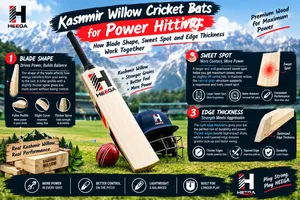 Kashmir Willow Cricket Bats for Power Hitting: How Blade Shape, Sweet Spot and Edge Thickness Work TogetherLearn how Kashmir willow cricket bat blade shape, sweet spot position, and edge thickness work together to support powerful shots, control, and balance.
 Kashmir Willow Cricket Bats: How Wood Density, Grain Patterns and Moisture Affect PerformanceDiscover how Kashmir Willow cricket bat density, grain patterns and moisture affect bat weight, balance, durability, and batting performance.