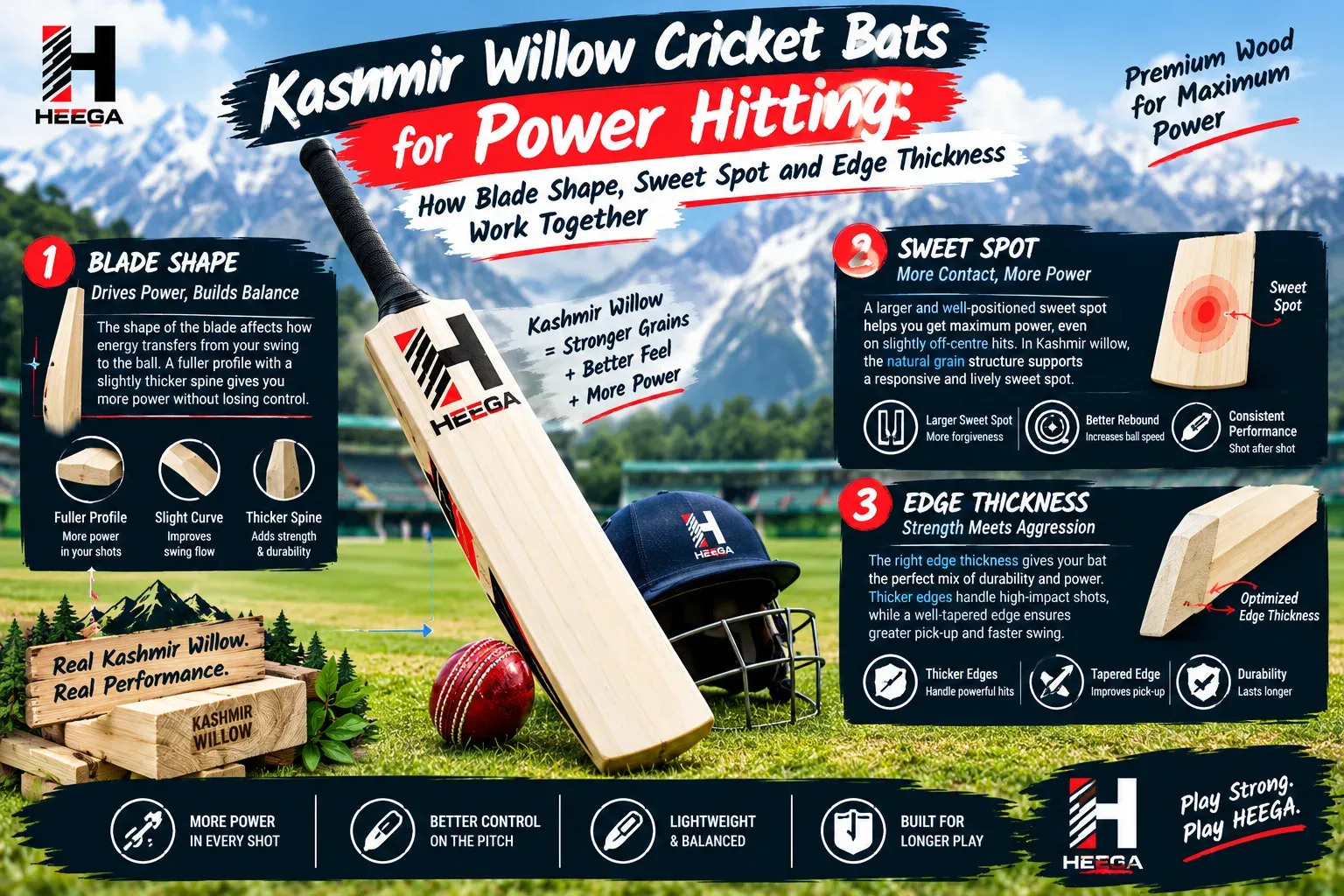
Kashmir Willow Cricket Bats for Power Hitting: How Blade Shape, Sweet Spot and Edge Thickness Work Together
Introduction
Power hitting is not simply about swinging a cricket bat as hard as possible. The way a bat is shaped, how its weight is distributed, and where the ball makes contact all influence the feel of a shot. For players who enjoy attacking cricket, choosing the right bat can make a meaningful difference to comfort, timing, and confidence at the crease.
Kashmir willow cricket bats are popular with beginners, developing players, and club cricketers looking for a practical option for regular training and match play. They are available in different profiles, weights, and blade designs, giving players plenty of choices depending on their preferred style of batting.
Three features deserve particular attention when selecting a Kashmir willow bat for power hitting: blade shape, sweet spot position, and edge thickness. These features are closely connected. A fuller profile may influence weight distribution, a differently positioned sweet spot may suit particular contact areas, and thicker edges can contribute to the overall shape and mass of the blade.
However, bigger edges or a more pronounced profile do not automatically produce longer shots. Bat speed, timing, contact quality, balance, and the player's ability to control the bat remain essential. A bat that looks powerful but feels too heavy or difficult to manoeuvre may not suit your batting style.
In this guide, we will explain how these three design features work together, what to look for when buying a Kashmir willow cricket bat, and how to choose a profile that supports your approach to power hitting.
What Makes Kashmir Willow Cricket Bats Suitable for Power Hitting?
Kashmir willow is used to manufacture cricket bats across a range of price points and playing levels. The wood's characteristics, the quality of the cleft, the pressing process, and the final bat profile all influence the finished product.
For players who want to attack the ball, the main objective is to find a bat that combines useful hitting characteristics with manageable weight and control.
A suitable power-hitting bat should offer:
- A blade profile that suits the player's preferred contact areas.
- A sweet spot that matches the player's typical shot selection.
- Enough edge thickness for the desired blade shape without unnecessary bulk.
- A pickup that allows the player to accelerate the bat comfortably.
- A handle and grip that support secure control throughout the swing.
- Construction appropriate for the type of ball, pitch, and cricket being played.
Kashmir willow is not automatically better or worse for power hitting than another willow type in every situation. The individual bat's construction and the player's needs matter more than relying on the timber name alone.
The best approach is to assess the actual bat rather than assuming that every Kashmir willow bat will perform the same way.
1. Blade Shape: The Foundation of a Bat's Hitting Profile
The blade is the main hitting surface of a cricket bat. Its profile affects how the wood is distributed through the blade, how the bat feels when picked up, and where much of its mass sits.
For power hitters, blade shape matters because the bat must provide a useful combination of hitting potential and manoeuvrability.
What is a cricket bat blade profile?
A blade profile describes the shape and distribution of wood across the face, edges, spine, and back of the bat. Two bats with similar overall dimensions can have noticeably different profiles.
One may have a pronounced spine and fuller lower blade, while another may distribute more wood through the middle or use a flatter back. These differences influence the bat's appearance and can affect its pickup and balance.
How blade shape influences power hitting
A fuller blade profile can accommodate more wood in selected areas. Depending on the design, this may contribute to a more substantial hitting area and influence the bat's mass distribution.
However, adding wood also adds weight. If the extra mass makes the bat difficult to swing quickly, the player may struggle to time shots consistently.
A more compact profile may feel easier to manoeuvre, while a fuller profile may appeal to a player who prefers a substantial blade. Neither design is automatically more powerful for every batter.
Low, mid, and high sweet-spot profiles
Blade profiles are often discussed in relation to sweet spot position. Although manufacturers may use slightly different terminology, the general distinctions are useful.
Profile TypeGeneral CharacteristicsPotential Suitability
Low sweet spot
More emphasis on the lower part of the blade
Players who frequently play front-foot shots on suitable lower-bouncing pitches
Mid sweet spot
Hitting area centred around the middle portion of the blade
Players looking for a versatile profile across a range of shots
High sweet spot
Hitting area positioned higher up the blade
Players whose conditions and shot selection favour contact higher on the blade
These are general guidelines, not strict rules. Pitch bounce, bat dimensions, individual technique, and the actual profile all affect how a bat feels.
What should power hitters look for?
Instead of choosing the thickest or fullest blade automatically, assess how the bat feels during your normal batting movements.
Ask yourself:
- Can I lift the bat comfortably into my stance?
- Does the blade feel manageable during a controlled downswing?
- Can I adjust the bat face without excessive effort?
- Does the profile suit the shots I play most often?
- Can I maintain control when playing both attacking and defensive shots?
A blade shape that supports a repeatable, controlled swing is often more useful than a profile selected purely for its appearance.
2. Sweet Spot: Where Contact Feels Most Effective
The sweet spot is the area of the bat face where contact often feels particularly clean and efficient. The exact location and size of this area depend on the bat's construction, blade profile, mass distribution, and other design factors.
For power hitting, understanding the sweet spot helps players choose a bat that suits their normal contact point.
How does the sweet spot work?
When the ball meets the bat, the impact creates vibration and transfers energy between the ball and the bat. Contact in a well-performing region can feel cleaner and more comfortable than a mishit closer to the edges or toe.
The sweet spot is not a single universal point marked on every bat. It is better understood as a region where the bat responds favourably to contact.
The quality of the wood, pressing, overall construction, and impact location can all influence how the bat feels.
Why sweet spot position matters
Players do not all make contact with the ball at the same location on the blade. Their stance, height, timing, preferred shots, and playing conditions influence where they tend to strike the ball.
A bat with a lower sweet spot may suit a player who frequently makes contact lower on the blade. A player who meets the ball around the middle may prefer a more central profile.
The key is to match the bat's characteristics to your technique and typical conditions rather than choosing a sweet spot based on marketing claims alone.
Sweet spot and shot distance
Clean contact can help a batter transfer energy efficiently to the ball. When a shot is mistimed or strikes an unsuitable area of the blade, the result may feel less effective.
However, the sweet spot does not guarantee sixes. Shot distance also depends on bat speed, incoming ball speed, launch angle, contact quality, physical ability, and the direction of the shot.
A well-timed shot with a manageable bat can travel farther than a poorly timed swing with a much heavier bat.
How to assess the sweet spot when buying
If you can test the bat safely and appropriately, ask an experienced coach or retailer to help you assess its response. Avoid striking bats against hard objects or using methods that could damage the blade.
You can also compare the profile, advertised sweet spot position, and balance of several bats before deciding.
Choose a bat that feels comfortable and controllable rather than expecting the sweet spot to compensate for inconsistent technique.
3. Edge Thickness: Does a Bigger Edge Mean More Power?
Edge thickness is one of the most noticeable features of a modern cricket bat. Many players associate thick edges with power hitting because they create a substantial-looking blade profile.
There is a practical reason edge dimensions matter, but the relationship between edge thickness and performance is more complicated than appearance suggests.
What is edge thickness?
The edges are the sides of the blade running along either side of the bat face. Their thickness varies according to the bat's profile and construction.
A bat with thicker edges contains more wood in those regions than a comparable profile with thinner edges. The exact effect on overall weight and balance depends on how the rest of the blade is shaped.
How thicker edges can influence a bat
Thicker edges can contribute to the blade's overall mass and may affect how the bat feels during the swing. Depending on the design, they can form part of a fuller profile and influence the distribution of wood across the blade.
However, edge thickness alone does not tell you how forgiving or powerful a bat will be.
A bat's performance depends on several connected features, including:
- Overall blade profile and spine.
- Sweet spot position.
- Weight and weight distribution.
- Pickup and swing control.
- Willow characteristics and pressing.
- Quality of contact between the ball and bat.
A bat with substantial edges may feel powerful to one player but too cumbersome to another.
Are thicker edges better for power hitters?
Not always. Thick edges can appeal to players who prefer a fuller blade, but the extra material may increase overall mass or alter the pickup.
If the bat feels difficult to accelerate, the player may lose some of the timing and bat speed needed for effective power hitting.
The right edge thickness is therefore the one that contributes to a suitable profile without making the bat difficult to control.
What about mishits?
A larger edge does not guarantee that every mishit will travel for a boundary. The outcome of an off-centre strike depends on the impact location, bat construction, ball speed, swing mechanics, and the quality of contact.
Choose a bat based on its overall characteristics, not on the assumption that thicker edges automatically compensate for poor timing.
4. How Blade Shape, Sweet Spot, and Edge Thickness Work Together
These features are connected parts of the same design. Looking at any one of them in isolation can give an incomplete picture of how a Kashmir willow bat may feel.
Consider how they interact.
Blade shape influences mass distribution
The spine, shoulders, toe, edges, and overall blade profile determine where wood is positioned. This influences the bat's overall dimensions and can affect its pickup.
Sweet spot position relates to the profile
The way wood is distributed through the blade can influence the region where contact feels most effective. A fuller lower profile, for example, may be designed around a different sweet spot position from a profile with more emphasis higher up the blade.
Edge thickness contributes to the overall structure
Thicker edges add material in the sides of the blade. Their contribution to total weight and balance depends on the complete design rather than on edge dimensions alone.
Pickup connects all three features
Pickup describes how heavy a bat feels when lifted and swung. Two bats with the same scale weight may feel very different because their mass is distributed differently.
A bat with a suitable profile and edge thickness may feel easier to swing than another bat of similar weight, depending on its balance and the player's preferences.
The goal is to find a combination that gives you the hitting profile you want without sacrificing control.
FeatureMain InfluenceWhat to Prioritise
Blade shape
Overall profile and wood distribution
A profile suited to your shots and playing conditions
Sweet spot
The region where contact may feel most effective
A position that matches your typical contact point
Edge thickness
Material distribution along the blade sides
Enough structure without unnecessary bulk
Pickup
How heavy the bat feels in motion
A manageable swing and comfortable control
Overall weight
Total mass of the bat
A weight you can accelerate consistently
A well-balanced combination of these features is more useful than maximising any single measurement.
5. Choosing a Kashmir Willow Bat for Different Power-Hitting Styles
Power hitting can look very different from one batter to another. Some players favour strong front-foot drives, while others rely on back-foot shots, pulls, cuts, or shots over the infield.
Your preferred scoring areas should influence the profile you choose.
For front-foot power hitters
Players who regularly drive the ball along the ground or loft it through the front of the field may prefer a profile that feels comfortable through their usual contact area.
A lower or mid-positioned sweet spot may suit some players, depending on the pitch and their technique. Test the bat's pickup and make sure you can move it through the hitting zone without forcing the swing.
For back-foot players
Batters who frequently play cuts, pulls, and back-foot punches may prefer a profile that feels responsive around their normal contact point.
A mid or higher sweet spot may suit certain players and conditions, but the right choice depends on the actual bat and the player's technique. Do not select a high sweet spot solely because you play back-foot shots.
For aggressive all-round batters
Players who mix drives, pulls, cuts, and lofted shots may benefit from a versatile profile that feels comfortable across different contact positions.
A manageable pickup and a balanced blade can be particularly useful when the batter needs to adjust quickly to different deliveries.
For beginners developing power
Beginners should focus on learning sound technique before choosing a bat designed around maximum blade bulk.
A bat that feels comfortable in the hands and allows a controlled swing can support better timing and more consistent practice. Excessive weight may make it harder to develop reliable movement and contact.
For club-level power hitters
Club players can look more closely at sweet spot position, blade profile, edge thickness, handle feel, and construction quality.
Because individual bats can vary, compare actual models where possible. Two Kashmir willow bats with similar specifications may still feel different when picked up.
6. How to Choose the Right Bat Weight and Pickup
Power hitting often leads players to consider heavier bats. The assumption is that more weight will always produce more powerful shots, but this is not necessarily true.
A heavier bat can carry more mass, yet it may also be harder to accelerate. If the extra weight affects timing or swing speed, the player may not benefit from it.
Understand scale weight and pickup
Scale weight is the actual weight of the bat.
Pickup is how heavy the bat feels when you lift and swing it. It is influenced by weight distribution, profile, handle characteristics, and the player's own strength and technique.
Both matter when selecting a power-hitting bat.
Test the bat in your stance
Hold the bat as you would when preparing to face a delivery. Lift it into your backlift and make a few controlled shadow swings.
Ask yourself:
- Can I lift it repeatedly without strain?
- Can I change direction comfortably?
- Does the bat feel balanced through the swing?
- Can I maintain control at a realistic batting tempo?
- Does the blade feel too heavy towards the toe or otherwise awkward?
The goal is not to select the lightest possible bat. It is to find a bat whose weight and pickup allow you to generate bat speed while remaining in control.
7. Common Mistakes to Avoid When Buying a Kashmir Willow Power-Hitting Bat
Choosing a bat based on appearance alone can lead to an unsuitable purchase. Keep these common mistakes in mind.
Mistake 1: Choosing the thickest edges available
Thicker edges can contribute to a fuller profile, but they do not guarantee greater distance. Check the overall pickup and how the bat suits your technique.
Mistake 2: Assuming a large sweet spot fixes mistiming
A suitable sweet spot can help with clean contact, but it cannot replace timing and control. Select a bat that suits your normal contact point and continue working on batting technique.
Mistake 3: Buying a heavier bat just for power
Extra weight may make a bat harder to accelerate. Test the pickup and choose a weight you can handle consistently throughout an innings.
Mistake 4: Ignoring blade shape
A bat can have thick edges yet still feel awkward because of its overall profile. Look at the spine, shoulders, toe, and balance as well as the edges.
Mistake 5: Choosing based only on the willow type
Kashmir willow bats vary in quality, construction, and performance. Willow type is only one part of the decision. The individual bat's shape, pressing, finish, and pickup also matter.
Mistake 6: Overlooking the handle and grip
The handle affects comfort, control, and how the bat feels in the hands. A suitable blade profile will not be enough if the handle feels uncomfortable or difficult to control.
Mistake 7: Skipping a practical fit check
Whenever possible, pick up the bat and test its movement. A specification sheet cannot fully describe how the bat will feel to you.
8. A Practical Buying Checklist for Power Hitters
Before purchasing a Kashmir willow cricket bat, use this checklist to compare your options.
- Blade profile: Does the shape suit your preferred shots?
- Sweet spot: Does its position make sense for your usual contact point and playing conditions?
- Edge thickness: Does it provide the profile you want without making the bat feel cumbersome?
- Pickup: Can you lift and swing the bat comfortably?
- Weight: Can you maintain control throughout repeated swings?
- Handle: Does the handle feel secure and comfortable?
- Willow and construction: Is the blade well finished, with no obvious structural damage?
- Playing conditions: Is the bat suitable for the type of ball and cricket you play?
- Preparation: Have you checked the manufacturer's guidance on knocking-in and maintenance?
If you are buying for a young player, ensure the bat is appropriately sized. A bat that is too long or heavy can make it harder to develop sound technique.
9. Care and Maintenance for Your Kashmir Willow Bat
Once you have selected a bat, looking after it helps preserve its condition and usability.
Follow the preparation instructions. Check whether the manufacturer requires knocking-in or other preparation before the bat is used with a hard cricket ball.
Inspect the toe and edges. These areas can experience wear and impact. Check for cracks, splitting, or damage after regular use.
Keep the bat dry. Avoid leaving it in damp conditions or exposing it to excessive heat.
Use suitable protection where appropriate. Toe guards and protective sheets may help manage certain types of surface wear, but they should be fitted according to the manufacturer's guidance.
Store it carefully. Keep the bat in a dry place and avoid leaving heavy equipment resting against the blade.
Address damage early. Minor surface marks may be part of normal use, but structural cracks or significant damage should be assessed before the bat is used again.
Maintenance will not make every bat last the same length of time. Longevity depends on the wood, construction, playing conditions, frequency of use, and how the bat is cared for.
10. Can a Kashmir Willow Bat Really Help You Hit Bigger Shots?
A well-chosen bat can support your power-hitting approach, but it cannot guarantee bigger shots on its own.
Blade shape, sweet spot position, and edge thickness influence how the bat is constructed and how it feels. When these features suit the player, they can help create a comfortable setup for controlled swings and cleaner contact.
However, shot distance also depends on bat speed, timing, body coordination, the speed of the incoming delivery, contact quality, and launch angle.
The best bat is one that allows you to swing confidently and meet the ball cleanly. A profile that looks powerful but feels difficult to control may work against your natural game.
For consistent improvement, combine a suitable bat with regular practice, sound technique, and a clear understanding of your preferred scoring areas.
Explore Cricket Equipment at Heega Sports
At Heega Sports, we understand that choosing a cricket bat involves more than selecting a willow type or looking for a large blade profile. The right bat should suit your playing style, feel comfortable in your hands, and support the way you approach your innings.
When comparing Kashmir willow bats, pay attention to blade shape, sweet spot position, edge thickness, and pickup. Consider how these features work together rather than choosing a bat based on one specification alone.
Whether you are a beginner developing your timing or a club cricketer looking for a bat that suits an attacking style, take the time to compare the available options and choose a profile that works for you.
Explore cricket equipment at Heega Sports and prepare for your next training session or match.
Frequently Asked Questions (FAQs)
1. Are Kashmir willow cricket bats good for power hitting?
They can be suitable for power hitting when the bat's profile, weight, pickup, and construction match the player's needs. Performance depends on the individual bat and the batter's technique, not just the willow type.
2. Do thicker edges make a cricket bat more powerful?
Thicker edges add material to the sides of the blade and can contribute to a fuller profile. However, they do not guarantee longer shots. Pickup, bat speed, timing, and contact quality also matter.
3. What is the best sweet spot position for power hitting?
There is no single best position for every batter. Lower, middle, and higher sweet spots may suit different techniques and playing conditions. Choose a profile that matches your usual contact point and shot selection.
4. Is a heavier cricket bat better for hitting sixes?
Not necessarily. A heavier bat may carry more mass, but it can also be harder to accelerate. A manageable bat that allows good swing speed and clean contact may be more effective for a particular player.
5. What is the difference between blade shape and edge thickness?
Blade shape describes the overall profile and distribution of wood across the bat. Edge thickness refers specifically to the depth of material along the sides of the blade. Edge thickness is one component of the wider blade profile.
6. How do I choose the right Kashmir willow bat for my batting style?
Consider your preferred shots, playing conditions, sweet spot position, blade profile, weight, and pickup. Test the bat where possible and choose one that allows you to swing comfortably while maintaining control.
7. Can a larger sweet spot improve mishits?
A bat's profile may influence how it responds to off-centre contact, but a larger-looking blade does not guarantee that mishits will travel well. The outcome depends on the impact location, construction, ball speed, and quality of contact.
8. Is Kashmir willow suitable for club cricket?
Yes, many players use Kashmir willow bats for training and club cricket. The right choice depends on the individual bat's construction, the type of ball being used, the playing conditions, and the player's preferences.
9. Should beginners choose a bat with thick edges?
Beginners should prioritise correct sizing, comfortable pickup, and control. Thick edges are not essential for developing power, and a bat that is too heavy or cumbersome can make learning good technique more difficult.
10. How can I maintain a Kashmir willow cricket bat?
Follow the manufacturer's preparation guidance, keep the bat dry, inspect the edges and toe regularly, and store it carefully. Address significant cracks or structural damage before returning the bat to use.
Final Thoughts
A Kashmir willow cricket bat designed for power hitting should offer more than a thick-looking blade. Blade shape influences the overall profile, sweet spot position helps determine where contact may feel most effective, and edge thickness contributes to the way wood is distributed through the bat.
These features work together with weight, pickup, handle design, and construction quality. When they suit your batting style, the bat can feel comfortable and controlled through the swing, helping you focus on timing and shot execution.
Before buying, look beyond appearance and specifications. Test the pickup, consider your preferred contact point, and make sure the bat is manageable enough to swing repeatedly without losing control.
Remember that bigger edges and heavier blades do not automatically produce bigger shots. Good timing, bat speed, and consistent technique remain central to power hitting.
Whether you are a beginner or an experienced club cricketer, the right Kashmir willow bat is the one that works with your game rather than forcing you to change it.
Explore cricket equipment at Heega Sports and find a bat that suits your playing style.
Related posts
 Kashmir Willow Cricket Bats: How Wood Density, Grain Patterns and Moisture Affect PerformanceDiscover how Kashmir Willow cricket bat density, grain patterns and moisture affect bat weight, balance, durability, and batting performance.
 Kashmir Willow Cricket Bats Explained: How Wood Characteristics Influence Bat Feel and PerformanceDiscover how Kashmir willow characteristics affect cricket bat feel, pickup, shot response, durability, and value, with tips for choosing the right bat.
 Kashmir Willow Bats Explained: How Willow Quality, Bat Profile & Balance Affect PerformanceLearn how Kashmir Willow bats, willow quality, bat profile, balance, pickup, weight, and sweet spot position can affect cricket batting performance.