The Cricketer’s Turning Point: 9 Changes That Can Transform Your Game

Nine practical changes that can help cricketers break through plateaus, build consistency, and turn everyday training into better match performances
Every cricketer eventually reaches a point where improvement feels slower.
You train.
You play matches.
You practice your skills.
Yet something feels missing.
Maybe you're scoring runs but not enough.
Maybe your bowling is good in practice but inconsistent in matches.
Maybe your fitness is improving but your decision-making isn't.
Maybe you know you have potential, but you haven't found the breakthrough that takes your game to another level.
That moment can become a turning point.
And the turning point doesn't necessarily require a completely new training program.
Sometimes, nine small changes in how you approach cricket can create a much bigger difference than expected.
At Heega Sports, we believe long-term cricket development comes from more than talent. Purposeful practice, mental preparation, physical conditioning, recovery, match awareness, discipline, and suitable equipment all contribute to better performance.
Here are nine changes that can transform the way you play.
1. Stop Training Without a Purpose
One of the easiest ways to waste a training session is to arrive without a clear objective.
Instead of simply saying:
"I'm going to practice batting today."
Choose something specific.
For example:
- Improve footwork against pace
- Practice rotating strike
- Defend better against spin
- Improve bowling accuracy
- Develop slower-ball control
- Practice high-pressure catches
A clear objective makes your session more focused.
Try This
Before training, complete:
"Today I want to improve ______."
At the end, ask whether you actually worked on it.
That simple habit can change the quality of your practice.
2. Turn Your Biggest Weakness Into Your Biggest Project
Most players naturally practice what they enjoy.
The problem is that your favorite skill may not be the skill holding your game back.
Identify the weakness that repeatedly appears in matches.
Ask:
"What is one problem that, if improved, would make the biggest difference to my performance?"
It might be:
- Playing swing bowling
- Facing spin
- Bowling at the death
- Running between wickets
- Catching under pressure
- Concentration
- Fitness
- Shot selection
Once you identify it, make it a training priority.
Don't expect to fix it in one week.
Build a project around it.
3. Make Training Feel More Like a Match
A relaxed net session can make you feel confident.
But cricket becomes very different when there is a score, target, opponent, and consequence.
Introduce match scenarios into practice.
Batting Scenario
30 runs required from 20 balls.
Bowling Scenario
Defend 9 runs from the final over.
Fielding Scenario
Complete three catches after sprinting.
All-Round Scenario
Perform a technical skill immediately after a conditioning drill.
This forces you to combine:
Technique + Decision-Making + Pressure + Execution
That's closer to real cricket.
4. Develop a Reliable Reset Routine
Every cricketer makes mistakes.
The important question is:
How quickly can you move past one?
A batter gets out.
A bowler concedes a boundary.
A fielder drops a catch.
The mistake is already finished.
The danger comes when the player carries it into the next delivery.
Create a simple reset:
Accept → Breathe → Refocus → Next ball
Don't spend the next delivery replaying the previous one.
Review it later.
During the match, focus on what's still within your control.
5. Stop Chasing Confidence—Build It
Many players think confidence comes first.
They wait to feel confident before taking on difficult situations.
In reality, confidence often comes from evidence.
You become more confident when you know:
I've practiced this.
I've faced this situation.
I've made this decision before.
I've prepared for pressure.
That's why deliberate practice matters.
Don't tell yourself you're ready.
Give yourself reasons to believe you're ready.
6. Train Your Body for Your Cricket Role
General fitness is useful.
But role-specific fitness can be even more valuable.
Batters
Focus on:
- Speed
- Endurance
- Mobility
- Core strength
- Running between wickets
Fast Bowlers
Prioritize:
- Strength
- Explosive power
- Conditioning
- Mobility
- Recovery
Spin Bowlers
Develop:
- Stability
- Strength
- Mobility
- Repeat-effort conditioning
Fielders
Focus on:
- Acceleration
- Agility
- Reaction speed
- Coordination
Your physical training should help you execute cricket skills for longer and under greater pressure.
7. Upgrade Your Recovery
One of the biggest mistakes serious players make is treating recovery as optional.
Training creates stress.
Recovery allows the body to adapt.
Pay attention to:
- Sleep
- Hydration
- Nutrition
- Mobility
- Rest days
You don't need to train at maximum intensity every day.
The goal is to create a routine you can maintain for months—not just a few intense weeks.
Remember:
Consistency beats occasional extremes.
8. Prepare Your Equipment Before It Becomes a Problem
Equipment shouldn't become a distraction on match day.
Before every important training session or match, check your kit.
Look at:
- Bat grip
- Bat condition
- Helmet fit
- Gloves
- Pads
- Cricket shoes
- Cricket bag
- Accessories
At Heega Sports, players can find cricket bats, helmets, gloves, pads, cricket shoes, bags, accessories, and sportswear for different training and competitive needs.
You don't need to spend the most money to build a useful cricket kit.
Choose equipment that:
- Fits properly
- Matches your playing style
- Provides appropriate protection
- Feels comfortable
- Can handle regular use
Good preparation removes unnecessary distractions.
9. Review Every Performance
This may be the most important change of all.
Many players finish a match and immediately move on.
They remember the score.
They remember whether they won.
Then they forget the lessons.
Instead, spend a few minutes reviewing your performance.
Ask:
What worked?
Identify one thing to repeat.
What didn't work?
Identify one problem.
Why did it happen?
Look for the cause rather than simply blaming the result.
What will I do differently?
Choose one action.
This creates a continuous improvement cycle:
Perform → Review → Learn → Adjust → Train → Perform Again
That cycle can keep your development moving.
The Turning Point Formula
You don't need to change everything simultaneously.
A simple approach is:
Purposeful Training + Pressure Practice + Mental Strength + Fitness + Recovery + Reflection = Sustainable Improvement
Each component supports the others.
Training improves skill.
Fitness supports execution.
Recovery allows consistency.
Mental preparation improves decision-making.
Reflection tells you what to work on next.
How Batters Can Apply These Changes
If you're a batter, consider starting with these questions:
Do I know how I usually get out?
Do I have a plan against different bowling styles?
Can I rotate strike when boundaries aren't available?
Can I stay patient when scoring becomes difficult?
Can I make good decisions under pressure?
Don't judge your batting only by runs.
A batter can contribute through:
- Partnerships
- Strike rotation
- Situational awareness
- Running between wickets
- Pressure management
Learn to value the quality of your decisions.
How Bowlers Can Apply These Changes
Ask yourself:
Do I have a clear plan for each batter?
Can I maintain accuracy when tired?
Do I know when to use my variations?
Can I adapt if the pitch isn't helping?
Can I execute under pressure?
The best bowling isn't always the fastest or most complicated.
Often, it is the bowling that consistently creates difficult decisions for the batter.
How Fielders Can Apply These Changes
Fielding can become a turning point in close matches.
Work on:
- First-step reactions
- Catching technique
- Ground fielding
- Throwing accuracy
- Positioning
- Communication
And don't only practice when fresh.
Add fatigue to some sessions.
Late-match fielding can demand concentration when the body is already tired.
Build a 30-Day Turning Point Challenge
If you're serious about changing your game, start small.
Week 1 — Awareness
Identify your biggest weakness.
Track how often it appears in training and matches.
Week 2 — Focus
Create specific drills around that weakness.
Week 3 — Pressure
Introduce match-style scenarios.
Week 4 — Review
Compare your performance with the beginning of the month.
Then choose your next priority.
You don't need to transform your entire cricket game in 30 days.
You need to prove that you can change one part of it.
Habits That Can Accelerate Your Progress
Build these into your routine:
Before Training
Set one clear objective.
During Training
Give full attention to the task.
After Training
Record one lesson.
Before a Match
Prepare your body, mind, and kit.
During the Match
Focus on the next ball.
After a Mistake
Reset quickly.
After the Match
Review honestly.
These habits are simple.
Their power comes from repetition.
What Can Prevent Your Turning Point?
Be careful of these common traps:
❌ Training without a goal.
❌ Only practicing strengths.
❌ Avoiding difficult opponents.
❌ Changing technique after every poor match.
❌ Ignoring fitness.
❌ Sacrificing recovery.
❌ Blaming teammates or conditions.
❌ Comparing your progress constantly.
❌ Focusing only on statistics.
❌ Expecting overnight improvement.
The turning point usually begins when you stop looking for shortcuts.
How You'll Know You're Improving
Your statistics may not change immediately.
Look for smaller signs first:
✅ You make better decisions.
✅ You recover faster after mistakes.
✅ Difficult situations feel more familiar.
✅ Your technique holds up under pressure.
✅ You understand your role better.
✅ Your fitness supports your skill.
✅ Your training becomes more focused.
✅ You can identify your own weaknesses.
These are meaningful signs of progress.
The scoreboard eventually reflects what your habits have already built.
Your Turning Point May Be Smaller Than You Think
Many players imagine a turning point as a huge innings or a five-wicket haul.
Sometimes it is.
But often, the real turning point is much quieter.
It's the day you stop avoiding a weakness.
The session where you finally practice under pressure.
The decision to recover properly.
The first time you reset immediately after a mistake.
The moment you start reviewing your matches honestly.
The day you stop saying:
"I can't."
And start asking:
"How can I?"
That's where transformation begins.
Final Thoughts
A better cricket career doesn't always require a dramatic change.
Sometimes it requires nine simple changes repeated consistently.
Train with purpose.
Attack weaknesses.
Practice pressure.
Reset after mistakes.
Build confidence through preparation.
Train your body.
Recover properly.
Prepare your equipment.
Review every performance.
These habits can turn ordinary training into meaningful development.
And meaningful development can eventually turn potential into performance.
At Heega Sports, we're proud to support cricketers who want to keep improving with cricket bats, helmets, gloves, pads, shoes, bags, accessories, and sportswear for serious training and competitive cricket.
Your turning point doesn't have to be tomorrow's match. It can start with today's training session.
Shop Now
Heega Sports – Helping Young Cricketers Build Skills, Confidence, Responsibility, and a Love for the Game.
Related posts
 The Cricket Gear Advantage: How the Right Equipment Can Transform Your GameDiscover how the right cricket gear—from bats and batting gloves to helmets, pads, and cricket shoes—can improve comfort, mobility, control, confidence, and consistency on the field.
 The Cricket Breakthrough: 10 Small Changes That Can Transform Your GameDiscover 10 small changes that can transform your cricket game, including smarter training, weakness-focused practice, pressure drills, mental routines, fitness, recovery, equipment preparation, and match analysis.
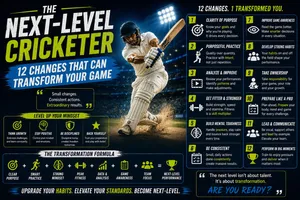 The Next-Level Cricketer: 12 Changes That Can Transform Your GameDiscover 12 practical changes that can transform your cricket game, from purposeful training and pressure practice to fitness, mental preparation, recovery, equipment, decision-making, and match analysis