The Evolution of Cricket Rules: How the Game Has Changed Over the Years.

Introduction: Cricket Has Never Stood Still
Cricket is one of the oldest organized sports in the world.
Its traditions are respected by millions of fans, yet the game has constantly evolved to meet the needs of players, spectators, broadcasters, and new generations of fans.
Many of the rules that seem completely normal today didn't exist a few decades ago.
There was no Decision Review System (DRS).
No Super Overs.
No Powerplays.
No concussion substitutes.
No free hits.
As cricket expanded globally across Nepal, Germany, the United States, Canada, the Netherlands, and the United Kingdom, the sport adapted to become faster, fairer, safer, and more entertaining.
Let's explore how cricket's rules have evolved and why those changes have made such a significant impact on the game.
Cricket's Early Days
Cricket began centuries ago with relatively simple rules.
Many aspects that define modern cricket today had not yet been standardized.
Over time, governing bodies introduced consistent playing conditions to ensure fairness across different countries and competitions.
This gradual standardization laid the foundation for international cricket.
The Birth of Official Laws
The Laws of Cricket are maintained by the Marylebone Cricket Club (MCC).
These laws define everything from:
- Player conduct.
- Bat dimensions.
- Ball specifications.
- Methods of dismissal.
- Match procedures.
Although the laws preserve cricket's traditions, they are regularly reviewed to reflect changes in the modern game.
Protective Equipment Changed the Game
Decades ago, many players competed with minimal protection.
Today, safety equipment has become standard.
Modern players commonly wear:
- Helmets.
- Batting gloves.
- Batting pads.
- Thigh guards.
- Arm guards.
- Abdominal guards.
These improvements have made cricket significantly safer while allowing players to perform more confidently.
Limited-Overs Cricket Changed Strategy
Traditional Test cricket remains important, but the introduction of limited-overs cricket transformed how the game is played.
The arrival of One Day Internationals (ODIs) encouraged:
- Faster scoring.
- More aggressive batting.
- Innovative bowling.
- Dynamic field placements.
It introduced a completely different tactical approach.
T20 Cricket Revolutionized Entertainment
Perhaps no change has influenced cricket more than Twenty20 cricket.
With only 20 overs per side, the format encourages:
- Aggressive batting.
- Creative stroke play.
- Athletic fielding.
- Fast-paced action.
T20 has attracted millions of new fans while making cricket more accessible to global audiences.
Powerplays Changed Fielding Strategies
Powerplays were introduced to encourage attacking cricket.
During specific overs, fielding restrictions limit how many players can remain outside the circle.
This creates:
- More scoring opportunities.
- Greater tactical planning.
- Different bowling strategies.
Powerplays have become a defining feature of limited-overs cricket.
Free Hits Reward Positive Batting
The introduction of the free hit after certain no-balls encouraged fair bowling while rewarding batters.
Because dismissal methods become limited during a free hit, these deliveries often create exciting moments for spectators.
Decision Review System (DRS)
Technology has significantly improved umpiring accuracy.
DRS allows teams to challenge certain decisions using technologies such as:
- Ball tracking.
- UltraEdge.
- Hawk-Eye.
- Replay systems.
Although debate still exists, DRS has improved fairness in many close decisions.
Super Overs Settle Tied Matches
Previously, tied matches often ended without a clear winner.
Today, many competitions use the Super Over.
Each team bats one additional over, and the higher score wins.
The rule has produced some of cricket's most dramatic finishes.
Concussion Substitutes Improve Player Safety
Player welfare has become increasingly important.
Modern cricket allows concussion substitutes when players suffer head injuries during matches.
This change prioritizes player health without unfairly disadvantaging teams.
Over-Rate Regulations
Slow over rates can reduce the quality of the game.
Competitions now monitor over rates more carefully.
Penalties may include:
- Fines.
- Fielding restrictions.
- Competition sanctions.
These rules help maintain the pace of play.
Technology Is Reshaping Cricket
Beyond umpiring decisions, technology now influences:
- Performance analysis.
- Fitness monitoring.
- Video coaching.
- Match statistics.
- Player workloads.
Modern cricket combines tradition with innovation more than ever before.
Women's Cricket Benefits from Rule Development
As women's cricket has grown, improvements in scheduling, broadcasting, facilities, and competition structures have helped increase participation and visibility worldwide.
Nepal: Rapid Development Through Modern Cricket
As Nepal's cricket continues growing internationally, players increasingly compete under the latest ICC playing conditions and modern regulations.
Germany: Learning the Global Game
Germany's expanding cricket community benefits from standardized international rules, making it easier for players to compete globally.
United States: Professional Cricket Adopts Modern Standards
Major League Cricket and other American competitions follow current ICC playing regulations, helping raise professional standards.
Canada: Developing Through International Competition
Canadian cricket continues adapting to evolving international rules while strengthening domestic competitions.
The Netherlands: Consistency Through International Standards
Dutch cricket has successfully integrated modern playing conditions while maintaining strong player development systems.
United Kingdom: Tradition Meets Innovation
As the birthplace of cricket's laws, the UK continues balancing respect for tradition with necessary innovation.
Competitions such as The Hundred demonstrate how new formats can coexist alongside Test cricket and county competitions.
Will Cricket Rules Continue Changing?
Almost certainly.
Future innovations may include:
- Expanded technology.
- Improved player safety measures.
- Faster decision-making systems.
- Enhanced broadcasting experiences.
- Data-driven officiating.
As the sport grows globally, its rules will continue evolving while preserving cricket's unique character.
How Heega Sports Supports Every Era of Cricket
Whether playing traditional Test-style cricket, T20 competitions, academy matches, or recreational weekend games, quality equipment remains essential.
At Heega Sports, we proudly support players with equipment designed for every format of the modern game.
Our collection includes:
- Kashmir Willow cricket bats.
- Leather cricket balls.
- Practice balls.
- Cricket helmets.
- Batting gloves.
- Batting pads.
- Cricket shoes.
- Practice nets.
- Cricket kit bags.
- Training accessories.
As cricket continues evolving, reliable equipment helps players adapt with confidence.
Final Thoughts
Cricket's greatest strength lies in its ability to evolve without losing its identity.
From timeless Test matches to exciting T20 leagues, from handwritten scorebooks to advanced ball tracking technology, every rule change has helped shape the game we know today.
Across Nepal, Germany, the United States, Canada, the Netherlands, and the United Kingdom, players and fans continue embracing both cricket's rich traditions and its exciting future.
The rules may change.
The formats may evolve.
Technology will continue advancing.
But the spirit of cricket—respect, teamwork, skill, and fair competition—remains unchanged.
That is what continues making cricket one of the world's most beloved sports.
🏏 Experience Modern Cricket with Heega Sports
Explore premium-quality Kashmir Willow cricket bats, leather cricket balls, practice balls, cricket helmets, batting gloves, batting pads, cricket shoes, practice nets, cricket kit bags, and training accessories designed for every format of the game.
Shop Now
Heega Sports – Supporting Cricket Through Every Generation and Every Format.
Related posts
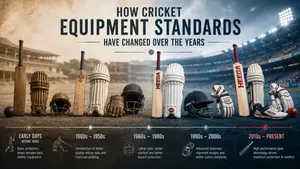 How Cricket Equipment Standards Have Changed Over the YearsDiscover how cricket equipment standards have changed over the years. Learn how bats, balls, helmets, gloves, pads, shoes, and ICC regulations have improved player safety and performance across Nepal, Germany, USA, Canada, the Netherlands, and the UK.
 Cricket Rules for Kids Explained: Understanding Runs, Wickets, Overs and Fielding Positions.Learn cricket rules for kids, including runs, wickets, overs, fielding positions, batting, bowling, and basic match rules in a simple beginner's guide.
 How Cricket Scoring Has Changed the Way Players Build Innings.Discover how modern cricket scoring has changed batting strategy, from strike rotation and boundary hitting to calculated risks across Test, ODI, and T20 cricket.