Cricket bat dispatch and packing: how a bat leaves our workshop
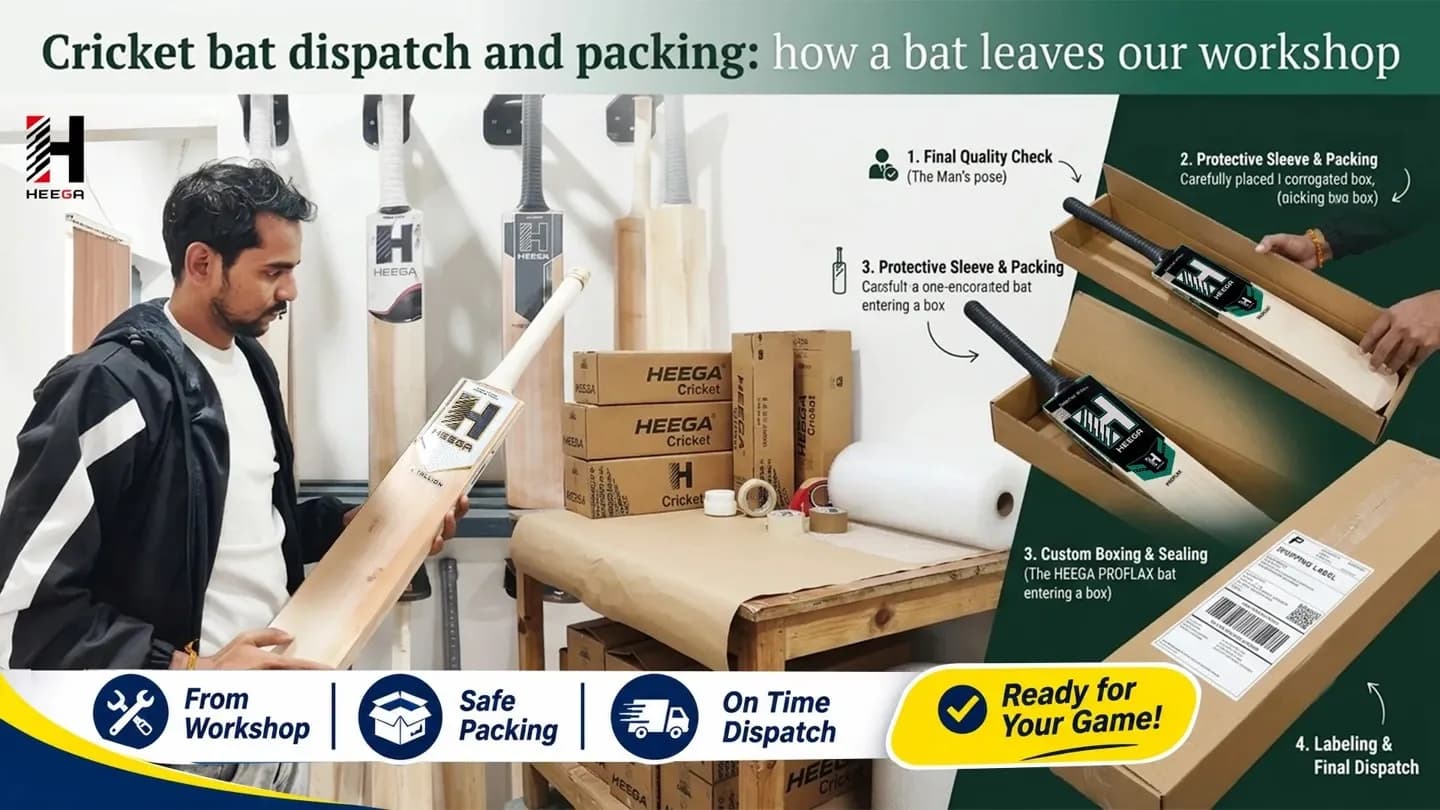
The gap between finished and sent
A bat is finished when it comes off the last bench. It is not yet ready to leave. Between those two moments sits dispatch day, and a fair share of the complaints any maker hears about a new bat begin in that gap: the wrong size in the right box, a weight that does not match the order, a toe that took a knock on the road.
This is how cricket bat dispatch and packing works in our workshop in Meerut, step by step, and what to do at your end when the carton lands.
The final weigh
The bat goes on the scale one last time, and it goes on fully dressed. Grip on, stickers on, toe guard on if the bat has one. That is the weight you will pick up, so that is the weight we check against the order.
It matters more than it sounds. A rubber grip alone adds roughly 50 to 60 grams. A bat that was weighed bare and then gripped will feel heavier than the figure you were given, and you will be right to say so.
If you asked for a weight, the bat has to sit inside the range you asked for. If it does not, it does not go in the box.
One honest note. Willow is wood, and wood takes in and gives up moisture. A bat weighed in a dry week in Meerut and weighed again in a humid coastal town can read 10 to 15 grams apart. Kitchen scales also disagree with each other. A small gap is weather. A gap of 50 grams or more is worth a message to us.
The sticker check
This is the dull step that catches the most mistakes. We read the bat against the order line, not against memory.
The size comes first. Size 5, size 6, Harrow and SH look close on a crowded rack, and a Harrow sent in place of an SH is a wasted week for everyone. Then the willow, then the model, then any custom work such as a name or a second grip.
After that we look at the stickers themselves. They should sit straight and flat, with every corner pressed down. A lifted corner catches on the cover and peels further on the journey.
The bat also gets a last look under good light. We check the face, both edges, the toe, the binding at the handle, and that the grip is rolled all the way down to the shoulder. Anything we would not want to receive ourselves goes back to the bench.
The cover
A bat should not travel bare against cardboard. Stickers scuff, and the face picks up marks that look like damage even when they are not.
If your order includes a cover, the bat goes into it before anything else. If it does not, the bat is wrapped in a sleeve so the face and edges do not rub. For a bat you will carry to nets three times a week, a proper cover is worth having anyway, and the padded bat covers can be added to the same order so the bat ships inside one.
The cover is there to stop rubbing. It does not make the bat proof against a hard drop, which is the carton's job.
The carton
Two parts of a bat are at risk on the road. The toe, because parcels get stood on end and dropped. The handle, because a long thin parcel gets used as a lever under heavier ones.
So the packing is built around those two. The toe gets padding beneath it, so it does not sit hard on the bottom of the box. The bat is packed snug along its length so it cannot slide. Hold a packed carton and shake it gently: nothing should move. If it rattles, it is opened and packed again.
Bulk orders for clubs, academies and dealers go the same way, bat by bat, with packing between each one. Bats are never left loose against each other. Edge against face for 800 kilometres does what you would expect.
The label goes on last, and the name and pin code are read against the order once more before the box is sealed.
The tracking number
When the courier collects the parcel, it gets a tracking number, and we send that number to you. Keep the message.
Do not worry if the tracking page shows nothing for the first day. The number exists from the moment of pickup, but the first scan often appears only when the parcel reaches the courier's hub. After that it should move every day or two.
If the tracking has not changed for three working days, tell us. We can raise it with the courier from our side, and a stuck parcel is easier to find early than late.
If it arrives damaged
Most bats arrive exactly as they left. When one does not, the order in which you do things decides how quickly it is put right.
- Look at the carton before you sign. If it is crushed, torn or wet, say so to the delivery person and ask for it to be noted.
- Photograph the closed carton from all sides, with the label visible.
- Open it and photograph the bat as it sits in the packing, before you lift it out.
- Photograph the damage close up, and then the whole bat, face and back.
- Keep the carton, the padding and the cover. Do not throw anything away.
- Do not oil the bat, knock it in or take it to nets. A bat that has been used is much harder to assess.
- Write to us the same day with the order number and the photographs, through the warranty claim page.
Tell us plainly what you see. A crack across the toe, a split along the edge and a handle that moves in the splice are three different problems, and each has a different fix.
It also helps to know what is not transit damage. Faint lines across the face from pressing are part of how a bat is made. Small differences in grain colour, a tiny knot on the back, or a light scuff on a sticker do not affect how the bat plays. If you are unsure, send the photograph anyway. We would rather look at ten pictures of nothing than miss one real crack.
The five-minute check is worth doing even when the box looks perfect. Read the size on the sticker. Run a thumb down both edges and around the toe. Hold the bat by the handle and tap the face with your knuckle from shoulder to toe, listening for a dull or rattling spot. Then weigh it if you have a scale. If all four are fine, the bat is ready for oil and the mallet.
To order a bat that goes through every step above, choose from the Kashmir willow bats on our site and the tracking number will follow once it leaves the workshop.
Related posts
 What Happens to a Cricket Ball After It Leaves the Bowler’s Hand?Discover what happens to a cricket ball after it leaves the bowler's hand. Learn how speed, seam position, swing, spin, air movement, pitch conditions, and bounce influence every delivery.
 A bat for tennis ball cricket: what we change in the buildHow the Meerut workshop builds a bat for tennis ball cricket: a lighter cleft, thick edges, a shorter blade, and why season willow is wasted on a tennis ball.
 Oiling a new cricket bat: how much, how often, and what it is forHow to oil a new cricket bat from the maker's bench: raw linseed oil, two thin coats a day apart, where the oil must not go, how to tell too much from enough.