A bat for tennis ball cricket: what we change in the build

Why a season bat is the wrong tool on a tennis ball
A season bat is built for a leather ball of about 156 grams. That ball arrives hard and leaves the face with a crack. So we press the willow, leave the middle thick and ask the player to knock it in, all so the blade survives a few seasons of that impact.
A tennis ball weighs about 57 grams. A taped one weighs a little more. It does not dent the face. It does not need the willow to give. When a player takes a season bat to a tennis-ball match, most of what we built into that blade does nothing. The extra wood in the middle only slows the swing.
That is the short case for a bat for tennis ball cricket: less willow where it is wasted, more where the ball actually goes. Here is what we change at the bench, step by step.
A lighter cleft, chosen for weight, not grain
For a season bat we grade a cleft by its grains, its colour and how it takes the press. For a tennis-ball bat we grade almost only by weight and straightness. Grain count matters far less here. A tennis ball never loads the face hard enough to show the gap between six grains and ten.
We pick Kashmir willow clefts that come in light for their size. They are the same timber we use for our Kashmir willow bats, sorted to a different rule. A full-size season bat from our bench usually finishes somewhere between 1,150 and 1,250 grams. A full-size tennis-ball bat finishes lighter, around 1,000 to 1,100 grams.
That gap of 100 to 150 grams is the whole point. Tennis-ball cricket is played on bat speed. Short boundaries, eight-over games, a ball that skids off concrete. A lighter bat lets the player dig out a full ball and still swing hard at the next one.
One aside from the grading table: the light clefts that suit this job are often the ones we would set aside for a season bat, because they are too light to give a big middle. In a tennis-ball bat they are exactly right, and nothing goes to waste.
A thicker edge, because the ball goes there
A tennis ball bounces more than leather and moves off the tape. Mis-hits find the edge far more often. The edge also carries the shots that win gully and tennis-ball games: the slog across the line, the thick inside edge that still runs for two.
So we keep the edges thick. A club season bat often has edges of 38 to 40 mm. On our tennis-ball bats we keep them at about 40 to 45 mm, and we carry that thickness further down the blade toward the toe.
The bat can afford that wood because it is lighter overall. The weight we take off the back of the middle goes to the sides. The pickup stays light, and the bat twists less in the hands on an off-centre hit.
A shorter blade with a low middle
Tennis-ball bowling is mostly quick and full. On concrete or matting it skids through rather than rising. The middle needs to sit low, where that ball arrives.
We shorten the blade by about an inch on a full-size bat and shape the middle lower down. The handle stays at standard length, or a little longer if the player asks, so the reach is not lost.
A shorter blade also moves the balance point toward the hands. On the scale a bat may read 1,050 grams, but in the hands it picks up like something lighter. That is the feel most tennis-ball players ask for when they first lift one: light in the swing, solid at the bottom.
What we do less of
Pressing is the first thing we ease off. Season willow is pressed hard so the face holds up to leather. A tennis-ball bat gets a lighter press, because a harder one would only add weight and deaden the face for no gain.
The second is the long knock. A season bat needs hours of mallet work before it meets a leather ball. A tennis-ball bat needs only a light going-over on the edges and toe, then a few overs with an old tennis ball.
What we do not skip is sealing the toe. On concrete the toe is where these bats wear out first. Keep it oiled and keep the bat out of standing water after a wet evening game.
The rule runs both ways
A season bat on a tennis ball wastes willow. A tennis-ball bat on a leather ball is worse: the lightly pressed face will dent and can crack in its first net session against a season ball. Keep one bat for each ball. If a player switches between the two through the week, they need two bats, not one bat that does both badly.
Tape ball sits in between. It is heavier and harder than a plain tennis ball, so for tape-ball players we lean toward the heavier end of our range, about 1,080 to 1,100 grams at full size, and keep the face a touch firmer.
Picking the weight
Size a tennis-ball bat by the player's height, the same as any bat. Then pick the weight. Most adult club players in tennis-ball cricket settle near 1,050 grams. A player who mostly hits through the line can go a little heavier. A player who lives on wrist and bat speed is better a little lighter.
If a player wants a particular handle, a weight to the gram or a longer reach, we build that to order through our custom bats.
The tennis-ball bats we make now are on the tennis-ball bat shelf, and you can order one straight from the workshop in Meerut.
Related posts
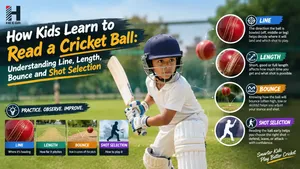 How Kids Learn to Read a Cricket Ball: Understanding Line, Length, Bounce and Shot SelectionLearn how kids can read a cricket ball by understanding line, length, bounce and shot selection to develop better batting skills and confidence.
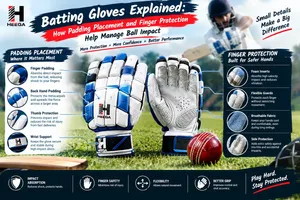 Batting Gloves Explained: How Padding Placement and Finger Protection Help Manage Ball ImpactLearn how batting glove padding placement, finger protection, and fit help manage ball impact. Find practical tips for choosing cricket batting gloves.
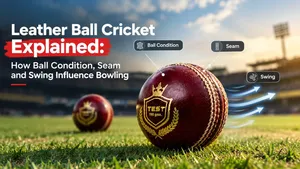 Leather Ball Cricket Explained: How Ball Condition, Seam and Swing Influence BowlingLearn how leather ball cricket works and how ball condition, seam position, shine, and swing influence bowling accuracy, movement, and performance.