How Kids Learn to Read a Cricket Ball: Understanding Line, Length, Bounce and Shot Selection
Introduction: Helping Kids Understand the Ball Before Hitting It
When children first start playing cricket, one of their biggest goals is often to hit the ball as hard as possible. They concentrate on their bat swing, try to score boundaries and enjoy the excitement of making contact.
However, becoming a better batter involves much more than swinging the bat.
Young players need to learn how to watch the ball, understand where it is going, judge how it will bounce and choose an appropriate response. These skills are collectively part of learning to read a cricket ball.
A child who understands the delivery can begin making better decisions before attempting a shot. Instead of reacting randomly, they can recognize whether the ball is likely to reach them on the front foot, bounce short enough for a back-foot shot or require a defensive response.
This ability develops gradually through observation, practice, coaching and experience.
For parents, coaches and young players, understanding the basics of line, length, bounce and shot selection can make cricket training more educational and enjoyable.
In this guide, we explain how kids can develop these skills step by step, explore simple practice activities and show how good decision-making helps build a stronger batting foundation.
1. What Does It Mean to Read a Cricket Ball?
Reading a cricket ball means observing a delivery and using the available information to decide how to respond.
A batter needs to notice several things:
- Where the bowler releases the ball.
- The direction in which the ball travels.
- Where the ball is likely to pitch.
- How high it may bounce.
- How much time is available to play a shot.
- Which batting response is appropriate.
These observations happen quickly during a match. However, children do not need to master everything at once.
At the beginning, they can focus on watching the ball carefully and identifying where it travels.
As their skills improve, they can start predicting the bounce, moving their feet and selecting different shots.
Why Reading the Ball Matters
A batter who watches the ball carefully has a better opportunity to judge its path and prepare for contact.
This can help young players:
- Improve hand-eye coordination.
- Develop better timing.
- Make more appropriate shot choices.
- Understand when to defend.
- Recognize deliveries that require forward or backward movement.
- Build confidence against different bowlers.
Reading the ball does not guarantee that every delivery will be played successfully. Cricket includes unpredictable movement, changes in bounce and deliveries that are difficult to judge.
The goal is to help children make increasingly informed decisions.
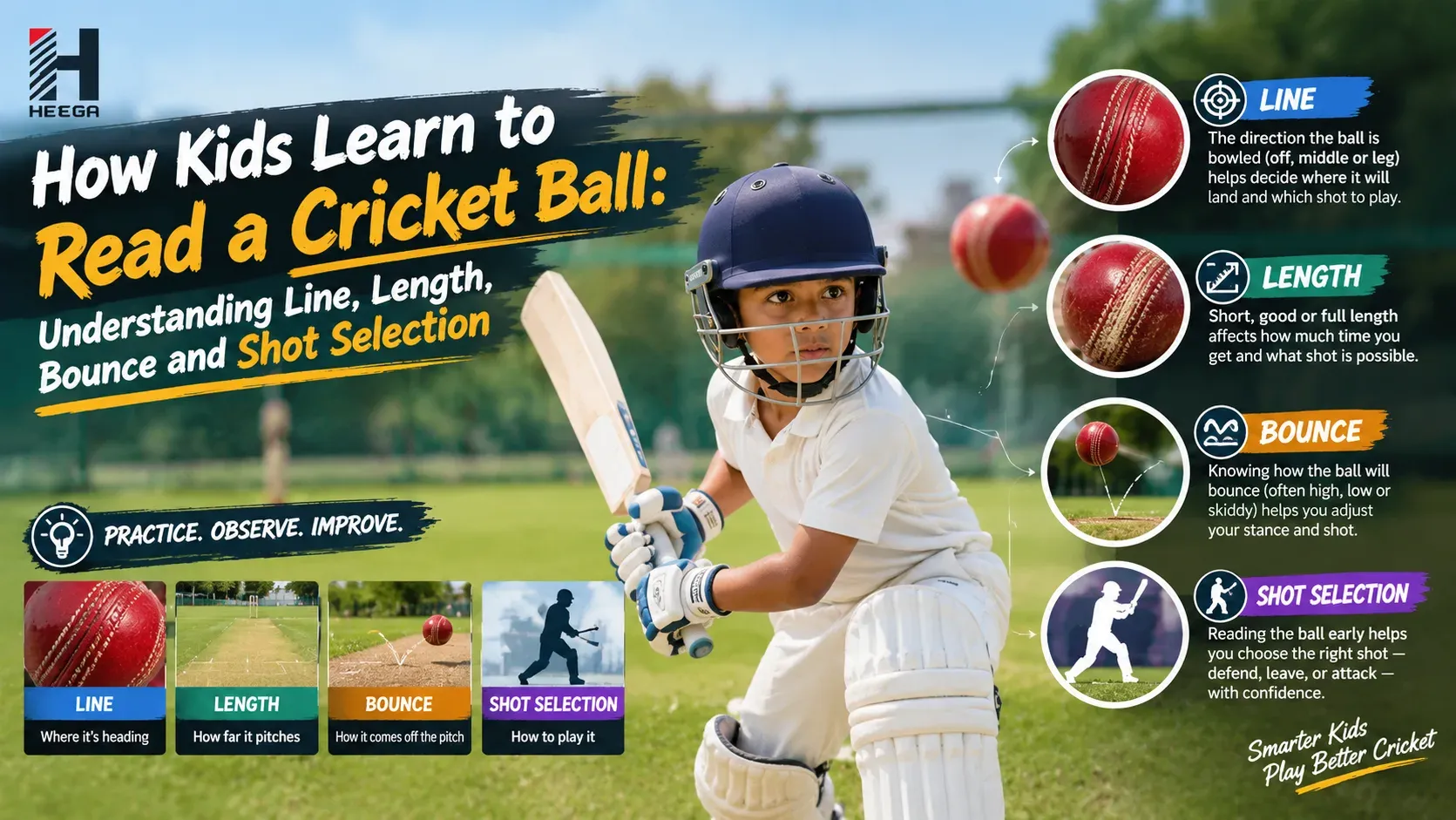
2. Understanding Line: Where Is the Ball Going?
Line describes the direction of a delivery in relation to the batter and the wickets.
For young players, the simplest way to understand line is to ask: Is the ball coming toward the stumps, toward the batter's body or away from the batter?
The answer helps the batter decide how to position their body and bat.
Line Around the Stumps
A delivery aimed at the stumps may require the batter to defend their wicket or choose an appropriate scoring shot.
If the ball threatens the stumps, the batter needs to ensure that the bat or another legal defensive response protects the wicket when necessary.
Children can begin by learning to identify balls that are likely to hit the stumps if left alone.
Line Outside Off Stump
The off side is the side of the batter's body opposite the legs when they take their normal batting stance.
A delivery outside off stump may be suitable for a cover drive, a cut or a defensive stroke, depending on its length and width.
However, not every ball outside off stump should be attacked.
Young players should learn to judge whether they can reach the ball comfortably and whether the shot is appropriate.
Line Toward the Leg Side
The leg side is the side of the batter's body where the legs are positioned.
Deliveries toward this side may offer opportunities for flicks, clips or other controlled shots.
The correct response depends on where the ball pitches, its height and how close it passes to the body.
Children should learn to maintain balance rather than reaching awkwardly for a ball that is too close or too far away.
Simple Line Recognition Drills
Exercise 1: Stump Line
Ask a coach to deliver gentle underarm balls toward the stumps. The child identifies whether the ball is on a line that threatens the wicket and practises an appropriate defensive response.
Exercise 2: Outside-Off Line
Place a marker outside off stump. Deliver balls along different lines and ask the child to identify which deliveries can be played comfortably and which should be left alone when the rules and situation permit.
Exercise 3: Leg-Side Line
Use soft practice balls to help the child recognize deliveries toward the legs. Practise balanced, controlled movements instead of swinging at every ball.
These exercises teach children to observe the delivery before deciding what to do.
3. Understanding Length: Where Will the Ball Pitch?
Length describes where the bowler's delivery pitches in the area between the bowler and the batter.
It is one of the most important clues a batter uses to judge how to move.
For children, understanding length begins with recognizing three broad categories:
- Full deliveries.
- Good-length deliveries.
- Short deliveries.
These categories are not fixed distances for every situation. Their effect depends on bowling speed, bounce, pitch conditions and the batter's position.
What Is a Full Delivery?
A full delivery pitches relatively close to the batter.
Depending on its line and pace, it may allow the batter to move forward and play a drive, a defensive stroke or another suitable front-foot shot.
A child who recognizes a full delivery early can begin moving forward while maintaining balance.
However, a full delivery is not automatically easy to hit. A fast, swinging or well-directed full ball can still be difficult.
What Is a Good-Length Delivery?
A good-length delivery pitches in an area that makes the batter decide whether to play forward or backward.
The exact area varies with the bowler, pitch and pace of the delivery.
Good-length balls can be challenging because the batter may have less time to make a comfortable decision.
Young players should learn to stay balanced and avoid committing too early.
What Is a Short Delivery?
A short delivery pitches farther away from the batter and generally has more room to rise before reaching them.
Depending on its speed and bounce, it may be suitable for a pull, cut, defensive response or another appropriate shot.
Children should not assume that every short ball needs to be attacked. Their first priority should be judging the bounce and staying safe.
The Front-Foot and Back-Foot Connection
Length helps the batter decide whether to move forward or backward.
A full ball may encourage a front-foot movement. A short ball may require backward movement. A good-length delivery may require the batter to assess the bounce before committing.
The objective is not to memorize a rule that every delivery receives one particular shot.
Instead, children should learn to use length as information and combine it with line, pace and bounce.
Simple Length Recognition Drills
Full-Ball Practice
Deliver gentle balls that pitch closer to the batter. Ask the child to identify the length and practise a balanced forward movement.
Short-Ball Recognition
Use soft balls and controlled feeds that bounce farther from the batter. Let the child practise moving backward and maintaining a balanced position.
Mixed-Length Practice
Alternate between full and shorter deliveries. Before each ball, ask the child to describe its length and explain the movement they intend to use.
Mixed practice helps children learn to observe each delivery instead of automatically repeating the same movement.
4. Understanding Bounce: What Happens After the Ball Pitches?
Bounce refers to how the ball rises after striking the ground.
Two deliveries with similar lines and lengths can behave differently because of their speed, spin, seam position and the surface on which they pitch.
For young batters, judging bounce helps determine where the ball may reach them and how to position the bat.
Why Does a Cricket Ball Bounce?
When the ball hits the pitch, its movement changes because of the collision between the ball and the surface.
The height and direction of the rebound depend on several factors, including:
- The speed and angle of the delivery.
- The surface of the pitch.
- The ball's seam position and rotation.
- Whether the ball deviates after pitching.
- The condition of the playing surface.
Children do not need to understand all the physics immediately. They can start by observing whether a ball bounces low, rises to a comfortable height or climbs higher than expected.
Low Bounce
A ball with low bounce stays closer to the ground after pitching.
A batter may need to lower the bat, bend their knees or adjust their position to play it safely.
Children should learn not to assume that a ball will always rise to the same height.
Higher Bounce
A delivery that rises higher than expected may reach the batter around the waist, chest or shoulder area, depending on the situation.
The appropriate response depends on the height, line, pace and rules of the match.
Young players should prioritize safety and learn from a qualified coach how to respond to short-pitched bowling.
Uneven Bounce
Some playing surfaces produce inconsistent bounce.
A ball may rise higher or lower than the batter expects, making it more difficult to time the shot.
This is one reason why watching the ball all the way toward the bat is an important habit.
Watching the Ball After It Pitches
Children sometimes watch the ball leave the bowler's hand but lose focus when it reaches the ground.
Coaches can encourage them to track the ball continuously—from release, to pitching, to contact.
This helps the child gather information about the delivery's movement.
Bounce Recognition Drill
Use soft practice balls on a safe, level area.
Ask the child to observe each ball and describe its bounce as low, medium or high. After they become comfortable with the exercise, introduce gentle feeds with different lengths.
The aim is observation first, followed by controlled batting practice.
Never use unpredictable high-bounce drills with young beginners without appropriate supervision and protective equipment.
5. How Kids Learn to Select the Right Shot
Shot selection means choosing an appropriate batting response to the delivery.
It is not simply about deciding which shot can score the most runs. A good decision considers the ball's line, length, bounce, pace, the batter's position and the match situation.
Young players should understand that defending a delivery or choosing not to hit it can be just as valuable as playing an attacking shot.
Defensive Shot
A defensive shot is used to protect the wicket or manage a difficult delivery.
Children can begin with a basic forward or backward defensive technique, depending on the length of the ball.
The objective is to control the bat and meet the ball safely rather than attempting to hit it hard.
Front-Foot Drive
A drive is often suitable when the ball is full enough and positioned within a comfortable hitting area.
The batter moves forward, maintains balance and swings the bat through the ball.
Young players should first practise the movement with a stationary ball or gentle feeds before trying to hit faster deliveries.
Cut Shot
A cut is generally played against a suitable shorter delivery outside off stump.
It requires the batter to position the body and bat appropriately while maintaining control.
Children should learn that reaching too far away from the body can cause poor balance and mistimed contact.
Pull Shot
A pull shot can be used against a suitable short-pitched delivery.
However, the batter must judge the height, pace and line before deciding whether the shot is appropriate.
For younger players, the movement should be introduced progressively with safe, controlled feeds and qualified coaching.
Flick or Clip
A flick or clip can be useful against a delivery directed toward the legs.
The batter uses controlled bat movement and timing to direct the ball toward the leg side.
Children should focus on balance and making contact in a comfortable position rather than forcing power.
When Should a Child Leave the Ball?
In cricket formats and situations where leaving the ball is permitted, learning when not to play a shot is an important skill.
A batter may leave a delivery that is too wide or unlikely to threaten the stumps, depending on the line and circumstances.
This teaches patience and decision-making.
Children should understand that batting is not about hitting every delivery. It is about choosing the right response.
6. The Four-Step Method for Reading a Cricket Ball
Young players can simplify the learning process by following four steps.
Step 1: Watch
Keep your eyes on the ball as it leaves the bowler's hand. Avoid looking away too early.
Step 2: Judge the Line
Notice whether the ball is moving toward the stumps, outside off stump or toward the legs.
Step 3: Read the Length and Bounce
Observe where the ball pitches and how it rises. Use this information to prepare your movement.
Step 4: Choose the Response
Decide whether to defend, move forward, move backward, play an appropriate scoring shot or leave the delivery when permitted.
With practice, children can gradually make these decisions more quickly and naturally.
7. Why Footwork Is Essential for Reading the Ball
Reading the ball and moving the feet are closely connected.
A child may correctly identify a full delivery but still struggle if they cannot move forward in a balanced way. Similarly, recognizing a short ball is only useful if the batter can move backward or adjust their position safely.
Moving Forward
When a delivery is suitable for a front-foot response, the batter needs to move into a comfortable position while keeping their head and body balanced.
The movement should be controlled rather than rushed.
Moving Backward
Against suitable shorter deliveries, moving backward can create space and help the batter adjust to the bounce.
Children should learn to move without losing their balance or turning away from the ball unnecessarily.
Staying Balanced
Good balance allows the batter to control the bat and recover after playing a shot.
If the player falls forward or backward, it becomes harder to direct the ball consistently.
Coaches can use shadow batting, where children practise without a moving ball, to develop footwork and balance before combining the movements with deliveries.
8. How to Teach Kids to Read the Ball Through Fun Drills
Young players learn best when training activities are engaging, progressive and appropriate to their abilities.
The following drills help develop observation, decision-making and batting control.
Drill 1: Watch and Call
A coach or parent gently feeds a ball toward the child.
Before playing it, the child calls out a simple description, such as:
- "Full."
- "Short."
- "Outside off."
- "On the stumps."
The child then attempts an appropriate response.
Start slowly and allow enough time for the child to observe the delivery. Increase the variety only when the player is comfortable.
Drill 2: Front Foot or Back Foot?
The coach alternates between safe, controlled feeds of different lengths.
The child identifies whether the ball calls for forward or backward movement.
At first, the player can simply make the movement without hitting the ball. Later, the drill can progress to controlled batting.
This helps children connect the information they see with the movement they need.
Drill 3: Choose Your Shot
Set up a safe practice area and explain a few basic shots.
The coach delivers a ball and asks the child to choose a suitable response based on the line and length.
The focus should be on explaining the decision, not on scoring runs.
For example, the child might say that a full ball outside the stumps is suitable for a controlled drive, provided it is within comfortable reach.
There may be more than one reasonable response to a delivery. Encourage the child to explain their choice rather than insisting that every ball has only one correct shot.
Drill 4: Soft-Ball Reaction Practice
Use a soft cricket ball and gentle feeds.
Ask the child to track the ball and make a controlled movement toward it.
This can help develop hand-eye coordination and confidence while keeping the exercise appropriate for beginners.
Drill 5: The Leave-or-Play Game
Mark a safe practice area representing a simplified off-stump line.
The coach delivers balls with different lines. The child decides whether to play or leave each delivery when leaving is appropriate under the practice rules.
Award praise for good decisions, not only for successful shots.
This encourages patience and teaches children that they do not need to attack every ball.
Drill 6: Target Batting
Place safe targets in different areas of the practice space.
Give the child a simple task, such as directing a gentle delivery toward a particular target using a suitable shot.
This helps develop control and encourages players to think about where they want the ball to go.
9. Common Mistakes Kids Make When Reading a Cricket Ball
Learning to read the ball takes time. Mistakes are a normal part of the process.
Recognizing common problems can help parents and coaches guide children more effectively.
Swinging Before Watching
Some children decide to swing the bat before they have properly observed the delivery.
This often leads to mistimed shots or poor contact.
How to help: Start with gentle feeds and ask the child to track the ball carefully before making a decision.
Playing Every Ball Aggressively
Young batters may believe that hitting hard is the best way to score.
However, aggressive shots are not suitable for every line or length.
How to help: Reward good defensive decisions and controlled shots alongside boundaries.
Moving Too Early
A child may commit to moving forward or backward before they have enough information about the delivery.
This can leave them in an uncomfortable position.
How to help: Use slower feeds and encourage the child to watch the ball before deciding how to move.
Ignoring the Bounce
Some children focus on the ball's direction but fail to adjust after it pitches.
They may swing too early or position the bat at the wrong height.
How to help: Use bounce-recognition drills with soft balls and ask the child to describe what they observed.
Losing Balance
Overreaching or swinging too hard can cause the batter to lose their balance.
This makes it difficult to control the bat and recover for the next delivery.
How to help: Begin with shadow batting and controlled movements, gradually introducing more realistic feeds.
Becoming Afraid of Missing
Some children lose confidence after missing a few deliveries.
They may begin closing their eyes, turning away or swinging too early.
How to help: Use softer balls, reduce the pace and celebrate improvements in observation and decision-making. Avoid criticizing every miss.
10. How Parents Can Support Their Child's Cricket Learning
Parents can play a helpful role in developing a child's understanding of cricket.
They do not need to be expert coaches to encourage good habits.
Ask Questions After Practice
Instead of asking only how many runs the child scored, ask:
- Which delivery was easiest to read?
- How did you know the ball was full?
- When did you decide to move backward?
- Which shot felt most comfortable?
- Was there a ball you were better off leaving?
These questions help children reflect on their decisions.
Praise Good Decisions
A child can make the right decision and still miss the ball.
For example, they may correctly identify a delivery as short but fail to time the shot.
Praise the recognition and the attempt, then help them understand what they can improve next time.
Avoid Comparing Children
Every young player develops at a different pace.
Some children quickly recognize line and length, while others need more practice.
Comparing one child with another may create unnecessary pressure.
Focus on individual progress and encourage consistent effort.
Keep Practice Enjoyable
Short, focused sessions can be more productive for beginners than long sessions filled with complicated instructions.
Include games, targets and simple challenges to make learning engaging.
The aim is to build confidence and a lasting interest in cricket.
11. How Cricket Equipment Supports Learning
Suitable equipment helps children practise safely and focus on developing their skills.
The equipment required depends on the player's age, ability and the type of cricket being played.
Choose an Appropriate Bat
A bat should be manageable for the child and suited to their height and strength.
A bat that is too heavy may make it difficult to control the swing or practise balanced movements.
Use Suitable Practice Balls
Soft balls can help beginners learn to watch the ball, identify line and length, and practise basic batting responses.
As their skills develop, they can progress to harder balls under suitable coaching and safety conditions.
Wear Appropriate Protection
When practising with hard cricket balls, children should use properly fitted protective equipment appropriate to the activity, including a suitable helmet and other required guards.
Protective equipment should be maintained in good condition and used according to the manufacturer's instructions and the coach's guidance.
Practise in a Suitable Space
A safe practice area gives children enough room to move without unnecessary hazards.
Cricket nets can help contain balls during supervised batting practice, while cones and markers can be used for simple movement and target drills.
Equipment supports the learning process, but it should always be combined with appropriate supervision and safe training methods.
12. A Simple Weekly Plan for Learning to Read the Ball
Children benefit from practising one or two key skills at a time. The following example can be adapted to their age, ability and training schedule.
Day 1: Line Recognition
Practise identifying balls directed toward the stumps, outside off stump and toward the legs.
Day 2: Length Recognition
Use gentle feeds to help the child distinguish between full, good-length and short deliveries.
Day 3: Bounce and Tracking
Practise watching the ball from release through pitching and toward the batting position.
Day 4: Shot Selection
Introduce simple defensive shots, controlled drives and appropriate forward or backward movement.
Day 5: Mixed Practice
Combine line, length, bounce and shot selection in a short, supervised session with varied deliveries.
Rest days and lighter activities can be included according to the child's schedule. Practice should be age-appropriate, enjoyable and free from unnecessary pressure.
13. How Learning to Read the Ball Builds Long-Term Batting Skills
Reading the ball is a foundation for several other batting abilities.
As children become better at recognizing deliveries, they can begin developing more advanced skills.
Better Timing
When a batter understands the delivery's path and bounce, they can prepare for contact more effectively.
This may help improve timing over repeated practice.
Improved Shot Selection
Recognizing line and length gives the batter more information when deciding which shot to play.
Over time, children can learn to avoid unsuitable shots and use their strengths more effectively.
Stronger Footwork
Reading the delivery encourages the batter to move in response to the ball rather than remaining fixed in one position.
This helps connect observation with practical movement.
Greater Confidence
When children understand what they are seeing, unfamiliar deliveries may become less intimidating.
Confidence develops through successful experiences, useful feedback and repeated practice—not from expecting every ball to be played perfectly.
Better Match Awareness
During matches, a batter must respond to different bowlers, field placements and changing situations.
The ability to recognize deliveries and make decisions provides a useful foundation for adapting to these challenges.
14. How Heega Sports Supports Young Cricketers
At Heega Sports, we believe that every young player's cricket journey should begin with a strong foundation in skills, confidence and safe training habits.
Learning to read the ball takes practice, and appropriate equipment can help children develop these abilities in a suitable training environment.
Our cricket equipment range includes:
- Junior cricket bats in different sizes.
- Kashmir Willow cricket bats.
- Cricket batting gloves.
- Batting pads and protective guards.
- Cricket helmets.
- Leather cricket balls.
- Practice balls.
- Cricket kit bags.
- Practice nets.
- Cricket shoes and training accessories.
Whether a child is learning to recognize line and length for the first time or developing more advanced batting skills, suitable equipment can support their training routine.
Parents should select products according to the child's size, playing level and training requirements. For hard-ball practice, make sure the child has appropriate protective equipment and qualified supervision.
Explore the cricket equipment available at Heega Sports to help support your child's development on the field.
Final Thoughts: Teach Kids to Read the Ball, Not Just Hit It
Learning to read a cricket ball is one of the most valuable skills a young batter can develop.
Understanding line helps children judge where a delivery is travelling. Recognizing length helps them decide whether to move forward or backward. Observing bounce helps them prepare for the ball's height, while shot selection teaches them to respond with control and purpose.
These abilities develop gradually through observation, repetition, coaching and experience.
Parents and coaches can make the process easier by introducing one concept at a time, using safe practice activities and praising thoughtful decisions alongside successful shots.
Children should also learn that missing a ball is part of cricket. The aim is not to achieve perfection immediately, but to become better at recognizing deliveries and choosing an appropriate response.
With consistent, enjoyable practice, young players can build stronger batting foundations, improve their confidence and develop a deeper understanding of the game.
Ultimately, good batting begins before the bat meets the ball. It begins with watching carefully, understanding what the delivery is doing and deciding how best to respond.
Help Your Young Cricketer Learn and Grow with Heega Sports
Explore junior cricket bats, Kashmir Willow bats, batting gloves, batting pads, cricket helmets, practice balls, leather cricket balls, cricket shoes, kit bags, practice nets and training accessories.
Shop Now: https://heegasports.com
Heega Sports – Supporting Young Players as They Learn, Practise and Enjoy Cricket.
Related posts
 How Tennis Bats Help Beginners Learn Cricket: Understanding Weight, Size & Bat ControlLearn how tennis bats help beginners learn cricket by improving bat control, timing, balance, grip, confidence, and basic batting technique through simple practice.
 How Cricket Bat Willow Selection Affects Durability, Performance, and ValueLearn how cricket bat willow selection affects durability, performance and value. Compare willow types, grades, grains and factors that matter when choosing a bat
 How Young Cricketers Can Learn From Their Cricket Idols Without Copying ThemLearn how young cricketers can learn from their idols without copying them. Discover how to study technique, mindset, habits, and playing styles effectively.