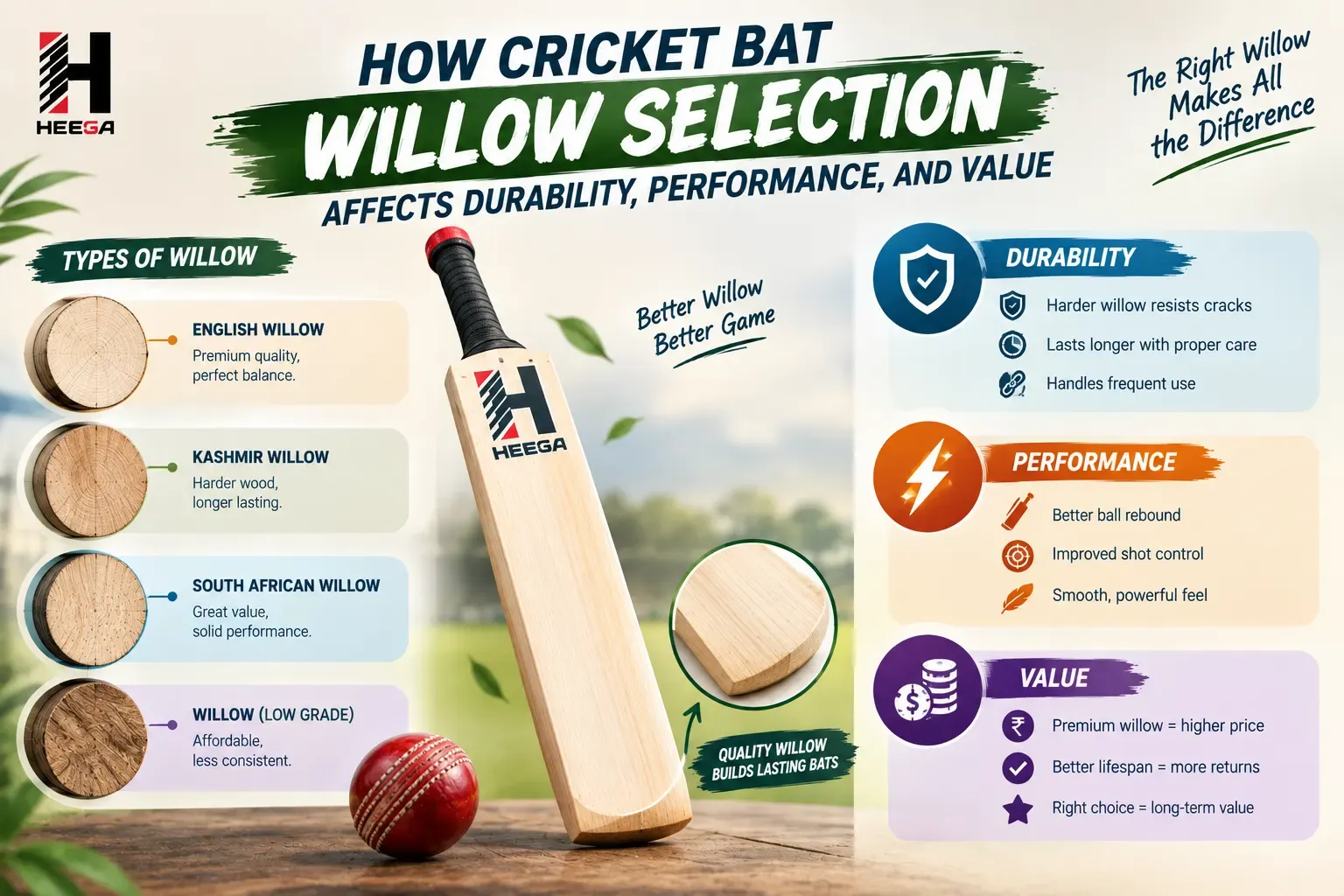
How Cricket Bat Willow Selection Affects Durability, Performance, and Value
Introduction: Why Willow Selection Matters in a Cricket Bat
When players start looking for a new cricket bat, the first things they often notice are the sticker, shape, edges and overall appearance.
Then comes the question that can make the decision much more complicated:
What type of willow should I choose?
Willow is the main material used to make the blade of a traditional cricket bat, and its characteristics can influence how the bat feels, performs and holds up over time.
You will often hear terms such as English Willow, Kashmir Willow, Grade 1, Grade 2, Grade 3, grains, clefts and pressing.
For a beginner, all of this can sound confusing.
Does more visible grain automatically mean a better bat?
Is English Willow always the right choice?
Does a more expensive bat last longer?
Is Kashmir Willow only for beginners?
The answer to these questions is not as simple as a price tag or grain count.
A cricket bat is a natural wooden product, so every piece of willow has its own characteristics. The final performance of the bat also depends on how the cleft is selected, shaped, pressed and finished.
In this guide, we will look specifically at cricket bat willow selection and explain how willow type and quality can influence durability, performance and overall value.
What Is Willow in a Cricket Bat?
Willow is the wood traditionally used to manufacture the blade of a cricket bat.
Two names appear most frequently when players shop for cricket bats:
- English Willow
- Kashmir Willow
Both are used to make cricket bats, but they have different characteristics and are positioned differently in the market.
The willow is cut into a cleft before the manufacturer shapes it into the final bat.
From that point, several factors influence the finished product, including:
- Natural characteristics of the wood
- Density
- Grain structure
- Cleft quality
- Pressing
- Bat profile
- Weight distribution
- Manufacturing quality
This is why simply saying “this bat has good willow” does not tell the entire story.
Why Cricket Bat Willow Selection Is Important
Willow selection affects several characteristics of a cricket bat.
Performance
The properties of the wood and the way it is prepared contribute to how the bat responds when the ball strikes the blade.
Durability
Natural wood varies in density and structure, so different clefts can respond differently to repeated impacts.
Weight
Willow density has a relationship with how much material is required to achieve a particular bat weight.
Feel
Players can notice differences in pickup, response and overall bat feel.
Value
Different willow types and grades are sold at different price levels.
The important point is that these factors are connected.
Choosing willow is not simply about buying the most expensive grade available.
English Willow vs Kashmir Willow
The most common comparison is between English Willow and Kashmir Willow.
Both are used for cricket bats, but they are generally associated with different price points and playing requirements.
FeatureEnglish WillowKashmir Willow
Common positioning
Premium and competitive bats
Value-focused and widely used bats
Typical price
Generally higher
Generally more affordable
Availability
Widely used in professional and serious cricket
Popular among beginners, schools and club players
Appearance
Often lighter and more traditionally associated with premium bats
Can have a different grain and colour appearance
Performance
Can offer a responsive playing feel
Can provide solid performance for its intended use
Durability
Depends on cleft and construction
Can be durable when properly selected and maintained
Best choice
Depends on player requirements
Depends on player requirements
These are broad characteristics, not guarantees.
A well-made bat should be judged as a complete product rather than solely by the name of the willow.
What Is English Willow?
English Willow is traditionally associated with high-quality cricket bat production and is widely used for premium bats.
It is valued by many players for its playing characteristics and is available in different grades.
English Willow clefts are natural products, so there can be significant variation between individual pieces of wood.
This means two bats made from English Willow can still feel very different.
The grade, cleft quality, manufacturing process and final profile all matter.
What Is Kashmir Willow?
Kashmir Willow is another type of willow used extensively in cricket bat manufacturing.
It is particularly common in bats aimed at:
- Beginners
- Junior players
- School cricket
- Academy training
- Club cricket
- Recreational cricket
One reason for its popularity is that it provides a more accessible price point for many players.
That does not mean every Kashmir Willow bat is identical.
The quality of the cleft, manufacturing and final construction still influence the finished bat.
Is English Willow Always Better Than Kashmir Willow?
There is no need to reduce the decision to simply “English is better.”
The more useful question is:
Which willow is appropriate for the player's level, budget and intended use?
A young player who is still learning the basics may not need a premium bat.
A club player who trains several times a week may have different requirements.
A serious competitive player may place greater importance on the feel and response associated with a particular bat.
The right choice depends on the player.
Understanding Cricket Bat Willow Grades
If you have looked at cricket bats online, you have probably seen terms such as:
- Grade 1
- Grade 2
- Grade 3
- Grade 4
These grading systems are commonly used to communicate differences in the appearance and characteristics of willow.
However, grading terminology is not perfectly standardized across every manufacturer.
One company's Grade 1 should not automatically be assumed to be identical to another company's Grade 1.
This is why players should read the manufacturer's description and consider the complete bat rather than relying on the grade number alone.
What Does Grade Actually Tell You?
Grade can provide useful information about the cleft, but it should not be treated as a complete performance guarantee.
Depending on the manufacturer, grading may take into account factors such as:
- Grain appearance
- Knots
- Blemishes
- Colour
- Natural marks
- Overall cleft characteristics
The important thing to understand is that visual appearance and playing performance are not exactly the same thing.
A bat that looks beautiful can still feel wrong for a particular player.
And a bat with minor natural marks can perform very well.
Do More Grains Mean a Better Cricket Bat?
This is one of the most common questions players ask.
The short answer is:
Not necessarily.
Grain count can be one visible characteristic of a willow cleft, but it should not be used as the only measure of quality.
Other factors matter, including:
- Grain consistency
- Grain straightness
- Cleft density
- Willow characteristics
- Pressing
- Bat construction
- Profile
- Weight distribution
- Intended use
A player can easily become distracted by counting grains while overlooking how the bat actually feels.
Why Grain Appearance Gets So Much Attention
Grains are easy to see.
That makes them attractive to both buyers and sellers.
Straight, clean-looking grains can give a bat a premium appearance.
However, natural willow is not manufactured like plastic or metal.
Every cleft has its own characteristics.
Some natural variation is normal.
Small marks, colour variations or differences in grain appearance do not automatically mean that a bat is unsuitable.
Willow Density and Bat Weight
Willow density is another factor that can influence bat construction.
A denser piece of wood can require different shaping to achieve a particular finished weight.
This is one reason bats with similar dimensions can have different weights.
Manufacturers have to work with the natural material rather than starting with identical pieces of wood.
For players, the practical takeaway is simple:
Do not judge willow only by appearance.
Pay attention to how the finished bat feels.
Willow Selection and Bat Durability
Durability is often misunderstood.
Some players assume that buying the most expensive willow automatically means the bat will last longer.
That is not necessarily true.
Bat durability depends on many factors.
These include:
- Willow characteristics
- Pressing
- Bat preparation
- Ball type
- Frequency of use
- Playing conditions
- Batting technique
- Storage
- Toe protection
- Edge protection
- General maintenance
A premium bat can be damaged through poor handling.
Likewise, a more affordable bat can provide a long service life when it is properly prepared and maintained.
Why Pressing Matters
Pressing is part of the manufacturing process used to prepare the willow for cricket.
The objective is to make the blade suitable for repeated ball impact while retaining useful playing characteristics.
The amount and method of pressing can influence how the finished bat responds.
Too much emphasis on one specification can therefore be misleading.
Players should remember that willow selection and manufacturing are connected.
A good cleft still needs to be turned into a properly constructed cricket bat.
How Willow Selection Affects Performance
The performance of a bat is not determined by willow type alone.
However, the natural characteristics of the willow contribute to the way the finished blade behaves.
Players may notice differences in:
- Ball response
- Feel at impact
- Feedback through the hands
- Overall bat character
- Weight
- Pickup
These differences become particularly noticeable to experienced players who are already comfortable with their technique.
For beginners, technique and bat control are often more important than chasing the finest available willow grade.
Willow Selection and Bat Pickup
Pickup refers to how the bat feels when you lift and move it.
Two bats with the same stated weight can have different pickup.
Why?
Because weight distribution is not identical.
Willow density, blade profile, edges, spine and handle construction all contribute to the final balance.
This means willow selection should not be considered separately from bat design.
The cleft is only the starting material.
Why the Same Willow Can Produce Different Bats
Imagine two bats made from the same general type of willow.
They can still feel completely different.
One might have:
- A thicker spine
- Larger edges
- A lower sweet spot
- More weight toward the blade
Another might have:
- A different profile
- A lighter pickup
- A different spine position
- Different weight distribution
So when players say they prefer a certain willow type, what they actually like may be a combination of willow characteristics and bat construction.
Cricket Bat Willow Selection for Beginners
Beginners usually do not need to start with the most expensive willow available.
At this stage, the player is still developing:
- Grip
- Stance
- Footwork
- Bat swing
- Timing
- Shot selection
- Defensive technique
A practical bat that is comfortable and manageable can be more useful than an expensive bat that is too heavy or difficult to control.
For beginners, consider:
- Appropriate size
- Manageable weight
- Comfortable pickup
- Suitable willow
- Good protection
- Reasonable price
Cricket Bat Willow Selection for Academy Players
Academy players generally train more frequently.
Their bat may be used for:
- Net sessions
- Throwdowns
- Technical drills
- Bowling-machine practice
- Match preparation
- Competitive matches
At this stage, players can start paying more attention to willow characteristics.
However, durability should remain a consideration because frequent training means the bat receives a lot of use.
A good academy bat should provide a sensible balance between performance, durability and cost.
Cricket Bat Willow Selection for Club Players
Club players often sit in the middle of the equipment spectrum.
They may play competitive cricket every weekend and train during the week.
For them, the bat needs to be practical.
A club player should think about:
- How frequently the bat will be used
- Match conditions
- Training surfaces
- Budget
- Pickup
- Willow type
- Maintenance requirements
A bat that performs well but is too expensive for the player's circumstances may not provide the best overall value.
Cricket Bat Willow Selection for Advanced Players
Experienced players may have more specific preferences.
They may already know:
- Their preferred bat weight
- Sweet-spot position
- Handle shape
- Balance
- Edge profile
- Willow type
- Pickup
At this stage, willow selection can become a more detailed part of the buying process.
An advanced player may notice subtle differences that a beginner would barely recognize.
How Budget Should Influence Willow Choice
Price is one of the easiest ways to create confusion.
Players often assume:
Higher price = better bat for me.
That is not always true.
A premium willow bat can be excellent, but if the player does not need its particular characteristics, the extra cost may not provide meaningful value.
A better approach is to divide the decision into three questions:
What Level Do I Play?
Beginner, academy, club or advanced?
How Often Do I Play?
Occasional, weekly or several times per week?
What Can I Comfortably Spend?
Set a realistic budget before comparing grades.
This makes the buying process much easier.
Cricket Bat Willow: Performance vs Value
A good-value bat is not necessarily the cheapest bat.
Value means getting equipment that makes sense for your use.
For example:
A beginner who plays occasionally may get excellent value from an affordable willow bat.
A serious club player who trains constantly may consider spending more because the bat receives much more use.
An advanced player may have very specific performance requirements that justify a higher-end product.
The right value is personal.
Can a More Expensive Willow Bat Last Longer?
Not automatically.
Price can reflect factors such as:
- Willow grade
- Cleft selection
- Manufacturing
- Finishing
- Brand positioning
- Quality control
- Bat profile
- Overall construction
But none of these guarantees that a particular bat will last longer for every player.
A bat that is prepared correctly and maintained carefully can have a useful life well beyond what its price might suggest.
Cricket Bat Willow and Natural Imperfections
Natural willow is not perfectly uniform.
Players may notice:
- Small knots
- Colour differences
- Grain variations
- Specks
- Minor marks
These can be natural characteristics of the wood.
They should not automatically be interpreted as structural defects.
This is one reason experienced buyers look at the complete bat rather than judging it only by photographs.
Why Appearance Should Not Be Your Only Buying Factor
A bat can look fantastic in a product photograph.
But the photograph cannot tell you everything.
It may not show:
- Exact pickup
- Actual feel
- Weight distribution
- Handle comfort
- Response during impact
- How the bat suits your technique
If you can physically test a bat, do so.
If you are buying online, pay close attention to the manufacturer's specifications and return or exchange policy where available.
What to Check When Buying a Willow Cricket Bat
Before purchasing, look at the following.
1. Willow Type
Understand whether it is English Willow or Kashmir Willow.
2. Grade
Check what the manufacturer means by the stated grade.
3. Weight
Make sure the weight is appropriate for your ability.
4. Pickup
The bat should feel manageable when lifted.
5. Profile
Consider where the bulk of the blade sits.
6. Grains
Look at them, but do not treat grain count as the only quality measure.
7. Protection
Check toe and edge protection.
8. Intended Use
Make sure the bat matches your level of cricket.
9. Price
Compare the overall package rather than the willow grade alone.
English Willow Grades: What Players Should Understand
Different manufacturers may use different grading systems for English Willow.
A common mistake is assuming that a higher grade number or lower grade number has exactly the same meaning everywhere.
It does not.
Before buying, read the manufacturer's description.
Ask:
- How is the willow selected?
- What does the stated grade represent?
- Is the grade based mainly on appearance?
- What playing level is the bat intended for?
- What weight options are available?
This prevents a lot of confusion.
Kashmir Willow Grades and Quality
The same principle applies to Kashmir Willow.
Not every Kashmir Willow cleft is identical.
Manufacturers may classify bats differently based on factors such as:
- Appearance
- Grain structure
- Cleft quality
- Manufacturing
- Intended price range
A good Kashmir Willow bat can be a practical choice for many players.
The important thing is to understand what you are buying rather than assuming the willow label tells the entire story.
Does Grain Count Predict Bat Performance?
Grain count alone is not a reliable performance guarantee.
This deserves repeating because it is one of the most common buying misconceptions.
A player may see a bat with many straight grains and assume it must automatically outperform another bat with fewer visible grains.
But performance depends on more than that.
The quality of the cleft, density, pressing, profile, weight and manufacturing all contribute.
Think of grains as one piece of information, not the final answer.
Willow Selection and Bat Maintenance
No willow type is completely maintenance-free.
Every wooden cricket bat benefits from sensible care.
Players should:
- Keep the bat dry
- Store it properly
- Avoid extreme moisture
- Inspect the toe
- Check for cracks
- Avoid unsuitable hard surfaces
- Follow preparation instructions
- Repair damage early
Good maintenance can help preserve the bat regardless of willow type.
How Ball Type Affects Willow Durability
The type of ball also matters.
A bat used regularly with a proper leather cricket ball experiences different impact conditions from one used mainly with softer training balls.
Players should use the bat according to its intended purpose.
If a bat is designed for certain levels of play, using it on unsuitable surfaces or with excessive force can accelerate wear.
Willow selection and usage should always be considered together.
Why Preparation Matters After Willow Selection
Choosing good willow is only the beginning.
The finished bat still needs appropriate preparation.
Depending on the bat, preparation may involve:
- Knocking-in
- Edge care
- Toe protection
- Checking for loose material
- Following manufacturer recommendations
Players should not assume that a higher-grade bat can be used carelessly straight out of the packaging.
Proper preparation helps the bat transition into regular use.
Common Cricket Bat Willow Selection Mistakes
Mistake 1: Choosing Only by Grain Count
More visible grains do not automatically mean better performance.
Mistake 2: Assuming English Willow Is Always the Best Choice
The right willow depends on the player and intended use.
Mistake 3: Buying the Most Expensive Grade
Premium pricing does not automatically mean better value for every player.
Mistake 4: Ignoring Weight
A beautiful willow bat is not useful if the player cannot control it.
Mistake 5: Ignoring Pickup
Total weight does not tell the whole story.
Mistake 6: Treating Grades as Universal
Different manufacturers may use different grading systems.
Mistake 7: Forgetting Maintenance
Even a premium bat can deteriorate through poor storage and handling.
A Simple Willow Selection Guide
PlayerWillow ConsiderationMain Priority
Beginner
Affordable, suitable willow
Control and learning
School Player
Durable and manageable
Practical value
Academy Player
Quality construction
Performance and regular use
Club Player
Suitable willow and profile
Balance of performance and durability
Advanced Player
Specific grade and cleft preferences
Feel and performance
This is only a general guide.
A player's individual needs should always come first.
How to Get Better Value From Your Cricket Bat
You do not always need to spend more.
Instead, make the most of the bat you buy.
Choose the Correct Weight
A manageable bat is more useful than an unnecessarily heavy one.
Match the Willow to Your Level
Do not buy beyond your actual needs.
Maintain the Bat
Good care can protect your investment.
Use the Bat Correctly
Avoid unsuitable surfaces and unnecessary impacts.
Repair Damage Early
Small problems are easier to deal with than major structural damage.
Willow Selection and the Long-Term Cost of Cricket
The cheapest bat is not always the least expensive option over time.
Suppose a player buys a very low-cost bat but replaces it frequently because it does not suit their playing requirements.
Another player spends more on a suitable bat and maintains it carefully for several seasons.
The second player may ultimately get better value.
This is why value should be measured over the useful life of the bat, not just at the moment of purchase.
How Willow Selection Connects With Bat Balance
Willow and balance are closely related.
The density and distribution of the wood influence how manufacturers shape the bat.
Once the blade is shaped, other factors such as:
- Spine
- Edges
- Toe
- Shoulders
- Handle
further affect the final balance.
This is why a player should not choose willow in isolation.
You are not buying a piece of wood.
You are buying a complete cricket bat made from that wood.
How Willow Selection Connects With Bat Toe Protection
The toe is one of the areas where willow is exposed to the playing environment.
Regardless of whether the bat is English Willow or Kashmir Willow, proper toe protection and maintenance remain important.
A premium willow bat can still suffer moisture damage if the toe is neglected.
Likewise, an affordable bat can benefit from good protection and sensible storage.
Willow quality and maintenance work together.
Heega Sports: Choosing Cricket Bats With the Player in Mind
At Heega Sports, cricket equipment is designed around the practical needs of players at different stages of the game.
A cricket bat is more than a willow grade printed on a product description.
The complete experience depends on the combination of:
- Willow
- Bat profile
- Weight
- Balance
- Pickup
- Handle
- Toe protection
- Finishing
- Intended level of play
For beginners, academy players and club cricketers, the most useful bat is one that matches their actual requirements.
That may mean choosing a practical Kashmir Willow bat for regular training, or selecting a higher-end willow option when the player's experience and playing requirements justify it.
The goal should always be to choose equipment that feels right for the player rather than buying based only on appearance, price or a grade number.
Frequently Asked Questions About Cricket Bat Willow Selection
1. What is cricket bat willow?
Willow is the wood used to make the blade of a traditional cricket bat. English Willow and Kashmir Willow are two common types used in cricket bat manufacturing.
2. Is English Willow better than Kashmir Willow?
They serve different market segments and player requirements. English Willow is commonly associated with premium cricket bats, while Kashmir Willow is widely used for affordable and practical bats. The right choice depends on the player.
3. Does more grain mean a better cricket bat?
No. Grain appearance is only one factor. Cleft quality, density, pressing, profile, weight and manufacturing also affect the finished bat.
4. What does cricket bat willow grade mean?
Grade is a classification used by manufacturers to describe characteristics of a willow cleft or bat. Grading systems can differ between manufacturers, so players should check the individual brand's explanation.
5. Does willow type affect bat durability?
It can contribute to the characteristics of the finished bat, but durability also depends heavily on preparation, usage, playing conditions, storage and maintenance.
6. Which willow is best for beginners?
There is no universal answer. Beginners should generally prioritize an appropriately sized, manageable and practical bat rather than choosing willow purely based on premium positioning.
7. Is Kashmir Willow suitable for club cricket?
Yes. Kashmir Willow bats can be suitable for club players depending on the player's requirements, bat construction and intended use.
8. Does expensive willow guarantee better performance?
No. Price and willow grade do not guarantee that a bat will suit a particular player's technique, weight preference or playing style.
9. Why do two bats made from the same willow feel different?
Differences in cleft characteristics, density, profile, pressing, weight distribution, spine, edges and handle construction can make two bats feel very different.
10. How can I make my cricket bat last longer?
Use the bat appropriately, prepare it according to recommendations, protect the toe, keep it dry, store it properly and deal with cracks or damage early.
Final Thoughts
Choosing cricket bat willow can seem complicated because the market uses so many different terms.
English Willow.
Kashmir Willow.
Grades.
Grains.
Clefts.
Density.
For a new player, it is easy to believe that one label automatically guarantees a better bat.
In reality, the complete bat matters.
Cricket bat willow selection can influence durability, performance, weight and value, but those characteristics are shaped by much more than the name of the willow.
The right bat is the one that matches your level, playing frequency, technique, budget and personal preferences.
Do not choose a bat only because it has the most grains.
Do not choose one simply because it is the most expensive.
And do not assume that a particular willow type is automatically suitable for every player.
Instead, look at the whole picture.
Consider the willow, weight, balance, pickup, profile, protection, construction and intended use.
Then think about how you actually play cricket.
That is how you get closer to a bat that not only looks good when you buy it, but also feels right when you walk out to the crease.
Shop Cricket Equipment from Heega Sports
Looking for cricket equipment for training, club cricket or competitive matches?
Explore the Heega Sports range, including:
- Cricket Bats
- Kashmir Willow Cricket Bats
- English Willow Cricket Bats
- Leather Cricket Balls
- Batting Gloves
- Wicketkeeping Gloves
- Cricket Protective Equipment
- Cricket Kit Bags
- Cricket Nets
- Cricket Training Equipment
Choose your cricket equipment according to your playing level, requirements and budget.
Shop Now with Heega Sports and get your cricket gear ready for the next innings.
Related posts
 Kashmir Willow vs. English Willow: An Honest Performance & Durability Comparison for Club CricketersCompare Kashmir Willow vs English Willow cricket bats for club cricket. Learn about performance, durability, weight, pickup, value, and choosing the right bat.
 How Kids Learn to Read a Cricket Ball: Understanding Line, Length, Bounce and Shot SelectionLearn how kids can read a cricket ball by understanding line, length, bounce and shot selection to develop better batting skills and confidence.
 English Willow Cricket Bats Explained: How Bat Pressing, Grain Structure and Blade Compression Influence PerformanceLearn how English willow bat pressing, grain structure, and blade compression influence performance, durability, shot response, and bat selection.