How Tennis Bats Help Beginners Learn Cricket: Understanding Weight, Size & Bat Control
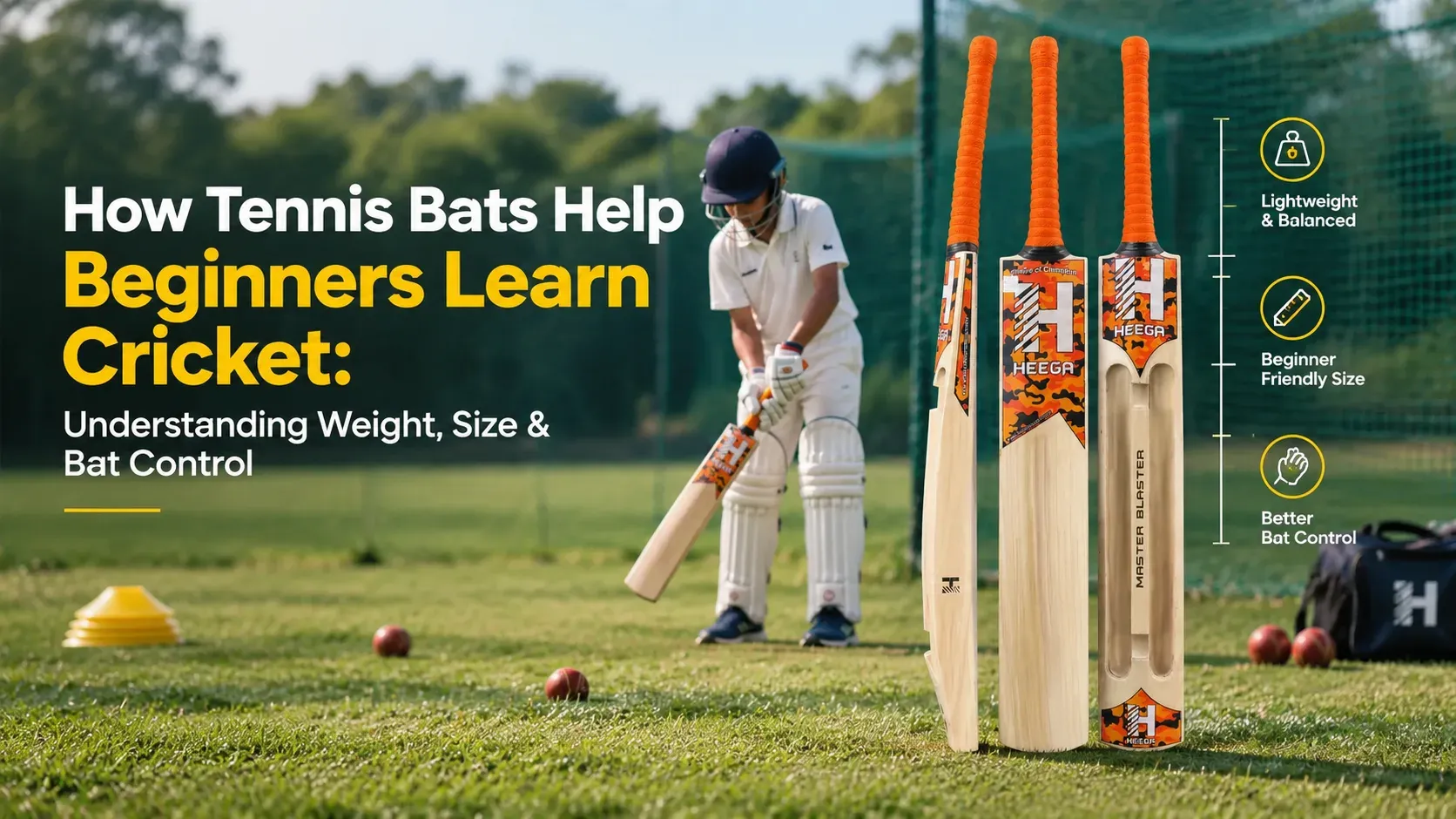
Introduction: Learning Cricket Starts With the Right Equipment
Starting cricket can be exciting for beginners.
For a new player, however, the game can also seem complicated.
There are cricket bats, leather balls, tennis balls, protective equipment, batting gloves, wickets, pads, helmets, and many different training accessories.
A beginner does not necessarily need professional-level equipment on the first day.
In many cases, learning the basic movements of batting with a tennis bat can be a simple and practical way to become familiar with the game.
Tennis bats are commonly used for casual cricket, school activities, backyard games, beginner training, and recreational cricket involving tennis or soft balls.
Their relatively simple construction and easy-to-handle designs can help beginners focus on fundamental skills such as:
- Holding the bat correctly
- Watching the ball
- Developing hand-eye coordination
- Controlling the swing
- Learning basic footwork
- Understanding timing
- Building confidence
The objective is not to suggest that a tennis bat replaces a proper cricket bat for every form of cricket.
Instead, it can be an accessible starting point for players who are learning the fundamentals.
The right beginner equipment should make learning easier—not unnecessarily complicated.
What Is a Tennis Bat?
A tennis bat is a bat designed primarily for cricket played with tennis balls or other softer practice balls.
Unlike traditional cricket bats designed for leather-ball cricket, tennis bats are often built with beginner and recreational use in mind.
Depending on the design, tennis bats can be made from materials such as:
- Lightweight wood
- Kashmir willow
- Poplar or similar woods
- Composite materials
- Other synthetic materials
The exact construction varies between products.
The most important factor for a beginner is whether the bat is comfortable, appropriately sized, and easy to control.
Why Are Tennis Bats Popular With Beginners?
One of the biggest advantages of beginner-friendly tennis bats is accessibility.
A new player can begin practicing basic cricket movements without immediately dealing with the weight and technical demands of advanced cricket equipment.
Tennis-ball cricket is also popular because it can be played in many environments.
Players may practice:
- At home
- In parks
- In schools
- On streets where appropriate
- In recreational grounds
- During casual games with friends
This makes tennis bats useful for introducing people to cricket.
Tennis Bats Make Batting Less Intimidating
A beginner can sometimes feel nervous when first picking up a cricket bat.
The bat may seem large or heavy.
A tennis bat can provide a more approachable introduction.
When the equipment feels manageable, beginners can concentrate on the ball rather than worrying about controlling the bat.
This can make early practice sessions more enjoyable.
Weight: One of the Most Important Factors
The weight of a bat affects how easily a player can move it.
For beginners, excessive weight can make basic batting movements difficult.
A manageable tennis bat can help a new player learn how to:
- Lift the bat
- Move the bat backward
- Swing forward
- Adjust the bat angle
- Control the follow-through
The goal is not to use the lightest possible bat.
The goal is to use a bat that the player can control comfortably.
Why a Heavy Bat Can Slow Down Learning
Imagine a beginner trying to learn a basic straight drive with a bat that feels too heavy.
They may struggle to:
- Lift the bat properly
- Maintain balance
- Swing smoothly
- Time the ball
- Recover after the shot
Instead of learning technique, they may spend most of their attention trying to manage the equipment.
That is why weight matters.
Lighter Equipment Can Help Beginners Learn Bat Speed
Bat speed is an important part of batting.
The bat needs to move efficiently toward the ball.
A beginner-friendly tennis bat can allow players to experiment with bat movement without requiring excessive physical strength.
As their coordination improves, they can gradually develop faster and more controlled swings.
Size Matters Too
Weight is only one part of bat selection.
The size of the bat also affects control.
A bat that is too large can make it difficult for a beginner to maintain the correct posture and swing path.
A bat that is appropriately sized is easier to position.
This is especially important for younger players.
Choosing the Right Size for a Beginner
The appropriate size depends on factors such as:
- Player height
- Age
- Strength
- Hand size
- Playing style
- Comfort
For children, the bat should be easy enough to lift and control.
For teenagers and adults, a slightly larger tennis bat may be appropriate depending on the design and intended use.
The important point is simple:
The player should be able to control the bat without struggling.
Bat Control Is More Important Than Power
Many beginners want to hit the ball as far as possible.
Power is exciting.
But good batting starts with control.
A beginner should first learn how to:
- Meet the ball cleanly
- Control the bat face
- Maintain balance
- Play straight
- Direct the ball
- Recover after the shot
Power can develop later.
Control creates the foundation.
Understanding Bat Face Control
The angle of the bat face influences where the ball travels.
A beginner who learns to control the bat face can gradually become more accurate.
For example, keeping the bat face relatively straight can help with basic defensive and straight-batting exercises.
A tennis bat provides an easy environment for beginners to practice these movements.
Hand-Eye Coordination Is a Major Benefit
Cricket requires players to track a moving ball and coordinate their hands with their body.
Tennis-ball cricket provides a simple way to practice this skill.
A beginner can learn to:
- Watch the ball.
- Judge its direction.
- Move into position.
- Bring the bat toward the ball.
- Make contact.
- Control the follow-through.
These basic skills are useful even when a player later progresses to traditional cricket.
Tennis Bats Can Help With Timing
Good batting is not simply about swinging hard.
Timing is essential.
A player needs to bring the bat into the correct position at the correct moment.
Tennis-ball practice can help beginners understand this concept.
Repeated practice teaches players that a smooth swing can produce better results than simply trying to hit the ball as hard as possible.
Why Beginners Should Watch the Ball
One of the most common beginner mistakes is looking at the bat instead of the ball.
Players should learn to keep their attention on the incoming delivery.
A tennis-ball setup can make this easier because beginners can practice repeatedly without the pressure associated with harder competitive deliveries.
Learning the Basic Batting Stance
Before hitting the ball, a beginner needs to understand how to stand.
A basic batting stance should allow the player to remain:
- Balanced
- Comfortable
- Ready to move
- Focused on the bowler
The bat should be positioned comfortably without creating unnecessary tension.
A manageable tennis bat can make it easier to learn this position.
Grip: Holding the Bat Correctly
Grip is another important beginner skill.
The player should learn how the hands work together on the handle.
The objective is not to squeeze the bat as hard as possible.
A controlled grip helps the player:
- Move the bat naturally
- Adjust the bat face
- Control shots
- Maintain balance
Beginners can develop these habits while playing tennis-ball cricket.
Bottom-Hand and Top-Hand Control
The two hands have different roles during batting.
The top hand can help control the bat.
The bottom hand can contribute to movement and power.
Beginners should gradually learn how both hands work together rather than relying entirely on one hand.
This becomes increasingly important as their batting develops.
Tennis Bats and Basic Footwork
Batting is not only about the hands.
The feet also need to move.
Beginners can use tennis-ball practice to learn simple movements such as:
- Moving forward
- Moving backward
- Moving sideways
- Getting into position
- Recovering after a shot
Good footwork helps the player reach the ball rather than simply reaching with the bat.
Learning the Straight Drive
The straight drive is one of the most useful basic cricket shots for beginners.
It teaches several fundamentals at once:
- Balance
- Footwork
- Bat control
- Head position
- Timing
- Follow-through
A tennis bat can be used during beginner drills to practice the basic movement.
The emphasis should be on technique rather than power.
Learning Defensive Batting
Beginners also need to understand that not every ball should be attacked.
Defensive batting teaches players how to control the bat and protect their wicket.
With a tennis ball, beginners can practice:
- Playing straight
- Keeping the bat close to the body
- Maintaining balance
- Softening contact
- Watching the ball closely
These skills create a foundation for more advanced batting.
Learning to Hit Different Areas
Once basic control improves, beginners can start learning directional batting.
They can practice hitting the ball:
- Straight
- Toward the off side
- Toward the leg side
- Into open spaces
This introduces the idea of shot placement.
Good cricket is not always about hitting the ball the hardest.
Sometimes the best shot is simply the one that finds space.
Tennis-Ball Cricket Can Teach Decision-Making
Even casual cricket involves decisions.
A batter must decide:
- Whether to attack
- Whether to defend
- Whether to move forward
- Whether to move backward
- Where to hit the ball
Beginners can develop these basic decision-making skills through repeated tennis-ball games.
Why Repetition Matters
Skill development requires repetition.
A beginner may need to perform the same movement many times before it feels natural.
Tennis-ball cricket can make repetition easier because players can practice frequently in informal environments.
A player might get hundreds of opportunities to:
- Swing
- Hit
- Defend
- Run
- Field
- Throw
This regular exposure can accelerate basic learning.
Tennis Bats Are Useful for Home Practice
Not every beginner has access to a professional cricket ground.
Tennis-ball cricket makes practice more accessible.
With suitable space and safe conditions, beginners can practice simple drills at home or in recreational environments.
A tennis bat can be particularly convenient for casual training because it can be used with appropriate soft or tennis balls.
Players should always choose a safe playing area and avoid practicing where a moving ball could injure people or damage property.
Tennis Bats for School Cricket
Schools often introduce students to cricket through simplified formats.
Tennis bats can be useful in these environments because beginners can focus on basic skills before progressing to more advanced equipment.
Group activities can teach:
- Batting
- Bowling
- Fielding
- Catching
- Running between wickets
- Teamwork
This makes cricket more approachable for students who have never played before.
Tennis Bats and Casual Cricket
Cricket does not always have to begin with formal coaching.
Many players discover the sport through casual games with friends.
Tennis-ball cricket can create an informal introduction to:
- Batting
- Bowling
- Fielding
- Scoring
- Competition
For some players, these early experiences eventually lead to academy or club cricket.
From Tennis Bat to Cricket Bat
A tennis bat can be a starting point, but players who move into traditional cricket will eventually need equipment suited to the type of ball and level of cricket they play.
As a player progresses, they may move toward:
- Junior cricket bats
- Kashmir Willow cricket bats
- English Willow cricket bats
- Leather cricket balls
- Batting gloves
- Batting pads
- Cricket helmets
The transition should happen when the player's skills and playing environment require it.
When Should a Beginner Move to a Traditional Cricket Bat?
There is no single age at which every player should make the transition.
It depends on:
- Playing level
- Type of ball being used
- Coaching environment
- Player strength
- Bat control
- Competition requirements
If a player begins structured leather-ball cricket, their coach can help determine when traditional cricket equipment is appropriate.
Tennis Bat vs Cricket Bat
The two are designed for different purposes.
A tennis bat is generally suited to:
- Tennis-ball cricket
- Beginner practice
- Casual cricket
- Recreational games
- Basic skill development
A traditional cricket bat is designed for cricket played with cricket balls, including leather-ball cricket.
The right choice depends on the type of cricket being played.
Why Beginners Should Not Focus Only on Batting Power
One of the biggest mistakes beginners make is trying to hit every ball for maximum distance.
This can lead to:
- Poor balance
- Incorrect technique
- Excessive bottom-hand use
- Poor shot selection
- Loss of control
Instead, beginners should focus on making clean contact.
Once timing and technique improve, power can naturally develop.
Tennis Bats Can Make Learning More Enjoyable
Enjoyment is an important part of learning any sport.
If beginners feel that cricket is too difficult, they may lose interest.
Tennis-ball cricket can simplify the early learning process.
Players can experiment, make mistakes, and try again without feeling that every delivery is a serious competitive situation.
That freedom can help build confidence.
Building Confidence Through Small Successes
Imagine a beginner who struggles to hit a traditional cricket ball.
Now imagine that same player successfully hitting several tennis balls in a row.
That small success can change their attitude.
They may become more willing to:
- Practice
- Try new shots
- Join a cricket group
- Attend coaching
- Participate in matches
Confidence can encourage continued involvement.
Tennis Bats and Beginners in Different Cricket Markets
Cricket is growing across many different countries and communities.
In Nepal, cricket is deeply popular and continues to attract young players.
In Germany, structured clubs and growing cricket participation are introducing new players to the sport.
In the United States, cricket is expanding through leagues, clubs, schools, and development programs.
In Canada, indoor and outdoor cricket opportunities give players different ways to train throughout the year.
In the Netherlands, established cricket structures provide pathways from beginner to competitive cricket.
In the United Kingdom, a long-established club and school cricket culture gives beginners many opportunities to learn the game.
Although these cricket environments differ, the fundamentals remain similar.
Players need to learn control, movement, timing, coordination, and decision-making.
Common Mistakes Beginners Make With Tennis Bats
Trying to Hit Every Ball Hard
Focus on timing before power.
Using a Bat That Is Too Heavy
Choose a bat that can be controlled comfortably.
Ignoring Footwork
Move the body toward the ball rather than relying only on the arms.
Watching the Bat Instead of the Ball
Keep your eyes on the incoming ball.
Using Poor Grip
Learn a controlled and comfortable grip.
Standing Still
Good batting requires movement and preparation.
Focusing Only on Runs
Skill development should come before scoring big numbers.
How Parents Can Choose a Tennis Bat for Beginners
Parents introducing children to cricket should consider:
- Child's height
- Age
- Strength
- Hand size
- Bat weight
- Handle comfort
- Overall balance
- Playing environment
A child should be able to lift the bat comfortably and swing it without excessive effort.
It is usually better to choose a manageable bat rather than buying a large bat simply because the child may grow later.
How Coaches Can Use Tennis Bats in Training
Coaches can use tennis bats for different beginner activities.
For example:
Basic Contact Drills
Players focus on hitting the ball cleanly.
Movement Drills
Players combine footwork with simple batting.
Reaction Drills
Players respond to different ball directions.
Placement Drills
Players practice hitting into specific areas.
Small-Sided Games
Players apply skills in simplified match situations.
This progression helps move learners from isolated skills toward actual game understanding.
Tennis Bat Practice Should Still Teach Good Technique
Using beginner-friendly equipment does not mean technique should be ignored.
Players should still learn:
- Balanced stance
- Correct grip
- Head position
- Footwork
- Bat swing
- Shot selection
- Follow-through
Good habits developed early can become valuable later.
How Heega Sports Supports Beginners
At Heega Sports, we understand that every cricketer starts somewhere.
Our cricket range includes equipment for different stages of development, including:
- Tennis bats
- Junior cricket bats
- Kashmir Willow cricket bats
- English Willow cricket bats
- Cricket batting gloves
- Wicketkeeping gloves
- Leather cricket balls
- Practice balls
- Batting pads
- Cricket helmets
- Cricket shoes
- Cricket kit bags
- Practice nets
- Training accessories
The goal is to help players choose equipment that matches their current level while giving them the opportunity to progress as their skills develop.
A Simple Beginner Batting Checklist
Before starting practice, beginners can remember:
1. Hold the bat comfortably.
2. Watch the ball carefully.
3. Stay balanced.
4. Move your feet.
5. Focus on timing.
6. Control the bat face.
7. Do not chase power too early.
8. Practice regularly.
9. Learn from mistakes.
10. Enjoy the game.
These simple habits can create a strong foundation for future cricket development.
Final Thoughts
Tennis bats can be a useful introduction to cricket for beginners because they can make early practice simple, accessible, and enjoyable.
They allow new players to explore important fundamentals without immediately focusing on advanced equipment.
Through tennis-ball cricket and beginner-friendly training, players can develop:
- Hand-eye coordination
- Bat control
- Timing
- Balance
- Footwork
- Grip
- Shot placement
- Decision-making
- Confidence
The goal is not to stay with beginner equipment forever.
The goal is to develop the skills needed to progress.
As players become stronger and more experienced, they can gradually move toward junior cricket bats, Kashmir Willow bats, English Willow bats, leather cricket balls, protective equipment, and more advanced training environments.
Whether a player begins cricket in Nepal, Germany, the United States, Canada, the Netherlands, or the United Kingdom, the learning process starts with the same basic principle:
Learn to control the bat before trying to hit the ball harder.
A simple tennis bat, a suitable ball, a safe playing space, and regular practice can be enough to introduce a beginner to the fundamentals of one of the world's most fascinating sports.
And sometimes, that first successful shot with a simple bat is all it takes to start a lifelong cricket journey.
🏏 Start Your Cricket Journey With Heega Sports
Explore tennis bats, junior cricket bats, Kashmir Willow cricket bats, English Willow cricket bats, batting gloves, wicketkeeping gloves, leather balls, practice balls, batting pads, helmets, cricket shoes, kit bags, practice nets, and training accessories designed for players at different stages of development.
Shop Now
Heega Sports – Helping Beginners Build Better Cricket Skills From the Very First Shot.
Related posts
 How to Choose the Right Cricket Bat Weight: Understanding Bat Speed, Power & ControlLearn how to choose the right cricket bat weight based on strength, playing style, bat speed, control, balance, and experience for better batting performance.
 How Cricket Bat Balance Affects Your Shots: Pickup, Weight Distribution, and ControlLearn how cricket bat balance affects pickup, shot control and batting comfort. Understand weight distribution, sweet spot, bat feel and choosing the right balance.
 Batting Gloves for Cricket: How Finger Design, Palm Materials and Grip Texture Affect Bat ControlDiscover how cricket batting gloves, finger design, palm materials and grip texture influence bat control, comfort, protection and batting performance.