How to Choose the Right Cricket Bat Weight: Understanding Bat Speed, Power & Control
Introduction: Why Cricket Bat Weight Matters More Than You Think
When buying a cricket bat, players often focus on willow grade, grains, profile, brand, and price.
One factor, however, can have an even more noticeable effect on how the bat feels in the hands:
Weight.
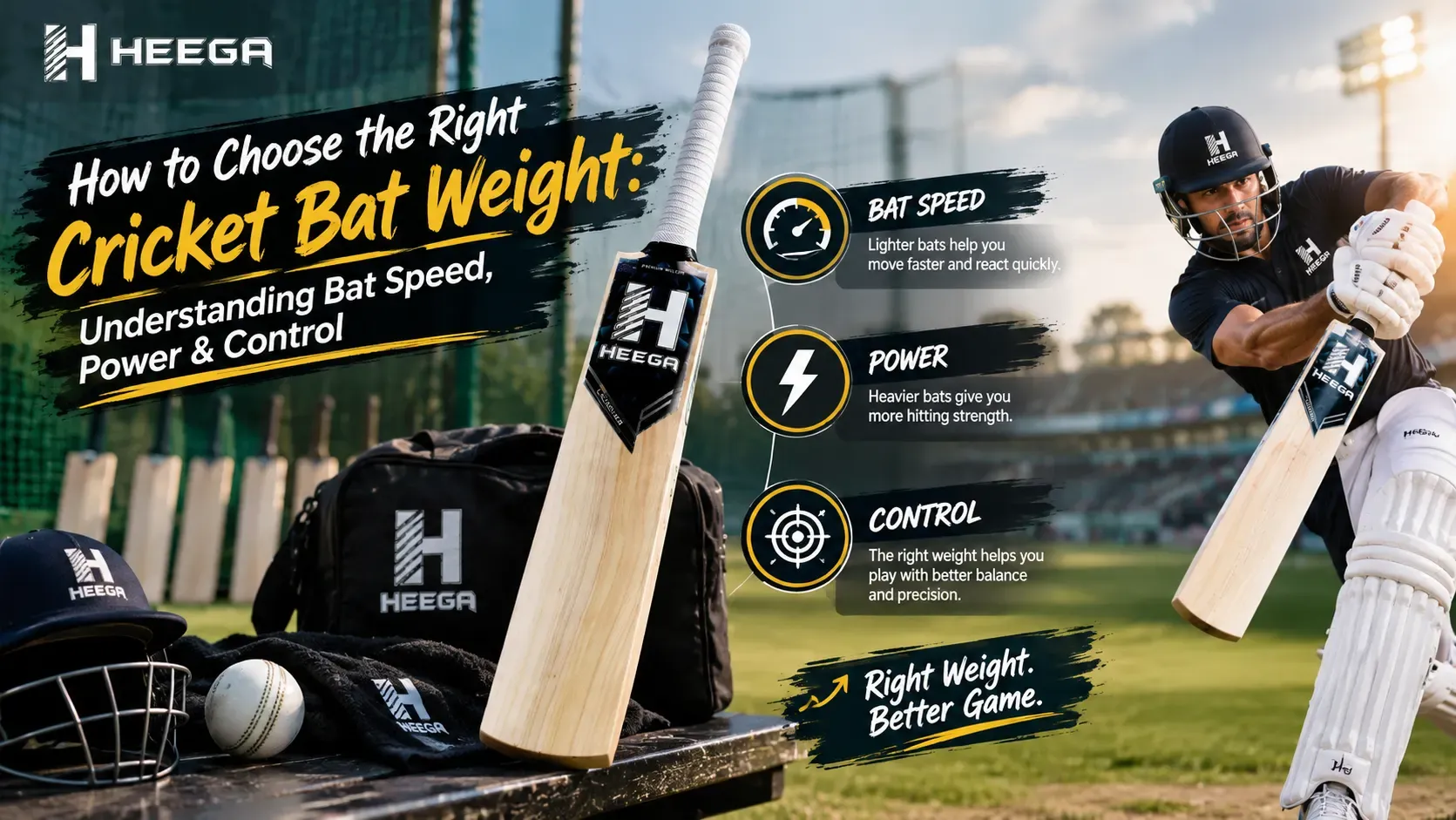
The weight of a cricket bat influences how quickly a player can move it, how comfortably they can control it, and how much mass they can put behind a shot.
A heavier bat can provide a powerful feel.
A lighter bat can often be easier to manoeuvre.
But choosing between them is not simply a question of whether a player wants more power or more speed.
The real objective is to find a weight that the player can control comfortably while maintaining good technique and bat speed.
A bat that is too heavy may reduce timing and make certain shots difficult.
A bat that is too light may feel extremely easy to swing but may not provide the preferred feel or stability for a particular player.
The ideal weight depends on several factors, including:
- Player strength
- Age and physical development
- Batting technique
- Playing style
- Bat balance
- Pickup
- Level of cricket
- Match format
- Personal preference
This guide explains how cricket bat weight affects performance and how players can make a more informed decision when choosing their next bat.
What Does Cricket Bat Weight Actually Mean?
Cricket bat weight refers to the physical mass of the bat.
Adult cricket bats are commonly available across a range of weights, although the exact weight suitable for a player varies considerably.
Two bats with the same listed weight can also feel completely different.
Why?
Because weight is only one part of the equation.
The way that weight is distributed throughout the blade can dramatically affect how the bat feels during the swing.
This is where balance and pickup become important.
Bat Weight vs Pickup: What Is the Difference?
A bat's actual weight and its perceived weight are not necessarily the same thing.
Imagine two bats that both weigh approximately the same.
One may feel easy to lift and move.
The other may feel heavier when you try to play a shot.
This difference is often related to the bat's balance and weight distribution.
This is known as pickup.
Pickup describes how the bat feels when a player lifts and moves it into position.
A well-balanced bat may feel lighter in the hands than its actual scale weight suggests.
This is why experienced players often judge a bat by how it feels rather than simply looking at the number printed on the specifications.
Why the Heaviest Bat Is Not Always the Best Bat
It is tempting to assume that a heavier bat automatically produces more powerful shots.
There is some logic behind this idea.
More mass can contribute to impact when the bat is moving effectively.
However, the player still needs to move that mass.
If the bat is too heavy for the player, they may struggle to generate sufficient bat speed.
The result can be:
- Slower backlift
- Slower downswing
- Reduced timing
- Less control
- Difficulty playing fast bowling
- Poorer shot manoeuvrability
- Earlier fatigue
A theoretically powerful bat is not useful if the batter cannot swing it efficiently.
Why Bat Speed Matters
Bat speed plays an important role in modern batting.
A batter needs to move the bat quickly enough to meet the ball at the right moment.
This is particularly important when facing fast bowling.
A bat that is too heavy can make it harder for a player to accelerate the blade.
A slightly lighter bat may allow the player to generate faster movement.
But again, lighter does not automatically mean better.
The objective is to find the best balance between weight and controllability.
The Relationship Between Bat Weight and Power
Power hitting is not produced by bat weight alone.
A powerful shot involves several components:
- Bat speed
- Timing
- Body movement
- Technique
- Strength
- Contact quality
- Bat path
- Weight transfer
A heavier bat can contribute to impact, but only if the player can control and accelerate it effectively.
This is why a player with excellent technique may hit the ball harder with a comfortably balanced bat than another player using a much heavier bat they cannot control.
Timing Can Matter More Than Raw Weight
Clean contact is one of the biggest factors in effective batting.
When the ball meets the bat in the right position and at the right moment, the result can be extremely efficient.
If a bat is too heavy and disrupts the player's timing, the theoretical advantage of additional mass may become less important.
For many players, a comfortable bat that allows consistent timing is more useful than simply choosing the heaviest option available.
How Strength Influences Bat Weight
Physical strength is one of the most important factors when choosing bat weight.
A stronger player may be capable of handling a heavier bat without sacrificing bat speed.
A developing player may perform better with a lighter model.
However, strength should not be judged only by general gym performance.
Batting requires specific coordination between:
- Hands
- Wrists
- Forearms
- Shoulders
- Core
- Legs
A player may be physically strong but still struggle with a bat that is too heavy for their batting technique.
Bat Weight and Player Age
Age can provide a general indication of equipment requirements, but it should not be the only factor.
Children and junior players are still developing physically.
Their bat should be selected according to:
- Height
- Strength
- Bat control
- Technique
- Comfort
As players grow stronger, they may gradually move toward heavier equipment.
The transition should happen naturally rather than simply because a player reaches a particular age.
Junior Players Should Prioritize Control
For younger cricketers, control is usually more important than maximum power.
A bat that is too heavy may make it difficult to:
- Lift the bat comfortably
- Develop a consistent backlift
- Move into position
- Play controlled shots
- Maintain balance
A lighter, correctly sized bat can allow young players to focus on learning technique.
As their strength develops, their equipment can change with them.
How Playing Style Influences Bat Weight
Not every batter plays cricket in the same way.
Some players rely heavily on timing.
Others prefer aggressive strokeplay.
Some are naturally strong through the leg side.
Others depend on quick hands and fast bat movement.
This means bat weight can be highly personal.
Timing-Based Batters
Players who focus on classical timing may prefer a bat that feels easy to manoeuvre.
They may prioritize:
- Pickup
- Balance
- Control
- Bat speed
Power Hitters
Aggressive players may prefer slightly more mass if they can control it comfortably.
They may look for:
- Strong pickup
- Stable blade
- Large hitting area
- Suitable weight distribution
The important point is that playing style should influence the decision.
Bat Weight for Fast Bowlers
Facing fast bowling demands quick reactions.
A batter may have only a short amount of time to respond to a delivery.
This makes bat speed and manoeuvrability particularly important.
A player who struggles to bring a heavy bat down quickly may find it harder to respond to high-speed bowling.
For these players, a comfortable and responsive bat can be especially valuable.
Bat Weight for Spin Bowling
Spin bowling creates a different set of challenges.
Batters often need to move forward, backward, or across the crease.
They may also need to adjust their shots based on flight and turn.
A bat that is easy to manoeuvre can help players make these movements without feeling restricted.
T20 Batting and Bat Weight
T20 cricket places strong emphasis on rapid scoring.
Batters may attempt:
- Lofted drives
- Pulls
- Sweeps
- Innovative shots
- Powerful boundary hitting
This does not mean every T20 player needs a heavy bat.
The right weight depends on the player's ability to generate bat speed while maintaining control.
A player who can comfortably handle additional mass may prefer it.
Another player may benefit from a lighter setup that allows faster movement.
Longer Formats and Bat Control
Longer formats can place greater emphasis on control, patience, and defensive technique.
A batter may spend significant time at the crease.
Comfort therefore becomes particularly important.
A bat that feels manageable over a long innings can help reduce unnecessary fatigue.
Balance Can Make a Heavy Bat Feel Manageable
This is one of the most important concepts when choosing bat weight.
Suppose two bats have similar actual weights.
One has a balanced pickup.
The other has more weight concentrated toward the blade.
The first bat may feel considerably easier to use.
This is why players should not reject a bat simply because the number on the scale looks slightly higher.
The way the bat behaves in the hands matters.
Low, Mid, and High Sweet Spots
Bat profile and sweet-spot position can also influence how a bat feels.
Low Sweet Spot
A lower sweet spot may suit players who frequently play on lower-bouncing surfaces or prefer certain types of strokeplay.
Mid Sweet Spot
A mid-positioned sweet spot provides a versatile option for many players.
High Sweet Spot
A higher sweet spot can be useful for players who regularly encounter certain pitch conditions and prefer a particular bat feel.
Sweet-spot position should therefore be considered alongside weight rather than separately.
Thick Edges Do Not Automatically Mean Better Performance
Modern cricket bats often feature substantial edges and pronounced spines.
These characteristics can create a powerful-looking profile.
But players should avoid choosing a bat based solely on appearance.
A large profile is useful only if the player can control the bat comfortably.
The complete combination of:
Profile + Weight + Balance + Pickup
is more important than any single feature.
Why Two Bats With the Same Weight Can Feel Different
This deserves special attention.
Consider two bats weighing approximately the same.
One may have:
- A balanced profile
- Comfortable pickup
- Moderate spine
- Even weight distribution
The other may have:
- More mass toward the lower blade
- Different spine characteristics
- Different handle construction
- Different overall balance
They can feel completely different despite having similar weights.
This is why experienced players often physically test bats before making a decision.
How to Test a Cricket Bat's Weight
If possible, players should test the bat rather than choosing based only on specifications.
Try the following:
1. Lift the Bat Naturally
Hold the bat in your normal batting grip.
Does it feel comfortable?
2. Practice the Backlift
Raise the bat into your normal starting position.
Does the movement feel smooth?
3. Play Shadow Shots
Try defensive strokes, drives, pulls, and other familiar movements.
Does the bat remain under control?
4. Check the Pickup
Does it feel heavier than expected?
5. Assess Fatigue
After several repetitions, does the bat begin to feel difficult to control?
These simple tests can reveal more than a specification sheet.
Signs Your Cricket Bat May Be Too Heavy
A bat may be too heavy if you regularly notice:
- Slow bat movement
- Difficulty controlling the backlift
- Late contact
- Reduced shot range
- Poor balance
- Wrist or forearm fatigue
- Difficulty playing fast bowling
- Technique breaking down during longer sessions
One or two of these signs may have other causes, but repeated problems are worth investigating.
Signs Your Bat May Be Too Light
A bat can also be too light for a particular player.
Possible signs include:
- The bat feels unstable during contact
- The player prefers more mass behind shots
- The bat does not feel solid on impact
- The player has enough strength to control more weight comfortably
However, moving to a heavier bat should always be gradual.
The Importance of the Handle
The handle influences how the bat feels in the hands.
Different handle constructions can affect:
- Vibration.
- Flexibility.
- Comfort.
- Control.
- Overall feel.
The handle works together with the blade and weight distribution.
Grip Thickness Can Change Perception
The grip can also affect how a bat feels.
A thicker or differently shaped grip can change the player's hand position and perception of control.
Some players prefer a thicker grip for comfort.
Others prefer a slimmer grip for a more direct connection with the handle.
There is no universal answer.
Kashmir Willow and Bat Weight
Kashmir Willow bats are widely used by developing players, club cricketers, academies, and recreational players.
They are available in different weights and profiles.
A Kashmir Willow bat can be an excellent choice when the player wants a practical combination of durability, performance, and value.
The important point is still selecting the appropriate weight and balance.
English Willow and Bat Weight
English Willow bats are commonly associated with higher-level cricket and are available in a wide range of specifications.
Players may select them based on:
- Willow quality
- Weight
- Profile
- Balance
- Pickup
- Playing style
English Willow does not mean a player automatically needs a heavier bat.
The same fundamental principle applies:
Choose the bat you can control.
Should Club Players Use Heavier Bats?
Not necessarily.
Club players have different physical abilities and playing styles.
Some may comfortably handle heavier bats.
Others may perform better with lighter, more responsive equipment.
The correct choice depends on the individual.
Professional Players and Customized Weight
At professional level, players can become extremely specific about equipment.
They may have preferred:
- Exact weight
- Pickup
- Balance
- Profile
- Handle
- Grip
- Sweet-spot position
Some players work with bat manufacturers to create equipment that matches their preferences.
This level of customization is the result of years of experience.
Why Bat Weight Preferences Can Change
A player's preferred bat weight may change over time.
For example:
A young player may start with a light bat.
As strength improves, they may move to a heavier model.
Later, they may discover that a slightly lighter bat improves their timing.
There is no rule saying players must continuously increase bat weight.
The best weight can change as the player's technique changes.
Don't Choose Weight Based on Another Player
A common mistake is copying the bat weight of a favorite professional cricketer.
Professional players have different:
- Strength
- Technique
- Bat speed
- Playing conditions
- Training routines
- Physical characteristics
A bat that works for a professional may not work for another player.
Use professional equipment as inspiration, not as a strict specification.
Why Bat Weight Should Be Reassessed Regularly
Players should periodically evaluate whether their bat still feels right.
Reassess when:
- Your strength changes.
- Your technique changes.
- Your playing format changes.
- You move to a higher level.
- Your bat starts feeling uncomfortable.
- Your bat speed appears to decrease.
Equipment should support development rather than limit it.
Common Cricket Bat Weight Mistakes
Choosing the Heaviest Bat Available
More weight does not automatically mean more performance.
Ignoring Pickup
Actual weight alone does not tell you how a bat will feel.
Buying Based Only on Price
A more expensive bat is not automatically better suited to the player.
Copying a Professional
Different players require different specifications.
Ignoring Technique
A bat cannot compensate for poor batting fundamentals.
Forgetting Long-Term Comfort
A bat that feels good for five minutes may not feel good after a two-hour practice session.
A Simple Rule for Choosing Bat Weight
When in doubt, remember this:
Choose the heaviest bat you can comfortably control without sacrificing bat speed, balance, timing, or technique.
This provides a useful starting point.
The ideal weight is not necessarily the lightest or heaviest option.
It is the weight that allows the player to perform naturally.
How Heega Sports Helps Players Choose the Right Bat
At Heega Sports, we understand that cricket bats should match the player's needs rather than simply follow trends.
Our cricket range includes:
- Junior cricket bats
- Size 3, 4, 5, and 6 bats
- Harrow bats
- Short Handle bats
- Long Handle bats
- Kashmir Willow bats
- Leather cricket balls
- Practice balls
- Batting gloves
- Batting pads
- Cricket helmets
- Cricket shoes
- Cricket kit bags
- Practice nets
- Training accessories
Whether you are buying your first serious cricket bat or looking to upgrade your current equipment, considering weight, pickup, balance, profile, and playing style can help you make a more informed choice.
Cricket Bat Weight and Player Development Around the World
Cricket is developing across many different markets.
In Nepal, young players are increasingly entering structured coaching and competitive cricket pathways.
In Germany, growing clubs and academies are introducing more players to organized cricket.
In the United States, the expansion of cricket creates opportunities for players at different levels to develop their skills.
In Canada, players progress through seasonal and organized cricket environments.
In the Netherlands, established cricket structures provide pathways from club cricket toward higher levels.
And in the United Kingdom, a deep club and academy culture gives players extensive opportunities to develop.
Despite differences in playing conditions and competition, one principle remains universal:
Equipment should match the player.
Final Thoughts
Choosing the right cricket bat weight is not about finding the heaviest bat you can lift.
It is about finding the weight you can control, accelerate, and use consistently.
A bat that is too heavy may reduce bat speed and affect timing.
A bat that is too light may not provide the feel or stability a player wants.
The ideal choice depends on strength, technique, playing style, balance, pickup, format, and personal preference.
As players develop, their ideal bat weight may change.
A junior player may eventually move to a heavier bat.
A developing club player may discover that a different balance improves their timing.
An experienced batter may become highly specific about pickup and weight distribution.
There is no single perfect cricket bat weight for everyone.
The best bat is the one that allows you to play your natural game with confidence and control.
Before choosing your next cricket bat, do not ask only:
"How heavy is it?"
Also ask:
"How does it feel when I play with it?"
That question can make all the difference.
🏏 Find the Right Cricket Bat for Your Game with Heega Sports
Explore junior cricket bats, Kashmir Willow bats, Short Handle and Long Handle bats, leather cricket balls, practice balls, batting gloves, pads, helmets, cricket shoes, kit bags, practice nets, and training accessories designed for players at every level.
Shop Now
Heega Sports – Helping Every Cricketer Find the Right Balance of Bat Speed, Power, and Control.
Related posts
 How Tennis Bats Help Beginners Learn Cricket: Understanding Weight, Size & Bat ControlLearn how tennis bats help beginners learn cricket by improving bat control, timing, balance, grip, confidence, and basic batting technique through simple practice.
 How Cricket Bat Balance Affects Your Shots: Pickup, Weight Distribution, and ControlLearn how cricket bat balance affects pickup, shot control and batting comfort. Understand weight distribution, sweet spot, bat feel and choosing the right balance.
 How Cricket Bat Grip and Hand Position Affect Shot Control and Bat Speed.Learn how cricket bat grip and hand position affect shot control, bat speed, timing, balance, and confidence while playing different cricket shots.