How Cricket Bat Balance Affects Your Shots: Pickup, Weight Distribution, and Control
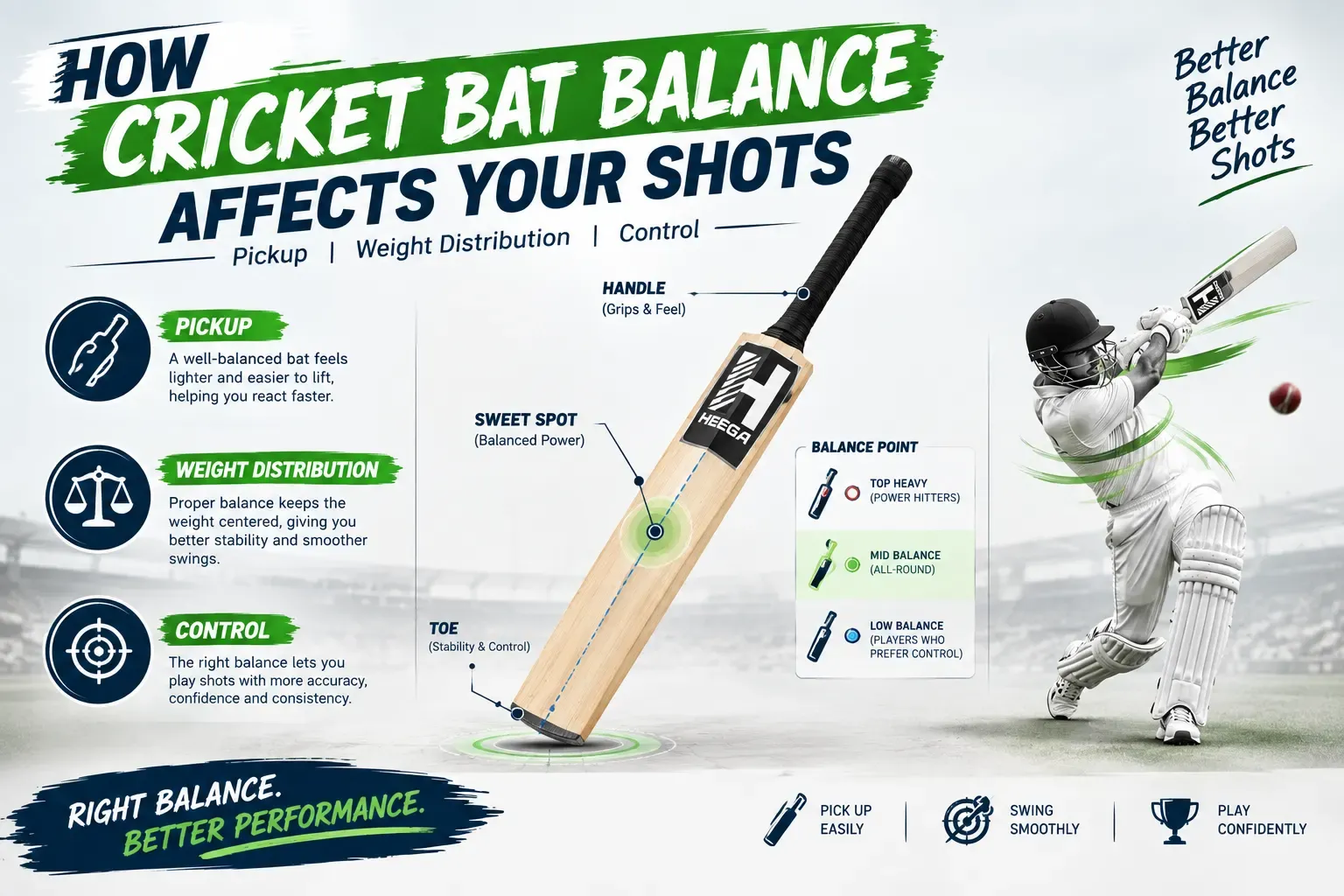
Introduction: Why Cricket Bat Balance Matters More Than You Think
Two cricket bats can weigh exactly the same on a scale and still feel completely different when you pick them up.
One might feel light, quick and easy to move.
The other might feel heavier, slower or more difficult to control.
So, what creates this difference?
A major part of the answer is cricket bat balance.
Balance describes how the weight of the bat is distributed and how that distribution affects the way the bat feels when you hold, lift and swing it.
This is why a 2.8 lb bat does not necessarily feel the same as another 2.8 lb bat.
For a batter, that difference can become noticeable when playing quick shots, adjusting to a shorter delivery, defending against movement or trying to generate power through a full swing.
Bat balance is not about finding one universally perfect setup.
It is about finding a balance and pickup that suits your strength, technique, batting style and comfort.
In this guide, we will break down what cricket bat balance means, how pickup works, how weight distribution changes the feel of a bat, and what players should understand before choosing their next bat.
What Is Cricket Bat Balance?
Cricket bat balance refers to how the weight of a bat is distributed along its length and how that distribution affects the way the bat feels in the hands.
It is closely connected to the bat's centre of mass.
Imagine holding two bats with the same total weight.
If more of the weight is concentrated toward the lower blade, the bat can feel different from one where more weight is positioned closer to the hands.
That difference is what players often describe as:
- Light pickup
- Heavy pickup
- Head-heavy feel
- Balanced feel
- Easy swing
- Strong lower-blade feel
The actual number on the weighing scale is only part of the story.
What Is Cricket Bat Pickup?
Pickup describes how heavy or light a bat feels when you lift and move it.
This is one of the first things experienced players notice when testing a bat.
A bat with a good pickup may feel easier to move than its actual weight suggests.
For example, a player may pick up a relatively heavy bat and immediately say:
“This doesn't feel that heavy.”
That does not mean the bat has somehow lost weight.
It means the weight distribution and balance make the bat feel manageable in the player's hands.
Pickup is therefore closely connected to balance, but the two terms are not exactly interchangeable.
Balance describes the distribution of weight, while pickup describes how that distribution feels when you handle the bat.
Why Two Bats With the Same Weight Can Feel Different
This is one of the most important concepts for new players.
Suppose you have two bats:
- Bat A: 2.8 lb
- Bat B: 2.8 lb
Both have the same measured weight.
But Bat A may feel quicker when lifted.
Bat B may feel as though more of its weight is sitting away from your hands.
The reason can be differences in:
- Weight distribution
- Profile
- Spine position
- Edge thickness
- Blade shape
- Handle construction
- Willow density
- Overall dimensions
This is why simply choosing a bat based on weight can sometimes lead to disappointment.
Different Types of Cricket Bat Balance
There is no single industry-wide system that divides bats into perfectly fixed balance categories, but players commonly describe bats using terms such as:
- Even balance
- Mid-balanced
- Head-heavy
- Low-balanced
- Light pickup
Understanding these descriptions makes it easier to explain how a bat feels.
Even-Balanced Cricket Bat
An even-balanced bat generally distributes its weight in a way that creates a neutral feeling in the hands.
The bat does not feel excessively heavy toward the toe or excessively concentrated near the handle.
How It May Feel
Players may experience:
- Controlled pickup
- Balanced swing
- Predictable movement
- Comfortable front-foot shots
- Good versatility
An even-balanced bat can suit players who want a neutral feel rather than a strongly specialized balance.
Mid-Balanced Cricket Bat
A mid-balanced bat places a significant amount of its usable mass around the middle section of the blade.
This can provide a combination of control and power.
Typical Feel
A player may notice:
- Natural pickup
- Stable swing
- Good control
- Comfortable stroke play
- Versatility across different shots
This type of balance can appeal to players who do not want a strongly head-heavy or extremely low-balanced bat.
Head-Heavy Cricket Bat
A head-heavy bat feels as though more of the weight is positioned toward the blade.
This can provide a strong sense of mass behind the shot.
Some players like this feeling because the bat can feel powerful through contact.
However, the trade-off can be that the bat requires more effort to control, especially for players who are not comfortable with the weight distribution.
A Head-Heavy Feel May Suit Players Who:
- Prefer a powerful swing
- Like a substantial bat feel
- Are comfortable controlling the blade
- Have the strength and technique to manage the pickup
It is not automatically better for powerful batting.
The player still has to control the bat effectively.
Low-Balanced Cricket Bat
A low-balanced bat generally has more weight concentrated toward the lower part of the blade.
This can create a particular type of pickup and can complement profiles designed around a lower sweet spot.
The important point is that low balance does not simply mean “heavier.”
It describes where the weight is concentrated.
A low-balanced bat can still have a manageable overall weight depending on its construction.
Cricket Bat Balance and the Sweet Spot
The sweet spot is the area of the blade where the bat is generally designed to perform efficiently when the ball is struck.
The position of the sweet spot can influence the type of balance that feels natural.
For example, a bat designed with a lower sweet spot may have more mass positioned lower in the blade.
Likewise, a bat designed around a mid or higher sweet spot may distribute material differently.
This is why balance and sweet spot location should be considered together rather than separately.
Does Cricket Bat Balance Affect Power?
It can influence how power feels during a shot, but balance does not create batting power by itself.
Power comes from the interaction of:
- Bat speed
- Technique
- Timing
- Body movement
- Strength
- Contact quality
- Bat mass
- Weight distribution
A bat that feels powerful but is difficult to control may not actually help a particular player hit the ball better.
In cricket, controlled bat speed and clean contact are extremely important.
A player may benefit more from a bat they can move confidently than from a heavier bat they struggle to control.
Cricket Bat Balance and Shot Control
Shot control is one of the biggest reasons balance matters.
Consider a fast bowler delivering a short ball.
The batter needs to adjust quickly.
If the bat feels cumbersome, that adjustment can become harder.
Similarly, when playing a late defensive shot or guiding the ball into a gap, the ability to move the bat precisely matters.
A comfortable pickup can help the batter feel more connected with the movement of the bat.
This is particularly noticeable during:
- Defensive strokes
- Late cuts
- Flicks
- Glances
- Drives
- Pull shots
- Lofted shots
Again, balance does not replace technique.
It simply affects how the equipment responds to the batter's movements.
How Weight Distribution Changes Your Swing
Think about a cricket bat like any other object you swing.
Where its weight sits affects how easily you can move it.
If more mass is positioned away from your hands, the bat can feel more demanding during rapid changes of direction.
If the weight is positioned in a way that feels closer to your hands, the bat may feel easier to maneuver.
This is why two bats with identical total weight can have very different swing characteristics.
The difference can become particularly noticeable during repeated shots.
Cricket Bat Balance for Front-Foot Players
Players who enjoy front-foot batting often appreciate a bat that gives them confidence through the drive.
A balanced or slightly lower-weighted design may provide a stable feeling through shots, depending on the individual player's technique and preferred contact area.
For front-foot players, consider:
- Where the sweet spot sits
- How the bat feels during a full drive
- Whether the pickup remains comfortable
- Whether the bat moves naturally through the shot
Do not choose a balance simply because another player uses it.
Your technique matters.
Cricket Bat Balance for Back-Foot Players
Back-foot batting often requires fast movement and quick adjustment.
Players who spend significant time playing:
- Cuts
- Pulls
- Square drives
- Back-foot punches
- Defensive back-foot strokes
may pay particular attention to pickup.
A bat that feels comfortable during quick movements can be easier to control.
However, the ideal balance still depends on the individual.
A strong back-foot player may prefer a different setup from another player who plays similar shots.
Cricket Bat Balance for Aggressive Batters
Aggressive batters often look for a combination of power and control.
It can be tempting to choose the heaviest bat possible because heavier bats are sometimes associated with more power.
But this can be misleading.
If the bat is too heavy or poorly suited to the player, bat speed may decrease.
A slightly lighter bat with a comfortable pickup may allow a player to swing more freely.
The goal should not be:
“How heavy a bat can I handle?”
A better question is:
“What bat weight and balance allow me to swing confidently while maintaining control?”
Cricket Bat Balance for Defensive Batters
Players who prioritize placement, timing and defensive technique may prefer a neutral or easy pickup.
A bat that can be moved precisely can be useful when playing:
- Forward defence
- Back-foot defence
- Soft-handed shots
- Late adjustments
- Controlled singles
This does not mean defensive batters should avoid heavier bats.
It simply means control and maneuverability may be particularly important when evaluating the feel of the bat.
Does Bat Balance Affect Timing?
It can affect how the bat feels during the timing process.
Timing is primarily a skill involving the batter's perception, footwork, body movement and contact point.
But the bat still has to arrive at the ball in the right position.
If the player is comfortable with the bat's pickup and movement, maintaining a consistent swing can feel more natural.
This is one reason experienced players often spend time picking up a bat before buying it.
They are not only checking the weight.
They are checking how the bat behaves in their hands.
Cricket Bat Balance vs Bat Weight
These two terms are often confused.
FeatureBat WeightBat Balance
What it describes
Total mass of the bat
Distribution of that mass
Usually measured
In pounds or kilograms
By feel and centre of mass
Affects
Overall physical weight
Pickup and handling characteristics
Can two bats differ?
Yes
Yes
Same weight guarantee same feel?
No
No
Main concern
Can you handle the weight?
Where does the weight feel like it sits?
The easiest way to remember it is:
Weight tells you how much the bat weighs. Balance helps explain how that weight feels.
How to Test the Balance of a Cricket Bat
You do not need complicated equipment to get a basic idea of a bat's balance.
Step 1: Hold the Bat Normally
Grip it as you would while batting.
Do not squeeze the handle excessively.
Step 2: Lift It Naturally
Bring the bat into your normal ready position.
Notice whether the blade feels easy to control.
Step 3: Shadow a Few Shots
Try a few controlled movements:
- Straight drive
- Defensive stroke
- Cut
- Pull
- Flick
You are not trying to hit anything.
Simply observe how naturally the bat moves.
Step 4: Check Recovery
After swinging, see how easily you can bring the bat back into position.
Step 5: Compare It With Another Bat
This is often the easiest way to notice differences.
Pick up two bats of similar weight and alternate between them.
The differences in pickup may become immediately obvious.
The One-Hand Pickup Test
Another simple test is to lift the bat using one hand near the normal grip position.
This can give you a rough sense of where the weight is concentrated.
However, do not treat this as a scientific measurement.
It is only a practical way of comparing feel between bats.
Your actual batting grip and technique should remain the most important test.
Cricket Bat Balance and Player Strength
Physical strength can influence which balance feels comfortable.
A stronger player may be able to handle a heavier or more head-heavy bat comfortably.
But strength alone should not determine bat choice.
A batter also needs:
- Quick hands
- Coordination
- Technique
- Timing
- Mobility
- Endurance
A bat that feels manageable for five minutes may feel completely different after a long net session.
That is why comfort over extended use matters.
Why a Bat Can Feel Heavy After Several Overs
Fatigue changes how equipment feels.
A bat that seems perfectly comfortable during the first few deliveries may become more demanding after an extended innings or training session.
This is particularly relevant when:
- Batting for long periods
- Playing multiple matches
- Training frequently
- Facing fast bowling
- Repeating power shots
The right bat is not simply one that feels good for ten seconds in a shop.
It should remain manageable during realistic use.
Cricket Bat Balance and Batting Technique
Your technique should influence your equipment choice, not the other way around.
For example, a player who naturally generates bat speed may not need a very heavy bat to produce powerful shots.
Similarly, a player who relies on timing and placement may prioritize a comfortable pickup.
Think about your actual batting.
Ask yourself:
- Do I like a quick swing?
- Do I prefer a solid blade feel?
- Do I play mostly front-foot or back-foot shots?
- Do I struggle with bat control?
- Do I feel tired after long innings?
- Does my current bat feel slow during quick shots?
These questions are more useful than simply copying another player's setup.
Common Mistakes When Choosing Cricket Bat Balance
Mistake 1: Choosing Only by Weight
A number on a scale cannot tell you everything about pickup.
Mistake 2: Copying a Professional Player
A professional player's bat may be customized to their exact preferences, physical characteristics and playing style.
That does not mean the same balance will suit you.
Mistake 3: Assuming Heavier Means More Powerful
A heavier bat can provide more mass, but if you cannot move it effectively, the benefit may not translate into better batting.
Mistake 4: Testing the Bat for Only a Few Seconds
Pickup becomes easier to understand when you perform several realistic movements.
Mistake 5: Ignoring Fatigue
A bat that feels comfortable initially may become tiring during a long session.
How Handle and Blade Design Affect Balance
Cricket bat balance is not created by the blade alone.
The handle contributes to the overall feel of the bat.
Different handle constructions and shapes can change how the bat sits in your hands.
The blade also matters because material distribution across:
- Spine
- Edges
- Toe
- Shoulders
- Profile
can influence the centre of mass.
This is why a bat should be assessed as a complete unit.
Does Bat Toe Design Affect Balance?
Yes, it can contribute.
The toe is part of the lower blade, so the amount of material retained there can influence overall weight distribution.
This does not mean toe shape alone determines balance.
Instead, think of the toe as one part of a larger design.
The previous article in this series focused specifically on cricket bat toe design because the toe has its own durability and construction considerations.
Here, the focus is different: understanding how all parts of the bat work together to create the pickup you feel in your hands.
Cricket Bat Balance for Beginners
Beginners should generally prioritize comfort and control.
There is little value in selecting an advanced, heavy bat if the player struggles to control it.
A beginner can start by looking for:
- Comfortable overall weight
- Easy pickup
- Good grip
- Appropriate bat size
- Natural swing
- Reliable construction
As the player's technique and strength develop, they can experiment with different balance profiles.
Cricket Bat Balance for Academy Players
Academy players often spend several hours training each week.
For them, balance can become more important because the bat is used repeatedly.
An academy player should consider how the bat feels during:
- Throwdowns
- Net sessions
- Bowling-machine practice
- Front-foot drills
- Back-foot drills
- Longer batting sessions
A comfortable pickup can make repeated practice more manageable.
Cricket Bat Balance for Club Players
Club players may need a bat that works across different match situations.
One day may involve long defensive batting.
Another may require aggressive scoring.
The ability to control the bat across different shots can therefore be valuable.
Club players should consider both:
How powerful does the bat feel?
and
How easily can I control it?
The best balance for one player may be different from another, even within the same club.
Cricket Bat Balance for Advanced Players
Experienced players often have a clear understanding of what they want.
They may notice small differences in:
- Pickup
- Sweet spot location
- Bat speed
- Handle feel
- Blade movement
- Balance
At this level, customization can also become more relevant.
An advanced player may know that a particular balance works well with their stance, backlift and preferred scoring areas.
A Simple Balance Comparison
Balance TypeGeneral FeelPossible AdvantagePossible Consideration
Even Balance
Neutral
Versatile control
May not provide a specialized feel
Mid Balance
Stable
Combination of control and power
Individual preference still matters
Head Heavy
More blade weight
Strong mass through shots
Can require more control
Low Balance
Weight toward lower blade
Can suit lower sweet-spot profiles
May feel different during quick movements
Light Pickup
Easier handling
Quick movement and control
May feel less substantial to some players
These are general descriptions rather than strict rules.
The same balance category can feel different depending on the complete bat design.
How to Choose the Right Cricket Bat Balance
Start with your current bat.
Ask yourself what you like and dislike about it.
If Your Current Bat Feels Too Heavy
Consider:
- Lower overall weight
- Easier pickup
- More neutral balance
- Whether the blade profile is adding unnecessary mass
If Your Current Bat Feels Too Light
You may prefer:
- Slightly more overall mass
- A stronger blade feel
- A different weight distribution
If Your Bat Feels Difficult to Control
Focus on:
- Pickup
- Handle comfort
- Overall weight
- Balance
- Your ability to move the bat through different shots
The goal is not to find the heaviest or lightest bat.
The goal is to find the bat that feels natural.
How to Know If a Cricket Bat Has the Right Balance for You
A good sign is when you stop thinking about the bat.
That might sound strange, but it is useful.
When the bat feels natural, you can concentrate more on:
- Watching the ball
- Footwork
- Shot selection
- Timing
- Balance at the crease
If you constantly feel like you are fighting the bat, the balance or weight may not suit you.
Try a few bats whenever possible.
Your hands can often tell you more than a specification sheet.
Heega Sports: Cricket Bats Built Around Practical Player Needs
At Heega Sports, cricket equipment is developed with the needs of real players in mind.
When choosing a cricket bat, players should look beyond appearance and consider how the complete bat feels during use.
Factors such as:
- Overall weight
- Balance
- Pickup
- Blade profile
- Handle
- Willow
- Finishing
- Protection
all contribute to the experience of using a bat.
For beginners, academy players and club cricketers, the right combination can make the bat feel more natural during training and matches.
Heega Sports offers cricket equipment for players with different levels of experience and playing requirements, allowing players to focus on finding equipment that fits their own style rather than simply following trends.
Frequently Asked Questions About Cricket Bat Balance
1. What does cricket bat balance mean?
Cricket bat balance refers to how the bat's weight is distributed and how that distribution affects the way the bat feels when held, lifted and swung.
2. What is bat pickup?
Pickup describes how heavy or light a cricket bat feels when you lift and move it. A bat can have a relatively high measured weight but still feel comfortable because of its weight distribution.
3. Is a lighter cricket bat always better?
No. A lighter bat may be easier to move, but the right weight depends on the player's strength, technique, comfort and playing style.
4. Is a heavier cricket bat more powerful?
Not necessarily. More mass can contribute to impact, but effective batting also depends on bat speed, timing, technique and control.
5. Why do two cricket bats with the same weight feel different?
Differences in weight distribution, profile, edges, spine, handle and blade construction can make two bats with identical measured weights feel different.
6. What is a head-heavy cricket bat?
A head-heavy bat generally feels as though more of its weight is concentrated toward the blade rather than close to the hands.
7. What is an even-balanced cricket bat?
An even-balanced bat has a more neutral distribution of weight, creating a balanced feel rather than strongly concentrating weight toward the top or bottom of the blade.
8. Does bat balance affect shot control?
It can affect how easily a player can move and position the bat. However, shot control still depends heavily on technique, coordination and timing.
9. How can I test cricket bat balance?
Hold the bat using your normal grip, lift it into your batting stance and perform a few controlled shadow shots. Comparing multiple bats can make differences in pickup easier to notice.
10. Should beginners worry about bat balance?
Yes, but they do not need to overcomplicate it. Beginners should primarily choose a bat that feels comfortable, manageable and easy to control.
Final Thoughts
Cricket bat balance is one of those details that can be difficult to understand until you actually pick up two bats of the same weight and notice how different they feel.
That is the key point.
Weight tells you how heavy the bat is. Balance helps explain where that weight feels like it sits. Pickup tells you how that distribution feels when you move the bat.
For some players, a neutral balance may feel natural.
Others may prefer a stronger blade feel or a particular sweet-spot position.
There is no universal answer.
The right choice depends on your technique, strength, preferred shots, training routine and personal comfort.
Instead of asking, “What is the best cricket bat balance?” ask a more useful question:
“Which balance allows me to control my bat naturally and play my shots with confidence?”
Once you understand that difference, choosing a cricket bat becomes much more practical.
You stop looking only at the number printed on the scale and start paying attention to how the bat actually behaves in your hands.
And in the end, that is what matters most when you walk out to bat.
Shop Now with Heega Sports and get your cricket gear ready for the next innings.
Related posts
 Why Cricket Bat Edge Thickness Matters for Power, Balance and Shot ControlLearn how cricket bat edge thickness affects power, balance, pickup, durability, shot control, and performance, and how to choose the right bat profile.
 How Cricket Bat Balance Affects Pickup and Swing Speed.Learn how cricket bat balance affects pickup, swing speed, control, timing, and batting comfort, and discover how to choose the right balance for your playing style.
 Batting Gloves for Cricket: How Finger Design, Palm Materials and Grip Texture Affect Bat ControlDiscover how cricket batting gloves, finger design, palm materials and grip texture influence bat control, comfort, protection and batting performance.