Why Cricket Bat Edge Thickness Matters for Power, Balance and Shot Control

Introduction: Why Cricket Bat Edges Matter
When players look at a cricket bat, the first things they usually notice are the willow, weight, stickers, and overall appearance.
But one of the most important parts of the blade is often overlooked:
The edge.
The thickness of a cricket bat's edges can influence how the bat is designed and how it feels during play.
A thicker edge can allow manufacturers to distribute more wood through parts of the blade.
A thinner edge may contribute to a different balance and overall profile.
Neither option is automatically better.
The right choice depends on the player's technique, strength, playing style, preferred shots, and level of cricket.
A beginner may prioritize control and comfort.
A club player may want a versatile cricket bat that performs well across different situations.
A power hitter may prefer a larger profile with substantial edges.
An experienced batter may care about how edge thickness interacts with the sweet spot, spine, pickup, and balance.
This is why understanding edge thickness can help players make a more informed decision when buying their next cricket bat.
What Is the Edge of a Cricket Bat?
The edge is the thicker side portion of the cricket bat blade that runs along both sides of the face.
If you look at the bat from the front, the edges sit between the flat face and the sides of the blade.
The size of these edges can vary significantly between different bat designs.
Some cricket bats have relatively slim edges.
Others feature much thicker edges as part of a modern power-oriented profile.
Edge thickness is usually discussed in millimeters.
However, the number alone does not tell you everything about the bat.
A cricket bat with thick edges can still have a different feel depending on its spine, sweet spot, bow, weight distribution, and overall profile.
Why Do Cricket Bats Have Different Edge Thicknesses?
Bat manufacturers design different profiles for different types of players.
The distribution of wood throughout the blade can affect:
- Power potential.
- Balance.
- Pickup.
- Bat speed.
- Sweet spot characteristics.
- Overall feel.
- Durability.
Modern cricket bats often feature larger profiles because players want a combination of power and forgiveness.
However, a larger profile is not automatically suitable for every batter.
The player still needs to control the cricket bat effectively.
How Thick Edges Can Support Power
One of the main reasons players are attracted to thick edges is the perception of power.
A larger edge generally means there is more wood through that part of the blade.
Depending on the overall bat construction, this can contribute to a substantial hitting area and a powerful profile.
When the ball is struck well, the combination of bat speed, timing, and mass can produce strong shots.
But it is important to understand something:
Thick edges do not create power by themselves.
The player still needs to generate bat speed and make quality contact.
Power Comes From More Than Edge Thickness
A powerful cricket shot depends on several factors working together.
These include:
- Player strength.
- Bat speed.
- Timing.
- Technique.
- Contact quality.
- Weight distribution.
- Bat construction.
- Ball speed.
A batter with excellent timing can hit the ball strongly with a relatively conventional bat.
Likewise, a player with a very large-edged bat may struggle if they cannot control it.
This is why edge thickness should always be considered as part of the complete bat design.
Thick Edges and the Bat's Profile
Edge thickness is closely connected to the overall profile of a cricket bat.
A bat may have:
- Thick edges.
- A large spine.
- A pronounced bow.
- A substantial sweet spot.
- A large hitting area.
These features can work together to create a modern power-oriented profile.
The result may be a bat that looks substantial while still being designed to maintain manageable pickup.
The exact result depends on how the manufacturer distributes the wood.
Does a Thicker Edge Mean a Heavier Bat?
Not necessarily.
This is one of the most common misconceptions about cricket bats.
A bat can have thick edges while still maintaining a manageable overall weight.
Manufacturers can redistribute wood throughout the blade to create different profiles.
For example, wood may be removed from less important areas while more mass is retained around the hitting zone.
This allows designers to create a large-looking cricket bat without making it unnecessarily heavy.
However, every bat is different.
Actual weight should always be checked.
Edge Thickness and Bat Balance
Balance is another important factor.
A cricket bat needs to feel comfortable when held in the player's hands.
If too much weight is concentrated toward the blade, the bat may feel bottom-heavy.
If weight is distributed closer to the hands, the bat may feel quicker during pickup.
Edge thickness can therefore contribute to the overall weight distribution.
But it is only one part of the design.
The sweet spot, spine, bow, toe, and handle can also influence balance.
Thick Edges and Pickup
Pickup describes how a cricket bat feels when you lift and swing it.
Two bats with the same listed weight can have completely different pickups.
One may feel quick.
Another may feel heavier.
A thick-edged bat can still have excellent pickup if its weight distribution is carefully designed.
This is why experienced players often test the bat rather than judging it only by measurements.
A bat should feel comfortable during the backlift and downswing.
Why Pickup Matters to Batters
Good pickup can make a cricket bat feel easier to control.
This can be especially useful when a batter needs to react quickly.
For example, a player may need to change from a defensive movement to an attacking shot within a fraction of a second.
A bat that feels natural can make this transition easier.
If the bat feels awkward, the player may have to compensate with their hands and arms.
That can affect timing and control.
Thick Edges and Shot Control
Power is useful, but control is just as important.
A batter does not play every delivery with maximum force.
Cricket requires:
- Defense.
- Placement.
- Strike rotation.
- Controlled drives.
- Attacking strokes.
- Improvisation.
A cricket bat should therefore allow the player to control the blade through different movements.
A very large profile is only useful if the player can handle it comfortably.
Edge Thickness and the Sweet Spot
Edge thickness can also be considered alongside the sweet spot.
The sweet spot is the area of the blade where well-struck contact can feel particularly clean.
Its position can be:
- Low.
- Mid.
- High.
The relationship between the sweet spot and the surrounding profile can influence the bat's overall feel.
A low sweet spot with substantial edges may suit certain players and playing conditions.
A mid sweet spot may provide a more versatile design.
A high sweet spot can appeal to players who prefer higher contact areas.
There is no universally perfect combination.
Thick Edges and the Sweet Spot Size
A larger cricket bat profile may provide a generous effective hitting area.
However, players should be careful about assuming that every thick-edged bat has a larger sweet spot.
Sweet spot size and edge thickness are related to the complete blade design.
The location of the spine, thickness of the blade, bow, and willow distribution all matter.
This is why two bats with similar edge measurements can perform and feel differently.
Thick Edges for Power Hitters
Power hitters often look for equipment that supports aggressive stroke play.
They may prefer:
- Larger profiles.
- Thick edges.
- Strong pickup.
- Suitable weight.
- A substantial spine.
- A comfortable handle.
A thick-edged cricket bat can be attractive to these players because of its substantial appearance and profile.
But the bat should still be manageable.
A power hitter needs to generate bat speed.
If the bat is too heavy or difficult to maneuver, the theoretical benefits of additional mass may not translate into better performance.
Thick Edges for T20 Cricket
T20 cricket encourages aggressive batting.
Players may regularly attempt:
- Lofted drives.
- Pull shots.
- Big hits down the ground.
- Innovative strokes.
- Boundary shots into gaps.
For this style of cricket, modern bats with substantial profiles are popular.
Thick edges can be part of these designs.
But there is no specific edge thickness that every T20 player should use.
Different batters have different physical abilities and techniques.
Thick Edges for Club Cricket
Club cricket can involve a wide variety of conditions.
One week a player may bat on a hard pitch.
The next week they may encounter a slower surface.
They may face swing bowling, spin bowling, or short-pitched bowling.
A versatile cricket bat can therefore be valuable.
Players should consider whether the bat provides enough power while remaining easy to control.
A balanced profile may be more useful than simply choosing the thickest possible edges.
Are Thin Edges Better for Control?
Not automatically.
Thin edges can contribute to a different overall bat profile.
Depending on the construction, they may allow manufacturers to reduce mass in certain areas.
Some players may find such bats easier to maneuver.
This can appeal to players who prioritize:
- Quick bat movement.
- Timing.
- Placement.
- Compact strokes.
- Fast hands.
But thin edges do not automatically mean better control.
The complete bat and the player both matter.
Thin Edges and Traditional Bat Profiles
Traditional cricket bats often have more conservative profiles compared with some of today's extremely large bats.
Players who prefer a classic feel may appreciate a more moderate edge.
They may prioritize:
- Balance.
- Feel.
- Timing.
- Traditional pickup.
- Maneuverability.
This can be particularly attractive to technically focused players.
Thick vs Thin Edges: Which Is Better?
There is no universal winner.
Instead, think about the differences in emphasis.
Thicker Edges
May suit players looking for:
- A substantial profile.
- Power-oriented design.
- More mass through parts of the blade.
- Modern bat aesthetics.
Thinner Edges
May appeal to players who prefer:
- A more traditional profile.
- Maneuverability.
- A lighter-feeling design.
- Compact stroke play.
But these are general tendencies.
The actual performance depends on the complete cricket bat.
Edge Thickness and Bat Speed
Bat speed is one of the most important factors in batting.
A player needs to accelerate the bat toward the ball.
The easier the bat is to control, the easier it may be for the player to maintain efficient movement.
If a cricket bat has excessive mass in the wrong areas, bat speed may suffer.
This is why manufacturers try to balance profile size with weight distribution.
The goal is not simply to make the edges as thick as possible.
The goal is to create a bat that performs efficiently.
Edge Thickness and Timing
Timing is one of cricket's most valuable skills.
A perfectly timed shot can travel quickly without requiring maximum physical effort.
The player needs to:
- Read the delivery.
- Move into position.
- Bring the bat through the correct path.
- Meet the ball cleanly.
If the bat is comfortable and controllable, it can support this process.
Edge thickness can influence the bat's overall characteristics, but it cannot replace good timing.
Thick Edges and Off-Centre Contact
Not every shot is struck perfectly.
Sometimes the ball catches the outside edge.
Sometimes contact is slightly away from the ideal hitting area.
Modern cricket bats often aim to provide useful performance across a reasonable portion of the blade.
A substantial profile can contribute to a forgiving design.
However, players should not interpret this as permission to ignore technique.
Consistent clean contact remains the goal.
Does a Thick Edge Make a Bat More Forgiving?
It can contribute to a larger and more substantial profile, but forgiveness depends on the entire design.
Factors include:
- Edge thickness.
- Spine.
- Sweet spot.
- Blade thickness.
- Willow quality.
- Bat construction.
The term "forgiving" is also subjective.
One player may find a particular bat very comfortable.
Another may prefer a different profile.
Edge Thickness and Bat Durability
A cricket bat experiences repeated impacts.
The edges can receive contact from the ball, especially when shots are not struck perfectly.
A well-constructed bat should be able to handle normal use when properly prepared and maintained.
However, thicker edges do not mean a bat is indestructible.
Players should still:
- Knock in the bat when required.
- Use suitable balls during preparation.
- Avoid unnecessary moisture.
- Protect the toe.
- Store the bat properly.
- Inspect the edges regularly.
Good maintenance is essential for long-term bat life.
Kashmir Willow and Edge Thickness
Kashmir Willow cricket bats are widely used by junior players, club cricketers, academies, and developing players.
They are available in different profiles and specifications.
Players may find Kashmir Willow bats with:
- Moderate edges.
- Larger edges.
- Different sweet spot positions.
- Different spines.
- Different weight distributions.
This means willow type alone does not determine edge thickness.
The complete bat design should be considered.
English Willow and Edge Thickness
English Willow bats are widely used in higher-level cricket.
They are available in many different profiles.
A player may find English Willow bats with:
- Thick edges.
- Traditional edges.
- Large spines.
- Different sweet spots.
- Different pickup characteristics.
Again, English Willow does not automatically mean a specific edge thickness.
Players should choose according to their individual requirements.
Edge Thickness and Playing Conditions
The surface you regularly play on can influence your preferences.
Low-bouncing pitches may encourage players to focus on lower contact areas.
Faster pitches may produce more back-foot play.
Artificial surfaces can feel different from natural turf.
Players should therefore think about where they play most often.
A bat that feels ideal on one type of surface may not feel exactly the same on another.
Edge Thickness for Front-Foot Players
Front-foot batters often enjoy:
- Straight drives.
- Cover drives.
- On drives.
- Front-foot defense.
They may prefer a bat that feels stable through the middle and lower portions of the blade.
A substantial edge can be part of such a bat's profile.
But the player should still prioritize pickup and control.
Edge Thickness for Back-Foot Players
Back-foot players may rely more heavily on:
- Cuts.
- Pulls.
- Back-foot punches.
- Square drives.
They may prefer a bat that moves quickly and comfortably.
A thinner or more balanced profile may appeal to some players.
Others may still prefer thick edges.
Personal preference remains important.
Young Players Should Not Chase Huge Edges
For young cricketers, oversized equipment can create problems.
A child may see a large cricket bat and assume that it will produce bigger shots.
But if the bat is too heavy, the child may struggle with:
- Backlift.
- Footwork.
- Timing.
- Bat speed.
- Control.
For juniors, the priority should be correct size and manageable weight.
Edge thickness comes later.
Professional Players Have Different Preferences
Professional players do not all use identical cricket bats.
One batter may prefer a huge profile.
Another may use a more traditional design.
One may prioritize pickup.
Another may prefer additional mass through the hitting zone.
These differences show that bat selection is personal.
The most expensive or visually impressive bat is not necessarily the right choice.
Why Edge Thickness Should Be Considered With Other Specifications
When choosing a cricket bat, do not look at edge thickness in isolation.
Consider:
Bat Weight
Can you swing it comfortably?
Pickup
Does it feel light or heavy in your hands?
Sweet Spot
Where do you naturally make contact?
Spine
How does the blade profile distribute mass?
Balance
Does the bat feel comfortable during your backlift?
Handle
Does the handle provide the feel and control you prefer?
Willow
Is Kashmir Willow or English Willow more appropriate for your level and budget?
Profile
Does the overall shape suit your playing style?
Together, these characteristics provide a much clearer picture.
How to Check Cricket Bat Edge Thickness
If you are buying a bat in person, examine the blade from different angles.
Look at:
- The front face.
- The side profile.
- The spine.
- The toe.
- The shoulders.
If the manufacturer provides an edge measurement, use it as a reference.
But also pick up the bat.
A measurement cannot tell you exactly how the bat will feel in your hands.
Why Measurements Should Not Replace Feel
Product specifications are useful.
They allow players to compare different bats.
But batting is a physical activity.
Your hands will ultimately decide whether the bat feels right.
A bat can have impressive specifications but still feel uncomfortable.
Another may have more modest measurements but feel perfect.
Whenever possible, combine technical information with practical testing.
Common Mistakes When Choosing Edge Thickness
Choosing the Thickest Edge Available
Bigger is not always better.
Assuming Thick Edges Guarantee Bigger Sixes
Power comes from the player and the complete bat design.
Ignoring Pickup
A large profile is not useful if you cannot control it.
Choosing Based Only on Appearance
Modern bats can look impressive without being suitable for your technique.
Buying an Oversized Bat
Young players should use equipment appropriate for their height and strength.
Ignoring Other Specifications
Weight, balance, sweet spot, spine, handle, and profile all matter.
How Heega Sports Helps Players Choose the Right Cricket Bat
At Heega Sports, we understand that different players need different cricket bat characteristics.
A junior player may need a lightweight and manageable bat.
A developing club player may want a versatile profile.
A power hitter may prefer a larger profile with substantial edges.
An experienced batter may have highly specific requirements for weight, pickup, balance, and sweet spot.
Our cricket range includes:
- Junior cricket bats.
- Size 3, 4, 5, and 6 bats.
- Harrow bats.
- Short Handle bats.
- Long Handle bats.
- Kashmir Willow cricket bats.
- English Willow cricket bats.
- Batting gloves.
- Batting pads.
- Cricket helmets.
- Cricket shoes.
- Leather cricket balls.
- Practice cricket balls.
- Cricket kit bags.
- Practice nets.
- Training accessories.
Our goal is to help players find equipment that matches their stage of development and style of play.
A Simple Cricket Bat Edge Selection Checklist
Before choosing your next cricket bat, ask yourself:
Do I Need Maximum Profile?
If you are a power-oriented player, a substantial profile may be worth considering.
Can I Control the Bat?
Make sure the bat does not compromise your technique.
How Does It Pick Up?
A bat's actual weight is only part of the experience.
Where Do I Usually Strike the Ball?
Consider your natural contact point and sweet spot preference.
What Shots Do I Play Most?
Your regular shots can influence the type of profile you prefer.
What Level Do I Play At?
A beginner does not need the same specifications as a professional.
What Conditions Do I Play In?
Think about pitch pace, bounce, and surface.
Does the Bat Feel Natural?
If it does, that is one of the strongest signs that you have found a suitable option.
Final Thoughts
Cricket bat edge thickness is more than a number printed in a product specification.
It is part of the overall blade design that can influence how a bat looks, feels, balances, and performs.
Thicker edges are commonly associated with modern, substantial bat profiles and can appeal to players who enjoy aggressive stroke play.
Thinner edges can appeal to players who prefer a more traditional or maneuverable feel.
But neither option is automatically superior.
A cricket bat needs to work with the player holding it.
That means considering much more than edge thickness.
Weight matters.
Pickup matters.
Balance matters.
Sweet spot position matters.
Spine profile matters.
Handle design matters.
Playing conditions matter.
And most importantly, the player's technique matters.
A batter with excellent timing and control can perform exceptionally well with a conventional bat.
A player with a massive-edged bat can still struggle if the equipment is too heavy or difficult to control.
This is why the best approach is to think about edge thickness as one part of a bigger picture.
If you are a power hitter, a substantial edge may be an attractive feature.
If you prefer quick bat movement, you may want to pay closer attention to pickup and balance.
If you are a technically focused player, feel and control may matter more than maximum profile size.
If you are buying a bat for a young player, correct sizing and manageable weight should come before chasing thick edges.
The goal is not to find the cricket bat with the biggest edges.
The goal is to find a bat that gives you the right combination of power, balance, control, and confidence.
Before making your next purchase, pick up the bat if possible.
Move it into your batting stance.
Practice a few shadow shots.
Try a straight drive.
Try a pull.
Try a defensive movement.
Notice how the bat moves.
Does it feel too heavy?
Does it feel easy to control?
Does the pickup feel natural?
Does the profile suit your style?
Those answers are often more valuable than simply choosing the largest edge measurement.
A good cricket bat should feel like an extension of your hands.
When the weight distribution, profile, pickup, and technique work together, you can focus on what actually matters—the next ball.
And that is ultimately what good equipment should do.
It should not distract you from your game.
It should support it.
🏏 Find the Right Cricket Bat for Your Playing Style
Explore junior cricket bats, Kashmir Willow and English Willow cricket bats, Short Handle and Long Handle options, batting gloves, pads, helmets, cricket shoes, leather balls, practice balls, cricket kit bags, practice nets, and training accessories at Heega Sports.
Shop Now
Heega Sports – Helping Every Player Find the Right Balance of Power, Control, and Performance.
Related posts
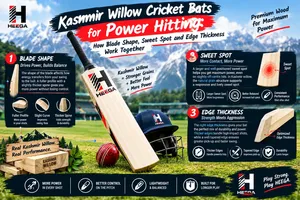 Kashmir Willow Cricket Bats for Power Hitting: How Blade Shape, Sweet Spot and Edge Thickness Work TogetherLearn how Kashmir willow cricket bat blade shape, sweet spot position, and edge thickness work together to support powerful shots, control, and balance.
 How to Choose the Right Cricket Bat Weight: Understanding Bat Speed, Power & ControlLearn how to choose the right cricket bat weight based on strength, playing style, bat speed, control, balance, and experience for better batting performance.
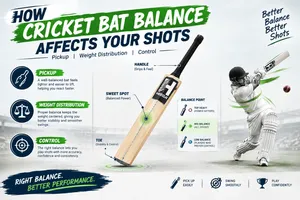 How Cricket Bat Balance Affects Your Shots: Pickup, Weight Distribution, and ControlLearn how cricket bat balance affects pickup, shot control and batting comfort. Understand weight distribution, sweet spot, bat feel and choosing the right balance.