Cricket Bat Profile Explained: How Blade Shape Influences Balance and Shot-Making
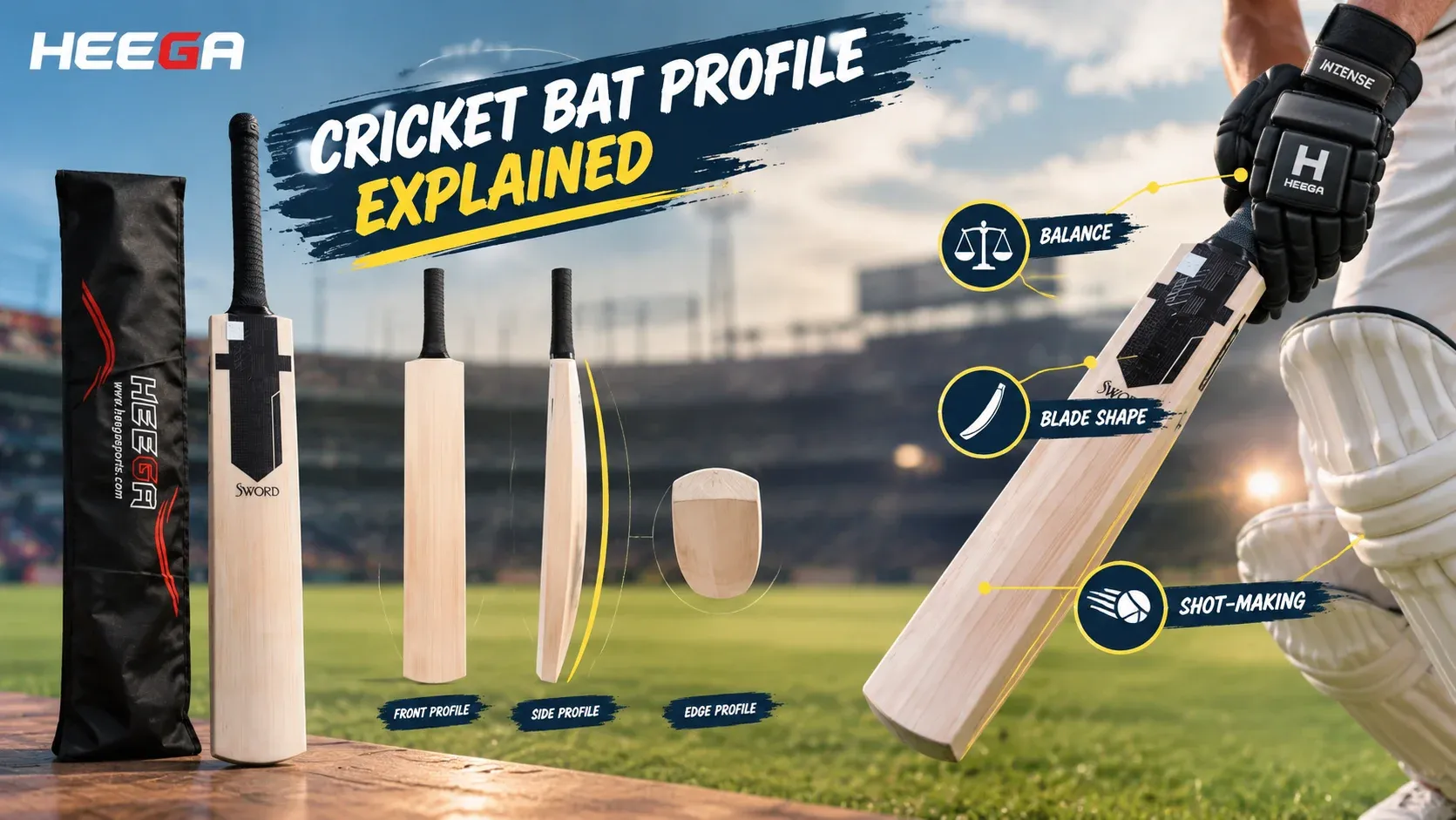
Introduction: Why Cricket Bat Profile Matters
When buying a cricket bat, players often focus on willow, weight, size, and brand.
But there is another important factor that can significantly influence how a bat feels in the hands:
The cricket bat profile.
The profile refers to the overall shape and structure of the bat blade.
It influences how the wood is distributed across the blade, how the bat sits in the hands, and how naturally it moves during a shot.
Two bats can have similar weights and the same overall length but feel completely different because their blade profiles are different.
One may feel compact and balanced.
Another may feel more powerful through the hitting area.
A third may feel easier to manoeuvre when playing quick shots.
This is why understanding cricket bat profile can help players make more informed equipment decisions.
The right profile does not automatically make someone a better batter.
Technique, timing, decision-making, and practice remain fundamental.
However, a suitable bat profile can complement a player's technique and make the equipment feel more natural.
From junior cricket and academy training to club and competitive cricket across Nepal, Germany, the United States, Canada, the Netherlands, and the United Kingdom, players can encounter different bat designs suited to different preferences.
This guide explains what cricket bat profile means, how blade shape affects balance and shot-making, and what players should consider before choosing a bat.
What Is a Cricket Bat Profile?
A cricket bat profile is the overall shape of the bat blade when viewed from the side and face.
It includes characteristics such as:
- Blade thickness.
- Spine shape.
- Shoulder structure.
- Toe design.
- Curvature of the blade.
- Distribution of wood.
- Shape of the hitting area.
Together, these features determine how the bat looks and feels.
The profile is not simply about making a bat look powerful.
It is about distributing material across the blade in a way that creates particular performance and handling characteristics.
Why Are Cricket Bat Profiles Different?
Not every batter plays cricket in the same way.
Players have different:
- Batting techniques.
- Physical strengths.
- Preferred shots.
- Playing conditions.
- Formats.
- Pitch types.
- Experience levels.
A player who likes aggressive stroke play may prefer a different profile from someone who prioritizes controlled timing.
Manufacturers therefore create different blade shapes to offer different combinations of balance, pickup, hitting characteristics, and control.
The Main Elements of a Cricket Bat Profile
Understanding individual profile elements makes it easier to understand the complete blade shape.
The Spine
The spine is the raised central section running along the back of the bat.
Its shape and height can influence how the bat looks and feels.
A pronounced spine can contribute to a substantial hitting profile while the way that spine flows toward the edges and toe affects the overall balance of the blade.
However, spine height should not be considered separately from the rest of the bat.
Two bats with similarly sized spines can still feel very different because of their overall construction.
The Shoulders
The shoulders are the upper sections of the bat blade near the handle.
Their shape contributes to the transition between the handle and the blade.
A well-designed shoulder area can help create a smooth overall profile.
The amount of wood in this region also contributes to the bat's overall balance.
Manufacturers often shape the shoulders carefully to provide the desired combination of strength, appearance, and weight distribution.
The Toe
The toe is the bottom section of the bat.
Its shape can affect:
- Ground clearance.
- Durability.
- Blade appearance.
- Weight distribution.
- Interaction with the crease.
Some bats have a more traditional toe shape, while others feature more modern designs.
The toe should also be considered in relation to the playing conditions and the player's technique.
The Curve of the Blade
Cricket bats are not always completely flat.
The blade can have a carefully designed curvature.
This curvature can influence how the bat sits behind the ball and how it feels during the swing.
The exact shape varies between manufacturers and models.
Players often develop preferences after using different bats over time.
Traditional vs Modern Cricket Bat Profiles
Traditional cricket bats often have a more classic appearance.
They may feature a balanced blade shape with a relatively conventional distribution of wood.
Modern bats can have more pronounced profiles designed around contemporary batting demands.
These designs may emphasize:
- Large hitting areas.
- Modern blade shapes.
- Distinctive spines.
- Carefully distributed mass.
- Aggressive visual profiles.
Neither approach is automatically suitable for every player.
The important question is how the profile feels during actual batting.
How Profile Influences Balance
Balance is one of the biggest reasons profile matters.
The way wood is distributed throughout the blade affects how the bat feels when held.
A well-balanced bat may feel natural when lifted into the backlift.
Another bat with a similar listed weight may feel more concentrated toward a particular part of the blade.
This is why two bats with the same weight can feel noticeably different.
The profile contributes to that difference.
What Does a Balanced Bat Feel Like?
A balanced bat generally feels comfortable in the hands.
It should allow the player to lift and move the bat without fighting against its weight distribution.
Good balance can help with:
- Bat control.
- Backlift.
- Manoeuvrability.
- Timing.
- Shot preparation.
However, balance is highly personal.
A player may prefer a bat that feels neutral, while another may prefer a blade with more mass concentrated lower down.
Pickup and Profile Are Closely Connected
Pickup describes how heavy or light a bat feels when the player lifts and moves it.
The actual weight is important, but the profile and distribution of wood also influence the perceived weight.
This means a bat with a certain listed weight may feel lighter or heavier depending on its construction.
Players should therefore avoid choosing a bat based solely on the number printed on the specification.
Why Two Bats With the Same Weight Can Feel Different
Imagine two bats that both weigh 1.2 kg.
One has a more compact distribution of wood.
The other has more mass concentrated toward the lower part of the blade.
They may feel completely different during the backlift.
This is why experienced players often pick up several bats before choosing one.
The number on the scale tells you the actual weight.
Your hands tell you how that weight is distributed.
Profile and Shot-Making
A bat profile can influence how a player experiences different shots.
For example, the overall shape of the blade can affect how easily a player manoeuvres the bat through:
- Drives.
- Cuts.
- Pulls.
- Flicks.
- Defensive strokes.
- Lofted shots.
The profile does not determine whether a shot will succeed.
Instead, it influences the equipment's handling characteristics.
Front-Foot Batting and Blade Shape
Players who frequently play front-foot drives may appreciate a profile that feels stable and controlled through the swing.
A comfortable balance can help the player move the bat smoothly toward the ball.
However, the ideal profile depends on the individual batter.
A player should test the bat rather than assuming a particular profile will automatically improve front-foot batting.
Back-Foot Shots and Manoeuvrability
Back-foot shots often require the batter to react quickly.
Cuts and pulls can involve rapid bat movement.
A profile that feels easy to manoeuvre may be attractive to players who rely heavily on these shots.
Again, technique remains the foundation.
The bat should complement the player's natural movement rather than force them to change their technique unnecessarily.
Profile and Defensive Batting
Defensive batting requires control and precision.
A batter often wants to present the bat confidently while maintaining balance.
A predictable and comfortable blade profile can help the player feel more secure during defensive movements.
This is particularly useful for players who spend significant time building innings through controlled stroke play.
Profile and Aggressive Batting
Modern aggressive batting can involve powerful shots across different areas of the field.
Players who frequently attack may prefer a profile that feels substantial while still remaining manageable.
However, maximum blade size should not automatically be the goal.
A bat that feels difficult to control can reduce the player's ability to react quickly.
The right combination of mass and manoeuvrability is more important than simply choosing the most dramatic-looking profile.
The Role of the Hitting Area
The shape of the blade influences the overall hitting area.
A broader profile may create a substantial area across the blade.
This can give the bat a powerful appearance and may appeal to players looking for a modern design.
But the player should still consider balance and handling.
A large-looking blade is not necessarily the best option for every batter.
Profile and Playing Conditions
Playing conditions can influence equipment preferences.
A player who regularly plays on pitches with different characteristics may develop particular preferences.
For example, some players may prefer a bat that feels easy to manoeuvre on slower surfaces.
Others may prefer a more substantial profile when playing on surfaces where they are comfortable playing powerful strokes.
There is no universal profile for every pitch.
Profile and Cricket Formats
Different cricket formats can create different equipment preferences.
Test and Long-Format Cricket
Long-format cricket requires patience, control, and the ability to bat for extended periods.
Players may value:
- Comfortable pickup.
- Reliable control.
- Consistent handling.
- A familiar blade profile.
One-Day Cricket
One-day cricket combines traditional stroke play with periods of acceleration.
Players may look for a balance between control and attacking capability.
T20 Cricket
T20 cricket often involves aggressive scoring and rapid shot-making.
Some players may prefer modern profiles that provide a substantial hitting area while remaining manageable during fast swings.
The ideal choice still depends on the individual batter.
Profile Should Match Your Batting Style
One of the simplest ways to approach profile selection is to think about how you actually bat.
Ask yourself:
- Do I rely on timing?
- Do I play mostly front-foot shots?
- Do I play many back-foot shots?
- Do I attack spin?
- Do I prefer quick singles?
- Do I play aggressive lofted shots?
- Do I need maximum manoeuvrability?
Your answers can help narrow down the type of profile worth testing.
Profile and Player Strength
Physical strength also matters.
A stronger player may be able to comfortably control a more substantial blade.
A developing player may benefit from a profile that feels easier to manoeuvre.
This is particularly important for younger players moving toward adult-sized bats.
Equipment should match the player's current physical ability rather than simply their aspirations.
Junior Players Need Special Attention
Young players should not choose a bat simply because an adult model looks impressive.
A junior player needs equipment that is appropriate for their:
- Height.
- Strength.
- Hand size.
- Batting technique.
- Playing level.
An unsuitable profile can make the bat feel awkward and may interfere with developing good batting habits.
Academy Players Often Experiment With Profiles
Academy players are at a stage where their technique is developing quickly.
They may have opportunities to try different bat designs during coaching and net sessions.
This can help them understand personal preferences.
One player may prefer a compact profile.
Another may feel more comfortable with a larger blade.
Experimentation can be useful before committing to a specific bat design.
Club Players May Need a Practical All-Round Profile
Club cricket often involves a mixture of conditions.
Players may train regularly and compete across different pitches.
A practical profile that offers a comfortable combination of balance, control, and durability can therefore be useful.
The objective is not to select the most extreme design.
It is to select a bat that works consistently.
Advanced Players Often Develop Strong Preferences
Experienced players usually know what they like.
They may have specific preferences for:
- Blade shape.
- Spine structure.
- Balance.
- Pickup.
- Toe design.
- Handle.
- Grip.
- Willow.
This comes from experience.
The more bats a player uses, the easier it becomes to recognize what feels natural.
How to Compare Two Cricket Bat Profiles
If you are choosing between two bats, do not simply compare their appearance.
Try both bats if possible.
Check:
1. Pickup
Lift both bats using your normal grip.
Which one feels more natural?
2. Backlift
Take your normal batting stance.
Raise the bat into your usual backlift.
Does the movement feel comfortable?
3. Swing
Make a few controlled practice swings.
Does the blade move naturally?
4. Control
Imagine playing your most common shots.
Does the bat feel easy to manoeuvre?
5. Overall Comfort
After several swings, does the bat still feel comfortable?
These simple checks can reveal more than specifications alone.
Do Not Choose a Profile Based Only on Looks
Modern cricket bats can have impressive profiles.
Large spines and thick-looking blades may create a powerful visual impression.
But appearance should not be the deciding factor.
A bat can look excellent and still feel wrong for your technique.
Your hands and batting movements should guide the decision.
The Importance of Trying Before Buying
Whenever possible, players should physically test a cricket bat.
Online specifications are useful, but they cannot fully describe how a particular bat feels.
Two bats with similar specifications can have different:
- Pickup.
- Balance.
- Handle feel.
- Swing characteristics.
If you cannot physically test the bat, pay close attention to its listed dimensions, weight, profile description, and intended player type.
Does a Bigger Profile Mean More Power?
Not necessarily.
A larger-looking profile may contain more material in certain parts of the blade, but actual performance depends on several factors.
These include:
- Willow quality.
- Bat construction.
- Weight.
- Balance.
- Player technique.
- Contact quality.
- Ball speed.
- Timing.
A well-timed shot does not require the most oversized bat.
Does Profile Affect Durability?
The construction and distribution of material can influence how a bat handles repeated impact.
However, durability also depends heavily on:
- Willow quality.
- Preparation.
- Knocking in.
- Maintenance.
- Ball quality.
- Playing conditions.
- How frequently the bat is used.
A profile alone should never be treated as a guarantee of longer bat life.
Kashmir Willow and Profile Selection
Kashmir Willow bats are popular among beginners, academy players, club cricketers, and developing players.
They are available in different blade profiles and designs.
Players can therefore consider profile and handling preferences without automatically moving to the most expensive equipment category.
For many players, a well-chosen Kashmir Willow bat can be a practical option for training and competitive use.
English Willow and Modern Profiles
English Willow bats are available across a wide range of grades and profile designs.
Players may find options with different blade shapes, spines, edges, and balance characteristics.
The key is to select a bat according to actual requirements rather than assuming the willow type alone determines performance.
Common Mistakes When Choosing a Bat Profile
Choosing the Biggest-Looking Bat
A large profile may look powerful, but it may not match your technique.
Ignoring Pickup
A bat can have an attractive profile but feel uncomfortable during the swing.
Choosing Based Only on Weight
Listed weight does not tell you exactly how the bat will feel in your hands.
Copying Another Player
A profile that works for another batter may not suit your technique.
Ignoring Your Playing Level
Beginners and advanced players often have different equipment requirements.
Buying Without Testing
Whenever possible, hold and swing the bat before making a decision.
A Simple Cricket Bat Profile Buying Checklist
Before choosing a bat, consider:
- Does the profile feel comfortable?
- Is the bat easy to lift?
- Does the backlift feel natural?
- Can you control the blade?
- Does the profile suit your common shots?
- Is the bat appropriate for your strength?
- Is the blade suitable for your playing conditions?
- Does the size match your height?
- Is the willow appropriate for your level?
- Can you maintain the bat properly?
A bat that satisfies these practical requirements is more likely to become a comfortable part of your equipment setup.
Cricket Bat Profile and Player Development
A player's equipment can evolve as their technique develops.
A beginner may initially focus on basic control.
As their technique improves, they may begin to understand the importance of:
- Balance.
- Pickup.
- Blade shape.
- Spine structure.
- Handle feel.
- Batting style.
This is a natural part of becoming a more experienced cricketer.
The goal is not to find a perfect profile once and never change.
It is to understand what works for you at each stage of development.
Nepal, Germany, USA, Canada, Netherlands, and UK
Cricket continues to grow across different regions and playing environments.
Players in Nepal, Germany, the United States, Canada, and the Netherlands are entering academies, clubs, schools, and competitive pathways.
The United Kingdom has a long-established cricket ecosystem covering junior cricket, club cricket, academies, county pathways, and professional competition.
Despite these differences, the fundamentals of equipment selection remain similar.
Players need bats that match their size, technique, physical ability, and playing requirements.
Understanding blade profile is one more step toward making a more informed equipment decision.
How Heega Sports Helps Players Find the Right Cricket Bat
At Heega Sports, we understand that every batter has different requirements.
Our cricket range includes bats designed for different playing levels and preferences, including:
- Junior cricket bats.
- Size 3, 4, 5, and 6 bats.
- Harrow bats.
- Short Handle bats.
- Long Handle bats.
- Kashmir Willow bats.
- Cricket batting gloves.
- Leather cricket balls.
- Practice cricket balls.
- Cricket pads.
- Cricket helmets.
- Cricket shoes.
- Cricket kit bags.
- Practice nets.
- Training accessories.
Whether you are buying your first serious bat or looking for equipment for regular competitive cricket, understanding the profile can help you choose more confidently.
Final Thoughts
Cricket bat profile is one of the most important design characteristics players should understand before choosing a bat.
The shape of the blade affects how the bat distributes its material, how it feels in the hands, and how naturally it moves during batting.
A well-designed profile can provide a comfortable combination of balance, pickup, control, and hitting characteristics.
But there is no single profile that is perfect for every player.
A batter who relies on timing may prefer one type of blade shape.
An aggressive player may prefer another.
A junior player may need a more manageable design, while an experienced batter may have highly specific preferences.
The most important thing is to look beyond appearance.
Pick up the bat.
Test the balance.
Try the backlift.
Make a few swings.
Think about your playing style.
Consider your strength, level, and typical playing conditions.
The right cricket bat profile should feel like an extension of your batting technique rather than something you have to fight against.
As your game develops, your equipment preferences may evolve too.
Understanding the role of blade shape gives you another useful tool for making better equipment decisions.
🏏 Find the Right Cricket Bat Profile With Heega Sports
Explore Heega Sports cricket bats in Size 3, 4, 5, 6, Harrow, Short Handle, and Long Handle, along with Kashmir Willow bats, batting gloves, cricket balls, pads, helmets, shoes, kit bags, practice nets, and training accessories.
Shop Now
Heega Sports – Helping Every Player Find the Right Equipment for Their Game.
Related posts
 Kashmir Willow Bats Explained: How Willow Quality, Bat Profile & Balance Affect PerformanceLearn how Kashmir Willow bats, willow quality, bat profile, balance, pickup, weight, and sweet spot position can affect cricket batting performance.
 Why Cricket Bats Have Different Spine Shapes and Profiles - Power, Balance, and Shot ControlLearn why cricket bats have different spine shapes and profiles and how bat design affects weight distribution, power, balance, pick-up, timing, and shot control.
 English Willow Cricket Bats Explained: How Bat Pressing, Grain Structure and Blade Compression Influence PerformanceLearn how English willow bat pressing, grain structure, and blade compression influence performance, durability, shot response, and bat selection.