How Does the Pitch Affect a Cricket Match?

How does the pitch actually affect the match?
The pitch decides how the ball behaves after it lands: how fast it comes through, how high it bounces, whether it seams or spins. A moist pitch grips the ball and helps bowlers; a dry one skids through lower and favours batting until it wears and the spinners come into play.
The pitch is not one thing, though. Its hardness, its moisture, the grass on it and the cracks that open up each do something different, and they change between the first session and the last.
Is a moist pitch good for batting or bowling?
Bowling, early on. On a damp surface the ball grips, which creates seam movement and variable bounce. Bowlers benefit most in the morning, when the pitch is still holding moisture. On a dry pitch the ball skids through with lower bounce, which suits the batter.
Moisture has a second effect. Too much of it and the pitch stays soft. A soft pitch absorbs energy, so the ball loses speed and bounce, and the batter gets slightly more time. A pitch with the right amount of moisture can firm up into a hard playing surface.
So the same word, moisture, means two different things depending on how much of it there is. Damp and firm helps the seamer. Wet and soft slows everything down.
What makes a pitch fast or slow?
Mainly hardness. A hard pitch returns more energy to the ball, so it comes through with better pace, higher bounce and stronger carry to the keeper. A softer pitch absorbs that energy and the ball arrives later and lower.
The things that set hardness:
- Soil. Many pitches carry a lot of clay, which gives a firm surface and consistent bounce.
- Rolling. Rolling compacts the surface and increases firmness, which is why a well-rolled pitch is usually quicker.
- Grass. Grass holds moisture and influences seam movement. Too much of it makes batting hard early in a match.
- Sun. Strong sunlight dries the surface out, which makes it harder and opens cracks.
As a rough guide: grass means higher bounce, dust means lower bounce, and cracks mean variable bounce, which is the one batters like least.
Why do spinners come in later?
Because the pitch wears. As it dries, the ball grips the surface more effectively, and cracks and rough patches give the spinner something to work with. Bowlers landing the ball in the same area over and over create worn patches, and footmarks add to them.
This is the pattern behind a lot of matches: the seamers get help while the surface is fresh and damp, batting gets easier as it firms up and dries, and then the spinners take over as it breaks up.
What does dew do in an evening game?
Dew tilts the game towards the batting side. The ball gets slippery and harder to grip and control. For swing bowlers, the swing reduces. For spinners it is worse, because the wet ball will not grip the surface. Dew also softens the ball, so the bounce is lower and skiddier.
For the batter, the ball comes nicely onto the bat and does not swing as much. That is why teams often prefer to bat second when dew is expected.
How should a batter adjust to the pitch?
Watch the first few deliveries before deciding anything. Then:
- On a bouncy pitch, play with soft hands and avoid hard drives.
- On a low pitch, get forward early and keep the bat close to the body.
- On a variable pitch, be patient and wait for the bad ball.
- When the ball is seaming, play late and use soft hands.
On a difficult surface, timing matters more than power. The aim is to meet the ball rather than overpower it, because a hard hit with poor timing still gets you out.
Two small equipment points. The ball itself changes the picture: a new, hard ball bounces sharply, and an old, soft one bounces lower and gives the spinner more grip. And footwear should match the surface: spikes for grass and turf, rubber or multi-stud soles for hard, matting and indoor wickets. Our cricket shoes come in both.
For the weather side of the same question, see how dew and weather affect a cricket ball.
Whatever the pitch is doing, it is doing it to the ball. Our hand-stitched leather cricket balls are made in Meerut for matches, practice and training.
Related posts
 Cricket Shoes Explained: How Stud Patterns, Grip and Sole Design Affect Performance on Different PitchesLearn how cricket shoes, stud patterns, grip and sole design affect traction, stability, comfort and performance on grass, turf and artificial pitches.
 How Cricket Pitch Conditions Affect Batting Technique and Shot SelectionLearn how cricket pitch conditions affect batting technique and shot selection, including pace, bounce, spin, grass, moisture, and surface changes.
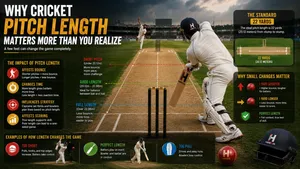 Why Cricket Pitch Length Matters More Than You Realize. Discover why cricket pitch length matters and how the distance between the creases influences batting reactions, bowling, bounce, timing, footwork, and overall match strategy.