How Small Cricket Challenges Can Help Kids Build Confidence Without Fear of Failure.

Introduction: Confidence Grows Through Small Wins
Confidence is one of the most important qualities a young cricketer can develop.
A confident child is more willing to try.
They are more comfortable making mistakes.
They are more likely to ask questions.
They are also more willing to attempt skills that initially feel difficult.
But confidence does not appear automatically.
It develops through experience.
For many children, one of the best ways to build confidence is through small, achievable cricket challenges.
Instead of asking a child to become the best batter or bowler immediately, parents and coaches can create simple goals that allow the player to experience progress.
One successful catch.
Five accurate throws.
Three controlled shots.
A good bowling spell.
These small achievements can gradually change how a child sees their own abilities.
What Is Confidence in Youth Cricket?
Confidence does not mean believing that you will always succeed.
It means believing that you can handle the challenge even when success is not guaranteed.
A confident young cricketer can think:
"I might miss this catch, but I can try."
That mindset is much healthier than:
"I cannot try because I might fail."
Why Fear of Failure Can Affect Young Players
Children naturally care about what others think.
If they repeatedly feel embarrassed after making mistakes, they may begin avoiding challenging situations.
A batter might stop attempting certain shots.
A fielder might become nervous before a catch.
A bowler might become afraid of bowling in front of others.
Over time, this can reduce opportunities to learn.
Small Challenges Make Learning Less Overwhelming
Imagine telling a beginner:
"Become a great batter."
That goal is too large and vague.
Now compare it with:
"Try to keep your head still for the next five balls."
The second goal is much easier to understand.
Small challenges give children something specific to focus on.
Why Achievable Goals Matter
A challenge should be difficult enough to require effort but realistic enough to feel possible.
For example:
- Catch five easy balls.
- Hit three controlled drives.
- Bowl six deliveries toward a target.
- Complete two accurate throws.
- Run one quick single safely.
These goals provide clear opportunities for success.
Confidence Builds Through Progress
A child may initially struggle to catch five balls.
After practice, they catch three.
Later, they catch four.
Eventually, they catch all five.
That progress creates a powerful message:
"I can improve when I practice."
This is more valuable than simply being told that they are talented.
The Difference Between Praise and Progress
Parents often tell children:
"You're very talented."
Positive encouragement is helpful.
But praising effort and improvement can be even more useful.
For example:
"You kept trying even after missing the first two catches."
This teaches children that persistence matters.
Small Challenges Encourage Effort
A well-designed challenge gives children a reason to concentrate.
Instead of simply telling them to practice catching, a coach might say:
"Let's see if you can complete five catches without dropping one."
Now the activity has a clear purpose.
Cricket Makes Goal Setting Practical
Cricket naturally provides measurable challenges.
Players can count:
- Runs.
- Deliveries.
- Catches.
- Targets hit.
- Boundaries.
- Successful throws.
This makes it easier for children to see improvement.
Batting Challenges for Young Players
Batting challenges can be simple and fun.
For example:
Challenge 1: Controlled Contact
Can the child make clean contact with five gentle deliveries?
Challenge 2: Placement
Can they hit the ball into a selected area?
Challenge 3: Defense
Can they successfully defend five balls?
These activities focus on specific skills rather than overall performance.
Bowling Challenges
Young bowlers can work toward simple accuracy goals.
For example:
"Can you hit the target three times from six deliveries?"
The objective is not necessarily wickets.
It is control.
Why Accuracy Challenges Build Confidence
A child who struggles to take wickets may become frustrated.
But if they learn to measure success through accurate deliveries, they can experience progress even without dismissing a batter.
This helps create a healthier understanding of performance.
Fielding Challenges
Fielding provides many opportunities for achievable goals.
Children can try:
- Five catches.
- Ten accurate throws.
- Three clean ground-ball stops.
- Hitting a target with a throw.
- Saving a certain number of runs in a game.
These activities can make fielding exciting.
Reaction Challenges
Simple reaction games can also help.
A coach or parent can use a soft ball and ask the child to react to different directions.
The challenge can gradually become harder.
The child sees that improvement comes through practice.
Running Between the Wickets
Running challenges can teach both confidence and decision-making.
For example:
"Can you complete three safe singles with good communication?"
This encourages children to focus on smart decisions rather than speed alone.
Challenges Should Not Always Be About Winning
A major mistake is turning every challenge into a competition.
Not every activity needs a winner.
Some challenges should simply help the child beat their previous performance.
For example:
Last week: 4 successful catches.
This week: 5 successful catches.
That is meaningful progress.
Personal Bests Can Be Better Than Comparisons
Comparing children can create pressure.
Instead, encourage personal improvement.
Ask:
"Can you beat your own previous score?"
This keeps the focus on development.
Why Comparison Can Hurt Confidence
If a child constantly hears that another player is better, they may start believing they cannot catch up.
This can discourage effort.
Every child develops differently.
A personal-progress approach allows children to grow at their own pace.
Challenges Teach Children to Accept Mistakes
A challenge should include the possibility of failure.
That is what makes it useful.
A child may attempt ten catches and miss three.
That is not necessarily a bad session.
They may have learned something about:
- Hand position.
- Footwork.
- Concentration.
- Timing.
Failure Becomes Feedback
Instead of thinking:
"I failed."
children can learn to think:
"I know what I need to practice."
This is an important mindset shift.
The Coach's Reaction Matters
The way an adult responds to mistakes can strongly influence a child's confidence.
If a child drops a catch and hears:
"How could you drop that?"
they may become nervous.
If they hear:
"Good try. Let's look at your hand position and try again."
the mistake becomes part of learning.
Parents Can Create the Same Environment
Parents do not need to become professional coaches.
They can simply provide encouragement.
Useful responses include:
- "Good effort."
- "Let's try again."
- "What do you think happened?"
- "You improved from last time."
- "That was a difficult one."
These statements help children remain comfortable with learning.
Avoid Making Every Match a Test
A young player does not need to prove themselves every time they play.
Sometimes they need to experiment.
They need to try new shots.
They need to bowl different deliveries.
They need to make mistakes.
Match experience should be part of learning rather than a constant examination.
Small Challenges Can Make Practice More Enjoyable
Challenges turn repetitive drills into games.
Instead of:
"Practice catching for twenty minutes."
try:
"Let's see how many catches you can complete in two minutes."
The skill remains the same, but the experience feels more engaging.
Use Imagination to Make Challenges Fun
Children respond well to simple stories.
For example:
"You are protecting the last five runs of the match. Can you stop the next three balls?"
Now fielding becomes a game situation.
Match Scenarios Can Build Confidence
Scenario-based challenges teach children that their skills have a purpose.
Examples include:
- Defending a small total.
- Chasing a target.
- Bowling the final over.
- Taking a difficult catch.
- Running a quick single.
These situations make practice more meaningful.
Challenges Should Gradually Increase
If a child successfully completes an easy challenge, make it slightly harder.
For example:
Stage 1
Catch five stationary or gentle balls.
Stage 2
Catch five moving balls.
Stage 3
Catch while moving.
Stage 4
Catch under match-like pressure.
This gradual progression allows confidence to develop alongside skill.
Don't Make the Challenge Too Difficult
If a child repeatedly fails, the challenge may be too advanced.
The solution is not necessarily to push harder.
Instead, reduce the difficulty.
Success should be possible with effort.
The Right Level of Difficulty Matters
A useful challenge sits somewhere between:
"This is too easy."
and
"I have no chance of doing this."
The ideal challenge makes the child think:
"This is difficult, but I might be able to do it."
Confidence and Skill Can Reinforce Each Other
When a child improves a skill, confidence can increase.
When confidence increases, the child may be more willing to practice.
More practice can improve the skill again.
This creates a positive cycle:
Challenge → Practice → Improvement → Confidence → More Challenge
Small Goals Can Teach Patience
A child may want to become an excellent cricketer immediately.
Small challenges teach them that improvement happens step by step.
Today they work on catching.
Tomorrow they work on throwing.
Later they combine both skills in a match.
Children Learn to Celebrate Small Achievements
A young player may think only a fifty or five-wicket haul is worth celebrating.
Parents and coaches can broaden that definition.
A successful achievement could be:
- First clean catch.
- First accurate over.
- First controlled drive.
- First direct hit.
- First successful run-out.
- First confident shot against faster bowling.
These moments matter.
Small Achievements Create Positive Memories
Children remember experiences.
If cricket becomes associated with:
- Encouragement.
- Fun.
- Achievement.
- Friendship.
they are more likely to want to continue playing.
Confidence Should Not Depend Entirely on Results
A child can have a good cricket day without scoring many runs.
Maybe they:
- Made good decisions.
- Stayed focused.
- Supported teammates.
- Improved their footwork.
- Tried something new.
These are valuable achievements.
Encourage Brave Attempts
Parents should celebrate sensible attempts, even when the result is unsuccessful.
A child who attempts a difficult catch may miss it.
But they demonstrated courage.
That willingness to try is important for development.
Confidence Does Not Mean Fearlessness
Even confident children can feel nervous.
Confidence means being willing to act despite nervousness.
Cricket provides many opportunities to practice this.
Pressure Can Be Introduced Gradually
Young players should not immediately be placed under intense pressure.
Instead, pressure can be introduced gradually.
For example:
First: Practice catching.
Then: Catch during a game.
Later: Catch in a match scenario.
This builds experience naturally.
Team Challenges Can Build Confidence
Not every challenge needs to be individual.
Teams can work together.
For example:
"Can the group complete 20 successful catches?"
This encourages:
- Communication.
- Support.
- Teamwork.
Pair Challenges Can Also Work
Two players can work together on:
- Throwing and catching.
- Batting and running.
- Bowling and fielding.
- Wicketkeeping and bowling.
This can reduce pressure while building cooperation.
Cricket Challenges Can Develop Leadership
Older children can sometimes help design challenges.
They can decide:
- What the target should be.
- How difficult it should be.
- How the team can improve.
This gives them ownership.
Parents Should Let Children Set Some Goals
Parents can ask:
"What would you like to improve this week?"
The answer may be simple.
Perhaps the child wants to catch better.
Or bowl more accurately.
Or hit a particular shot.
Allowing children to choose goals can increase motivation.
Keep Goals Specific
Instead of:
"Get better at cricket."
try:
"Complete ten accurate throws this week."
Specific goals are easier to understand and measure.
Keep Goals Realistic
A child should be challenged, but the goal should remain achievable.
Unrealistic targets can create unnecessary frustration.
Review Progress Without Pressure
At the end of the week, ask:
- What improved?
- What was difficult?
- What did you enjoy?
- What should we practice next?
This turns practice into reflection.
Equipment Can Influence Confidence
Children often feel more comfortable when their equipment fits properly.
An appropriately sized bat can help with:
- Control.
- Balance.
- Timing.
- Swing speed.
Comfortable gloves and protective equipment can also help children focus on learning.
Avoid Oversized Equipment
Buying equipment that is too large simply because the child will eventually grow can make training difficult.
Young players need equipment they can control today.
Junior Cricket Bats Can Support Skill Development
Junior bats are designed for developing players and are available in different sizes.
Parents should consider:
- Child's height.
- Strength.
- Bat weight.
- Playing level.
- Coach recommendations.
The right equipment can make practice more comfortable.
Kashmir Willow Can Be a Practical Choice
For many young players, Kashmir Willow bats can provide durability and value for regular practice.
They can be suitable for:
- Academy training.
- School cricket.
- Practice sessions.
- Developing players.
The correct size and weight remain essential.
How Heega Sports Supports Young Players
At Heega Sports, we believe children should have equipment that allows them to learn comfortably and confidently.
Our cricket range includes:
- Junior cricket bats.
- Kashmir Willow bats.
- Leather cricket balls.
- Practice balls.
- Batting gloves.
- Batting pads.
- Cricket helmets.
- Cricket shoes.
- Cricket kit bags.
- Practice nets.
- Training accessories.
The right equipment cannot replace practice or coaching, but it can help children focus on developing their skills.
A Simple Weekly Challenge Plan
Parents or coaches can create a simple weekly structure.
Monday: Batting Challenge
Complete five controlled shots.
Wednesday: Bowling Challenge
Hit the target three times from six deliveries.
Friday: Fielding Challenge
Complete ten catches.
Weekend: Match Challenge
Make one smart decision under pressure.
This keeps development varied and manageable.
A Simple Confidence-Building Challenge
Try this activity with a young player.
Choose one skill they find slightly difficult.
For example, catching.
Start with five easy catches.
Once they complete them, gradually increase the difficulty.
Do not rush.
The objective is to show:
"Something that felt difficult can become easier with practice."
That experience can be more valuable than simply telling a child to be confident.
What Parents Should Remember
Parents can help young players build confidence by:
- Setting small goals.
- Celebrating improvement.
- Allowing mistakes.
- Avoiding constant comparisons.
- Keeping challenges fun.
- Listening to the child's interests.
- Using age-appropriate expectations.
- Supporting good coaching.
- Choosing suitable equipment.
- Focusing on long-term development.
The Bigger Lesson Beyond Cricket
The confidence children develop through small cricket challenges can transfer into other areas.
A child who learns:
"I can improve with practice."
may approach other challenges differently.
They may become more willing to:
- Learn difficult subjects.
- Try new activities.
- Speak in front of others.
- Solve problems.
- Work through setbacks.
Cricket becomes more than a sport.
It becomes a learning environment.
Final Thoughts
Confidence does not need to come from winning every match.
For young cricketers, confidence can come from something much simpler:
trying something difficult and discovering that they can improve.
Small cricket challenges make this process easier.
A few successful catches.
A better bowling over.
A controlled batting session.
A smart running decision.
Each achievement tells a child that progress is possible.
The important thing is to keep challenges realistic, enjoyable, and appropriate for the child's development.
When children are allowed to make mistakes without feeling embarrassed, they become more willing to experiment.
When they experience small successes, they become more confident.
And when they learn to measure themselves against their own progress rather than constantly comparing themselves with others, cricket becomes a much healthier learning experience.
The goal is not to remove failure from cricket.
The goal is to teach children that failure is simply part of the process of getting better.
Give a child a challenge they can work toward.
Give them room to make mistakes.
Give them encouragement when they improve.
Over time, those small moments can help build something much bigger than cricket skill:
the confidence to keep trying.
🏏 Help Your Child Build Confidence Through Better Cricket Practice
Explore junior cricket bats, Kashmir Willow bats, leather balls, practice balls, batting gloves, pads, helmets, cricket shoes, kit bags, practice nets, and training accessories at Heega Sports.
Shop Now
Heega Sports – Helping Young Cricketers Practice With Confidence, Learn From Every Challenge, and Enjoy the Game.
Related posts
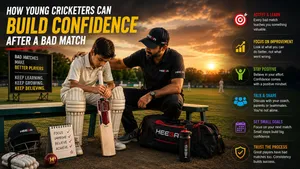 How Young Cricketers Can Build Confidence After a Bad Match.Learn how young cricketers can rebuild confidence after a bad match, handle mistakes, manage pressure, and return to practice with a positive mindset.
 Cricket Leg Guards Explained: How Fit, Protection, and Comfort Improve Batting ConfidenceLearn how cricket leg guards provide protection, comfort, fit, and confidence while batting, plus tips for choosing and maintaining the right pair.
 How Cricket Scoring Has Changed the Way Players Build Innings.Discover how modern cricket scoring has changed batting strategy, from strike rotation and boundary hitting to calculated risks across Test, ODI, and T20 cricket.