How to Build Your Child's Cricket Confidence After a Bad Match

Introduction: Every Cricketer Has Bad Days
One Saturday, your child walks off the field smiling after scoring runs and taking a catch.
The next weekend, they get out for zero, drop an easy catch, and don't bowl well either.
On the drive home, they quietly say:
"Maybe I'm just not good at cricket."
As a parent, hearing those words can be heartbreaking.
Your first instinct might be to offer technical advice or tell them to practice harder.
But after a difficult match, children usually don't need coaching first.
They need encouragement.
Every successful cricketer—from local club players to international stars—has experienced bad matches.
The difference is not that they never fail.
The difference is that they learn how to recover.
Across Nepal, Germany, the United States, Canada, the Netherlands, and the United Kingdom, youth coaches understand that confidence is one of the biggest factors in long-term player development.
This guide explains how parents can help children bounce back after disappointing performances and continue enjoying the game.
First, Remember That One Match Doesn't Define a Player
Children often judge themselves based on their most recent game.
If they performed poorly today, they may believe they are poor cricketers.
Help them understand an important lesson:
One match is only one chapter—not the whole story.
Every player has good days and difficult days.
Avoid Criticizing Immediately After the Match
The journey home isn't usually the best time for technical discussions.
Avoid questions like:
- "Why did you play that shot?"
- "Why did you drop that catch?"
- "Didn't your coach tell you what to do?"
Instead, simply let them talk if they want to.
Sometimes silence and support are more valuable than advice.
Praise Their Effort Before Discussing Results
Ask questions such as:
- "Did you enjoy playing today?"
- "What did you learn?"
- "What was your favourite moment?"
These questions shift attention away from failure and toward growth.
Help Them See the Bigger Picture
Remind your child:
- Even international cricketers get out for zero.
- Great fielders drop catches.
- Bowlers sometimes have expensive overs.
A bad match is part of cricket—not proof that they lack ability.
Focus on What Went Well
Even during difficult games, something usually goes right.
Maybe your child:
- Encouraged teammates.
- Bowled one good over.
- Fielded energetically.
- Stayed positive.
Celebrate those moments.
Confidence grows when children recognise their strengths.
Don't Compare Them with Other Players
Avoid saying:
"Your teammate scored 40 runs."
Comparisons rarely motivate children.
Instead, compare your child only with their previous performances.
Progress is personal.
Create One Small Goal for the Next Practice
After a disappointing match, don't try to fix everything.
Choose one simple goal.
For example:
- Watch every ball carefully.
- Practice straight drives.
- Catch twenty tennis balls.
Small successes rebuild confidence quickly.
Keep Cricket Fun
Children who enjoy cricket recover from setbacks much faster.
Play:
- Backyard cricket.
- Tennis-ball games.
- Family catching competitions.
Removing competitive pressure reminds children why they started playing in the first place.
Teach Positive Self-Talk
Children often speak harshly to themselves after poor performances.
Help replace thoughts like:
"I'm terrible."
with:
"I'll do better next time."
Positive thinking doesn't ignore mistakes.
It simply keeps mistakes in perspective.
Encourage Patience
Cricket improvement takes time.
Some weeks children improve quickly.
Other weeks progress feels slow.
Both are completely normal.
Remind them that every practice session adds experience.
Be Careful with Expectations
Parents naturally want children to succeed.
But too much expectation can create unnecessary pressure.
Instead of expecting:
- Runs every match.
- Wickets every game.
Expect:
- Effort.
- Learning.
- Positive attitude.
These are qualities children can control.
Nepal: Building Resilient Young Players
Youth academies across Nepal increasingly help children develop mental resilience alongside cricket skills.
Germany: Confidence Through Coaching
German cricket clubs encourage positive learning environments where mistakes become opportunities for improvement.
The United States: Developing Growth Mindsets
American youth cricket programs increasingly emphasize learning rather than simply winning.
Canada: Encouragement Builds Better Players
Canadian coaches understand that confident children usually improve faster than fearful ones.
The Netherlands: Small Improvements Matter
Dutch academies encourage players to focus on continuous progress rather than individual match results.
The United Kingdom: Resilience Is Part of Cricket
British junior cricket has long recognized that resilience often becomes a player's greatest strength.
How Heega Sports Supports Every Young Cricketer
At Heega Sports, we believe cricket should build confidence—not fear.
Quality equipment allows young players to practice comfortably while enjoying the game.
Our collection includes:
- Junior cricket bats
- Premium Kashmir Willow bats
- Practice balls
- Leather cricket balls
- Cricket helmets
- Batting gloves
- Batting pads
- Practice nets
- Cricket kit bags
- Training accessories
Every practice session becomes another opportunity to learn, improve, and regain confidence.
Parent's Confidence Checklist
After a difficult match:
- ✔ Listen patiently.
- ✔ Avoid immediate criticism.
- ✔ Praise effort.
- ✔ Celebrate small positives.
- ✔ Set one simple goal.
- ✔ Keep cricket enjoyable.
- ✔ Remind your child that tomorrow is another opportunity.
These simple actions often make a lifelong difference.
Final Thoughts
Bad matches are not failures.
They are part of every cricketer's journey.
Children who learn how to recover from disappointment often become stronger, more confident, and more resilient players—not only in cricket but in life.
Across Nepal, Germany, the United States, Canada, the Netherlands, and the United Kingdom, experienced coaches continue proving that confidence grows through encouragement, patience, and consistent support.
As a parent, you cannot guarantee your child will always have a good match.
But you can ensure they always have someone who believes in them after a difficult one.
Sometimes, that's the greatest advantage any young cricketer can have.
🏏 Support Every Step of Your Child's Cricket Journey with Heega Sports
Explore premium-quality junior cricket bats, Kashmir Willow bats, practice balls, leather cricket balls, cricket helmets, batting gloves, batting pads, practice nets, cricket kit bags, and training accessories designed to help young cricketers practice with confidence and enjoy every stage of their development.
Shop Now
Heega Sports – Helping Young Cricketers Grow with Confidence, One Match at a Time.
Related posts
 How Young Cricketers Can Build Confidence After a Bad Match.Learn how young cricketers can rebuild confidence after a bad match, handle mistakes, manage pressure, and return to practice with a positive mindset.
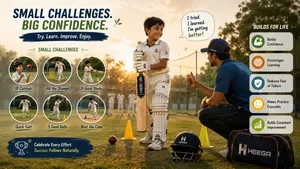 How Small Cricket Challenges Can Help Kids Build Confidence Without Fear of Failure.Learn how small cricket challenges can help kids build confidence without fear of failure. Discover practical ways parents and coaches can make youth cricket more positive and enjoyable.
 Cricket Leg Guards Explained: How Fit, Protection, and Comfort Improve Batting ConfidenceLearn how cricket leg guards provide protection, comfort, fit, and confidence while batting, plus tips for choosing and maintaining the right pair.