Lightweight vs Heavy Cricket Bat: Which Option Is Better for Your Playing Style?
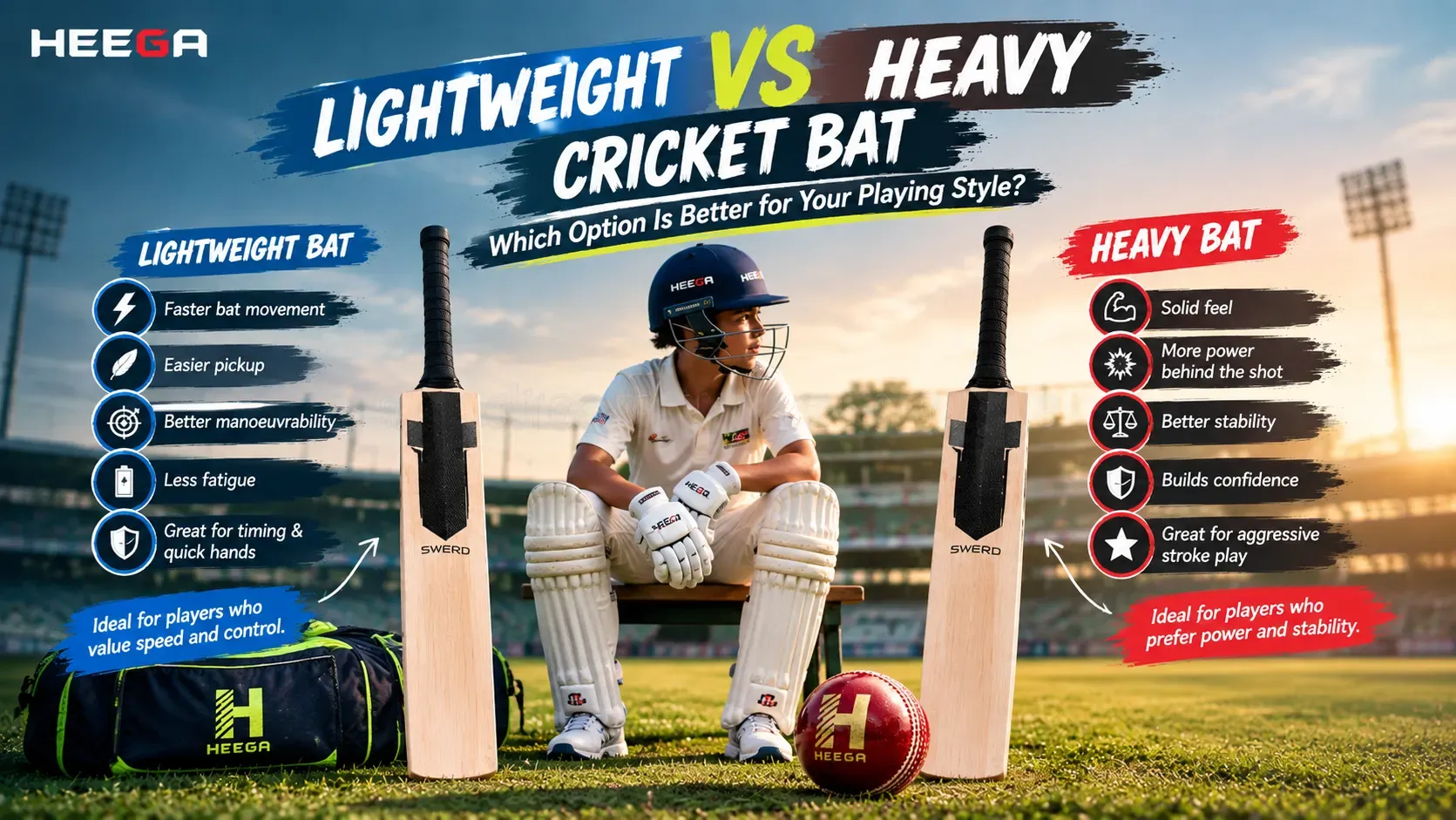
Introduction: Bat Weight Can Change Your Batting Experience
Choosing the correct cricket bat is about more than willow type, appearance, or price.
One of the most important decisions a player must make is selecting the right bat weight.
Some batters prefer lightweight bats because they offer quick movement and easy control. Others prefer heavier bats because they provide a solid feel and can support powerful stroke play.
Neither option is automatically suitable for every player.
The right weight depends on:
- Age.
- Height.
- Strength.
- Batting technique.
- Playing style.
- Match format.
- Physical conditioning.
- Personal comfort.
A bat that feels powerful in one player's hands may feel difficult to control for another. Similarly, a lightweight bat may feel fast and comfortable but may not provide the preferred balance for every batter.
This guide explains the differences between lightweight and heavy cricket bats and helps players understand which option may suit their individual requirements.
What Is a Lightweight Cricket Bat?
A lightweight cricket bat is designed to reduce the overall weight the player needs to lift and move during the swing.
The exact weight considered “light” depends on the bat size and the player's level.
A lightweight bat may offer:
- Faster bat movement.
- Easier pickup.
- Better manoeuvrability.
- Reduced fatigue.
- Comfortable defensive play.
- Quick response against fast bowling.
Lightweight bats are often popular among junior players, developing cricketers, and batters who rely on timing and quick hands.
However, lightweight does not mean weak or unsuitable for serious cricket. The bat still needs appropriate construction, preparation, and durability for its intended use.
What Is a Heavy Cricket Bat?
A heavy cricket bat has greater overall mass than a lightweight model.
Some players prefer heavier bats because they provide:
- A solid feel.
- Greater mass behind contact.
- Stability during certain shots.
- A powerful pickup sensation.
- Confidence during aggressive stroke play.
However, a heavier bat requires more strength and control.
If the player cannot move it quickly enough, the additional weight may reduce:
- Bat speed.
- Timing.
- Manoeuvrability.
- Shot control.
- Reaction time.
A heavy bat is useful only when the player can handle it effectively.
Bat Weight and Bat Speed
Bat speed is a major part of effective batting.
A player needs to move the bat quickly enough to respond to the delivery and control the shot.
A lightweight bat may help some players generate faster movement, particularly when they have quick hands and a compact technique.
A heavy bat may produce strong impact when the batter can swing it efficiently. But if the weight slows the swing, the potential benefit of additional mass may be reduced.
The most useful bat is one that provides a practical balance between:
Weight + Speed + Control + Timing
Does a Heavy Bat Always Hit the Ball Farther?
No.
A heavier bat does not automatically produce longer shots.
Distance depends on several factors, including:
- Bat speed.
- Quality of contact.
- Timing.
- Bat angle.
- Player strength.
- Ball speed.
- Shot direction.
- Contact location.
A player who swings a lightweight bat quickly and strikes the ball cleanly may hit the ball farther than a player who struggles to control a heavier bat.
The goal should not be to choose the heaviest bat possible. It should be to choose a bat that allows efficient contact.
The Relationship Between Bat Weight and Control
Control is especially important when facing different lengths and lines.
A batter may need to:
- Defend a good-length delivery.
- Adjust to a slower ball.
- Play a late cut.
- Control a drive.
- Change the shot at the last moment.
- Respond to a short delivery.
A bat that is too heavy can make these adjustments difficult.
A lightweight bat may provide easier movement, but it must still feel stable during contact.
The best weight is the one that allows the batter to control the blade without excessive effort.
Lightweight Bats and Quick Bat Movement
Lightweight bats can be useful for players who value fast movement.
Potential advantages include:
- Faster backlift.
- Easier changes in shot direction.
- Quick defensive responses.
- Comfortable horizontal-bat shots.
- Easier movement for younger players.
These characteristics may be particularly useful in shorter formats, where batters often need to react quickly and score at a high rate.
However, the player must still generate power through technique and body movement.
Heavy Bats and Stability
Some batters prefer the stability of a heavier bat.
A heavier model may feel steady during certain shots, particularly when the player has enough strength to control it.
This can appeal to batters who:
- Prefer a strong bottom-hand grip.
- Play powerful drives.
- Use aggressive stroke play.
- Have developed upper-body strength.
- Prefer a solid impact sensation.
However, stability should not come at the cost of bat speed or control.
Bat Weight and Playing Style
Different playing styles can influence bat-weight preferences.
Timing-Based Batters
Players who rely on placement and timing may prefer:
- Lightweight or moderate weight.
- Easy pickup.
- Smooth swing.
- Good balance.
- Comfortable control.
These characteristics can help the player move the bat into position naturally.
Power Hitters
Power hitters may prefer:
- Moderate or heavier weight.
- Strong blade construction.
- A substantial spine.
- Thick edges.
- A stable feel.
However, the bat must remain manageable throughout the innings.
Defensive Batters
Players who focus on patience and defensive technique may value:
- Easy control.
- Comfortable pickup.
- Balanced weight.
- Reliable movement.
A bat that feels excessively heavy may make defensive adjustments harder.
All-Round Batters
Players who use a wide range of shots may prefer a versatile bat with a weight that supports both control and attacking play.
Lightweight vs Heavy Bats for T20 Cricket
T20 cricket often requires rapid decision-making and quick scoring.
Batters may need to:
- Rotate the strike.
- Play innovative shots.
- Attack different bowling lengths.
- Hit boundaries.
- Change shots quickly.
A lightweight or moderately weighted bat may help some players maintain quick bat speed.
However, some powerful batters may prefer heavier models if they can swing them efficiently.
The ideal T20 bat depends on the individual rather than a fixed weight rule.
Lightweight vs Heavy Bats for One-Day Cricket
One-day cricket requires adaptability.
Players may need to defend early, rotate the strike in the middle overs, and attack toward the end of the innings.
A versatile bat with comfortable pickup can be useful.
Both lightweight and heavier bats can work, provided the player can maintain:
- Timing.
- Control.
- Bat speed.
- Endurance.
- Shot flexibility.
Lightweight vs Heavy Bats for Longer Formats
Longer formats may involve extended periods at the crease.
A batter may face many deliveries and spend several hours batting.
In these situations, comfort and fatigue management become important.
A bat that is too heavy may become tiring over time, especially if the player has to repeatedly lift it during defensive movements.
Some players may prefer a moderate-weight bat that provides a balance of stability and comfort.
Bat Weight and Player Strength
Strength is an important consideration when selecting bat weight.
A physically strong player may be able to control a heavier bat more easily than a beginner or junior player.
However, strength alone is not enough.
The player also needs:
- Good technique.
- Wrist control.
- Efficient footwork.
- Proper balance.
- Sufficient bat speed.
A player should not choose a heavy bat merely because they can lift it once. They should be able to use it repeatedly during practice and matches.
Bat Weight for Junior Players
Young players should be especially careful when selecting bat weight.
A bat that is too heavy can affect:
- Batting posture.
- Backlift.
- Footwork.
- Timing.
- Confidence.
- Skill development.
Junior players should prioritize a bat that they can control comfortably.
The correct bat size should be selected according to height and physical development, while weight should be tested through actual movement.
Parents should avoid choosing a heavy bat simply because they want it to last longer.
Bat Weight and Player Height
Height can influence bat size and the way the player naturally moves at the crease.
Taller players may be able to use longer or heavier bats, but this is not automatic.
The player should still be able to:
- Maintain a balanced stance.
- Lift the bat comfortably.
- Move forward and backward.
- Control the bat during the swing.
- Play both defensive and attacking shots.
Height is a useful starting point, but comfort and strength remain essential.
Listed Weight vs Actual Pickup
The number printed on a bat does not tell the entire story.
Two bats with the same listed weight may feel different because of:
- Weight distribution.
- Sweet-spot position.
- Spine design.
- Edge thickness.
- Handle construction.
- Blade profile.
This is why pickup matters.
A bat with good pickup may feel lighter than its actual weight. Another bat with poor balance may feel heavier than expected.
Players should test the bat rather than relying only on the listed weight.
How to Test Bat Pickup
Before purchasing, a player can try several simple movements.
Backlift Test
Lift the bat into the normal batting position.
Check whether the movement feels natural.
Shadow Shot Test
Practice:
- Straight drives.
- Defensive strokes.
- Pull shots.
- Cuts.
- Flicks.
Repeated Swing Test
Perform several controlled swings.
Notice whether the bat becomes difficult to control or causes unnecessary fatigue.
Wrist Comfort Test
Check whether the wrists, forearms, or shoulders feel strained.
If the bat becomes uncomfortable quickly, it may be too heavy or poorly balanced for that player.
Bat Weight and Fatigue
Fatigue can influence batting performance.
As an innings continues, a player may experience reduced energy and slower reactions.
A bat that feels manageable during the first few shots may become difficult to control after extended use.
This is particularly important for:
- Long net sessions.
- Match simulations.
- Multi-day cricket.
- Regular academy training.
- Long innings.
Players should choose equipment they can control consistently rather than only during a short test.
Bat Weight and Fast Bowling
Fast bowling demands quick reactions.
The batter may have limited time to respond after the ball leaves the bowler's hand.
A lightweight bat may help some players move the blade quickly.
However, the player must still maintain balance and control.
A heavier bat can also work against fast bowling if the batter has sufficient strength and technique to use it effectively.
The key factor is not simply weight. It is how efficiently the player can respond.
Bat Weight and Spin Bowling
Spin bowling often requires changes in footwork and shot selection.
The batter may need to:
- Move down the pitch.
- Defend with soft hands.
- Use the crease.
- Sweep.
- Cut.
- Adjust to flight and turn.
A bat that is easy to manoeuvre can be useful in these situations.
However, a stable bat may also suit players who prefer controlled defensive play.
The correct choice depends on the batter's technique and comfort.
Bat Weight and Bat Profile
Weight should be considered alongside bat profile.
A bat with thick edges and a large spine may have a different balance from a bat with a more traditional profile.
Profile features can affect:
- Pickup.
- Sweet-spot location.
- Swing feel.
- Blade stability.
- Overall manoeuvrability.
A player should not choose weight without considering the complete design.
Bat Weight and Willow Type
Both Kashmir Willow and English Willow bats are available in different weights.
Kashmir Willow
Kashmir Willow bats are often selected by:
- Beginners.
- Junior players.
- School cricketers.
- Academy players.
- Developing club players.
They can provide practical durability and value.
English Willow
English Willow bats are commonly used by advanced club and professional-level players.
They are available in different grades, profiles, and weight options.
Neither willow type is automatically better for every player. The bat must still match the player's needs.
Should Beginners Use Lightweight Bats?
Many beginners benefit from a bat that is easy to control.
A lightweight or moderately weighted bat may help them learn:
- Proper backlift.
- Balanced stance.
- Bat swing.
- Footwork.
- Shot control.
However, the bat should not be so light that it feels unstable or unsuitable for the player's strength.
The most important requirement is comfortable control.
Should Advanced Players Use Heavy Bats?
Some advanced players prefer heavier bats because they have developed the strength and technique to use them efficiently.
However, advanced players may also prefer lightweight bats for quick movement and fast scoring.
Experience does not automatically mean a player should use a heavy bat.
The correct choice remains personal.
Common Mistakes When Choosing Bat Weight
Choosing the Heaviest Bat
Heavy does not always mean powerful or better.
Selecting Only by Appearance
A stylish bat may not have the right pickup.
Ignoring Fatigue
A bat should remain comfortable during extended use.
Copying a Professional Player
A professional's bat weight may not suit another player's strength or technique.
Ignoring Bat Size
An oversized bat can be difficult to control.
Focusing Only on Listed Weight
Balance and weight distribution can change how the bat feels.
Forgetting the Playing Format
Different formats may create different equipment preferences.
Skipping a Practical Test
The player should try the bat before making a final decision whenever possible.
How to Maintain a Lightweight or Heavy Cricket Bat
Regardless of weight, every cricket bat requires proper care.
Players should:
- Follow preparation instructions.
- Knock in the bat where required.
- Keep it dry.
- Protect the toe.
- Check for cracks.
- Maintain the grip.
- Store it correctly.
- Avoid unsuitable use.
- Inspect it regularly.
A heavier bat is not automatically more durable, and a lightweight bat is not automatically fragile. Durability depends on construction, willow, preparation, use, and maintenance.
When Should You Change Your Bat Weight?
A player may consider changing bat weight when:
- Their strength has increased.
- Their technique has developed.
- Their current bat feels too heavy.
- Their current bat feels too light.
- Their playing style has changed.
- They have moved into a different format.
- They are experiencing repeated fatigue.
- Their coach recommends a change.
Any change should be gradual.
Players should spend time practicing with the new weight before using it in important matches.
How Heega Sports Helps Players Choose the Right Bat
At Heega Sports, we understand that bat weight is a personal decision.
Whether you are a junior player, academy cricketer, school batter, club player, or advanced competitor, the right bat should support your technique and playing style.
Our cricket range includes:
- Kashmir Willow cricket bats.
- English Willow cricket bats.
- Junior cricket bats.
- Size 3, 4, 5, and 6 bats.
- Harrow bats.
- Short Handle bats.
- Long Handle bats.
- Leather cricket balls.
- Practice cricket balls.
- Batting gloves.
- Batting pads.
- Cricket helmets.
- Cricket shoes.
- Cricket kit bags.
- Practice nets.
- Training accessories.
Our goal is to help players select equipment that offers comfort, control, confidence, and dependable performance.
Final Thoughts
The debate between lightweight and heavy cricket bats does not have one universal answer.
A lightweight bat may offer:
- Faster swing speed.
- Easy pickup.
- Better manoeuvrability.
- Reduced fatigue.
A heavier bat may provide:
- A solid feel.
- Greater mass behind contact.
- Stability during certain shots.
- Support for powerful stroke play.
But both options work best only when the player can control them properly.
The ideal bat should match your height, strength, technique, batting style, playing format, and personal comfort.
Do not choose a bat simply because it is the heaviest model available. Do not assume that the lightest bat will always produce the fastest or most effective performance either.
Test the pickup, practice several movements, and consider how the bat feels over an extended session.
The best cricket bat is the one that allows you to move naturally, maintain control, time the ball well, and play with confidence.
🏏 Find the Right Cricket Bat Weight at Heega Sports
Explore lightweight, moderate-weight, and power-oriented cricket bats, along with Kashmir Willow and English Willow bats, junior bats, leather balls, batting gloves, pads, helmets, shoes, kit bags, practice nets, and training accessories.
Shop Now
Heega Sports – Helping Every Cricketer Find the Right Balance of Speed, Power, and Control.
Related posts
 Kashmir Willow Cricket Bat: How to Choose the Right One for Your Playing Style.Learn how to choose the right Kashmir Willow cricket bat based on playing style, size, profile, balance, weight, willow quality, and batting technique.
 How to Choose the Right Cricket Bat for Your Playing StyleLearn how to choose the right cricket bat based on your playing style, bat weight, willow, profile, sweet spot, handle, balance, and level.
 Why Cricket Bat Sweet Spot Position Matters for Different Playing Styles and Shot SelectionLearn how cricket bat sweet spot position affects timing, power, balance, shot selection, and playing style, and discover which position suits different batters.