Mastering Bat Balance and Pick-Up Weight: Why Digital Scale Numbers Lie
Introduction
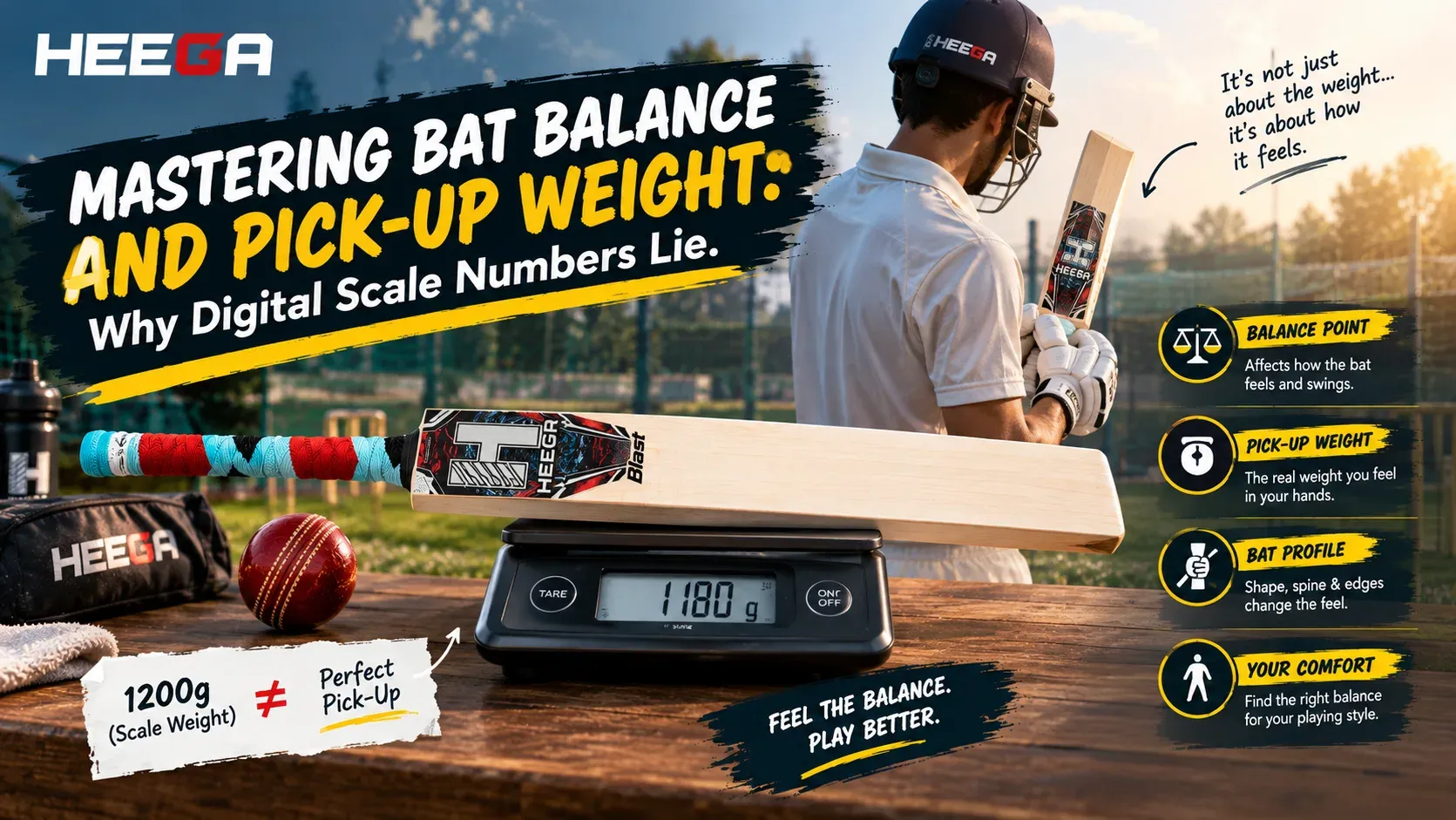
Step into any cricket dressing room or equipment shop, and you will inevitably witness a familiar ritual: a player picking up a cricket bat, placing it on a digital scale, and making a sweeping judgment based on the exact numbers that appear on the screen. However, scale weight tells only a fraction of the story. Two bats with identical scale weights can feel completely different in motion due to rotational inertia, center of gravity, and profile geometry. This comprehensive guide uncovers the science behind cricket bat balance, explaining why dynamic pick-up weight matters far more than static grams—and how to choose a blade that truly fits your game.
Step into any cricket dressing room or equipment shop, and you will inevitably witness a familiar ritual: a player picking up a cricket bat, placing it on a digital scale, and making a sweeping judgment based on the exact numbers that appear on the screen.
"2 lbs 9.5 oz? Too heavy for me, I need something under 2 lbs 8 oz."
It is one of the most common misconceptions in cricket equipment selection—the belief that the static scale weight of a bat determines how heavy it will feel when you are actually out at the crease. In reality, static scale weight is only a partial truth. Two cricket bats can register the exact same weight down to the single gram on a digital scale, yet feel completely different when you lift them into your batting stance and execute a backlift.
Understanding the mechanics of pick-up weight (dynamic swing weight), center of gravity, and mass distribution is essential for any cricketer looking to optimize their hand speed, shot timing, and control on the pitch. Here is the engineering reality behind why digital scale numbers lie, and how you can select a bat that truly feels like an extension of your arms.
1. Scale Weight vs. Pick-Up Weight: The Physics of the Swing
To understand why scale numbers are misleading, we must separate two fundamental physical concepts: static mass and rotational inertia.
Static Scale Weight (Static Mass)
When you place a bat on a digital balance, the scale measures the static gravitational force exerted by the entire piece of timber, handle, grip, and toe guard. This is a single, dead-weight figure. It tells you how much the bat weighs when it is sitting perfectly still.
Pick-Up Weight (Rotational Moment of Inertia)
Pick-up weight—often referred to by bat makers as dynamic feel or swing weight—is the actual resistance you feel when holding the bat by its handle, lifting it off the ground, and initiating a swing.
Because a cricket bat is held at one end (the handle) and swung around a pivot point (your hands and wrists), the feel of its weight is governed by the Moment of Inertia (MOI):
MOI=m⋅r2
Where:
- m = mass of the wood
- r = distance of that mass from the pivot point (your hands)
Because the distance factor (r) is squared, mass positioned further away from your hands (down toward the toe) has an exponentially greater impact on how heavy the bat feels during your backlift than mass positioned closer to the handle (near the shoulders and splice).
2. The Center of Gravity: The Hidden Balance Point
The single most influential factor governing a bat's pick-up weight is its Center of Gravity (CG), also commonly known as the balance point.
The center of gravity is the exact point along the vertical axis of the blade where the bat balances perfectly on a single pivot.
Why CG Changes Everything
Imagine two bats that both weigh exactly 2 lbs 9 oz (1,162 grams) on a digital scale:
- Bat A has a high center of gravity, positioned 23 inches down from the top of the handle.
- Bat B has a low center of gravity, positioned 25 inches down from the top of the handle.
Even though both bats weigh identical amounts on a digital scale, Bat A will feel like a 2 lb 7 oz blade in your hands during your backlift. Conversely, Bat B will feel like a 2 lb 11 oz blade, demanding far more wrist strength to lift and control.
By shifting the center of gravity just 1 to 2 inches higher toward the player's hands, bat carvers can dramatically reduce the rotational resistance without removing a single gram of timber from the overall build.
3. How Bat Carving and Shape Control Dynamic Feel
Master bat makers manipulate the physical profile of a cleft to alter the balance point and optimize pick-up weight. Several structural features directly dictate how heavy or light a bat feels in motion:
Spine Profile and Height Tapering
The spine represents the thickest ridge of wood along the back of the blade. A full, continuous spine that carries its peak thickness all the way down to the bottom third of the blade places heavy timber far from the hands, creating a toe-heavy pick-up.
Conversely, a spine that reaches its peak in the mid-to-high hitting zone and then tapers gracefully toward the toe reduces mass at the distal end, drawing the balance point upward and lightening the pick-up significantly.
Duckbill and Toe Shaping
The "duckbill" profile is one of the most effective techniques used by modern bat crafters to create light-feeling bats. By keeping the spine tall in the middle and cutting away wood near the toe in a sharp, concave slope (resembling a duck's bill), the maker removes non-essential weight from the bottom of the blade. This drastically reduces the distance (r) of the wood mass from the hands, resulting in an exceptionally feather-light swing.
Scalloping (Concaving)
Concaving—scooping out wood on the back of the blade on either side of the central spine—allows bat makers to craft visually imposing blades with thick edges (40mm+) while keeping the dead scale weight low. By selectively removing wood from the lateral shoulders, the maker reduces overall mass while maintaining a thick central spine, helping maintain a crisp balance point.
4. The Role of Handle Construction and Ergonomics
While much of the discussion around pick-up centers on the blade, the handle plays an equally crucial role in counterbalancing the bat and improving ergonomics.
Counterbalancing via Handle Mass
The handle acts as a lever arm. A slightly thicker or denser cane handle adds weight directly inside or near the batter's grip. Because this handle weight sits at the pivot point (r≈0), it increases the total static scale weight of the bat without increasing its swing weight. In fact, adding weight to the handle acts as a counterbalance, pulling the overall center of gravity upward and making the blade feel noticeably lighter during the backlift.
Oval vs. Round Handles
Handle shape also impacts the subjective perception of weight and control:
- Oval Handles: An oval cross-section aligns with the natural mechanics of human hand joints. It forces the top hand into a consistent, firm grip, preventing the blade from rotating during the backlift. This added stability gives the player greater mechanical leverage, making the pick-up feel smoother and lighter.
- Round Handles: A round handle offers classic flexibility for wristy bottom-hand players, but provides slightly less natural resistance against torque, which can make a heavy toe feel more pronounced during rapid swing adjustments.
5. Willow Density and Moisture Content: The Hidden Variables
Two clefts of English Willow (Salix alba var. caerulea) harvested from the same tree can vary significantly in wood fiber density and moisture distribution.
High-Density Willow
High-density willow has tightly packed wood fibers and a narrow grain structure. A bat pressed from high-density willow will be physically smaller in volume for a given weight. To hit a scale target of 2 lbs 9 oz, a bat carver might have to shape slightly thinner edges or introduce deeper concaving. However, high-density timber offers exceptional structural resilience, outstanding rebound energy, and long-term durability.
Low-Density Willow
Low-density willow features wider grain structures and air-filled cellular space. This allows the bat maker to sculpt massive, full-profile shapes with 40mm+ edges and a 65mm+ spine while still achieving a scale weight under 2 lbs 9 oz. Because low-density wood spreads mass over a larger volume, these bats often offer an extraordinarily light pick-up relative to their impressive visual proportions.
6. How to Test for True Pick-Up and Balance (Forget the Scale)
When selecting your next cricket bat, put away the digital scale and rely on dynamic testing to evaluate performance. Here is a step-by-step approach to evaluating a bat's pick-up:
1. The One-Handed Stance Test
Assume your standard batting stance and pick up the bat using only your top hand. Lift the blade into a natural backlift position and hold it steady for 5 seconds. If your forearm or wrist feels strained, or if the toe pulls the bat downward, the center of gravity is too low for your hand strength—regardless of what the scale says.
2. The Dynamic Shadow Swing
Execute three rapid shadow strokes with your normal footwork: a front-foot cover drive, a back-foot punch, and a late wristy flick. Pay close attention to how quickly you can change the trajectory of the bat mid-swing. A bat with a superior pick-up allows instant adjustments to seam movement or variations in bounce.
3. The Blind Pick-Up Test
If shopping in a physical store, ask a friend or shop staff member to hand you 3 or 4 different bats while you close your eyes or look away. Pick each bat up into your backlift and rank them purely by feel from lightest to heaviest. In almost every case, players select a bat that is actually 1 to 2 ounces heavier on the scale as their "lightest feeling" option due to superior balance and high center of gravity.
7. Matching Profile Balance to Your Batting Style
Choosing the right pick-up profile comes down to matching wood mass distribution with your personal technique and the pitches you play on:
The Front-Foot Driver & Low-Bounce Specialist
- Preferred Profile: Low sweet spot with a full toe.
- Scale vs. Pick-Up: Expect a slightly heavier pick-up feel due to mass at the bottom of the blade. However, this lower weight distribution delivers immense power into front-foot drives and low-bouncing deliveries.
The Fast-Scoring T20 Finisher & Wristy Player
- Preferred Profile: High sweet spot, tapered duckbill toe, oval handle.
- Scale vs. Pick-Up: Delivers an exceptionally light pick-up, allowing maximum hand speed, rapid wrist manipulation, and quick reaction time against high-velocity bowling and short-pitched deliveries.
The All-Round Player
- Preferred Profile: Mid sweet spot, slight spine tapering, standard oval or semi-oval handle.
- Scale vs. Pick-Up: Delivers a 1:1 balance ratio where scale weight matches pick-up weight perfectly, providing predictable feedback for a complete 360-degree shot selection.
Final Summary
Digital scale weight is merely a static measurement, but cricket is a dynamic game played in motion. By shifting your focus from total grams to center of gravity, mass distribution, and handle mechanics, you can select a cricket bat that offers effortless pick-up, maximum hand speed, and optimal power transfer. Trust your hands, evaluate the dynamic balance, and choose a blade that feels like a natural extension of your strokeplay.
Shop Now at- www.Heegasports.com
Related posts
 English Willow Cricket Bats: How to Identify Quality, Check Bat Balance and Avoid Buying MistakesLearn how to identify a quality English willow cricket bat, check its balance and pickup, understand grain patterns, and avoid common buying mistakes.
 Kashmir Willow Bats Explained: How Willow Quality, Bat Profile & Balance Affect PerformanceLearn how Kashmir Willow bats, willow quality, bat profile, balance, pickup, weight, and sweet spot position can affect cricket batting performance.
 Cricket Bat Profile Explained: How Blade Shape Influences Balance and Shot-MakingLearn how cricket bat profile and blade shape affect balance, pickup, control, durability, and shot-making, and choose a profile suited to your playing style.