Private label cricket bats: eight questions to ask the maker first
What a private-label order is, from our side of the bench
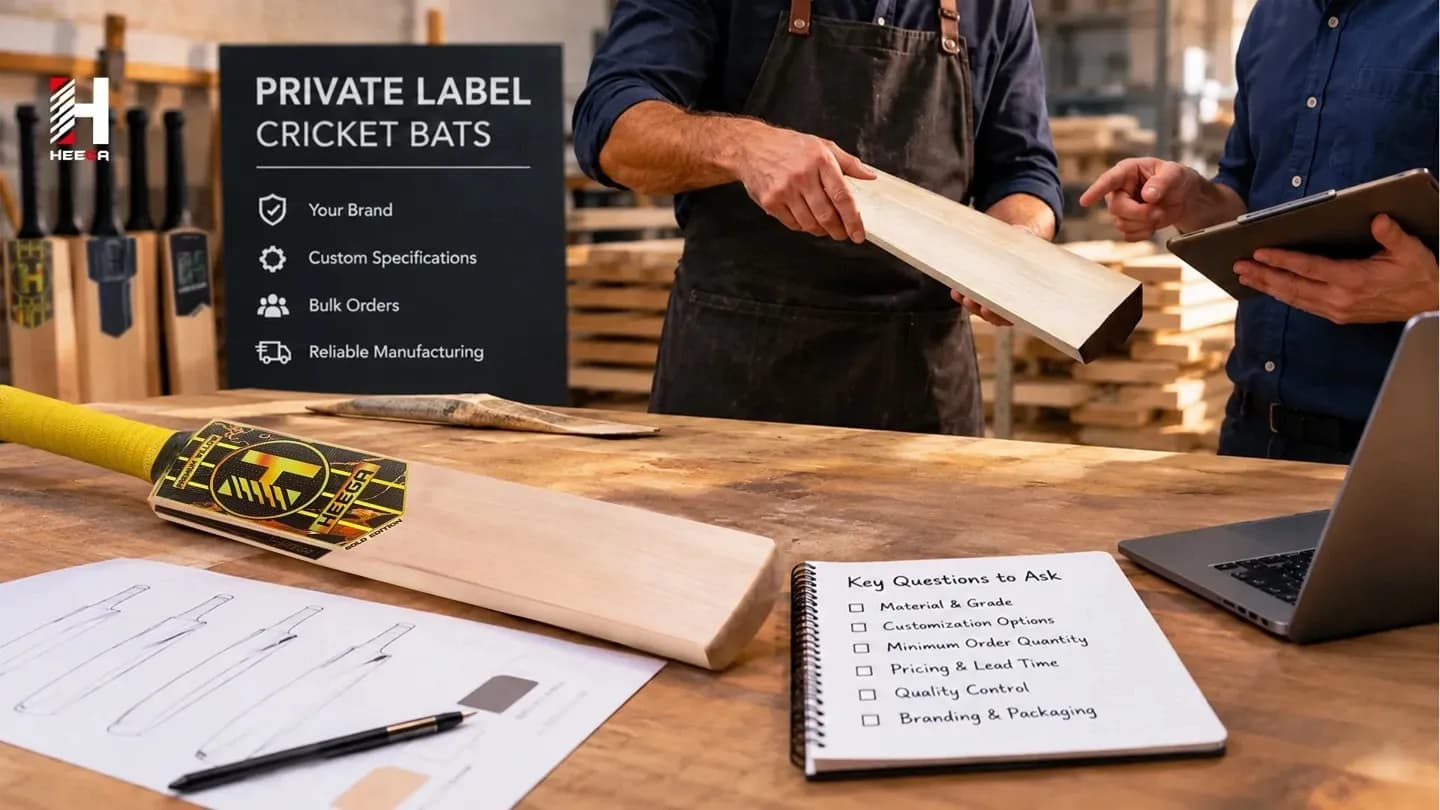
A private-label order means the bat is made in our Meerut workshop and goes out with your name on it. Your stickers, your grip colour, your cover if you want one. Shops, academies and new brands order private label cricket bats from us every season. Most of the trouble we see later comes from a question nobody asked at the start.
These are the eight questions we would ask if we were on your side of the table. Write the answers down. A maker who will not put them on paper is telling you something.
1. Samples first, always
Ask for samples of the exact spec you are ordering, not a bat off the shelf. Ask for two of each size. Two bats from the same grade tell you about consistency. One tells you about luck.
When they arrive, weigh both on a kitchen scale. Count the straight grains on the face. Hold each one in your stance and pick it up a few times. If two bats of the same size differ by more than about 40 g, ask why before you go further.
We make the samples before the run, and the run is built to match the sample you sign off. Keep one sample. It is the reference if any bat in the order is ever in doubt.
2. Who owns the design
This is the question people skip, and it matters most a year later.
Your name and your logo are yours. That part is simple. The sticker artwork is less simple. Ask who drew it, who holds the files, and whether the maker may reuse any part of it. Our answer: artwork you send, or artwork we draw for your label, belongs to your order. We do not print your label for anyone else.
The blade shape is a separate thing. Our standard profiles stay ours. You can have them under your label, and we may make the same profile for other orders. If you want a shape nobody else gets, say so at the start. That is a custom job, priced and timed as one. Our custom cricket bats page shows what can be set per bat: willow, weight, handle and stickers.
3. The willow and the grade, in words
A grade name on its own means nothing. Grade 1 in one workshop is grade 2 in another. Ask the maker to write the grade on the order with what it means at the crease.
That means three things. The willow, Kashmir or English willow. A minimum count of straight grains on the face, for example eight. And how many marks or knots are allowed on the face and edges, and where.
We grade every cleft ourselves before it is shaped. So we can tell you what the grade is, and also how many clefts of that grade we have for your order this season.
4. A weight band for each size
Give the maker a band, not a single number. For a men's short handle bat, a band of 50 to 70 g is workable. Narrower than that and the order slows down, because fewer clefts fit.
Ask about pickup too. Two bats of the same weight can feel very different, depending on where the middle sits and how thick the edges are. Settle the handle as well: cane handle, round or oval, and the grip you want.
5. The size split
An academy order is rarely all one size. Write the split by size before the quote: how many SH, how many Harrow, how many of each junior size. Our Kashmir willow bats run from size 3 to 6, Harrow, SH and LH. English willow comes in 5, 6, Harrow, SH and LH.
The split changes the timing. Junior sizes use smaller clefts, and some seasons we have more of those than others.
6. Lead time, and when the clock starts
Ask two things: how many weeks, and counted from what.
The honest answer counts from the day the sample is signed off and the advance arrives. Not from your first message. We give a dispatch week in the quote on that basis.
Ask what moves it. In our workshop it is the season. In the weeks before club cricket starts, the benches are full and willow that is still drying cannot be rushed. Order early for the season. A late order is still possible, but on a later date.
7. Payment stages tied to things you can see
Each payment should match a step you can check. Our term is 100% in advance against a proforma invoice. Before the bats ship, ask to see photos of the finished bats and a weight list, bat by bat.
Ask, in writing, what happens if a bat does not match the spec. Our answer is that it is replaced, not argued over. Get that sentence into the order.
8. What is checked before the bats leave
Ask what the maker checks on each bat before packing. We weigh every bat and list the weight against its size. We check sticker alignment and the grip. We check the face and edges against the grade written on the order.
Ask whether the bats go out oiled, and whether they need knocking in before use. Then tell your own customers the same thing on the label or the card. Most first-week cracks come from that one missing line.
What we say no to
We will not copy another brand's name, logo or sticker design. If artwork looks like someone else's mark, we stop and ask.
We will not write English willow on a Kashmir willow bat, or a grade on a bat that the wood does not meet.
We will not print a safety or performance claim on the sticker that we cannot back.
We will not start a run before the sample is signed off. And we will not give a ship date we do not expect to keep. Saying no early costs us an order now and then. It costs you far less than a container of bats that do not match what you sold.
To start a private-label order, send your sizes, willow, weight band and artwork to us through the OEM and dealer page.
Related posts
 Ready to play cricket bat meaning: what our label promisesReady to play on a bat label means pressed and oiled at our Meerut bench. It does not mean finished. Here is what is left for you before the first net session.
 How to Choose the Right Cricket Bat Weight: Understanding Bat Speed, Power & ControlLearn how to choose the right cricket bat weight based on strength, playing style, bat speed, control, balance, and experience for better batting performance.
 How Tennis Bats Help Beginners Learn Cricket: Understanding Weight, Size & Bat ControlLearn how tennis bats help beginners learn cricket by improving bat control, timing, balance, grip, confidence, and basic batting technique through simple practice.