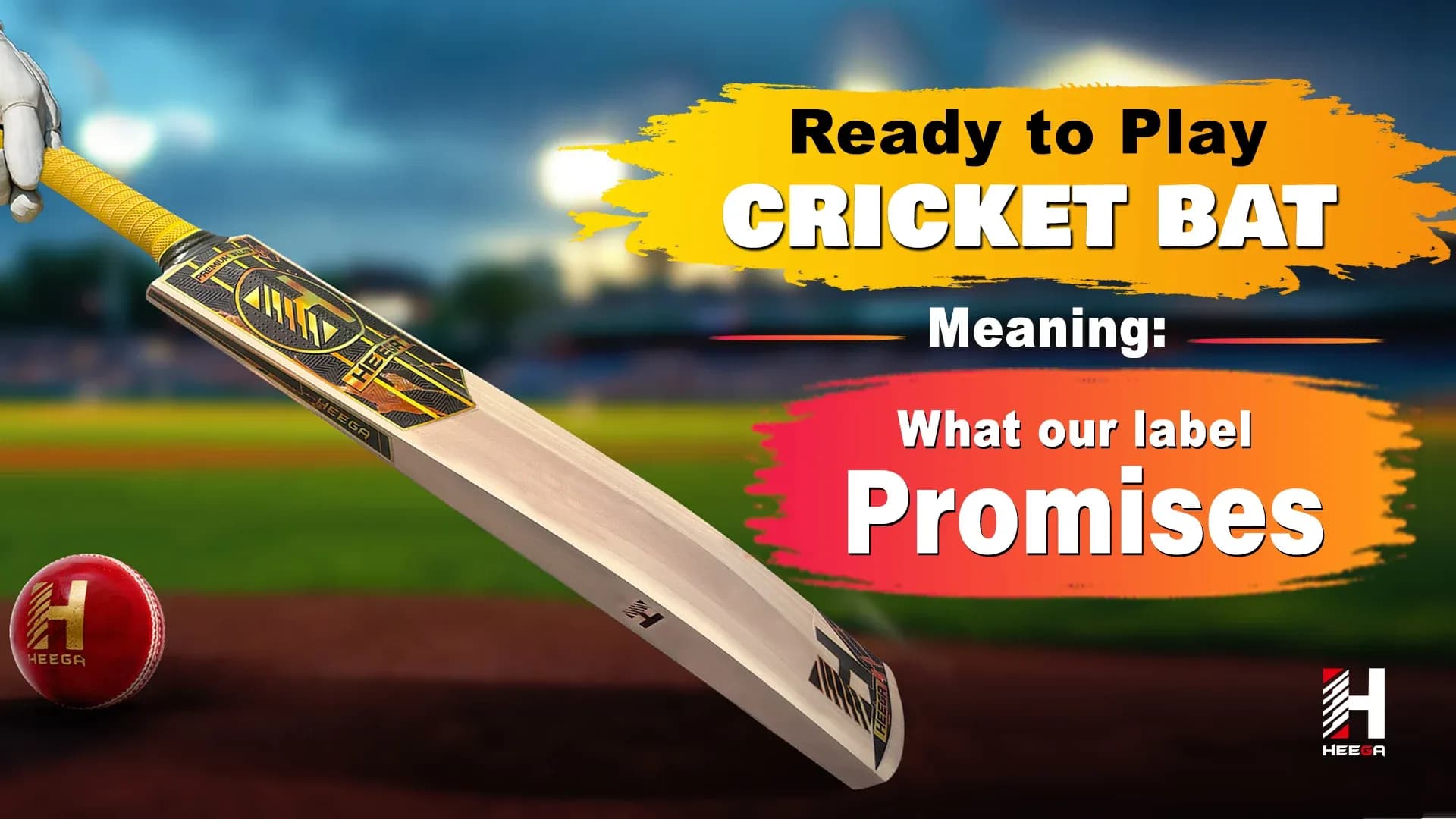
Ready to play cricket bat meaning: what our label promises
What ready to play means on our label
When we write "ready to play" on a Heega bat label, we mean two jobs are done at the bench. The face has been pressed. The bat has been oiled. That is the whole of it.
Most players read the words as something bigger. They expect to take the bat out of its cover and face a season ball in the nets the same evening. So the ready to play cricket bat meaning on the shop floor and the meaning at our bench are not the same thing. We would rather say that here than have a player find out with a dent in the middle of a new blade.
A bat that is ready to play needs less from you. It does not need nothing. Plan on three short sessions with a mallet and one careful net before it walks out in a match.
What we do at the bench before the label goes on
Willow fresh from the cleft is soft at the face. Press a thumbnail into a raw blade and it leaves a mark. A hard ball does the same thing, only deeper.
Pressing fixes most of that. The blade goes face up under a roller, and we take it down the face in slow passes. The middle gets the most load, because that is where the ball lands most. The edges and the toe are thinner, so they get less. The roller squeezes the top layer of fibres together so they hold when the ball arrives.
There is a balance to it. Press too hard and the face goes dead and loses its ping. Press too little and the first good drive leaves a crater. We stop a little short on purpose. The last bit of firming is better done slowly, by hand, over a few days, and that part is yours.
Then the oil. We wipe a thin coat of raw linseed oil over the face, the edges and the toe. The toe gets its share because it is the part that sits in damp grass. We keep oil off the splice, off the handle and away from the stickers. The bat then lies flat to dry for a full day before it is packed. Oil stops the face from drying out and splitting along the grain in the first weeks. (In November the whole workshop smells of linseed, and nobody here notices it any more.)
What ready to play does not mean
It does not mean knocked in. Pressing takes a few minutes on a roller. Knocking-in is hundreds of small, soft blows spread over several days. They are different jobs, and the second one cannot be rushed by a machine.
It does not mean the bat can take a new, hard ball at full pace from the first delivery. A new ball has a sharp, proud seam. On a face that has only been pressed, that seam can cut a line into the wood.
It does not mean you are done with oil for the season. One coat at the bench covers the first stretch, not the whole year.
And it does not mean the same thing for every willow. Kashmir willow is denser and a little harder at the face to begin with. A pressed bat from our Kashmir willow bats needs a little less work from you, but we still label it the same way, because the steps left to do are the same steps.
The three sessions still left for you
This is not a long job. Three evenings, ten to fifteen minutes each, is enough for most of our bats.
Use a wooden mallet, not an old ball held in the hand. Tap the face lightly at first, then a little firmer as the session goes on. The edges get softer, angled blows, so they round over rather than flatten. Leave the toe mostly alone. It is the easiest part of a bat to split, and a few light taps are enough.
Between sessions, look at the face in good light. You want an even, slightly firmer surface with no sharp marks. If one patch still feels soft under the thumb, give that patch a few more minutes the next evening.
If you do not own a mallet, our bat care kits carry the oil, a mallet, a grip, a cone and an anti-scuff sheet together. The sheet goes on the face after the third session and takes some of the wear in the first month.
The first net
The first net is part of the knocking, not the end of it. Take an old ball, one that has lost its shine and its sharp seam. Ask someone to throw down at a gentle pace, or use soft half-volleys if you are on your own with a partner.
Twenty minutes is plenty. Play straight, along the ground, and let the ball find the middle. Do not try to hit the cover off it. Skip the short stuff and the yorkers for now, since those tend to land on the toe and the edges.
After the session, check the face again. Shallow seam marks that you can feel but not catch with a nail are normal. That is the face doing what it should. Deep dents, or fine lines running along the edge, mean the bat wants two more sessions with the mallet before it sees a match. Better to give it a week now than to lose a season later.
Once the face takes an old ball cleanly, move up to a newer one in the next net. Then it is a match bat.
Why we write it on the label at all
We could leave the words off. Many bats in the trade carry "ready to play" with no one saying what was done. We keep the words because they tell you two real things: the bat has been pressed by someone who does it every day, and it has had its first coat of oil. That saves you most of a week of work.
What we will not do is let the words promise more than the bench did. A bat is a piece of wood that firms up with use. Pressing and oiling start that process. Your three evenings and one gentle net finish it.
If the bat you have in mind is English willow, pick it from our English willow bats, each one pressed and oiled at the Meerut bench before it leaves.
Related posts
 Private label cricket bats: eight questions to ask the maker firstEight questions to ask a maker before ordering private label cricket bats: samples, design ownership, willow grade, weight, lead time and payment stages.
 How to Keep Your Bat Match-Ready All SeasonLearn how to maintain an English Willow cricket bat with proper cleaning, oiling, knocking in, storage, toe protection, and regular bat care.
 Why Cricket Players Tap Their Bat Before Facing a Delivery: The Meaning Behind the RoutineWhy do cricket players tap their bat before facing a delivery? Discover the meaning behind bat tapping, marking guard, routines, focus, confidence, and batting preparation.