The Cricket Advantage Nobody Talks About: How Game Awareness Wins Matches

Why understanding the game can be just as important as technique—and how smarter decisions can turn good cricketers into valuable match winners
Cricket is often described as a game of skill.
Batters need technique.
Bowlers need control.
Fielders need speed and reactions.
But there is another advantage that can quietly separate good players from great ones:
Game awareness.
Two players can have similar technical ability, yet one consistently makes better decisions.
Why?
Because they understand what the match is asking them to do.
They read the situation.
They recognize patterns.
They anticipate what comes next.
They know when to attack, when to defend, when to take a risk, and when to stay patient.
That ability can turn ordinary skills into extraordinary results.
At Heega Sports, we believe cricket performance isn't built around talent alone. Technique, fitness, mindset, preparation, recovery, tactical awareness, and suitable equipment all contribute to becoming a more complete player.
Here's why game awareness deserves more attention—and how you can develop it.
What Is Game Awareness in Cricket?
Game awareness is the ability to understand what is happening, why it is happening, and what should happen next.
It includes understanding:
- Match situation
- Pitch conditions
- Score and required rate
- Field placements
- Opponent strengths
- Opponent weaknesses
- Bowling patterns
- Batting partnerships
- Match momentum
- Risk versus reward
It's not simply knowing the rules.
It's understanding the game within the game.
1. Read the Match Before You Read the Scoreboard
The scoreboard tells you what has happened.
Game awareness helps you understand what is happening.
Suppose a team needs 60 runs from 48 balls.
That sounds manageable.
But what if three wickets are already down and the best bowlers have two overs remaining?
Suddenly, the situation is different.
Smart players don't look at one number.
They consider the entire picture.
Ask:
"What does the match actually require right now?"
2. Learn to Read the Pitch
The pitch can change the way you approach the game.
Before and during a match, observe:
- Bounce
- Pace
- Seam movement
- Swing
- Grip
- Turn
- Moisture
- Wear and tear
A batter may discover that driving isn't easy because the ball is stopping slightly.
A bowler may realize that hitting a hard length is more effective than searching for excessive swing.
The player who notices these details early can adjust before others do.
3. Watch the Bowler, Not Just the Ball
Good batters don't only watch where the ball goes.
They watch patterns.
Ask:
Where does this bowler prefer to bowl?
What happens after a boundary?
Are they changing pace?
What field are they bowling to?
Do they repeat a particular delivery under pressure?
The more deliveries you observe, the more information you collect.
That information can influence your next decision.
4. Learn to Read Batters as a Bowler
The same principle works in reverse.
A bowler should observe:
- Preferred scoring areas
- Foot movement
- Trigger movement
- Shot selection
- Reaction to short balls
- Reaction to spin
- Ability against swing
- Intent during different phases
Don't simply bowl your best delivery.
Build a plan around the batter.
A good ball becomes even more effective when it is part of a larger strategy.
5. Understand Risk Versus Reward
Every cricket decision has a level of risk.
A batter attacking a wide delivery may score four.
They may also edge it.
A bowler attempting a difficult variation may take a wicket.
They may also concede runs.
Game awareness means understanding when the risk makes sense.
Ask:
"What do we gain if this works, and what do we lose if it doesn't?"
The answer changes depending on the match situation.
6. Know When to Attack
There are moments when aggression can change a match.
For example:
- A new batter arrives
- A weaker bowler enters
- The field is spread
- The required rate rises
- A partnership needs breaking
Game-aware players recognize these moments.
They don't attack simply because they feel aggressive.
They attack because the situation creates an opportunity.
7. Know When to Be Patient
The opposite is equally important.
Sometimes the best decision is to wait.
A batter may need to survive a difficult spell.
A bowler may need to build pressure rather than chase wickets.
A fielder may need to stay in position instead of constantly moving.
Patience isn't passive.
It can be tactical.
8. Understand Match Phases
Different formats have different phases.
T20 Cricket
The powerplay, middle overs, and death overs require different strategies.
ODI Cricket
Powerplay restrictions, middle-over consolidation, and late acceleration create different tactical demands.
Longer Formats
Sessions, partnerships, spells, pitch deterioration, and time become increasingly important.
The best players understand that the same skill can have different value depending on the phase.
9. Learn From Field Placements
Field placement is information.
If a captain places a deep fielder behind square, it may reveal something about the bowler's plan.
If a slip is removed, the team may be expecting a different type of shot.
If a boundary rider appears, the opposition may be protecting a particular scoring area.
Ask:
"Why is that fielder there?"
Then use the answer.
10. Communicate With Your Teammates
Game awareness shouldn't stay inside one player's head.
Communication can improve team performance.
Fielders should communicate:
- Bowling plans
- Batter tendencies
- Throwing options
- Field changes
- Match situations
Batters should communicate:
- Running decisions
- Bowling patterns
- Field gaps
- Required rate
- Partnership strategy
Clear communication can prevent small mistakes from becoming big ones.
11. Watch the Match Even When You're Not Involved
If you're waiting to bat, don't switch off.
Watch the bowlers.
Study the pitch.
Observe the field.
Look at how the ball behaves.
Notice which shots are successful.
Then, when you enter the game, you already have information.
The same applies to bowlers waiting for their spell.
Use your time off the field to study the match.
12. Develop Situational Batting
A good batter doesn't have one mode.
They can adapt.
You may need to:
- Attack
- Defend
- Rotate strike
- Build a partnership
- Target one bowler
- Protect a lower-order batter
The correct approach depends on the situation.
The goal isn't to play your favorite style.
It's to play the style the team needs.
13. Develop Situational Bowling
Bowling also requires adaptation.
You may need to:
- Attack the stumps
- Bowl defensively
- Change pace
- Use the crease
- Attack a weakness
- Protect a boundary
- Build pressure
The best bowling plan isn't always the most aggressive.
It's the plan that gives the team the best chance of success.
14. Recognize Momentum
Cricket momentum can change quickly.
A team may lose two wickets in an over.
A partnership may suddenly score 20 runs.
A brilliant catch may lift the fielding side.
A bowler may complete three excellent deliveries and create pressure.
Game-aware players recognize these moments.
When momentum shifts, decisions may need to change with it.
15. Don't Chase the Game When You Don't Need To
One of the biggest tactical mistakes is unnecessary urgency.
A team may need 40 runs from 36 balls.
That's not necessarily a situation requiring constant boundary attempts.
Sometimes singles and twos are enough.
Likewise, a bowler may already have pressure on a batter.
There's no need to attempt a miracle delivery.
Stay aware of what the situation actually requires.
16. Understand the Value of Partnerships
A partnership isn't simply two batters scoring runs.
It's about managing risk together.
One batter may attack.
The other may rotate strike.
They communicate.
They understand when to take singles.
They know which bowler to target.
Strong partnerships often come from strong awareness.
17. Make Fitness Part of Your Tactical Advantage
Game awareness becomes harder when you're exhausted.
Fatigue can affect:
- Concentration
- Reaction speed
- Decision-making
- Footwork
- Bowling accuracy
Role-specific fitness can help players maintain quality deeper into matches.
Batters
Build speed, endurance, mobility, and core strength.
Bowlers
Develop strength, conditioning, explosive power, mobility, and recovery.
Fielders
Focus on acceleration, agility, reactions, and coordination.
Fitness doesn't replace game awareness.
It helps you use it for longer.
18. Prepare Your Equipment So It Doesn't Distract You
Game awareness requires concentration.
Equipment problems can create unnecessary distractions.
Before matches, check:
- Bat grip
- Helmet fit
- Gloves
- Pads
- Shoes
- Cricket bag
- Accessories
At Heega Sports, players can find cricket bats, helmets, gloves, pads, cricket shoes, bags, accessories, and sportswear for serious training and competitive cricket.
You don't need to buy everything.
Choose equipment that is:
- Comfortable
- Properly fitted
- Suitable for your role
- Protective
- Reliable
Your equipment should support your preparation—not dominate it.
19. Study Cricket Outside Your Own Matches
Watch high-level cricket.
Don't watch only for entertainment.
Study decisions.
Ask:
Why did the batter attack here?
Why did the bowler change the field?
Why was the spinner introduced?
Why did the captain keep that fielder there?
The more cricket you understand, the more patterns you begin to recognize.
20. Build a Game-Awareness Habit
After every match, write down three things:
1. What did I notice?
A bowling pattern?
A pitch change?
A fielding weakness?
2. What decision did I make?
Was it effective?
3. What would I do differently?
This turns experience into knowledge.
The Game-Awareness Formula
A simple framework is:
Observe → Interpret → Decide → Execute → Review
That's the cycle.
Don't just watch.
Interpret.
Don't just interpret.
Decide.
Don't just decide.
Execute.
Then review.
How Batters Can Improve Game Awareness
Before facing a bowler, consider:
What is the field telling me?
Where is the bowler trying to make me play?
What is my safest scoring option?
Which delivery should I attack?
What does the team need?
These questions can improve decision-making without changing your technique.
How Bowlers Can Improve Game Awareness
Before each over:
What is the batter trying to do?
Where are my best fielders?
What is the safest boundary option?
What delivery has worked?
What can I change?
The goal is to bowl with a plan rather than simply deliver six balls.
How Fielders Can Improve Game Awareness
Before every delivery:
Where is the ball most likely to go?
What is my responsibility?
Where is the best throwing option?
What does the batter prefer?
Being mentally involved can improve reaction and positioning.
A 30-Day Game-Awareness Challenge
Week 1 — Observe
Watch matches with tactical attention.
Week 2 — Analyze
Identify bowling and batting patterns.
Week 3 — Apply
Use those observations during your own matches.
Week 4 — Review
Write down what decisions worked and what didn't.
You're not trying to become a tactical expert overnight.
You're training yourself to notice more.
Common Game-Awareness Mistakes
Avoid:
❌ Focusing only on the ball.
❌ Ignoring field placements.
❌ Playing the same way in every situation.
❌ Forgetting the required rate.
❌ Ignoring opponent patterns.
❌ Switching off when you're not directly involved.
❌ Making high-risk decisions unnecessarily.
❌ Failing to communicate.
❌ Ignoring pitch changes.
The more information you notice, the more options you have.
Signs Your Cricket IQ Is Improving
You'll notice:
✅ You anticipate deliveries better.
✅ You understand field changes.
✅ You make calmer decisions.
✅ You adapt faster.
✅ You communicate more effectively.
✅ You recognize momentum shifts.
✅ You understand your role better.
✅ Difficult situations become easier to read.
These improvements can have a major impact even without dramatic technical changes.
The Advantage Nobody Sees on the Scorecard
Game awareness doesn't always appear in statistics.
A smart decision to leave a difficult delivery isn't recorded.
A well-timed bowling change isn't credited to one player.
A fielder's communication may prevent a boundary.
A batter's decision to take a single may keep a chase under control.
Yet these decisions can influence the outcome.
That's why game awareness is such a powerful advantage.
Final Thoughts
Cricket rewards skill.
But it rewards smart skill even more.
The best players don't simply execute.
They observe.
They adapt.
They anticipate.
They communicate.
They understand context.
They know when to attack and when to wait.
They read the pitch.
They study opponents.
They understand momentum.
And they make decisions based on what the match needs.
Start developing that awareness today.
During your next match, don't just ask:
"What happened?"
Ask:
"Why did it happen—and what should happen next?"
That question can change the way you see cricket.
At Heega Sports, we're proud to support cricketers who want to develop every part of their game with cricket bats, helmets, gloves, pads, shoes, bags, accessories, and sportswear for serious training and competitive cricket.
Technique may help you execute the ball. Game awareness helps you know what the ball actually needs from you.
Shop Now
Heega Sports – Supporting Every Step From Training Ground to Match Day.
Related posts
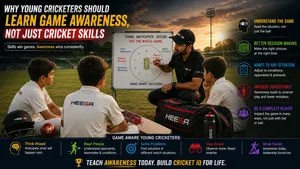 Why Young Cricketers Should Learn Game Awareness, Not Just Cricket SkillsLearn why young cricketers need game awareness alongside cricket skills, including decision-making, field placement, match situations, communication, and strategy.
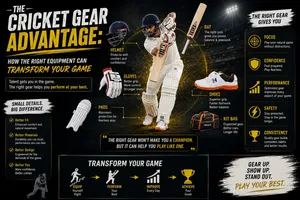 The Cricket Gear Advantage: How the Right Equipment Can Transform Your GameDiscover how the right cricket gear—from bats and batting gloves to helmets, pads, and cricket shoes—can improve comfort, mobility, control, confidence, and consistency on the field.
 The Cricketer’s Secret Advantage: 10 Habits That Create Better PerformancesDiscover 10 habits that can give cricketers a secret performance advantage, from purposeful training and pressure practice to mental preparation, fitness, recovery, equipment preparation, and match analysis.