Why Young Cricketers Should Learn Game Awareness, Not Just Cricket Skills

Introduction: Cricket Is More Than Batting, Bowling, and Fielding
When a child starts playing cricket, the first things they usually want to learn are simple.
They want to hit the ball.
They want to bowl.
They want to take catches.
They want to score runs and take wickets.
These basic skills are extremely important.
But as young players become more competitive, another ability starts making a major difference:
Game awareness.
A player may have excellent batting technique but still struggle to make the right decision during a match.
A bowler may bowl accurately but fail to understand when to attack and when to contain runs.
A fielder may be athletic but stand in the wrong position.
These situations show why cricket is not only a game of physical and technical ability.
It is also a game of observation, decision-making, communication, and understanding.
For young cricketers, learning how to read the game can help turn individual skills into actual match performance.
The goal is not to make children think about every possible tactical detail.
It is to gradually teach them why things happen on a cricket field and how their decisions can influence the match.
What Is Game Awareness in Cricket?
Game awareness means understanding what is happening during a match and making decisions based on the situation.
It involves noticing things such as:
- The current score.
- Number of overs remaining.
- Wickets available.
- Required run rate.
- Batter's strengths and weaknesses.
- Bowler's plan.
- Field placement.
- Pitch conditions.
- Match situation.
- Team requirements.
A player with good game awareness does not simply react to the ball.
They understand the bigger picture.
Why Technical Skills Alone Are Not Enough
Imagine two young batters with similar batting techniques.
Both can play drives.
Both can defend.
Both can hit boundaries.
But one batter understands when to attack and when to rotate the strike.
The other tries to hit every ball.
The first player may perform better in a real match even though their basic technique is similar.
Why?
Because they understand the situation.
Technical skills help players execute.
Game awareness helps them decide what to execute and when.
Young Players Should Learn to Watch the Game
Children often become focused on their own role.
A batter watches the ball.
A bowler concentrates on their delivery.
A fielder waits for the ball to come toward them.
But cricket is constantly changing around them.
Young players should gradually learn to observe:
- Where fielders are positioned.
- Which batter is scoring quickly.
- Which bowler is creating problems.
- How the pitch is behaving.
- How many runs the team needs.
- How many wickets remain.
Watching the game develops understanding.
Scoreboard Awareness Matters
A cricket scoreboard tells a story.
The same batting situation can require completely different decisions depending on the score.
For example, chasing 180 with 15 overs remaining is different from chasing 180 with only five overs remaining.
The batter must understand that difference.
Young players should become comfortable checking:
- Team score.
- Overs completed.
- Wickets lost.
- Target.
- Runs required.
These numbers provide important context.
Learning to Understand Match Situations
One of the best ways to develop game awareness is to teach children to recognize different situations.
A team may be:
- Building an innings.
- Recovering after early wickets.
- Accelerating the scoring.
- Defending a total.
- Chasing quickly.
- Protecting a small lead.
- Trying to take the final wicket.
Each situation requires a different approach.
Batting Is About More Than Scoring Runs
Young batters often think their job is simply to score as many runs as possible.
But batting is also about helping the team.
Sometimes the best decision is to attack.
Sometimes it is to defend.
Sometimes it is to rotate the strike.
Sometimes it is to avoid unnecessary risk.
A mature batter understands that the value of a shot depends on the situation.
Learning When to Attack
Aggressive batting can be exciting.
But attacking every delivery is rarely the smartest strategy.
A batter should gradually learn to recognize opportunities.
For example, a delivery that matches their strength may be a good scoring opportunity.
A difficult ball outside their preferred area may not be worth attacking.
Game awareness helps players distinguish between the two.
Learning When to Defend
Defensive batting is sometimes misunderstood by young players.
They may think that defending means playing negatively.
It does not.
A good defensive shot can:
- Protect the wicket.
- Reduce pressure.
- Help a batter settle.
- Allow the player to wait for a better opportunity.
The ability to defend is an important part of intelligent batting.
Running Between the Wickets Requires Awareness
Running is another area where decision-making matters.
A batter needs to judge:
- Where the ball has gone.
- How quickly the fielder can reach it.
- Where the throwing arm is positioned.
- Where the partner is.
- How much time is available.
A fast runner can still make a poor decision.
A player with good awareness can sometimes turn a small opportunity into an extra run.
Communication Between Batters
Young players should learn to communicate clearly with their batting partners.
Simple calls such as:
- Yes.
- No.
- Wait.
- Two.
can prevent confusion.
Communication becomes particularly important when the ball is played into areas where both batters need to make a quick decision.
Understanding Strike Rotation
In longer innings, not every ball needs to produce a boundary.
Singles and twos can keep the scoreboard moving.
Strike rotation can also prevent bowlers from building pressure against one batter.
Young players should learn that scoring efficiently does not always mean hitting boundaries.
Bowling Requires Tactical Awareness
Bowling is also about more than delivering the ball correctly.
A bowler should gradually learn to think about:
- The batter's strengths.
- The batter's weaknesses.
- Field placement.
- Bowling plans.
- Match situation.
- Required scoring rate.
This helps transform bowling from a series of deliveries into a tactical contest.
Line and Length Should Have a Purpose
Young bowlers are often told to bowl a good line and length.
That is important.
But they should eventually understand why.
For example, a bowler may want to restrict scoring in one area.
They may try to force a batter to play a particular shot.
They may use a particular field placement to support the plan.
Understanding the reason behind the delivery makes bowling more meaningful.
Field Placement Is Part of the Plan
Fielders are not placed randomly.
Their positions usually support a bowling or match strategy.
Young players should learn to notice positions such as:
- Slip.
- Gully.
- Point.
- Cover.
- Mid-off.
- Mid-on.
- Square leg.
- Fine leg.
- Midwicket.
- Long-on.
- Long-off.
The exact field will depend on the situation and format.
But understanding why fielders are positioned in certain areas helps players read the game.
The Leg Side Can Create Scoring Opportunities
Young batters should learn to recognize how field placement affects the leg side.
If a team has limited protection around areas such as:
- Fine leg.
- Square leg.
- Midwicket.
- Cow corner.
a batter may see scoring opportunities.
At the same time, attacking these areas can carry risk if fielders are specifically placed to catch those shots.
Awareness means recognizing both the opportunity and the danger.
The Off Side Requires Similar Awareness
The same principle applies to the off side.
A batter may notice gaps around:
- Point.
- Cover.
- Extra cover.
- Mid-off.
- Third slip or slip areas.
The objective is not to memorize field positions.
It is to understand that the location of fielders can influence shot selection.
Young Fielders Should Understand Their Role
A young fielder should know:
- Where they are positioned.
- Why they are there.
- Which shots may come toward them.
- Where to throw.
- Who is backing them up.
This makes fielding more proactive.
Instead of simply waiting for the ball, the player starts anticipating what might happen.
Anticipation Is a Major Part of Game Awareness
Good fielders often appear to move before the ball is struck.
They are not necessarily guessing.
They are using information.
They may notice:
- Batter's stance.
- Batter's preferred shots.
- Bowler's line.
- Field placement.
- Match situation.
This allows them to prepare for likely outcomes.
Wicketkeepers Need Excellent Game Awareness
The wicketkeeper has a unique view of the game.
They can observe the batter, bowler, fielders, and pitch.
A wicketkeeper can help communicate:
- Field changes.
- Bowling plans.
- Running opportunities.
- Batter tendencies.
Young wicketkeepers should therefore develop both technical skills and strong observation.
Game Awareness Helps Players Make Better Decisions Under Pressure
Match situations can change quickly.
A batter may suddenly lose a partner.
A bowler may concede several boundaries.
A fielder may need to stop a crucial run.
Players who understand the situation can respond more calmly.
Instead of reacting emotionally, they can ask:
What does the team need right now?
That question can lead to better decisions.
Young Players Should Learn to Think One Ball Ahead
Game awareness does not mean predicting everything.
It often means preparing for the next possibility.
A batter can think:
Where can I score from this bowler?
A bowler can think:
What shot am I trying to prevent?
A fielder can think:
Where is the next likely shot?
Thinking one ball ahead helps players become more proactive.
Learning From What Happened on the Previous Ball
Every delivery provides information.
Perhaps the batter struggled against a particular length.
Perhaps the bowler found movement.
Perhaps a fielder was almost in the right position.
Players can use that information.
The next ball is not completely independent from what happened before it.
Game Awareness Develops Through Watching Cricket
Children can learn a lot simply by watching matches.
Parents and coaches can encourage young players to notice:
- Why fielders move.
- Why bowlers change plans.
- Why batters slow down or accelerate.
- Why captains change field placements.
- Why certain players attack particular bowlers.
Watching cricket becomes more valuable when children learn to ask why.
Parents Can Ask Simple Questions
Parents do not need to give tactical lectures.
Instead, they can ask questions after watching a match.
For example:
"Why do you think the captain moved that fielder?"
"Why did the batter choose not to attack?"
"Why did the bowler change the field?"
These questions encourage children to think independently.
Coaches Can Teach Through Questions
Coaches also play an important role.
Instead of always telling players what to do, coaches can sometimes ask:
"Where would you bowl here?"
"What shot would you play against this field?"
"Where should you stand if the batter likes pulling?"
Questions encourage players to develop their own cricket intelligence.
Match Simulations Are Excellent for Game Awareness
Practice sessions can recreate real match situations.
For example:
Scenario 1: Chasing a Target
The batting team needs 40 runs from 30 balls with six wickets remaining.
Players must decide how aggressively to bat.
Scenario 2: Defending a Total
The bowling team needs to protect 12 runs from the final over.
The bowler and captain need a clear plan.
Scenario 3: Recovering From Early Wickets
The batting team is 25 for 3.
The next batters need to balance rebuilding and scoring.
These scenarios teach players how decisions change according to circumstances.
Game Awareness Helps Players Become Better Team Players
Cricket is not an individual sport played alone.
A batter's decision affects their partner.
A bowler's plan affects fielders.
A fielder's position affects the bowler.
The captain's decisions affect everyone.
Game awareness helps young players understand these connections.
Learning to Communicate With Teammates
Good communication can prevent mistakes.
Players should learn to communicate:
- Fielding positions.
- Back-up responsibilities.
- Running decisions.
- Bowling plans.
- Match situations.
Communication should be clear and respectful.
Young Captains Need Game Awareness Even More
Captaincy teaches children to see the match from a broader perspective.
A captain has to consider:
- Which bowler should bowl.
- Where fielders should stand.
- Which batter should face particular bowlers.
- When to attack.
- When to defend.
Young captains should not be expected to get every decision right.
The important thing is learning how to think through decisions.
Game Awareness Is Not About Overthinking
There is a balance.
Young players should not become so focused on tactics that they forget to enjoy playing.
Game awareness should eventually become natural.
A player should be able to observe the situation and make a decision without becoming overwhelmed by information.
Skills First, Awareness Alongside Them
Technical development remains essential.
Young players still need to learn:
- Batting technique.
- Bowling technique.
- Fielding technique.
- Catching.
- Throwing.
- Running.
Game awareness should complement these skills.
The two areas should develop together.
Physical Development Also Supports Decision-Making
As children grow, their physical abilities change.
They may become:
- Faster.
- Stronger.
- More coordinated.
- More confident.
This can create new tactical possibilities.
A faster fielder may cover more ground.
A stronger batter may access different shots.
A more athletic player may take different fielding positions.
Confidence and Awareness Work Together
Confidence can help players trust their decisions.
A batter who understands the match situation may feel more comfortable choosing a defensive shot.
A bowler who understands their plan may recover more easily after conceding a boundary.
Awareness provides context.
Confidence helps players act on it.
Learning to Stay Calm When the Plan Fails
Not every plan works.
A bowler may execute the correct delivery and still concede a boundary.
A batter may choose the right shot and get caught.
A fielder may anticipate correctly but miss the ball.
Good game awareness includes the ability to adapt.
The player asks:
What should I do now?
rather than staying stuck on the previous mistake.
Adaptability Is a Cricket Skill
Conditions can change.
The pitch may slow down.
The ball may start swinging.
A batter may change their approach.
A new bowler may create pressure.
Good players adapt their decisions accordingly.
This is why awareness should never become a rigid set of rules.
Young Players Should Learn to Read the Batter
For bowlers and fielders, the batter provides useful information.
Players can observe:
- Stance.
- Foot movement.
- Favorite shots.
- Scoring areas.
- Reactions to different deliveries.
This does not mean young players need advanced technical analysis.
Simply paying attention can teach them a lot.
Young Batters Should Read the Bowler
Batters can also observe:
- Run-up.
- Release point.
- Bowling angle.
- Pace.
- Line.
- Length.
- Field placement.
These observations can help them prepare before the ball reaches them.
Understanding Risk and Reward
Cricket involves constant decisions about risk.
A batter can attempt a boundary but risk losing their wicket.
A bowler can attack the stumps but potentially concede runs if the delivery is missed.
A fielder can move aggressively but may leave another area exposed.
Young players should gradually learn that every decision has consequences.
Game Awareness Can Improve Match Performance
When players understand situations better, they can use their technical skills more effectively.
A technically good batter may score more efficiently because they choose better moments to attack.
A capable bowler may take more wickets because they understand how to create pressure.
A good fielder may save more runs because they anticipate play.
The skills were already there.
Awareness helps apply them.
Technology Can Support Learning
Modern cricket training can use:
- Video analysis.
- Match footage.
- Scorecards.
- Performance statistics.
- Training simulations.
These tools can help young players review decisions.
However, technology should support coaching rather than replace it.
Young Players Can Review Their Matches
After a match, players can ask:
- What happened?
- Why did it happen?
- What decision did I make?
- Was there another option?
- What can I try next time?
This simple reflection process can gradually improve cricket intelligence.
Don't Judge Every Decision Only by the Result
This is an important lesson.
A good decision can sometimes produce a bad outcome.
A batter can play the correct shot and get caught.
A bowler can deliver a good ball and concede an edge.
A fielder can move correctly and still miss a difficult catch.
Players should learn to evaluate the decision as well as the result.
Game Awareness Should Develop With Age
Younger children should learn simple concepts.
For example:
"Where is the ball?"
"Where should I throw?"
"Can we run?"
As players become older, these questions can become more advanced:
"What does the team need?"
"Where is the scoring opportunity?"
"What plan is the bowler using?"
Learning should progress naturally.
Parents Should Encourage Curiosity
One of the best things parents can give young players is curiosity.
Encourage children to ask:
Why?
Why did the bowler do that?
Why was the fielder there?
Why did the batter attack?
Why did the captain change the field?
Curiosity turns watching cricket into learning.
Game Awareness Is Useful Beyond Cricket
The skills developed through game awareness can also help children in everyday situations.
Players learn to:
- Observe.
- Think.
- Communicate.
- Make decisions.
- Adapt.
- Work with others.
- Respond to changing circumstances.
These are valuable life skills.
Nepal, Germany, USA, Canada, the Netherlands, and the UK
Young cricketers around the world are entering different cricket environments.
In Nepal, growing youth participation is creating more opportunities for children to develop their cricket skills and understanding.
In Germany, developing club and academy structures are introducing more young players to organized cricket.
In the United States, youth cricket continues to create new opportunities for children to learn the sport.
In Canada, young players can develop through seasonal and indoor cricket programs.
In the Netherlands, structured cricket pathways provide opportunities to develop both technical and tactical understanding.
The United Kingdom has a long-established junior and club cricket culture where young players can experience structured competition.
The facilities and pathways may differ, but one principle remains the same:
Young players benefit when they learn how to understand the game, not simply perform individual skills.
A Simple Game-Awareness Checklist for Young Cricketers
Before and during a match, players can ask themselves:
Before the Match
- What is our game plan?
- What are the conditions like?
- What role am I playing?
While Batting
- What does the team need?
- Where are the gaps?
- Which balls should I attack?
- When should I rotate the strike?
While Bowling
- What is my plan?
- What shot am I trying to prevent?
- Where are my fielders?
- How is the batter responding?
While Fielding
- Where should I stand?
- What shot is likely?
- Where should I throw?
- Who is backing me up?
After a Mistake
- What happened?
- What can I learn?
- What should I do next?
These questions can gradually become part of a player's natural thinking.
How Heega Sports Supports Young Cricketers
At Heega Sports, we believe young players need more than equipment.
They need opportunities to practice, compete, learn, and understand the game.
Our cricket range includes:
- Junior cricket bats.
- Kashmir Willow cricket bats.
- Leather cricket balls.
- Practice cricket balls.
- Batting gloves.
- Batting pads.
- Cricket helmets.
- Cricket shoes.
- Cricket kit bags.
- Practice nets.
- Training accessories.
Suitable equipment allows young players to focus on developing their skills and enjoying the game.
Final Thoughts
Cricket skills are important.
Young players need to learn how to bat, bowl, field, catch, throw, and run.
But these skills become far more valuable when players understand when and how to use them.
That is where game awareness comes in.
A smart batter understands the match situation before choosing a shot.
A thoughtful bowler considers the batter, field placement, and scoring situation.
An alert fielder anticipates where the ball might go.
A good teammate communicates and understands what the team needs.
These abilities do not appear overnight.
They develop through watching cricket, asking questions, playing matches, practicing realistic situations, and learning from experience.
Parents and coaches have an important role to play.
They do not need to turn every young cricketer into a tactical expert.
Instead, they can encourage children to observe the game, think about their decisions, and remain curious.
The most important question is not always:
"How good is your cricket skill?"
Sometimes it is:
"Do you understand what the game needs from you right now?"
When young players learn to answer that question, they begin to move from simply playing cricket to understanding cricket.
And that understanding can make a remarkable difference as they progress from school cricket to academy cricket, club cricket, and eventually higher levels of competition.
🏏 Build Smarter Cricketers With Heega Sports
Explore junior cricket bats, Kashmir Willow bats, leather balls, practice balls, batting gloves, pads, helmets, cricket shoes, kit bags, practice nets, and training accessories designed to support young players as they learn, practice, and compete.
Shop Now
Heega Sports – Supporting Better Skills, Smarter Decisions, and Better Cricket.
Related posts
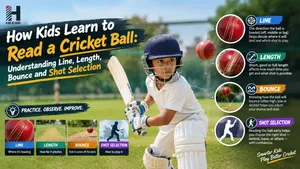 How Kids Learn to Read a Cricket Ball: Understanding Line, Length, Bounce and Shot SelectionLearn how kids can read a cricket ball by understanding line, length, bounce and shot selection to develop better batting skills and confidence.
 How Tennis Bats Help Beginners Learn Cricket: Understanding Weight, Size & Bat ControlLearn how tennis bats help beginners learn cricket by improving bat control, timing, balance, grip, confidence, and basic batting technique through simple practice.
 How Young Cricketers Can Learn From Their Cricket Idols Without Copying ThemLearn how young cricketers can learn from their idols without copying them. Discover how to study technique, mindset, habits, and playing styles effectively.