Why Cricket Players Change Their Grip During an Innings: The Hidden Role of Hand Position

Introduction: Your Hands Control More Than You Think
When watching an experienced batter, the focus usually goes toward the bat swing.
We notice the elegant cover drive.
The powerful pull shot.
The controlled defensive stroke.
The quick flick through the leg side.
But behind every one of these movements is something that receives far less attention:
the player's grip.
The way a batter holds the cricket bat influences how easily they can control its movement.
It affects wrist action, bat angle, shot direction, and the amount of freedom available during a stroke.
That is why experienced players sometimes adjust their hand position during an innings.
The change may be very small.
A batter may move one hand slightly.
They may loosen their grip.
They may change the pressure applied by their fingers.
They may alter the relationship between their top and bottom hands.
These adjustments can help them respond to different bowlers, pitches, shots, and match situations.
Grip is therefore not simply about holding the bat securely.
It is an important part of batting technique.
What Is a Cricket Batting Grip?
A batting grip is the way a player positions their hands around the bat handle.
For a conventional batting grip, both hands work together to control the bat.
The grip needs to provide a balance between:
- Control
- Stability
- Wrist movement
- Bat speed
- Comfort
- Shot flexibility
There is no single grip that feels identical for every player.
Why Grip Matters in Batting
The bat is an extension of the player's hands.
If the hands cannot control the bat effectively, the player may struggle to control the shot.
A suitable grip can help a batter:
- Keep the bat stable.
- Control the bat face.
- Generate speed.
- Adjust the angle.
- Play different strokes.
- Respond to changing deliveries.
The Top Hand and Bottom Hand
The two hands do not always perform exactly the same job.
The top hand is generally important for control and stability.
The bottom hand can contribute significantly to bat speed, wrist movement, and certain attacking strokes.
The exact balance varies according to the player's technique.
Why the Top Hand Matters
The top hand helps guide the bat.
It can influence:
- Bat direction.
- Bat face control.
- Defensive technique.
- Straight-bat shots.
- Stability during contact.
A strong but relaxed top-hand position can help a batter maintain control.
Why the Bottom Hand Matters
The bottom hand can contribute to:
- Wrist movement.
- Bat acceleration.
- Power generation.
- On-side shots.
- Certain attacking strokes.
However, using too much bottom-hand force can sometimes cause the bat face to close prematurely.
The Balance Between Both Hands
Good batting is not simply about making one hand stronger.
The hands need to work together.
A batter may adjust their grip depending on the shot they want to play.
This creates subtle differences in how the bat moves.
Why Players Do Not Always Hold the Bat Identically
Batting is not a single repeated movement.
A player may face:
- Fast bowling.
- Swing bowling.
- Spin.
- Short deliveries.
- Yorkers.
- Slower balls.
Different deliveries require different responses.
The grip therefore needs to allow the player to adapt.
Grip Pressure Can Change
One of the easiest adjustments a batter can make is grip pressure.
A player may hold the bat firmly when stability is important.
They may relax the hands when they want more fluidity and wrist movement.
Why a Relaxed Grip Can Help
Holding the bat too tightly can restrict movement.
A relaxed grip may allow:
- Better wrist movement.
- Smoother bat acceleration.
- Improved timing.
- More natural shot execution.
This does not mean the bat should be held loosely enough to become unstable.
The goal is controlled relaxation.
Why a Firm Grip Can Be Useful
There are situations where a player needs greater stability.
For example, a batter facing a very fast delivery may want to maintain strong control through contact.
A firm but controlled grip can help prevent the bat from twisting.
Grip and Defensive Batting
Defensive batting usually prioritizes control over maximum power.
The batter wants the bat to meet the ball with a stable face.
A controlled top-hand grip can be particularly important for this.
Grip and the Straight Drive
The straight drive requires precise bat control.
The batter needs the bat face to remain aligned with the intended direction.
A balanced grip can help maintain this alignment.
Grip and the Cover Drive
The cover drive involves movement through the off side.
The hands help guide the bat through the intended swing path.
Too much bottom-hand involvement may alter the bat face and affect placement.
Grip and the Cut Shot
The cut shot requires a different bat path.
The batter needs to control the bat while playing the ball square on the off side.
Hand position and wrist movement can influence how easily the player can adjust the bat angle.
Grip and the Pull Shot
The pull shot often involves greater bat speed and wrist involvement.
The bottom hand may become more active during aggressive on-side strokes.
Grip and the Flick
Flick shots rely heavily on wrist control.
The batter may use subtle changes in hand pressure to guide the bat toward the leg side.
Grip and the Sweep
Sweep shots against spin require controlled wrist and bat movement.
A batter needs enough flexibility in the hands to adjust the bat path while maintaining balance.
Grip and Power Hitting
Modern cricket includes increasingly aggressive strokes.
Players may attempt:
- Lofted drives.
- Pulls.
- Hooks.
- Pick-up shots.
- Straight sixes.
- Innovative attacking strokes.
These require high bat speed without losing control.
Why Power Does Not Come From Grip Strength Alone
A common misconception is that squeezing the bat harder automatically creates more power.
In reality, power comes from the coordinated movement of:
- Legs.
- Hips.
- Torso.
- Shoulders.
- Arms.
- Wrists.
- Bat.
Grip is one part of the system.
Bat Speed and Hand Position
The hands help accelerate the bat.
But excessive tension can sometimes make the swing less fluid.
A batter therefore needs enough control without creating unnecessary stiffness.
Grip Changes Against Fast Bowling
Fast bowling reduces reaction time.
Batters often need compact movements and reliable control.
A stable grip can help them respond to:
- Short balls.
- Yorkers.
- Fast good-length deliveries.
- Late movement.
Grip Changes Against Spin
Spin creates a different challenge.
The batter may need greater freedom to:
- Use the crease.
- Sweep.
- Defend.
- Step down the pitch.
- Change bat angles.
A flexible grip can support these adjustments.
Why Spinners Make Hand Control Important
A spinner can change:
- Flight.
- Speed.
- Turn.
- Bounce.
- Direction.
The batter therefore needs to remain adaptable.
Grip and Playing the Ball Late
Against swing and seam bowling, playing the ball late can provide additional control.
The hands need to remain relaxed enough to make late adjustments.
Grip and Leaving the Ball
Even when the batter does not play a shot, grip still matters.
The player needs to remain balanced and ready for the next delivery.
Grip and the Back-Foot Game
Back-foot shots often require quick bat movement.
The batter may use their hands and wrists to guide:
- Cuts.
- Pulls.
- Punches.
- Back-foot drives.
Grip and Front-Foot Batting
Front-foot strokes generally require controlled movement toward the ball.
The hands help maintain bat-face stability during contact.
Why Players Sometimes Adjust Their Bottom Hand
A subtle movement in the bottom hand can change the way the bat feels.
It may influence:
- Bat acceleration.
- Wrist movement.
- Shot direction.
- Power.
Players often develop these adjustments naturally through experience.
Why Grip Changes Can Be Hard to Notice
Professional players do not necessarily make dramatic grip changes.
The adjustment may be only a few millimeters.
However, small changes can alter how the bat moves.
Grip and Different Batting Conditions
Players may encounter:
- Fast pitches.
- Slow pitches.
- Low bounce.
- Extra bounce.
- Turning surfaces.
- Wet conditions.
Grip preferences can change depending on these conditions.
Slow Pitches and Bat Control
On slower surfaces, timing can become more difficult.
The batter may need to generate more of their own power.
Good hand control becomes important for maintaining shot timing.
Fast Pitches and Compact Control
On faster surfaces, the batter often has less time.
A compact grip and efficient movement can help the player respond quickly.
Grip and Match Situation
The scoreboard can also influence batting decisions.
A player chasing a high run rate may take more risks.
A batter protecting a partnership may prioritize control.
Grip is therefore connected indirectly to match strategy.
Why Players Change Their Grip After a Few Balls
Sometimes a batter realizes that their current grip does not feel comfortable.
They may adjust after:
- A mistimed shot.
- A change in bowler.
- A change in pitch behavior.
- A change in batting intention.
The adjustment may help restore confidence.
Grip Changes Can Be Psychological Too
Equipment familiarity affects confidence.
If a player feels that the bat is sitting correctly in their hands, they may feel more comfortable committing to shots.
The Role of Gloves
Batting gloves create the direct contact between the player's hands and bat grip.
Their:
- Padding.
- Palm material.
- Finger protection.
- Fit.
can influence how the handle feels.
Why Glove Fit Matters
If gloves are too loose, the hands may move unnecessarily.
If they are too tight, wrist and finger movement may feel restricted.
A secure fit supports better control.
The Bat Grip Also Matters
The material covering the bat handle affects how it feels.
Different grips can vary in:
- Thickness.
- Texture.
- Cushioning.
- Firmness.
- Weight.
A New Grip Can Change Bat Feel
Replacing an old grip can make a familiar bat feel surprisingly different.
A thicker grip may feel more comfortable.
A thinner grip may provide a closer connection to the handle.
Why Players Have Personal Grip Preferences
Two players can use identical bats and still prefer completely different grips.
This happens because batting technique is highly individual.
Preferences develop through:
- Experience.
- Hand size.
- Playing style.
- Coaching.
- Comfort.
- Previous equipment.
Hand Size Can Influence Grip Preference
Players with larger hands may prefer a different handle thickness from players with smaller hands.
This is particularly important for junior players.
Young Players Should Not Copy Professional Grips Blindly
A professional batter's grip may work perfectly for them.
That does not mean it will automatically work for a young or developing player.
Grip should be comfortable and appropriate for the individual's technique.
Grip and Left-Handed Batters
Left-handed batters use the same basic principles but operate from the opposite side of the crease.
Their hand positions and shot directions naturally create different movement patterns.
Grip and Right-Handed Batters
Right-handed players also need to find the hand balance that supports their technique.
The important factor is not simply which grip looks correct.
It is whether the grip allows controlled and repeatable movement.
How Coaches Teach Batting Grip
Coaches generally focus on fundamentals first.
They may teach players to:
- Hold the bat naturally.
- Maintain control.
- Avoid excessive tension.
- Keep the hands coordinated.
- Develop repeatable movement.
As players progress, individual adjustments can develop.
Why Beginners Should Avoid Constantly Changing Grip
Beginners need consistency.
If a player changes grip after every mistake, it becomes difficult to understand what actually works.
It is better to build a reliable foundation first.
Advanced Players Can Experiment More
Experienced batters understand their technique better.
They may experiment with subtle adjustments depending on:
- Bowler type.
- Match conditions.
- Shot selection.
- Batting situation.
Grip and Muscle Memory
Repeated batting movements help develop automatic responses.
Eventually, players may adjust their grip without consciously thinking about it.
Why Repetition Matters
Practice allows the brain and body to learn:
- Correct hand position.
- Appropriate pressure.
- Bat movement.
- Wrist coordination.
This creates more consistent batting.
Grip Is Connected to Timing
Timing is one of cricket's most valuable batting skills.
The hands help position the bat so that the ball meets the desired part of the blade.
A comfortable grip can support this process.
Grip and Bat Face Control
The angle of the bat face can determine where the ball travels.
Small changes in hand position can therefore influence shot direction.
Why Small Grip Errors Can Cause Big Mistakes
A slight change in bat angle can turn:
- A defensive shot into an edge.
- A straight drive into a mistimed stroke.
- A controlled flick into a leading edge.
Precision matters.
Grip and Bat Pickup
The grip also contributes to how the player perceives the bat's weight.
A comfortable handle can make the bat feel easier to maneuver.
Why Bat Handle Shape Matters
Handles may have different shapes and construction characteristics.
Some players prefer a more rounded feel.
Others prefer an oval shape that provides greater awareness of blade orientation.
Grip and Batting Style
Different batting styles naturally create different grip preferences.
A classical batter may prioritize control and straight-bat technique.
An aggressive batter may favor greater wrist freedom and bat speed.
Neither approach is automatically better.
There Is No Perfect Grip for Everyone
This is perhaps the most important lesson.
The best grip is the one that allows the player to:
- Control the bat.
- Maintain balance.
- Move naturally.
- Play appropriate shots.
- Remain comfortable.
Common Grip Mistakes
Players should watch out for:
- Holding the bat too tightly.
- Excessive bottom-hand dominance.
- Inconsistent hand placement.
- Using an uncomfortable grip thickness.
- Copying another player's grip without understanding it.
- Changing grip constantly after mistakes.
How to Find a Comfortable Grip
Players can experiment carefully.
Step 1: Start With the Basic Grip
Learn the fundamentals from a qualified coach.
Step 2: Check Hand Position
Make sure both hands work together naturally.
Step 3: Relax Unnecessary Tension
Avoid squeezing the handle excessively.
Step 4: Practice Basic Shots
Try defensive strokes, drives, cuts, and flicks.
Step 5: Notice the Bat Face
Check whether the bat naturally moves into the intended position.
Step 6: Make Small Adjustments
Change one variable at a time.
Grip Drills for Players
Players can practice grip control through:
- Shadow batting.
- Front-foot defense.
- Straight drives.
- Soft-hand catching.
- Controlled wrist shots.
- Bat-lift drills.
The purpose is to develop awareness rather than simply increase grip strength.
Why Shadow Batting Helps
Shadow batting allows players to focus on:
- Hand position.
- Wrist movement.
- Bat path.
- Balance.
without worrying about the ball.
Grip and Soft Hands
Good batters often develop the ability to use soft hands.
This can help reduce the force of contact when defending or playing controlled strokes.
Why Soft Hands Matter Against Seam
When the ball moves off the pitch, soft hands can sometimes reduce the chance of the ball carrying sharply to a close fielder.
The exact outcome still depends on the delivery and contact.
Grip and Modern Cricket
Modern batting continues to evolve.
Players now use innovative shots that require unusual bat angles and wrist movements.
This makes hand control increasingly important.
Reverse Sweeps and Innovative Shots
Shots such as reverse sweeps and ramps require the batter to manipulate the bat in unconventional directions.
A flexible and controlled grip can help make these movements possible.
Grip and T20 Batting
T20 cricket places a premium on:
- Bat speed.
- Power.
- Quick decision-making.
- Innovative strokes.
Players often develop grips and techniques that allow them to generate rapid bat movement while retaining control.
Grip and Test Match Batting
Test batting often places greater emphasis on:
- Patience.
- Defense.
- Leave judgment.
- Long-duration concentration.
A stable and comfortable grip can help a player maintain technique over extended periods.
Grip and One-Day Cricket
One-day cricket requires a balance between accumulation and acceleration.
Players may change their approach throughout an innings.
Their grip and hand pressure can naturally adapt to different batting situations.
Different Conditions Across the World
Cricket is played in a wide range of environments across Nepal, Germany, the United States, Canada, the Netherlands, and the United Kingdom.
Players may encounter differences in:
- Pitch pace.
- Bounce.
- Weather.
- Ball movement.
- Playing surfaces.
Developing adaptable batting technique is therefore valuable.
Nepal
As cricket continues to grow in Nepal, young players are increasingly exposed to structured coaching and organized competition.
Developing sound fundamentals, including grip control, can create a strong technical foundation.
Germany
German cricket continues to develop through clubs, academies, and indoor training environments.
Players can benefit from learning how small technical adjustments affect batting performance.
United States
The expanding cricket environment in the USA exposes players to different formats and coaching approaches.
Adaptable batting skills can become particularly valuable as players move between playing environments.
Canada
Canadian players may train indoors during colder months and compete outdoors during the cricket season.
Changing conditions can encourage players to become more adaptable.
Netherlands
Dutch cricket has a strong emphasis on technical development.
Players can benefit from understanding the relationship between grip, balance, and controlled batting.
United Kingdom
The UK's established cricket structure provides players with opportunities to develop against varied bowling styles and conditions.
Strong fundamentals remain central to long-term batting development.
Heega Sports and Batting Equipment
At Heega Sports, we understand that batting performance depends on the relationship between the player and their equipment.
A player's setup can include:
- Cricket bat.
- Bat grip.
- Batting gloves.
- Protective pads.
- Helmet.
- Cricket shoes.
- Kit bag.
- Training balls.
Choosing equipment that feels comfortable allows players to focus on technique and development.
Why the Right Bat Matters
The bat should match the player's:
- Height.
- Strength.
- Playing level.
- Batting style.
- Preferred weight.
- Balance preference.
A bat that is too heavy can make grip and control more difficult.
Why Grip Should Be Tested With the Bat
Players should not judge a grip separately from the bat.
The complete setup should feel balanced.
Try lifting the bat.
Perform shadow shots.
Check the handle thickness.
Notice whether the wrists move comfortably.
Final Thoughts
A cricket batting grip may look simple, but it plays an important role in how a player controls the bat.
The top hand helps guide and stabilize the movement.
The bottom hand can contribute to acceleration and wrist action.
Grip pressure influences freedom and control.
Handle thickness changes comfort.
The bat grip affects cushioning and connection.
Different shots require different combinations of hand movement and bat control.
This is why experienced cricket players may make subtle grip adjustments during an innings.
They are not necessarily changing their entire technique.
Instead, they are making small adjustments that help them respond to the delivery in front of them.
The best players understand that batting is about adaptation.
Sometimes the right response is a firm grip.
Sometimes it is softer hands.
Sometimes it is more wrist freedom.
Sometimes it is simply maintaining the same comfortable setup and trusting the technique.
Ultimately, the purpose of a good grip is not to make the player look technically perfect.
It is to help the player control the bat confidently, comfortably, and consistently.
In cricket, even the smallest movement of the hands can influence the direction of the bat—and sometimes, the outcome of the shot.
🏏 Find the Right Batting Setup With Heega Sports
Explore quality cricket bats, bat grips, batting gloves, leather cricket balls, batting pads, helmets, cricket kit bags, practice nets, and training accessories designed to support players at every stage.
Shop Now
Heega Sports – Helping Players Build Better Grip, Better Control, and Better Batting.
Related posts
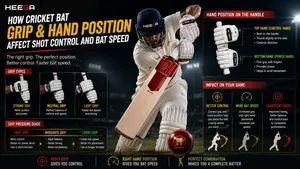 How Cricket Bat Grip and Hand Position Affect Shot Control and Bat Speed.Learn how cricket bat grip and hand position affect shot control, bat speed, timing, balance, and confidence while playing different cricket shots.
 Cricket Rules for Kids Explained: Understanding Runs, Wickets, Overs and Fielding Positions.Learn cricket rules for kids, including runs, wickets, overs, fielding positions, batting, bowling, and basic match rules in a simple beginner's guide.
 Batting Gloves for Cricket: How Finger Design, Palm Materials and Grip Texture Affect Bat ControlDiscover how cricket batting gloves, finger design, palm materials and grip texture influence bat control, comfort, protection and batting performance.