Why Some Kids Learn Cricket Skills Faster Than Others — And What Parents Should Know

Introduction: Every Young Cricketer Learns Differently
Parents often notice something interesting when children start playing cricket.
Two kids may join an academy at almost the same age.
They may attend the same training sessions.
They may receive the same coaching.
Yet one child appears to learn batting, bowling, or catching much faster than the other.
This can sometimes make parents wonder:
"Why is my child taking longer to learn?"
The answer is rarely as simple as talent.
Children develop at different speeds because cricket learning is influenced by many factors.
Coordination, physical development, confidence, practice habits, motivation, coaching, concentration, previous sporting experience, and even the way a child learns can all affect progress.
Most importantly, a child who develops slowly at one stage can make rapid progress later.
Youth cricket development is not a race.
Learning Speed Does Not Define Cricket Potential
One of the biggest mistakes parents can make is assuming that the fastest learner will automatically become the best player.
Early development can be encouraging, but it does not predict a child's entire cricket journey.
A child may struggle with batting at age eight and become an excellent batter later.
Another may perform brilliantly at a young age but need to make major technical adjustments as competition becomes stronger.
Long-term development matters more than early comparisons.
Coordination Plays a Major Role
Cricket requires several movements to happen together.
A young batter needs to:
- Watch the ball.
- Judge its movement.
- Move their feet.
- Control the bat.
- Maintain balance.
- Make contact.
That is a lot of information for a developing brain and body to process.
Some children naturally develop coordination earlier than others.
Previous Sports Experience Can Help
A child who has played other sports may already have useful movement skills.
For example, football can develop:
- Balance.
- Direction changes.
- Spatial awareness.
- Agility.
Throwing sports can help develop:
- Arm coordination.
- Timing.
- Ball tracking.
These abilities can transfer into cricket.
This does not mean children need to specialize in cricket from a very young age.
General physical activity can provide valuable foundations.
Hand-Eye Coordination Develops Over Time
Good hand-eye coordination helps players track and respond to moving objects.
But it is not a fixed ability.
Children can improve it through repeated activities such as:
- Catching.
- Throwing.
- Hitting targets.
- Reaction games.
- Ball-control exercises.
Regular exposure can gradually make these movements easier.
Some Children Need More Repetition
Learning a cricket skill often requires repetition.
One child may understand a movement after a few attempts.
Another may need dozens of repetitions.
That does not necessarily mean the second child lacks ability.
They may simply need more opportunities to build familiarity.
Repetition Builds Movement Confidence
Consider a basic catching skill.
At first, a child may think about:
"Where should my hands go?"
After repeated practice, the movement can become more natural.
Eventually, the child may simply react.
This transition from conscious effort to more automatic movement is an important part of learning.
Confidence Can Speed Up Learning
A confident child is often more willing to attempt unfamiliar skills.
They may:
- Try harder shots.
- Attempt difficult catches.
- Experiment with bowling.
- Ask questions.
- Accept mistakes.
A child who lacks confidence may avoid challenging activities.
That can reduce learning opportunities.
Fear of Making Mistakes Can Slow Progress
Children sometimes become afraid of being wrong.
A child who worries about:
"What if I miss?"
may hesitate before swinging.
A child who thinks:
"Let me try."
is more likely to experiment.
This is why creating a safe learning environment matters.
Parents Should Make Mistakes Normal
Mistakes are unavoidable in cricket.
Children will:
- Miss catches.
- Play poor shots.
- Bowl wides.
- Forget techniques.
- Get out cheaply.
These moments are part of learning.
Parents should avoid treating every mistake as evidence of poor ability.
Motivation Changes Learning Speed
Children learn faster when they are genuinely interested in what they are doing.
A child who loves cricket may naturally spend more time:
- Watching matches.
- Practicing at home.
- Talking about players.
- Playing with friends.
- Trying new skills.
That extra exposure can accelerate learning.
Not Every Child Is Motivated by Competition
Some children love competition.
Others prefer games, challenges, teamwork, or personal improvement.
Parents and coaches should understand what motivates the individual child.
A child does not need to love winning in order to become a good cricketer.
Fun Is a Powerful Learning Tool
Young children often learn best when they are enjoying themselves.
Instead of turning every practice session into a technical lesson, coaches can use:
- Target games.
- Relay races.
- Catching competitions.
- Batting challenges.
- Team games.
Fun can encourage children to repeat skills without feeling like they are doing repetitive work.
Attention Span Matters
Young children cannot always concentrate for long periods.
A coach might explain a technique perfectly, but the child may lose focus after several minutes.
Short, varied activities can be more effective.
For example:
10 minutes batting → 10 minutes fielding → 10 minutes bowling → game
This keeps the session active.
Children Learn in Different Ways
Some children learn by watching.
Others learn through physical repetition.
Some need verbal explanations.
Others understand better when a coach demonstrates the movement.
A good coach uses different methods.
Visual Learners
A child may understand a batting movement after watching someone perform it.
Video or demonstrations can be useful for these players.
Physical Learners
Some children need to physically perform the movement before they understand it.
For them, practical drills can be more effective than long explanations.
Verbal Learners
Other children respond well when coaches explain:
- What to do.
- Why to do it.
- When to use it.
Combining explanation with demonstration can help different types of learners.
Physical Development Can Affect Cricket Skills
Children do not grow at the same rate.
One child may suddenly become taller.
Another may develop strength earlier.
Another may remain smaller for longer.
These differences can temporarily affect cricket performance.
Growth Can Temporarily Change Technique
When a child grows quickly, their movement patterns may feel unfamiliar.
Their:
- Balance.
- Bat swing.
- Running stride.
- Throwing action.
may change temporarily.
This is normal.
Don't Judge a Child During a Growth Phase
A child who suddenly looks less coordinated may simply be adjusting to a changing body.
With time and practice, coordination can catch up.
Strength Is Not Everything
Parents sometimes assume stronger children should automatically perform better.
But cricket also depends heavily on:
- Timing.
- Coordination.
- Decision-making.
- Balance.
- Technique.
- Concentration.
A smaller player can still develop excellent cricket skills.
Height Can Influence Certain Skills
Height can eventually affect aspects of cricket such as:
- Bowling release.
- Bat reach.
- Stride length.
- Fielding range.
But height alone does not determine cricket ability.
Children should not be compared solely by physical size.
Coaching Quality Matters
Good coaching can make a significant difference.
An effective coach does more than demonstrate technique.
They understand:
- Child development.
- Individual differences.
- Communication.
- Motivation.
- Appropriate training loads.
One Technique Does Not Fit Every Child
A coach may teach the same basic principle to a group.
But the exact movement may look different from child to child.
A player's:
- Height.
- Mobility.
- Strength.
- Coordination.
can influence how they perform a skill.
Feedback Should Be Specific
Instead of saying:
"That was bad."
a coach can say:
"Try keeping your head still when the ball reaches you."
Specific feedback gives the child something they can actually change.
Too Much Information Can Slow Learning
Children can become confused when coaches give them ten instructions at once.
A better approach is often to focus on one or two important improvements.
For example:
"Watch the ball and stay balanced."
Once those habits improve, the coach can introduce another detail.
Practice Quality Matters More Than Practice Hours
A child does not necessarily need hours of practice every day.
Focused practice can be more valuable.
Ten minutes of purposeful catching may be more useful than an hour of unfocused activity.
Consistency Beats Occasional Intense Practice
Regular practice allows skills to develop gradually.
For example:
- 20 minutes three times a week
may be easier to sustain than:
- Two hours once every two weeks.
Consistency creates familiarity.
Home Practice Can Help
Parents do not need expensive cricket facilities.
Simple activities can include:
- Throwing and catching.
- Tennis-ball batting.
- Target bowling.
- Shadow batting.
- Reaction games.
These can help children become more comfortable with cricket movements.
Equipment Should Match the Child
Equipment that is too large or heavy can make learning harder.
Young players should use appropriately sized:
- Cricket bats.
- Gloves.
- Pads.
- Helmets.
- Shoes.
Comfort and control are particularly important during early development.
Why the Right Bat Matters
A bat that is too heavy can make it difficult for a child to control the swing.
This can affect:
- Timing.
- Balance.
- Confidence.
- Technique.
Parents should select equipment according to the child's current size and development rather than buying excessively large equipment for future growth.
Kashmir Willow Can Be a Practical Starting Point
For many developing players, Kashmir Willow cricket bats can provide a practical combination of durability and value.
They can be suitable for:
- Coaching.
- Practice.
- School cricket.
- Early competitive development.
The important factor is choosing an appropriate size and weight.
Children Can Be Fast Learners in One Skill and Slow in Another
A young cricketer may learn batting quickly but struggle with catching.
Another may bowl naturally but take longer to understand batting technique.
This is completely normal.
Cricket contains many different skills.
Skill Development Is Not Always Balanced
Players can have different strengths at different ages.
A coach can use those strengths while gradually improving weaker areas.
The goal is not to make every child identical.
Natural Ability Does Matter — But It Is Not Everything
Some children may appear naturally gifted.
They might:
- Time the ball easily.
- Throw accurately.
- Move quickly.
- React instinctively.
Natural ability can provide an advantage.
But development still requires practice.
Talent without consistent training may not reach its potential.
Discipline Can Outperform Early Talent
A child who practices consistently may eventually overtake someone who relied heavily on early natural ability.
Long-term improvement often depends on habits.
Patience Is Essential
Children develop at different speeds.
Parents should avoid expecting instant results after every coaching session.
Some skills may take weeks.
Others may take months.
That is normal.
Comparing Children Can Create Unnecessary Pressure
Statements such as:
"Your friend is already better than you."
can make cricket feel like an exam.
Instead, parents can ask:
- What did you learn today?
- What was your favorite drill?
- What would you like to improve?
- What did you enjoy?
These questions encourage reflection.
Progress Should Be Measured Against the Player's Past
A better comparison is:
"Are you better than you were last month?"
If a child catches more consistently, moves better, or understands the game more clearly, progress is happening.
Small Improvements Matter
Youth cricket development can happen through tiny changes.
A child may:
- Improve their grip.
- Catch one more ball.
- Bowl more accurately.
- Run faster.
- Understand field placement.
These improvements accumulate.
Confidence Often Follows Competence
When children become better at a skill, confidence often increases.
That confidence can encourage them to practice more.
More practice can improve the skill further.
This creates a positive cycle:
Practice → Improvement → Confidence → More Practice
Set Achievable Goals
Instead of asking a child to become the best batter in the academy, set smaller goals.
Examples:
- Complete ten catches.
- Hit five controlled drives.
- Bowl five balls at the target.
- Improve running between wickets.
Small goals feel achievable.
Celebrate Effort and Improvement
Parents can praise:
- Hard work.
- Concentration.
- Persistence.
- Good decisions.
- Improvement.
This helps children understand that success is more than match results.
Don't Turn Every Match Into an Evaluation
A child needs opportunities to simply play.
Not every match should become a detailed performance review.
Sometimes the best question after a game is:
"Did you enjoy it?"
The Role of Teammates
Children also learn from other players.
Playing with slightly more experienced teammates can expose them to:
- Better techniques.
- Different strategies.
- Match awareness.
- New ideas.
Positive peer environments can support development.
Competition Can Accelerate Learning
Healthy competition can motivate children to improve.
But competition should remain appropriate for their age and development.
The objective should be challenge, not fear.
Technology Can Help Older Young Players
As children become more advanced, technology can provide useful feedback.
Examples include:
- Slow-motion video.
- Batting analysis.
- Bowling analysis.
- Performance statistics.
Technology should support coaching rather than overwhelm young players.
Cricket Academies Should Individualize Development
A good academy understands that every child is different.
Training can be adjusted according to:
- Experience.
- Physical development.
- Skill level.
- Confidence.
- Goals.
Individual attention can make a major difference.
Nepal, Germany, USA, Canada, Netherlands, and UK
Youth cricket continues to develop across different cricket communities around the world.
Children in Nepal, Germany, the United States, Canada, and the Netherlands may have very different access to facilities and competition.
The United Kingdom has a long-established junior cricket structure.
Despite these differences, one principle remains universal:
Children develop at different speeds.
The right coaching environment should recognize those differences rather than trying to eliminate them.
What Parents Should Remember
When a child appears to be learning slowly, parents should consider the bigger picture.
Ask:
- Is the child enjoying cricket?
- Are they practicing consistently?
- Are they physically developing?
- Are they receiving useful coaching?
- Are they becoming more confident?
- Are they improving compared with their previous performance?
These questions provide a much clearer picture than simply comparing them with another child.
A Simple Development Checklist for Parents
Parents can support their child's cricket journey by:
- Choosing suitable equipment.
- Encouraging regular practice.
- Keeping training enjoyable.
- Avoiding constant comparisons.
- Supporting good coaching.
- Celebrating small improvements.
- Allowing mistakes.
- Being patient during growth phases.
- Encouraging general physical activity.
- Focusing on long-term development.
How Heega Sports Supports Young Cricketers
At Heega Sports, we understand that young players need equipment that matches their stage of development.
Our cricket range includes:
- Junior cricket bats.
- Kashmir Willow cricket bats.
- Leather cricket balls.
- Practice balls.
- Batting gloves.
- Batting pads.
- Cricket helmets.
- Cricket shoes.
- Cricket kit bags.
- Practice nets.
- Training accessories.
The right equipment cannot replace coaching or practice.
But comfortable, appropriately sized equipment can help children train with greater control and confidence.
Final Thoughts
Some children learn cricket skills quickly.
Others need more time.
Neither situation automatically predicts future success.
A child's development is influenced by coordination, physical growth, previous sporting experience, motivation, confidence, coaching, practice quality, concentration, and many other factors.
The most important thing parents can do is avoid turning cricket into a comparison between children.
Instead, focus on progress.
Is the child enjoying the game?
Are they learning something new?
Are they becoming more confident?
Are their skills improving over time?
If the answer is yes, development is happening.
Young cricket is not about producing the finished player as quickly as possible.
It is about building foundations.
A child who learns slowly today may develop rapidly tomorrow.
A child who looks advanced today may face new challenges during adolescence.
There is no single timeline for becoming a good cricketer.
Give children time.
Give them encouragement.
Give them suitable equipment.
Give them quality coaching.
Most importantly, give them a reason to keep enjoying the game.
Because when children enjoy cricket, they are more likely to keep practicing, keep learning, and keep discovering what they are capable of.
🏏 Support Your Child's Cricket Journey With Heega Sports
Explore junior cricket bats, Kashmir Willow bats, leather balls, practice balls, batting gloves, pads, helmets, cricket shoes, kit bags, practice nets, and training accessories designed to support young players at every stage.
Shop Now
Heega Sports – Helping Young Cricketers Learn, Grow, and Enjoy the Game.
Related posts
 Why Some Cricket Grounds Feel Faster Than Others: Understanding Outfield Speed and Ball TravelWhy do some cricket grounds feel faster than others? Discover how grass, moisture, soil, weather, slope, ground maintenance, and ball condition affect outfield speed.
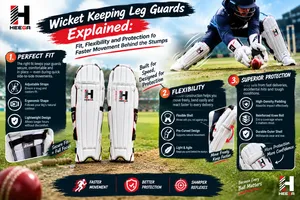 Wicket Keeping Leg Guards Explained: Fit, Flexibility and Protection for Faster Movement Behind the StumpsDiscover how to choose wicketkeeping leg guards with the right fit, flexibility, and protection for quicker movement, comfortable crouching, and confident keeping.
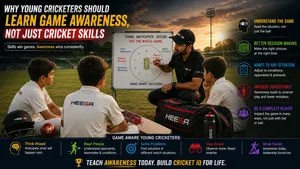 Why Young Cricketers Should Learn Game Awareness, Not Just Cricket SkillsLearn why young cricketers need game awareness alongside cricket skills, including decision-making, field placement, match situations, communication, and strategy.