Buying a Cricket Bat from India: A Guide for Overseas Buyers.
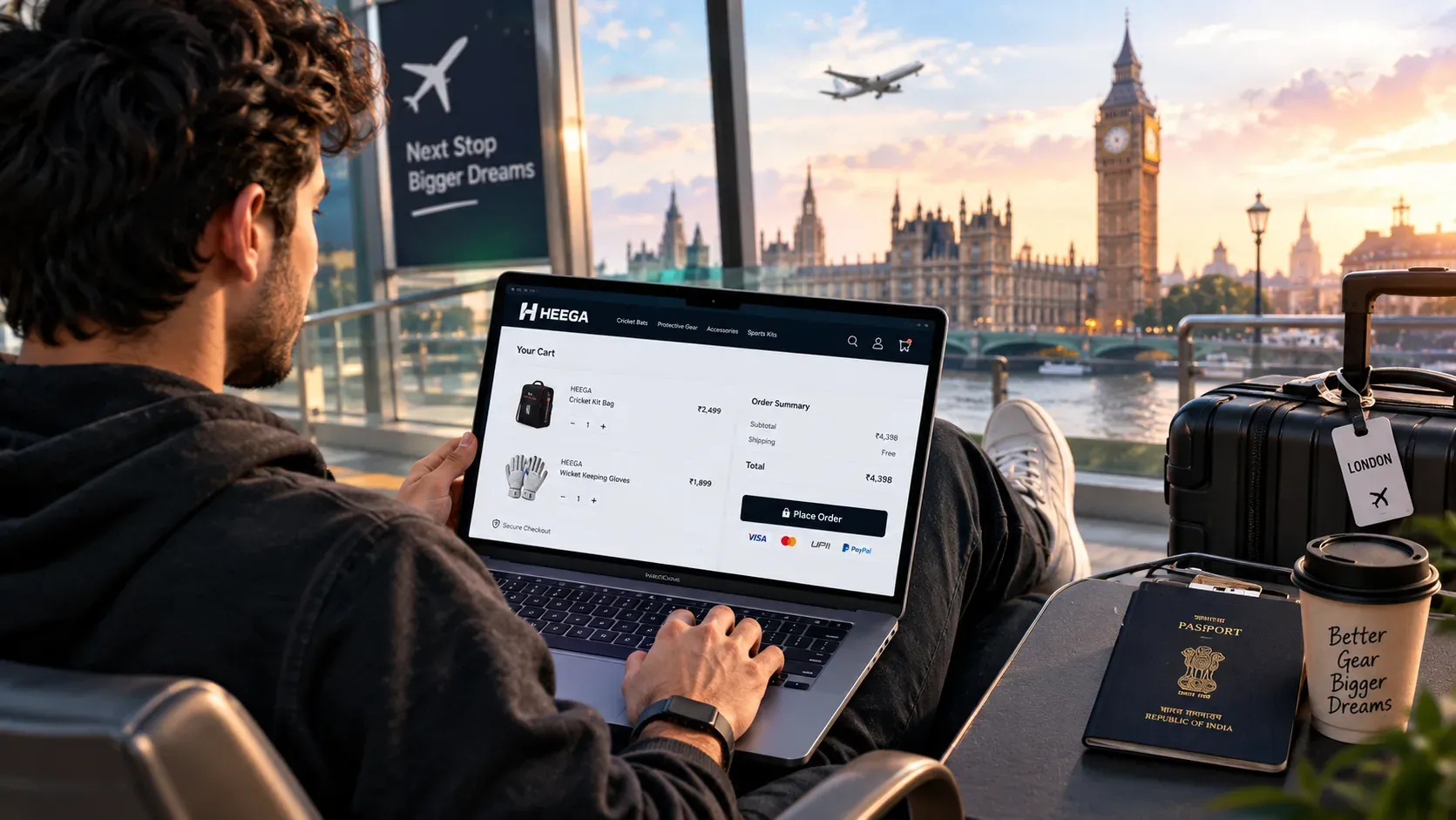
Buying a cricket bat from India while living overseas starts with five essential checks: who is selling it, which bat you are ordering, what preparation it needs, the full cost, and when it should arrive. Getting those details in writing before paying—particularly if the bat is customized—is the foundation of a successful transaction.
For cricketers living in the UK, Australia, the United States, Canada, New Zealand, the Gulf region, or anywhere across the global cricketing diaspora, acquiring a bat directly from India represents an exciting opportunity. India is the heartland of world cricket equipment manufacturing. Cities like Meerut in Uttar Pradesh and Jalandhar in Punjab, along with specialized boutique workshops across the country, house generations of master bat carvers (karigars). These craftsmen shape raw willow into high-performance instruments for international superstars and grassroots players alike.
However, the most challenging aspect of buying a cricket bat online is usually the feel. When you walk into a local brick-and-mortar sports store, you can pick up a dozen bats off the rack, settle into your stance, check the pick-up, test the ping with a mallet, and feel how the weight is distributed through your hands and wrists. Online shopping strips away that tactile feedback. You can see glossy photos, detailed specs, and brand stickers, but you cannot physically experience the backlift.
That does not mean buying overseas has to be a game of chance. A clear, structured conversation with the seller allows you to make an informed choice, whether you are ordering a bat for weekend club cricket, elite league matches, or intensive net training.
1. Start with the Seller, Not Just the Product Photo
Before comparing individual bats or falling in love with a specific grain structure in a digital photograph, take a close look at the business behind the listing. A reliable overseas transaction depends on clear communication, transparency, and accountability.
Evaluating the Business Credentials
When researching an Indian bat seller or manufacturer online, look for:
- Clear Business Identification: A registered company name, physical factory or shop address, and verifiable contact details (email addresses, phone numbers, and active customer support channels).
- Accessible Policies: Transparent written terms regarding international shipping, customs responsibilities, returns, refunds, and warranties.
- Direct Communication Channels: Accessible customer service via email or direct messaging where you can ask specific technical questions about willow inventory.
Always use the official contact details provided on the seller’s verified website. Before making any payment, ensure that your written quotation explicitly identifies both the specific product details and the registered business receiving the funds.
Understanding Stock Photos vs. Actual-Bat Photographs
When reviewing a product listing, ask the seller whether the photos display the exact individual bat you will receive or a representative factory model.
- Representative Model Photographs: Show the general design, sticker aesthetic, and shape profile of a bat line. They give you a clear idea of what the finished model looks like, but they do not reflect the unique grain structure, blemish profile, or exact weight of an individual wooden blade.
- Actual-Bat Photographs: Show the precise piece of timber assigned to your order. Reviewing photos of the actual piece allows you to inspect the grain density, grain straightness, face purity, edge thickness, and toe profile before it is boxed and shipped.
Both types of photography serve a purpose. However, if you are purchasing a premium Grade 1 English Willow blade or requesting a custom profile, asking for actual photographs or a quick video clip of the raw or finished blade is an excellent way to confirm your order details.
For players seeking custom-built options direct from Indian manufacturing hubs, Heega Sports offers cricket bats and customization services based in Meerut, India. You can explore available models and bespoke options through their custom cricket bat service.
2. Give the Seller a Useful Playing Brief
One of the most common mistakes overseas buyers make is sending vague inquiries like: "I want a good, lightweight bat with maximum power." Because "good" and "light" are subjective terms, vague requests leave wide room for misunderstanding.
A detailed, structured playing brief helps the bat maker select or craft a blade tailored precisely to your batting style, local pitch conditions, and personal preferences.
What to Share and Why It Matters
Here is the key information to provide your seller and how each detail helps them:
- The Ball Type You Play With: State whether you play with a standard 156g (5.5 oz) leather match ball, heavy rubber/tennis balls, or indoor composite balls. Leather-ball bats require specific pressing density and structural reinforcement compared to tennis-ball blades.
- Your Current Bat Size and Comfortable Weight: Provide your current bat's scale weight in ounces or grams (e.g., 2 lbs 9 oz / 1160 grams) and state whether it feels comfortable or too heavy. This gives the craftsman a concrete reference point.
- What You Like or Dislike About Your Present Bat: Explain how your current bat feels in hand. If your current blade feels "toe-heavy" or hard to pick up quickly on fast pitches, tell the maker. If you love a thick spine with a full profile, make that clear.
- Your Budget and Destination Postcode: Sharing your destination postcode alongside your budget allows the seller to calculate precise product cost, packaging fees, and international shipping rates together.
- Your Required Arrival Date: If you need the bat before the start of a specific league season, tour, or match fixture, stating your deadline early helps identify potential timing issues before payment is made.
Example of an Effective Player Brief
Instead of a simple weight request, a well-structured message looks like this:
"I play weekend club cricket in Australia on hard synthetic and turf wickets facing 120 km/h leather-ball bowling. My current short-handle bat weighs 2 lbs 9.5 oz (1175 grams), but it feels heavy toward the toe, which slows down my swing against short-pitched bowling. I am looking for a mid-profile bat weighing between 2 lbs 8 oz and 2 lbs 9 oz (1135g–1160g) with a light, featherweight pickup. Please deliver to postcode 3000 before October 15th for the start of our season."
Notice how this brief gives the bat carver clear targets: a specific weight range, a mid-sweet spot, a light pickup profile, and a firm deadline. You do not need deep technical jargon to explain what feels comfortable; clear describing words work best.
If you are still deciding between different willow types or bat shapes, you can review our cricket bat selection guide to narrow down your options before finalizing your checklist.
3. Confirm Exactly What You Are Buying
Before transferring funds or completing an online checkout, request a written order confirmation summarizing every technical specification of your chosen blade.
Essential Specifications Checklist
Make sure your written summary explicitly details:
- Bat Size & Handle Specifications: Size (e.g., Short Handle, Long Handle, Harrow, Size 6) and handle shape preference (round, oval, or semi-oval).
- Willow Type & Grade: Clear identification of timber origin and grade (e.g., Grade 1 English Willow, Grade 3 English Willow, or Premium Kashmir Willow).
- Weight Range in Grams: Confirm weight in both imperial (pounds and ounces) and metric (grams) units. A 2 lb 9 oz bat equals roughly 1162 grams.
- Finished vs. Dead Scale Weight: Clarify whether the quoted weight includes accessories like a rubber grip, toe guard, anti-scuff sheet, or thread binding. An anti-scuff sheet and toe guard can add 15 to 25 grams to a bat's dead weight.
- Custom Shaping Profile: Detail edge thickness (e.g., 38mm–40mm), spine height (e.g., 60mm–65mm), toe thickness, and sweet spot positioning (low, mid, or high).
Requesting Visual Verification
For high-value or customized orders, ask the seller for clear photographs or a short video of the finished bat prior to dispatch. Request views of:
- The front face (showing grain alignment and visual purity).
- The back profile and spine height.
- The edge profile and toe thickness.
- The handle construction and splice.
- The bat resting on a digital scale showing its total weight.
While photos cannot replace the physical sensation of holding the bat, seeing the finished profile on a scale confirms that your specified requirements have been met.
To compare baseline models, Heega's English willow range and Kashmir willow range provide structured starting points. Always confirm the recommended ball type listed on the product page rather than assuming performance based on willow category alone.
4. Ask What Preparation Remains After Delivery
A common source of confusion for overseas buyers is assuming that a bat arriving in the mail is 100% match-ready out of the box simply because a listing mentions "factory knocking" or "pre-knocked."
Understanding "Pre-Knocked" vs. "Match-Ready"
In bat manufacturing terminology, factory knocking or machine pressing compresses the top fibers of the willow cleft to prepare the surface. However, factory machine pressing rarely hardens the vulnerable edges and toe fully.
Before placing your order, ask the seller three specific questions:
- Has the bat been hand-knocked with a mallet, machine-pressed, or both?
- Are the edges and toe rounded off and hardened for leather-ball play?
- What additional preparation do you recommend after I unpack the bat at home?
Post-Arrival Preparation Allowance
If you order a bat shortly before the start of a season or a crucial match, build extra time into your schedule for proper home preparation.
Even a factory-prepared bat benefits from:
- Acclimatization: Allowing the bat to sit in your home environment for 24 to 48 hours to adjust to local ambient humidity levels after air transport.
- Light Oiling: Applying a light coat of raw linseed oil (1 teaspoon) to the face, edges, and toe if the wood appears dry, then allowing it to dry horizontally face-up for 24 hours.
- Manual Mallet Work: Spending 2 to 4 hours gently knocking the edges at a 45-degree angle with a wooden mallet to ensure seam impacts do not cause edge cracking or splatters.
- Surface Protection: Fitting a clear Extratec anti-scuff sheet across the face and securing the toe with a rubber toe guard or specialized toe sealant.
If you prefer to have the seller fit an anti-scuff sheet, toe guard, or extra grip prior to shipping, agree on those details before dispatch so everything is applied cleanly at the factory.
5. Compare the Complete Delivered Cost
When evaluating options across different manufacturers or online stores, looking solely at the bat's listed retail price can be misleading. An overseas transaction involves multiple cost components.
Breakdown of Overseas Order Costs
To calculate your true financial commitment, request an itemized quotation covering:
- The Base Product Price: The cost of the shaped blade itself.
- Customization Charges: Fees for custom shaping, special handle requests, or personalized laser engraving.
- Accessories & Add-ons: Costs for fitted anti-scuff sheets, extra grips, toe guards, or padded bat covers.
- International Packaging & Express Freight: The cost of box packaging and air courier transit to your exact delivery address and postcode.
Understanding Import Duties and Local Taxes
International shipping fees paid at checkout cover transit from the factory to your door, but they usually do not include local import duties or taxes levied by your country's government.
- United Kingdom: Imports above threshold values are subject to UK VAT (20%) plus customs handling fees collected by the courier prior to delivery.
- Australia: Imports under AUD $1,000 generally enter GST-free, but orders exceeding AUD $1,000 incur 10% GST plus customs processing fees.
- United States: Imports under USD $800 usually enter duty-free under de minimis provisions, but orders above this threshold incur import tariffs.
- Canada & Europe: Subject to local GST/HST/VAT and carrier clearance fees upon arrival.
Heega's shipping policy notes that international freight rates are quoted at checkout, while any applicable destination import duties or taxes are payable by the recipient upon arrival. Check your local customs guidelines before placing an order to avoid unexpected fees when the delivery courier contacts you.
When comparing quotes between two sellers, always compare the total delivered cost (inclusive of shipping and estimated duties) rather than comparing a bat-only price with a delivered quote.
6. Separate Preparation Time from Delivery Time
When planning your purchase, keep in mind that total fulfillment time consists of two separate phases: production/preparation time and shipping transit time.
Typical Production & Transit Timelines
Timeline expectations vary depending on whether you choose a standard off-the-shelf model, a bespoke custom piece, or a bulk private-label order.
Heega currently outlines these typical operational timelines for different order categories:
- Standard Off-the-Shelf Products: Readily available stock items ship quickly, with typical worldwide delivery taking 4 to 5 business days from order confirmation.
- Single Custom-Built Bat: Takes roughly 1 to 2 days to custom-build, shape, press, and finish, followed by 4 to 5 business days for express air delivery.
- Bulk OEM or Private-Label Orders: Requires 30 to 45 days for full factory production following artwork and sample approval, followed by 4 to 5 business days for air freight transit.
Factoring in Shipping Variables
While express international couriers (such as FedEx, DHL, or UPS) deliver rapidly, several factors can affect delivery schedules:
- Remote Postcodes: Delivery to regional or rural areas outside major metropolitan hubs may require an additional 2 to 3 days.
- Customs Clearance Holds: Routine security inspections or unpaid duty notifications can temporarily hold parcels at import hubs.
- Peak Seasons: Holiday periods and peak pre-season months (e.g., September/October for Southern Hemisphere cricket; March/April for Northern Hemisphere cricket) can increase shipping transit times.
If you need your bat for a specific fixture or tour, communicate that deadline to the seller at the very beginning of your conversation so they can confirm whether your timeline is realistic.
For team orders, club equipment packages, or establishing your own private cricket brand, use the specialized OEM, bulk, and export inquiry route to discuss volume pricing and production schedules.
7. Keep Order Details and Inspect the Parcel Upon Arrival
A smooth buying process ends with careful documentation and thorough product inspection when your package arrives.
Documenting Your Purchase
Save digital copies of all transaction documents in one folder, including:
- The final written specification agreement (detailing weight, edges, profile, and handle).
- The itemized invoice and payment receipt.
- The seller’s written warranty, return, and refund policy terms.
- The courier tracking number and shipping manifest.
Review the seller’s return policy before completing your purchase. Note that while defective standard items can typically be returned under warranty, custom-sculpted bats tailored specifically to individual requests may carry restricted return terms unless there is a clear manufacturing defect or a deviation from written specifications.
Inspecting Your New Bat Step-by-Step
When the courier delivers your box, take a few minutes to inspect everything carefully before taking the bat to the nets:
- Inspect the External Packaging: Check the shipping box for deep punctures, crushing, or water damage caused during transit. Take photos of any visible box damage before opening it.
- Unpack and Inspect the Timber: Remove the bat from its protective cover and carefully examine the face, edges, toe, and handle for any cracks, splits, or shipping bruises.
- Verify the Specifications: Place the bat on a digital kitchen scale to verify its total weight against your agreed written brief. Check edge thickness using a digital caliper or ruler, and test the backlift to feel the pickup.
- Prompt Communication: If you notice any damage or significant discrepancy compared to your written summary, take clear photos and contact the seller immediately with your order reference number before applying oil, knocking the bat, or using it in practice.
Frequently Asked Questions
- Can I buy one cricket bat from India, or do I need a bulk order?
You can easily buy a single cricket bat. Individual custom-bat services are completely separate from commercial bulk OEM offerings. You can design and purchase one custom bat tailored to your exact preferences without needing a private-label order.
- Can I request photographs of the bat before buying?
Yes, you can ask the seller if photos of the exact bat are available. For stock bats, sellers can send photos of the actual piece. For custom-built bats that have not been carved yet, ask the seller to send photos or a video once shaping is complete and before dispatch.
- What details should I include in an international inquiry?
To get a fast and accurate quote, include: your country and delivery postcode, the ball type you play with, preferred bat size, comfortable weight range in grams or ounces, budget, and required arrival date. Attaching a photo of your current bat can also help explain your preferred shape profile.
- Will my overseas order include all import charges?
Typically no. While international express freight is paid at checkout, destination customs duties, VAT, GST, or import taxes are levied by your local government and collected by the courier upon arrival. Always review your destination country's import duty thresholds beforehand.
Summary
The idea that Kashmir Willow is strictly an entry-level timber is one of the biggest misconceptions in modern cricket. Kashmir Willow is a tough, high-density timber that delivers incredible durability, dependable power, and unmatched value for players at every stage of their journey. When given patient knocking in, light oiling, and consistent care, a quality Kashmir Willow cricket bat will handle fast leather-ball bowling with ease and deliver crisp, powerful shots season after season.
Buying a cricket bat directly from India while living abroad is a practical way to access top-tier craftsmanship, custom shaping options, and exceptional value. By following a clear checklist—choosing a reputable seller, providing a detailed playing brief, confirming specifications in writing, accounting for shipping and import duties, and allowing time for proper preparation—you can purchase your next blade with complete confidence.
Ready to discuss your next blade? Send Heega Sports your playing requirements and delivery postcode at info@heegasports.com, or explore custom cricket bats directly through their online service. A short, clear inquiry explaining your playing level, preferred feel, and location gives the team the exact starting point needed to craft your ideal bat.
Related posts
 English Willow Cricket Bats: How to Identify Quality, Check Bat Balance and Avoid Buying MistakesLearn how to identify a quality English willow cricket bat, check its balance and pickup, understand grain patterns, and avoid common buying mistakes.
 Ordering Cricket Equipment for a Club or Academy: An Overseas Buyer's ChecklistOrdering cricket equipment for your club or academy from overseas? Use this checklist for bats, protective gear, quantities, samples, shipping and quotations.
 The Ultimate Knocking-In & Bat Maintenance Guide for Overseas CricketersLearn how to knock in and maintain your cricket bat for overseas cricket, including oiling, moisture control, storage, repairs, travel, and seasonal care.