Cricket Bat Toe Design Explained: How Toe Shape Affects Durability and Performance
Introduction: Why Cricket Bat Toe Design Deserves More Attention
When players choose a cricket bat, most of the attention usually goes to the willow, weight, grains, profile and overall appearance. The bottom part of the bat often gets much less attention.
That bottom section is the toe.
It may look like a small part of the bat, but the toe has an important job. It is one of the areas that repeatedly comes into contact with the ground, especially when a batter taps the bat, takes guard, plays shots close to the crease or uses the bat on surfaces that are not perfectly smooth.
This is where cricket bat toe design becomes important.
The shape, construction and protection around the toe can influence how well the bat handles everyday use. A poorly maintained toe can absorb moisture, develop cracks or suffer damage much faster than the rest of the blade.
At the same time, toe design can have a small effect on the bat's balance and pickup because material distribution changes depending on how the lower part of the blade is shaped.
That does not mean one toe shape is automatically perfect for every player. Different designs are made with different priorities in mind.
In this guide, we will look closely at cricket bat toe design, the common toe shapes available, how they affect durability, why toe protection matters, what players should check before buying a bat and how to maintain this often-overlooked part of the blade.
What Is the Toe of a Cricket Bat?
The toe is the bottom section of the cricket bat, opposite the handle.
It sits closest to the ground when the bat is placed vertically during batting.
The toe connects the lower part of the blade with the rest of the bat and forms an important part of the bat's overall construction.
Although the hitting area is higher up the blade, the toe experiences a different kind of stress.
For example, the toe can be affected by:
- Repeated contact with the ground
- Moisture from damp pitches
- Hard or uneven surfaces
- Bat tapping before delivery
- Accidental knocks
- Poor storage
- Incorrect toe protection
- General wear and tear
Because of this, the toe needs both sensible shaping and proper care.
Why Is Cricket Bat Toe Design Important?
The toe has two main responsibilities: surviving regular use and fitting naturally into the overall bat profile.
A well-designed toe should work with the rest of the blade rather than feeling like a separate part.
Here are some of the main reasons toe design matters.
1. It Helps Protect the Bottom of the Blade
The bottom edge is naturally exposed to the ground.
A suitable toe design and protection system can reduce direct contact between the willow and the playing surface.
2. It Can Influence Bat Balance
The amount of willow and material around the lower section contributes to the overall weight distribution.
This can influence how the bat feels when lifted and moved.
3. It Helps With Everyday Durability
Players frequently tap their bats on the ground while preparing for a delivery.
Over hundreds or thousands of deliveries, this repeated contact can contribute to wear.
4. It Helps Manage Moisture Exposure
Willow and excessive moisture do not make a good combination.
The toe is particularly vulnerable because it is closest to wet grass and damp surfaces.
5. It Affects the Look of the Bat
Toe shape also contributes to the bat's visual profile.
Some bats have a more traditional squared appearance, while others feature more rounded or sculpted toe designs.
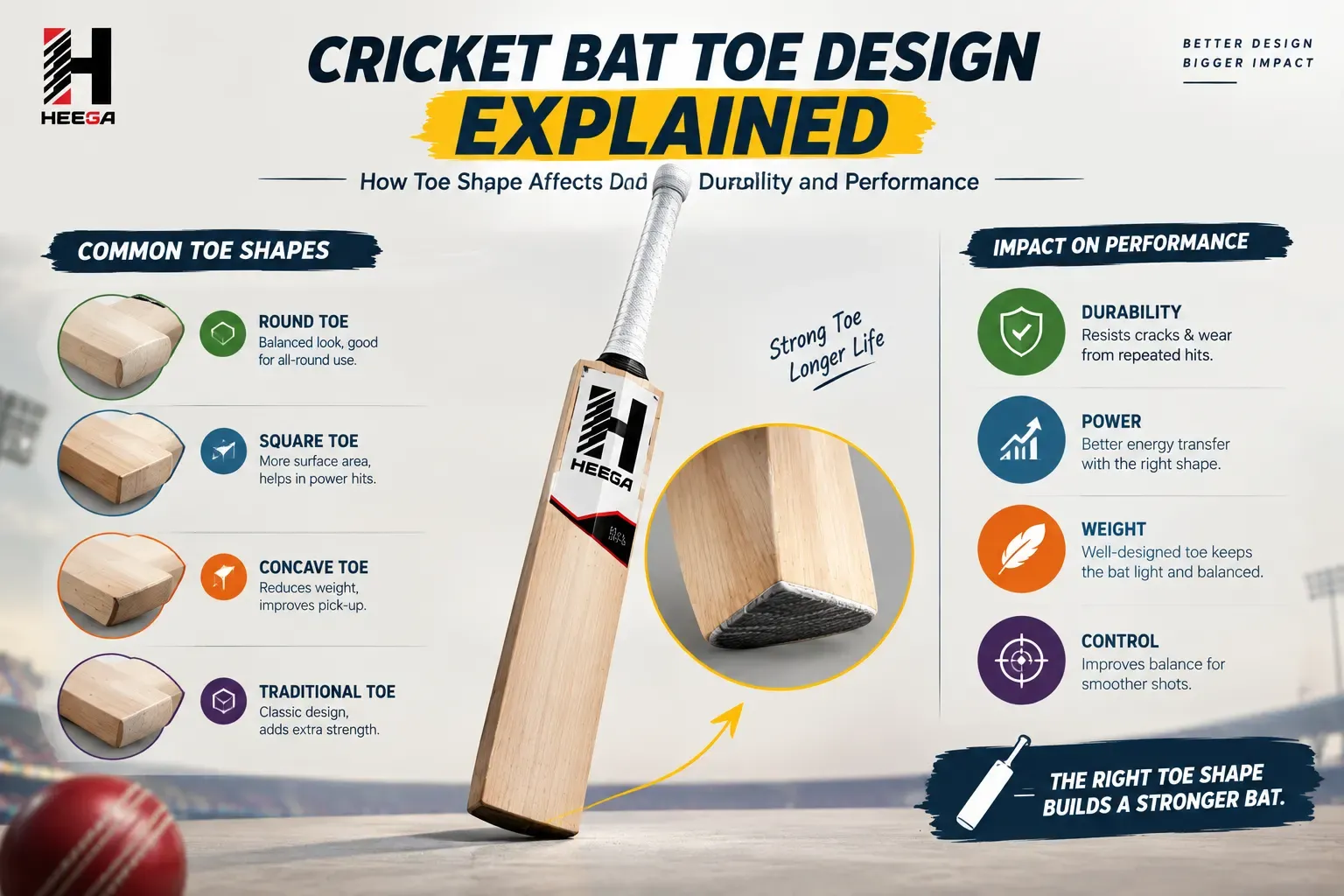
Common Cricket Bat Toe Shapes
There is no single toe shape used across every cricket bat.
Manufacturers may use different designs depending on the intended playing level, bat profile, weight distribution and construction approach.
Some common designs include:
- Square toe
- Rounded toe
- Semi-rounded toe
- Traditional flat toe
- Sculpted or slightly curved toe
- Toe designs combined with external protectors
Let's look at how these designs differ.
Square Toe Design
A square toe has a relatively straight bottom edge with defined corners.
It is one of the more traditional-looking designs and is commonly associated with classic cricket bat shapes.
Characteristics of a Square Toe
- Straight lower edge
- Defined corners
- Traditional appearance
- Clear connection between the toe and blade
- Can provide a solid visual profile
A square toe can look particularly clean on bats with traditional profiles.
However, the exact performance and durability depend on the complete bat construction rather than the shape alone.
The quality of the willow, toe protection and manufacturing process still matter significantly.
Rounded Toe Design
A rounded toe has curved edges instead of sharp lower corners.
The transition from the bottom of the bat toward the edges is softer and more gradual.
Why Do Manufacturers Use Rounded Toes?
A rounded design can create a smoother transition between different sections of the blade.
It may also give the bat a slightly more modern appearance.
Players who like a streamlined-looking bat often find rounded toe profiles visually appealing.
However, the important point is that shape should not be judged independently from construction.
A rounded toe is not automatically stronger than a square toe, just as a square toe is not automatically more durable.
Semi-Rounded Toe
A semi-rounded toe sits somewhere between a square and fully rounded design.
The central portion can remain relatively flat while the corners are softened.
This type of design attempts to combine a traditional blade appearance with smoother lower edges.
It can be useful for manufacturers looking for a balanced visual and structural profile.
Again, the final result depends on the willow and manufacturing quality.
Flat Toe vs Sculpted Toe
Another way to look at toe design is by considering how much shaping has been applied to the bottom of the blade.
A relatively flat toe keeps the lower section straightforward and traditional.
A sculpted toe may involve more shaping around the bottom and lower edges.
This shaping can change how much material sits in different areas of the blade.
That is why toe design should not be viewed only as an aesthetic feature.
Even relatively small changes in material distribution can influence how the bat feels during pickup.
How Toe Shape Can Affect Bat Balance
Balance is one of the most noticeable characteristics of a cricket bat.
Two bats can have similar total weights but feel completely different when picked up.
Why?
Because the weight is not necessarily distributed in exactly the same way.
The toe is one part of this equation.
If more material is retained toward the lower section of the bat, the bat may feel different in the hands compared with a design that removes or redistributes some of that material.
However, toe shape is only one factor.
Bat balance is also influenced by:
- Overall profile
- Spine position
- Edges
- Shoulder shape
- Handle construction
- Willow density
- Total bat weight
- Weight distribution across the blade
So, choosing a toe shape alone cannot determine whether a bat will have a particular pickup.
The best approach is to consider the complete bat.
Does Toe Design Affect Batting Performance?
Yes, but mostly as part of the overall bat construction rather than as an independent performance feature.
The toe itself is not the main area responsible for power when a batter strikes the ball.
The main hitting area, profile, willow characteristics and weight distribution have a much more direct relationship with how a bat performs.
Still, toe construction can contribute to how the bat feels.
A player may notice differences in:
- Pickup
- Balance
- Overall bat feel
- Ground interaction
- Confidence when tapping the bat
- Long-term condition of the blade
For most players, these small details become more noticeable over time rather than during a single shot.
Cricket Bat Toe Design and Durability
Durability is one of the biggest reasons to pay attention to the toe.
The toe can suffer damage even when the main blade looks almost new.
Imagine a batter playing several sessions on slightly damp ground.
The bat may be tapped repeatedly, placed on the ground and exposed to moisture.
If the toe is left unprotected, moisture can gradually enter the lower section.
Over time, this may contribute to:
- Swelling
- Softening of the willow
- Cracks
- Peeling
- Separation of protective material
- General deterioration
This is why toe protection is more than a cosmetic addition.
Why Toe Protection Is Important
Many cricket bats use some form of toe protection.
Depending on the bat and manufacturer, this may involve a protective sheet, sealant, toe guard or another protective treatment.
The basic purpose is straightforward:
Create a barrier between the willow and the ground.
A good protective system can help reduce exposure to:
- Water
- Damp grass
- Mud
- Dust
- Repeated ground contact
- Minor impacts
It is particularly useful for players who play frequently in outdoor conditions.
What Happens If the Toe Gets Wet?
Moisture is one of the biggest concerns for wooden cricket bats.
The toe is especially vulnerable because it is close to the ground.
If the bottom of the bat repeatedly comes into contact with wet surfaces, moisture can enter the willow.
Possible warning signs include:
- Toe swelling
- Discoloration
- Soft areas
- Cracking
- Lifting or peeling of protection
- Changes in the shape of the bottom section
This is why players should avoid leaving their bat standing on wet ground.
Even a high-quality bat benefits from careful handling.
Can Toe Damage Spread to the Rest of the Bat?
Toe damage should not be ignored.
A small crack or damaged protective layer does not necessarily mean the bat is finished, but leaving the problem untreated can allow it to become more serious.
For example, if a toe guard becomes loose, moisture can potentially reach the willow underneath.
If the toe begins splitting, repeated impacts may make the damage worse.
The safest approach is simple:
Deal with small problems early.
A professional bat repairer can assess the damage and determine whether the toe needs resealing, repair or replacement of the protective material.
Toe Shape and Different Playing Conditions
The playing environment also changes how much attention a player should give to the toe.
Dry and Hard Grounds
Hard surfaces can create repeated impact on the bottom of the bat.
Toe protection becomes especially useful for players who regularly tap the bat on firm pitches.
Damp Grounds
Moisture becomes the primary concern.
Players should be particularly careful about placing the bat directly on wet grass.
Indoor Nets
Indoor environments generally expose the toe to less moisture, although rough surfaces can still cause wear.
Concrete or Artificial Surfaces
These surfaces can be harsh on the toe.
Players should avoid unnecessary tapping on very hard surfaces and should take extra care when using a valuable match bat during practice.
Does a Cricket Bat Toe Need a Toe Guard?
For many players, a toe guard is a sensible form of protection.
A toe guard can help reduce direct contact between the willow and the ground.
It can also provide an additional layer of protection against moisture and minor knocks.
However, fitting and maintenance matter.
If a toe guard begins to lift at the edges, it should not simply be ignored.
A loose protective layer can allow moisture and dirt underneath it.
How to Check Cricket Bat Toe Quality Before Buying
When buying a bat, do not inspect only the grains and face.
Turn the bat over and look carefully at the toe.
Check the Bottom Edge
Look for:
- Clean finishing
- No visible cracks
- No unusual gaps
- No loose material
- Even shaping
Check the Toe Protection
If the bat has a toe guard, make sure it sits firmly and evenly.
There should not be obvious lifting or separation.
Check the Corners
Look closely at the toe corners.
They should have a clean finish without unnecessary splintering.
Check the Overall Shape
The toe should look properly integrated into the blade.
It should not appear excessively thin, uneven or poorly finished.
Common Cricket Bat Toe Problems
Even a well-made bat can develop problems if it is used or stored incorrectly.
Here are some common issues.
Toe Cracks
Small cracks can develop from repeated impact or improper use.
They should be monitored rather than ignored.
Toe Swelling
Usually associated with moisture exposure.
Swelling can change the shape of the lower blade and weaken the wood.
Toe Guard Separation
The protective layer can become loose after prolonged use.
This should be repaired before moisture gets underneath.
Splintering
Hard contact with rough surfaces can cause small pieces of willow to lift.
Uneven Wear
Constantly tapping the same spot can produce localized wear.
How to Protect Your Cricket Bat Toe
Good maintenance does not have to be complicated.
A few simple habits can make a significant difference.
1. Keep the Toe Dry
Avoid placing the bat directly on wet grass or damp ground.
2. Use Appropriate Toe Protection
A suitable toe guard or protective treatment can reduce exposure to moisture and ground contact.
3. Do Not Tap on Extremely Hard Surfaces
The bat is designed for cricket, not for repeatedly striking concrete or other hard surfaces.
4. Inspect the Toe Regularly
Take a few seconds to check the bottom after matches and training sessions.
5. Store the Bat Properly
Keep it in a dry environment away from excessive humidity.
6. Repair Small Damage Early
Do not wait until a small crack becomes a major split.
Cricket Bat Toe Design: Beginner vs Club vs Advanced Players
Different players may have different priorities.
Player LevelToe PriorityWhat to Look For
Beginner
Basic protection
Clean finish and sensible toe protection
Academy Player
Durability and balance
Good construction and secure protection
Club Player
Regular-use durability
Strong finishing and reliable toe protection
Advanced Player
Feel and long-term performance
Precise construction and professional maintenance
For beginners, there is no need to become obsessed with tiny differences in toe shape.
For regular club and serious players, however, the condition of the toe becomes more important because the bat is exposed to significantly more use.
Does a Bigger Toe Mean a More Durable Bat?
Not necessarily.
This is an important point because bat appearance can sometimes be misleading.
A thicker-looking or larger toe does not automatically mean the bat will last longer.
Durability depends on several factors, including:
- Willow quality
- Wood density
- Construction
- Moisture exposure
- Toe protection
- Playing conditions
- Bat preparation
- Player handling
- Frequency of use
The shape is only one part of the equation.
Cricket Bat Toe Design and Bat Preparation
A new cricket bat needs proper preparation before heavy match use.
While much of the preparation focuses on the striking surface and edges, the toe should not be forgotten.
Players should make sure the toe protection is secure before taking the bat onto damp or rough grounds.
If a bat requires knocking-in or other preparation, follow the manufacturer's instructions rather than applying random treatments.
More is not always better when it comes to bat preparation.
Common Mistakes Players Make With the Toe
Even experienced players sometimes overlook the bottom of the bat.
Mistake 1: Leaving the Bat on Wet Grass
This is one of the easiest ways to expose the toe to unnecessary moisture.
Mistake 2: Ignoring a Loose Toe Guard
A small gap can become a bigger problem.
Mistake 3: Using the Match Bat on Rough Practice Surfaces
A training environment can be harder on a bat than players realize.
Mistake 4: Checking Only the Face
A beautiful bat face does not tell you everything about the condition of the bat.
Mistake 5: Storing the Bat in a Damp Bag
The toe and lower blade can suffer when moisture remains trapped around the bat.
How Often Should You Inspect the Toe?
There is no fixed inspection schedule for every player.
A practical habit is to check the toe:
- After intensive training
- After playing in wet conditions
- After matches
- When changing bat grips or accessories
- Whenever you notice unusual sounds or movement
- Before storing the bat for a long period
The inspection only takes a minute.
That minute can help you spot a problem before it becomes expensive.
Signs That Your Cricket Bat Toe Needs Attention
Watch for changes such as:
- New cracks
- Softness in the willow
- Swelling
- Loose toe protection
- Splinters
- Separation between protective material and willow
- Water marks
- Unusual movement at the bottom
- A change in the bat's shape
If you notice any of these issues, avoid continuing to expose the bat to unnecessary moisture or impact until the problem has been assessed.
How Toe Design Fits Into the Overall Bat Profile
A cricket bat should always be considered as one complete structure.
The toe works together with:
- Blade profile
- Spine
- Edges
- Shoulders
- Handle
- Willow
- Weight distribution
This is why comparing two bats only by toe shape can be misleading.
Two bats may both have rounded toes but feel completely different.
Likewise, two square-toe bats can have very different pickup, profiles and durability.
The toe is an important detail, but it is not the whole bat.
What Makes a Good Cricket Bat Toe?
A good toe does not need to look complicated.
In practical terms, players should look for:
- Clean and even finishing
- Properly shaped lower edges
- No visible cracks
- Secure protective material
- Good integration with the blade
- Appropriate protection against moisture
- No unnecessary splintering
For serious players, the quality of manufacturing matters just as much as the visual design.
Choosing the Right Cricket Bat Toe Design for Your Style
Rather than choosing a bat purely because it has a square or rounded toe, think about how you actually use your bat.
If you regularly play outdoor cricket, moisture protection should be a priority.
If you spend a lot of time in practice nets, consider the type of surface you are using.
If you are a club player who uses the same bat throughout the season, long-term toe protection becomes particularly important.
And if pickup and balance are major considerations for you, pay attention to how the complete bat feels rather than judging the toe independently.
A simple rule works well:
Choose the overall bat first, then make sure the toe design and protection support the way you play.
Cricket Bat Toe Maintenance Checklist
Before and after playing, use this simple checklist.
Before Playing
- Check the toe for cracks
- Check the toe guard
- Make sure there is no loose material
- Keep the bat away from wet surfaces
After Playing
- Wipe away dirt carefully
- Check for new damage
- Dry the bat naturally if it has been exposed to moisture
- Do not store it while damp
- Keep it in a suitable bat cover
During the Season
- Inspect the toe regularly
- Repair minor damage early
- Replace damaged protective material when necessary
- Avoid unnecessary contact with rough surfaces
Why Players Should Not Ignore Small Toe Damage
Cricket bats are an investment for many players.
A small toe problem may look harmless, particularly when the face and edges are still in excellent condition.
But the toe is exposed to repeated contact.
A small crack can become larger. A loose guard can allow moisture underneath. A damaged corner can begin to splinter.
This is why regular maintenance is more practical than waiting for a major repair.
Think of toe maintenance in the same way you think about checking your bat grip.
It takes very little time, but it can help extend the useful life of the equipment.
Heega Sports: Cricket Bats Designed for Real Playing Conditions
At Heega Sports, cricket equipment is designed with the practical needs of players in mind.
A cricket bat is more than a striking surface. Every part of the bat contributes to its overall usability, from the handle and blade profile to the edges and toe.
For players who train regularly or play competitive cricket, details such as finishing, construction and protection can make a difference to the ownership experience.
When selecting a Heega Sports cricket bat, players should consider the complete bat rather than focusing on one visual feature.
The right combination of willow, profile, weight, balance, construction and protective details can provide a bat that feels natural in the hands and is easier to maintain throughout the season.
Whether you are purchasing your first serious bat or replacing an older one, paying attention to smaller construction details can help you make a more informed decision.
Frequently Asked Questions About Cricket Bat Toe Design
1. What is cricket bat toe design?
Cricket bat toe design refers to the shape, construction and finishing of the bottom section of a cricket bat. Common designs include square, rounded and semi-rounded toes.
2. Does toe shape affect cricket bat performance?
It can have a small influence on overall balance and feel because material distribution changes with construction. However, performance depends on the complete bat rather than toe shape alone.
3. Is a square toe better than a rounded toe?
Neither shape is automatically better for every player. The choice should be based on the overall construction, protection, balance and intended use of the bat.
4. Why does the cricket bat toe get damaged?
The toe is repeatedly exposed to the ground, moisture, hard surfaces and accidental impacts. Poor storage and excessive tapping can also contribute to damage.
5. Does a toe guard protect a cricket bat?
A toe guard can provide a protective barrier between the willow and the ground, helping reduce exposure to moisture and everyday wear.
6. Can moisture damage the toe of a cricket bat?
Yes. Repeated exposure to moisture can contribute to swelling, softening and deterioration of the willow.
7. How can I protect my cricket bat toe?
Keep the toe dry, use suitable protection, avoid hard surfaces, store the bat properly and inspect it regularly for cracks or loose protective material.
8. Should I repair a small toe crack?
It is generally sensible to have noticeable damage assessed early rather than continuing to use the bat without checking it. A professional bat repairer can determine the appropriate repair.
9. Does toe shape affect bat weight?
The amount and distribution of material in the lower part of the bat can contribute to its overall weight and balance, but total bat weight depends on the entire construction.
10. What should I check on the toe before buying a cricket bat?
Look for clean finishing, even shaping, secure toe protection, no visible cracks or splinters and a well-integrated connection between the toe and blade.
Final Thoughts
The toe might be one of the smallest parts of a cricket bat, but it has a surprisingly important role in everyday use.
A well-finished toe helps the bat cope with one of its most vulnerable areas: the point where the willow comes closest to the ground.
Understanding cricket bat toe design can also help players look beyond the obvious features of a bat. Instead of judging a bat only by its grains, stickers or overall appearance, take a few seconds to inspect the bottom as well.
Remember that no single toe shape guarantees better performance or longer life.
Square, rounded and semi-rounded designs can all work effectively when they are properly constructed and maintained.
What matters most is the complete combination of bat construction, willow, balance, protection and player care.
And when it comes to durability, simple habits still make a big difference: keep the toe dry, avoid unnecessary contact with hard surfaces, inspect it regularly and deal with small problems before they become major ones.
A little attention to the bottom of your bat today can help keep the entire bat ready for the next innings.
Shop Cricket Equipment from Heega Sports
Looking for reliable cricket equipment for training, club cricket or competitive matches?
Explore the cricket range from Heega Sports, including:
- Cricket Bats
- Kashmir Willow Cricket Bats
- English Willow Cricket Bats
- Leather Cricket Balls
- Cricket Protective Equipment
- Batting Gloves
- Wicketkeeping Gloves
- Cricket Kit Bags
- Cricket Practice Equipment
- Cricket Nets
Choose equipment that matches your playing requirements, training routine and level of cricket.
Shop Now with Heega Sports and get your cricket gear ready for the next innings.
Related posts
 Kashmir Willow Cricket Bats for Power Hitting: How Blade Shape, Sweet Spot and Edge Thickness Work TogetherLearn how Kashmir willow cricket bat blade shape, sweet spot position, and edge thickness work together to support powerful shots, control, and balance.
 Batting Gloves for Cricket: How Finger Design, Palm Materials and Grip Texture Affect Bat ControlDiscover how cricket batting gloves, finger design, palm materials and grip texture influence bat control, comfort, protection and batting performance.
 Cricket Shoes Explained: How Stud Patterns, Grip and Sole Design Affect Performance on Different PitchesLearn how cricket shoes, stud patterns, grip and sole design affect traction, stability, comfort and performance on grass, turf and artificial pitches.