English Willow Cricket Bat Grades Explained: What Separates Grade 1, Grade 2 & Grade 3 Bats?
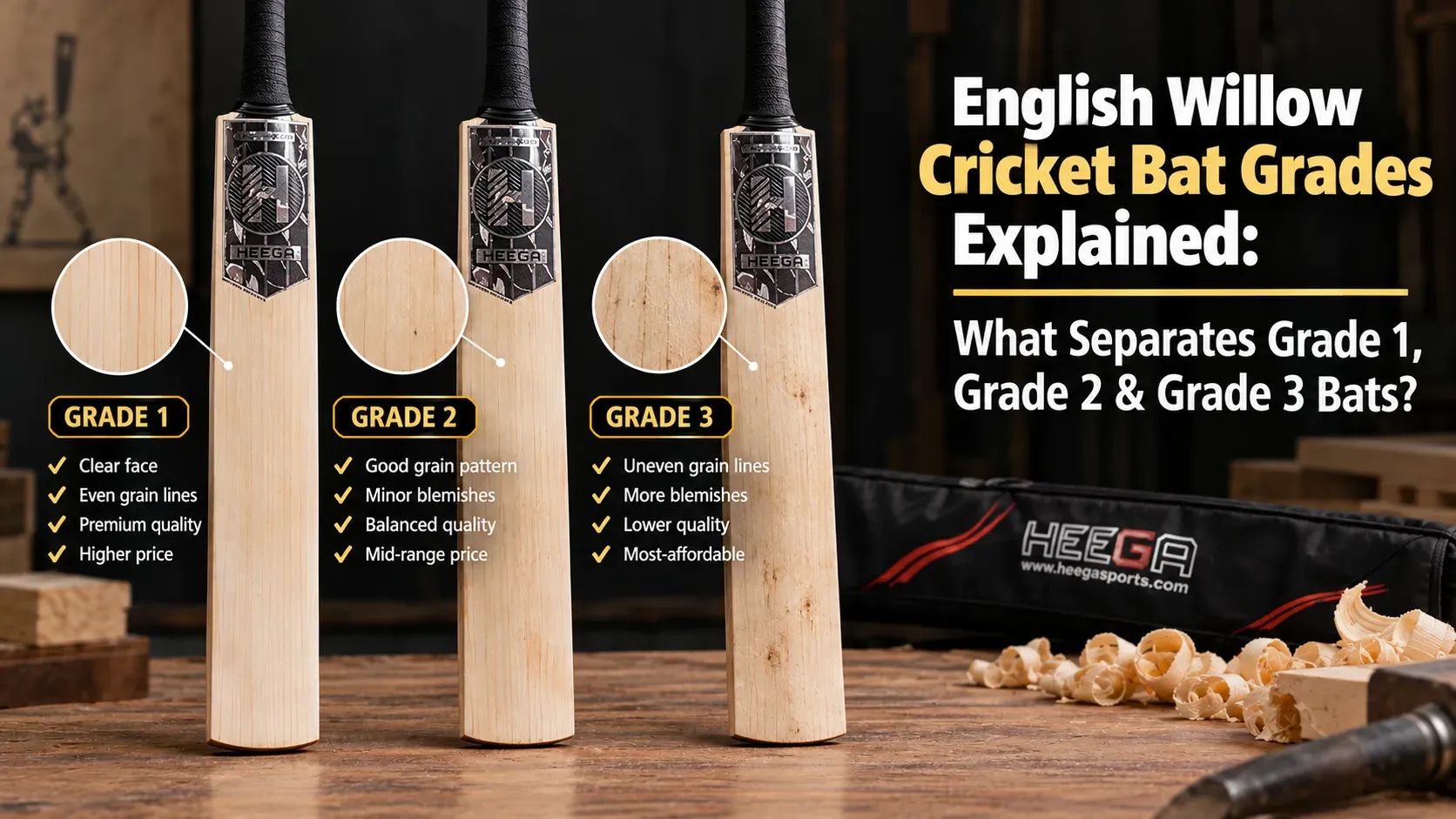
Introduction: Does a Higher English Willow Grade Always Mean a Better Cricket Bat?
Choosing an English Willow cricket bat can be confusing, especially when different bats carry labels such as Grade 1, Grade 2, and Grade 3.
At first glance, the differences may appear straightforward. Higher-grade bats often have a cleaner appearance, more uniform grain patterns, and fewer visible blemishes. Lower grades may have more noticeable marks or less regular grain spacing.
However, there is more to choosing a cricket bat than looking at its grade.
A bat's weight, balance, pickup, profile, sweet spot, preparation, and suitability for the player all influence the overall experience. Two bats within the same grade can also feel noticeably different.
For example, a Grade 1 bat may have an attractive appearance, but that does not automatically mean it will suit every batter. A well-selected Grade 2 or Grade 3 bat may offer a more comfortable pickup or a profile that better matches another player's technique.
Understanding the differences between grades helps you make a more informed decision instead of paying extra for a label alone.
In this guide, we will explain what English Willow cricket bat grades generally mean, how Grade 1, Grade 2, and Grade 3 bats compare, what grain patterns can tell you, and how to choose a bat that matches your playing style and budget.
What Is English Willow?
English Willow is a type of willow wood widely used to manufacture cricket bats.
It is valued for its combination of lightness, responsiveness, and suitability for cricket bat production. When selected and prepared appropriately, it can provide the balance of weight and performance that many competitive players seek.
The quality of an individual bat depends on the particular piece of willow, how it is shaped, and how the bat is finished and prepared.
Not every piece of willow has identical characteristics. Natural wood varies in colour, grain pattern, density, and visible markings.
This variation is one reason manufacturers classify bats into grades.
However, English Willow is a material category, while Grade 1, Grade 2, and Grade 3 are grading labels used by particular manufacturers or sellers. These labels are not a universal performance guarantee.
What Do English Willow Cricket Bat Grades Mean?
Bat grades generally describe the quality and visual characteristics of the willow selected for manufacturing.
Depending on the maker, grading may consider:
- Grain appearance and regularity
- Number and spacing of visible grains
- Natural blemishes or marks
- Colour consistency
- Overall visual presentation
- The manufacturer's own selection standards
Higher grades are commonly associated with cleaner-looking willow and fewer visible imperfections. Lower grades may contain more natural markings or less uniform grain patterns.
The exact criteria vary between manufacturers, so one company's Grade 1 is not necessarily identical to another company's Grade 1.
A grade can provide useful information about the willow selection, but it does not tell you everything about the bat's playing characteristics.
Grade 1 English Willow Cricket Bats: Premium Appearance and Willow Selection
Grade 1 English Willow bats are generally positioned among the premium options within a manufacturer's grading range.
They are often selected for their attractive appearance and relatively clean, regular grain patterns.
What Makes Grade 1 Different?
Grade 1 bats commonly feature:
- Relatively straight and uniform visible grains
- Fewer prominent natural blemishes
- A cleaner blade appearance
- More consistent visual presentation
- Premium positioning within a product range
The precise requirements depend on the manufacturer.
A Grade 1 bat may appeal to players who value the appearance of the willow as well as the bat's overall specifications.
Does Grade 1 Automatically Mean Better Performance?
No.
A higher visual grade does not guarantee that a bat will deliver more power, faster bat speed, or better timing than every lower-grade option.
Performance also depends on:
- Willow characteristics
- Bat weight
- Pickup and balance
- Blade profile
- Sweet-spot position
- Bat preparation
- Player technique
A Grade 1 bat that feels awkward or too heavy may be a worse fit for a particular player than a well-balanced bat from a lower grade.
Who Might Consider Grade 1?
Grade 1 may suit players who want a premium-looking English Willow bat and have a budget that accommodates the higher price often associated with this category.
Competitive club players and experienced batters may appreciate the opportunity to select a bat with their preferred profile, weight, and pickup.
Even at this level, testing the actual bat remains important.
Grade 2 English Willow Cricket Bats: Balancing Appearance and Value
Grade 2 English Willow bats generally sit between Grade 1 and Grade 3 in a manufacturer's range.
They can provide an attractive option for players who want English Willow without necessarily paying for the cleanest-looking willow selection.
Common Characteristics of Grade 2
Depending on the maker's grading policy, Grade 2 bats may feature:
- Mostly straight grains
- Some natural blemishes or colour variation
- Slightly less uniform grain patterns than higher grades
- A balance between appearance and price
These are general tendencies, not fixed rules. A manufacturer may use different standards or distinguish grades in another way.
Can Grade 2 Deliver Excellent Performance?
Yes. A Grade 2 bat can perform very well when the willow, construction, preparation, and specifications suit the player.
A batter may find a Grade 2 model with comfortable pickup and an ideal sweet spot. Those characteristics can be more important to their game than a perfectly clean blade.
Players should compare actual bats rather than assuming that a higher grade must always feel better.
Who Might Choose Grade 2?
Grade 2 can be a sensible option for club cricketers, developing players, and experienced batters who want a balance between appearance and cost.
It may also suit players who care more about weight, balance, and playing characteristics than about having the cleanest possible grains.
Grade 3 English Willow Cricket Bats: A Practical Entry Point
Grade 3 English Willow bats are generally a more accessible option within a manufacturer's English Willow range.
They may have more visible natural blemishes, greater variation in grain spacing, or a less uniform appearance than Grade 1 and Grade 2 bats.
These characteristics do not automatically make them unsuitable for competitive cricket.
What Can You Expect From Grade 3?
Depending on the manufacturer, Grade 3 bats may feature:
- More noticeable natural markings
- Greater variation in grain spacing
- Less uniform colour
- A more economical price position
The exact appearance and construction standards vary.
It is important to inspect the bat itself rather than relying entirely on the grade printed on the label.
Is Grade 3 Suitable for Club Cricket?
It can be.
A Grade 3 bat with suitable weight, balance, and preparation may work well for regular practice or club cricket.
Players should assess whether the bat feels comfortable and whether its specifications match their requirements.
A lower grade should not automatically be interpreted as a bat that cannot perform well. Equally, a Grade 3 label should not be treated as proof that every bat is suitable for every player.
Who Might Consider Grade 3?
Grade 3 may appeal to players who want to explore English Willow at a more accessible price point.
It can be worth considering for recreational players, developing club cricketers, and budget-conscious buyers who still want to evaluate the actual bat's performance characteristics.
Grade 1 vs Grade 2 vs Grade 3: The Main Differences
The most useful way to compare these grades is to understand the general selection differences rather than treating them as strict performance rankings.
1. Willow Appearance
Grade 1 is commonly associated with a cleaner, more uniform appearance.
Grade 2 may have some additional natural markings or variation.
Grade 3 may show more visible blemishes or less regular grain patterns.
These are general conventions. Individual manufacturers may classify willow differently.
2. Grain Patterns
Higher grades often feature more regular-looking grains, but grain count alone does not establish overall bat quality.
Grain spacing, the condition of the willow, and the manufacturer's selection standards also matter.
A bat should never be chosen solely because it displays a particular number of grains.
3. Price
Grade 1 bats are often more expensive because of their willow selection and premium positioning.
Grade 2 generally occupies a middle price range, while Grade 3 is often positioned more affordably.
Actual prices depend on the brand, bat model, manufacturing process, profile, and market.
4. Performance
There is no universal rule that every Grade 1 bat will outperform every Grade 2 or Grade 3 bat.
Performance depends on the complete bat and how well it suits the player.
A lower-grade bat with comfortable pickup and appropriate preparation may be a better choice for an individual batter than a more expensive bat that does not feel right.
5. Suitability for Different Players
All three grades can offer options for different playing levels.
The important consideration is whether the particular bat matches the player's technique, strength, preferred weight, and budget.
Understanding English Willow Cricket Bat Grains
Grains are the visible lines running along the face of a cricket bat.
They reflect the wood's natural growth structure and are often used as one visual factor when selecting willow.
Many buyers examine grain patterns closely because they can make one bat look more attractive than another.
However, grain count is not a complete measure of quality.
What Do Straight Grains Tell You?
Straight, relatively regular grains can indicate a visually consistent piece of willow.
Some players prefer this appearance because it looks clean and traditional.
Nevertheless, straight grains alone do not establish the bat's pickup, rebound characteristics, structural condition, or suitability for a particular player.
Are More Grains Always Better?
No.
A common misconception is that more grains automatically mean better performance.
Grain count can be one useful observation, but it should not be used as the only selection criterion.
A bat with fewer visible grains may still be an excellent choice, while a bat with many grains may not have the ideal balance or feel.
Does Grain Count Affect Durability?
Grain count by itself cannot reliably predict how long a bat will last.
Durability depends on multiple factors, including:
- The characteristics of the willow
- The bat's construction
- Knocking-in and preparation where required
- Playing frequency
- Ball type and impact
- Storage and moisture exposure
- Maintenance and repairs
It is better to evaluate the overall condition and construction of the bat than to use grain count as a durability guarantee.
Natural Marks and Blemishes: Should You Be Concerned?
Willow is a natural material, so small variations in colour and appearance are normal.
Some bats may have visible marks, while others have a cleaner face.
The significance of a mark depends on what it is and where it appears.
A superficial cosmetic mark is not necessarily a structural problem. A crack, split, or area of damaged wood deserves closer inspection.
When buying a bat, distinguish between natural appearance variations and signs of actual damage.
If you are uncertain, ask the seller or a knowledgeable bat specialist to inspect the area.
Why Bat Weight Matters More Than Grade Alone
One of the most important factors in selecting a cricket bat is weight.
A bat should be manageable enough for the player to lift, swing, and control throughout an innings.
An unnecessarily heavy bat may reduce bat speed or affect timing. A lighter bat may feel easier to manoeuvre, although some players prefer more mass behind their shots.
The best weight is personal.
When comparing Grade 1, Grade 2, and Grade 3 bats, assess the actual weight rather than assuming that a higher grade will automatically have a more suitable specification.
Pickup and Balance: How the Bat Feels in Your Hands
Two bats can have similar scale weights but feel very different when lifted.
This difference is related to balance and weight distribution.
A bat with comfortable pickup may feel easier to swing, while another bat of similar weight may feel more blade-heavy.
When testing a bat:
- Hold it using your normal grip.
- Practise your backlift.
- Play a few shadow shots.
- Check whether the bat feels easy to manoeuvre.
- Notice whether your technique remains comfortable.
The bat that feels most natural may be the better option, regardless of its grade.
Bat Profile and Sweet Spot Also Matter
The blade profile influences the bat's shape, weight distribution, and feel.
Different models may feature variations in:
- Spine height
- Edge thickness
- Blade shape
- Toe design
- Sweet-spot position
The sweet spot is the area of the blade where contact can feel particularly clean and efficient.
Some players prefer a lower sweet spot, while others favour a mid or higher position based on their playing conditions and technique.
A higher grade does not automatically guarantee a profile that suits your game.
Compare the actual bat specifications alongside its willow grade.
Does Bat Preparation Affect Performance?
Yes. Preparation is an important part of getting a wooden cricket bat ready for use.
Depending on the model, this may involve knocking-in, suitable oiling, or other manufacturer-recommended steps.
However, not every bat requires the same preparation. Some models may be supplied with specific preparation instructions or protective finishes.
Always follow the manufacturer's guidance before using a new bat with a hard cricket ball.
Do not assume that a Grade 1 bat is automatically ready for match use, or that a Grade 3 bat necessarily needs more preparation simply because of its grade.
Which English Willow Grade Is Best for Beginners?
There is no single best grade for every beginner.
A player who is learning the game may benefit most from a bat that has:
- The correct size
- Comfortable weight
- Manageable pickup
- A suitable profile
- Appropriate preparation
- A price within budget
A Grade 3 or Grade 2 bat may be a practical starting point, depending on the options available.
However, beginners should not select a bat solely by choosing the lowest price or the highest grade.
Comfort, control, and suitability are more important than the label alone.
Which Grade Is Best for Club Cricketers?
Club players have varied requirements.
Some play occasionally, while others practise several times a week and compete throughout a season.
Grade 1, Grade 2, and Grade 3 bats can all be worth considering, depending on the individual product and the player's needs.
Before deciding, evaluate:
- Playing frequency
- Bat weight
- Pickup and balance
- Willow condition
- Bat profile
- Preparation requirements
- Budget
A club cricketer may prefer a Grade 2 bat with excellent pickup over a more expensive model that feels less comfortable.
Another player may prefer a Grade 1 bat because its specifications suit their style.
The correct choice is individual rather than universal.
Is a Grade 1 Bat Worth the Extra Money?
It can be, but not for every player.
A Grade 1 bat may offer a cleaner appearance and a premium willow selection according to the manufacturer's standards.
If those qualities matter to you and the bat's specifications are suitable, paying more may be worthwhile.
However, if your priority is a comfortable, reliable bat for regular cricket, a Grade 2 or Grade 3 model may provide better value.
The additional price should reflect qualities you actually want, not simply the belief that a higher grade must deliver superior performance.
Common Mistakes When Buying an English Willow Cricket Bat
Choosing by Grade Alone
A grade does not tell you everything about weight, pickup, profile, or preparation.
Counting Grains Without Inspecting the Bat
Grain count is only one visual factor and cannot guarantee performance or durability.
Assuming Expensive Means Perfect
A premium price does not guarantee that a particular bat suits your technique.
Ignoring Weight and Pickup
A bat that is too heavy or poorly balanced for you may be difficult to control.
Overlooking Visible Damage
Natural markings and structural cracks are not the same thing. Inspect the wood carefully and seek advice if needed.
Forgetting Preparation
Follow the manufacturer's instructions before using the bat, especially with hard leather balls.
Copying a Professional Player's Bat
Professional players often have highly individual preferences. Their bat specifications may not suit your strength, technique, or budget.
A Practical Checklist Before Buying
Before purchasing an English Willow cricket bat, ask yourself these questions:
- Does the bat feel comfortable when lifted?
- Can I perform my backlift without struggling?
- Is the weight appropriate for my strength?
- Does the profile suit my batting style?
- Is the toe and blade free from concerning damage?
- Do I understand the manufacturer's grading criteria?
- Are preparation instructions available?
- Does the price fit my budget?
- Is the seller clear about the bat's material and specifications?
These checks can help you make a more informed purchase than relying on the grade alone.
How to Care for Your English Willow Cricket Bat
Whichever grade you choose, appropriate maintenance matters.
To help look after your bat:
- Keep it away from prolonged moisture.
- Wipe off dirt and surface moisture after use.
- Store it in a cool, dry place.
- Avoid leaving it in direct sunlight or a hot vehicle.
- Inspect the toe, edges, face, and handle regularly.
- Use bat oil only when appropriate and according to the manufacturer's instructions.
- Follow the recommended knocking-in and preparation process.
- Address cracks or structural damage promptly.
Good maintenance cannot prevent every form of damage, but it can help you identify problems early and reduce avoidable wear.
How Heega Sports Helps Players Find Suitable Cricket Equipment
At Heega Sports, we understand that choosing cricket equipment involves more than selecting a grade or price.
Players need equipment that suits their level, technique, comfort, and playing requirements.
Our cricket range includes:
- Kashmir Willow cricket bats
- Junior cricket bats
- Batting gloves
- Batting pads
- Cricket helmets
- Leather cricket balls
- Practice balls
- Cricket kit bags
- Cricket shoes
- Practice nets
- Training accessories
When comparing English Willow bats, look beyond the grade and consider the actual product specifications, construction, pickup, and preparation requirements.
Explore the available cricket equipment at Heega Sports.
Final Thoughts: Choose the Bat, Not Just the Grade
Grade 1, Grade 2, and Grade 3 English Willow cricket bats are commonly distinguished by the manufacturer's willow-selection standards and the appearance of the wood.
Grade 1 bats generally offer a cleaner, more premium appearance. Grade 2 bats can balance appearance and price, while Grade 3 bats often provide a more accessible entry point into English Willow.
But these are general conventions, not universal performance rankings.
A higher grade does not automatically mean greater power, better timing, or longer durability. Grain count alone cannot establish the quality of an entire bat, and a premium-looking blade may not have the pickup or profile you prefer.
The smartest approach is to consider the complete bat.
Look at its willow, inspect its condition, check its weight, assess its balance, and make sure it suits your playing style. Understand the manufacturer's grading criteria and follow the recommended preparation and maintenance instructions.
Whether you choose Grade 1, Grade 2, or Grade 3, the right English Willow cricket bat is the one that offers a suitable combination of comfort, control, construction, and value for your needs.
Choose with knowledge, test the pickup, and let the bat's overall suitability—not the grade alone—guide your decision.
🏏 Find Cricket Equipment That Fits Your Game with Heega Sports
Explore cricket bats, batting equipment, cricket balls, kit bags, practice nets, and training accessories at Heega Sports.
Shop Now
Heega Sports – Helping Every Cricketer Make a More Informed Equipment Choice.
Related posts
 Grade 1 vs Grade 4: The Ultimate Guide to English Willow Cricket Bat Grades and PerformanceDiscover the real differences between Grade 1 vs Grade 4 English Willow cricket bats. Learn how grain count, durability, ping, and cosmetics impact performance without paying extra.
 English Willow Cricket Bats Explained: How Bat Pressing, Grain Structure and Blade Compression Influence PerformanceLearn how English willow bat pressing, grain structure, and blade compression influence performance, durability, shot response, and bat selection.
 English Willow Cricket Bats: How to Identify Quality, Check Bat Balance and Avoid Buying MistakesLearn how to identify a quality English willow cricket bat, check its balance and pickup, understand grain patterns, and avoid common buying mistakes.