How Cricket Players Build Better Batting Habits Through Regular Practice.

Introduction: Better Batting Starts With Better Habits
Most players want to improve their batting.
They want to score more runs, hit the ball cleaner, play better shots, and feel more confident when they walk out to bat.
But improvement rarely comes from one brilliant practice session.
It usually happens in a much less exciting way.
A player repeats a movement.
Makes a mistake.
Tries again.
Gets some feedback.
Repeats the drill.
Gradually, the movement becomes more natural.
That is how good batting habits are developed.
For cricket players, regular practice is not simply about spending more time in the nets. It is about using that time intelligently.
Hitting hundreds of random deliveries may feel productive, but focused practice often provides much more value.
A batter might spend one session working on front-foot movement.
Another session might focus on playing the ball late.
Another could involve rotating the strike.
Later, match simulations can help turn those skills into decisions under pressure.
Over time, these repeated actions can become habits.
And once good habits become automatic, the player has more mental space to focus on the bowler, field placement, match situation, and scoring opportunities.
That is one of the biggest advantages of consistent cricket practice.
What Is a Batting Habit?
A batting habit is a movement, decision, or routine that a player repeats regularly.
Some habits are physical.
For example:
- Stance
- Backlift
- Footwork
- Head position
- Bat swing
- Follow-through
Others are mental.
These can include:
- Watching the ball closely
- Assessing the field
- Selecting scoring options
- Staying patient
- Resetting after a dot ball
- Preparing for the next delivery
Good batting combines both.
A technically sound movement is useful, but it becomes much more valuable when the player can use it naturally during a real cricket match.
Why Regular Practice Matters
Practice gives players the opportunity to repeat important skills.
During a match, there is little time to stop and think about every part of the batting movement.
The bowler is already running in.
The ball is coming.
The batter has to react.
Regular practice helps turn important movements into familiar patterns.
The goal is not to make every movement completely automatic.
Instead, the player develops reliable foundations that can be adjusted according to the delivery.
This is particularly useful when facing different bowling styles.
Repetition Is Important, But Repetition Alone Is Not Enough
Repetition is one of the foundations of skill development.
However, simply repeating the same mistake does not create a better habit.
Imagine a batter repeatedly moving their head away from the ball.
If they practice that movement hundreds of times without feedback, they may become more comfortable with the mistake.
Good practice therefore combines:
Repetition + Feedback + Adjustment
The player performs the skill.
The coach or player identifies an issue.
The movement is corrected.
The player repeats the improved version.
This process is much more useful than mindless repetition.
Start With a Consistent Batting Setup
A consistent pre-delivery routine can help players prepare mentally.
The routine might include:
- Getting into position.
- Looking at the field.
- Checking the bowler.
- Settling the feet.
- Taking a breath.
- Preparing the backlift.
- Watching the bowler's release.
The exact routine does not matter as much as consistency.
A familiar routine can help reduce unnecessary distractions.
It gives the batter a clear process to follow before each delivery.
Build a Strong Stance
The stance is the starting point for batting.
A player's stance should allow them to move comfortably in different directions.
The feet should provide balance.
The head should remain stable.
The hands should be positioned comfortably.
There is no single stance that every player must copy.
Different players have different body structures and techniques.
The important thing is that the stance allows the player to respond effectively to the ball.
Regular practice helps the player become comfortable in that position.
Develop a Reliable Backlift
The backlift prepares the bat for the shot.
A controlled backlift can help the player generate bat speed while maintaining balance.
Beginners sometimes make their backlift unnecessarily complicated.
They may move the bat too far away from the body or create excessive movement before the ball arrives.
Simple, repeatable movements are often easier to control.
Practice should focus on making the backlift comfortable rather than forcing a particular style.
Watch the Ball From Release to Contact
One of the most valuable batting habits is watching the ball carefully.
It sounds obvious.
Yet it is surprisingly easy to lose concentration.
A batter may start thinking about:
- The previous delivery
- The required run rate
- The field
- The bowler
- The score
- What shot they want to play
The ball, however, still needs their attention.
Developing the habit of watching the delivery from the bowler's hand can improve decision-making.
The player can better judge:
- Line
- Length
- Pace
- Swing
- Bounce
This allows the batter to react instead of deciding too early.
Learn to Judge Length Early
Good batting is partly about recognizing where the ball is going to land.
A batter needs to distinguish between:
- Full deliveries
- Good-length balls
- Short balls
- Yorkers
- Wide deliveries
With practice, players become better at reading length.
This is one reason structured net sessions are useful.
A coach can deliberately vary deliveries and ask the batter to respond appropriately.
Practice Front-Foot Movement
Front-foot movement is important when dealing with fuller deliveries.
The batter needs to move into a position that allows control.
Common front-foot shots include:
- Straight drive
- Cover drive
- On-drive
- Defensive push
- Flick
The objective is not simply to move forward.
The movement needs to be balanced and connected with the ball's line and length.
Repeated drills can help players develop this coordination.
Practice Back-Foot Movement
Back-foot movement becomes important against shorter deliveries.
The player may need to move back and create enough space to play the shot.
Depending on the delivery, they might play:
- Cut
- Pull
- Back-foot drive
- Defensive stroke
Good back-foot movement gives the batter more options.
Regular practice helps players become comfortable moving both forward and backward rather than getting stuck on the crease.
Learn to Play the Ball Late
Playing the ball late can be an extremely useful batting habit.
It gives the batter more time to judge the delivery.
This can be particularly valuable against swing and seam bowling.
Instead of committing too early, the player waits for the ball to come closer before completing the shot.
This does not mean every ball should be played extremely late.
It means the batter should avoid rushing into the shot before understanding the delivery.
Practice Defensive Batting
Modern cricket often emphasizes aggressive scoring.
But defensive technique remains important.
A batter who can defend confidently can:
- Survive difficult spells
- Build an innings
- Reduce unnecessary risk
- Frustrate bowlers
- Wait for scoring opportunities
Defensive practice also teaches players about bat-face control.
It helps them understand how small changes in bat angle can affect where the ball goes.
Practice Strike Rotation
Scoring does not always require boundaries.
Singles and twos can keep the scoreboard moving.
Players should practice:
- Pushing into gaps
- Running quickly
- Calling clearly
- Rotating strike
- Using soft hands
Strike rotation is particularly valuable in limited-overs cricket.
A batter who can consistently find singles puts pressure on the fielding team without taking excessive risks.
Practice Different Scoring Areas
A developing batter should gradually learn to score around the ground.
This can include:
- Straight
- Cover
- Mid-off
- Mid-on
- Square leg
- Fine leg
- Third area behind point
The exact scoring options depend on the delivery.
The goal is to avoid becoming dependent on one favorite shot.
A versatile batter can respond to different bowling plans.
Don't Practice Only Your Favorite Shots
This is a common problem.
Players naturally enjoy practicing shots they are already good at.
A batter who loves driving may spend most of the session playing drives.
But matches rarely provide only perfect driving deliveries.
You may face:
- Short balls
- Yorkers
- Wide balls
- Swinging deliveries
- Slower balls
- Spin
- Different field placements
Practice should therefore include areas of weakness.
The shots you dislike practicing may be the ones that help you most during competition.
Practice Against Fast Bowlers
Facing pace requires quick decision-making.
Players can practice against faster bowling by focusing on:
- Stable head position
- Early length recognition
- Compact movements
- Playing late
- Controlled backlift
The objective is not simply to hit the ball hard.
It is to develop enough control to respond to pace confidently.
Practice Against Spin Bowlers
Spin requires a different approach.
Batters need to judge:
- Flight
- Turn
- Pace
- Length
- Variation
Practice can include moving down the pitch, staying back, using the crease, and rotating the strike.
The goal is to avoid becoming predictable.
Use Throwdowns for Specific Technical Problems
Throwdowns are useful because the coach can repeatedly feed balls into a particular area.
For example, a coach may focus on:
- Outside off stump
- Straight deliveries
- Short balls
- Leg-side deliveries
- Full tosses
This allows the batter to repeat one movement without dealing with the unpredictability of a full bowling spell.
Throwdowns are particularly useful when working on a specific technical correction.
Use Bowling Machines Carefully
Bowling machines can provide consistent deliveries.
They can help players practice:
- Pace
- Line
- Length
- Repetition
- Specific shot responses
However, machine practice should not replace live bowling completely.
A real bowler provides changes in:
- Action
- Release point
- Pace
- Swing
- Seam
- Variation
The best training programs often use both.
Practice With Different Cricket Balls
Different balls can create different training experiences.
Players may use:
- Leather cricket balls
- Practice balls
- Tennis balls
- Soft training balls
Tennis balls can be useful for certain reaction and confidence drills.
Leather balls are more relevant when preparing for traditional competitive cricket.
The ball should match the purpose of the drill.
Introduce Match Situations Into Practice
Technique is only part of batting.
Players also need to learn how to make decisions.
Match simulation can create situations such as:
Scenario 1
Your team needs 40 runs from 30 balls.
Scenario 2
Your team has lost three wickets quickly.
Scenario 3
You are facing a difficult fast bowler.
Scenario 4
The field is set to stop boundaries.
Scenario 5
You need only five runs from the final over.
These situations force players to think.
That thinking is what connects practice with real cricket.
Practice Under Pressure
Players should occasionally practice with consequences.
For example:
- A missed shot means changing the drill.
- A certain number of dot balls creates a challenge.
- A successful scoring target ends the session.
- A batting pair has a limited number of deliveries.
The objective is not to create unnecessary stress.
It is to teach players how to remain composed while making decisions.
Learn From Every Dismissal
Getting out is part of cricket.
Instead of simply becoming frustrated, players can ask:
What happened?
Was the ball difficult?
Was the shot selection poor?
Was the technique incorrect?
Did the player lose concentration?
Did they misjudge the field?
Did they attack a delivery that could have been left alone?
These questions turn mistakes into useful information.
Develop a Post-Practice Review Habit
After training, spend a few minutes reviewing the session.
Ask:
- What worked today?
- What felt uncomfortable?
- Which deliveries caused problems?
- Which shots felt natural?
- What should I practice next time?
The review does not need to be complicated.
Even a few notes can help players identify patterns over time.
Video Can Reveal Habits You Don't Feel
Some batting problems are difficult to notice while playing.
Video can make them obvious.
A recording may show:
- Falling over
- Head movement
- Poor footwork
- Late backlift
- Excessive movement
- Unbalanced follow-through
Players can compare different sessions and track progress.
The goal is not to become obsessed with perfect technique.
It is to understand whether changes are actually helping.
Keep a Simple Training Log
A training log can help players stay consistent.
Record things such as:
- Date
- Session length
- Main focus
- Number of deliveries
- Strong areas
- Weak areas
- Next objective
For example:
Monday: Front-foot movement
Wednesday: Spin practice
Friday: Match simulation
This creates structure.
It also prevents every training session from becoming the same routine.
Don't Chase Perfect Technique
One of the biggest mistakes players make is trying to make every movement look perfect.
Cricket is not a laboratory.
Real deliveries are unpredictable.
Players move differently.
Conditions change.
Good batting technique should provide a strong foundation while allowing the player to adapt.
The objective is effective movement and decision-making, not a picture-perfect batting pose.
Build One Habit at a Time
Trying to change everything at once can become overwhelming.
A player might decide to improve:
- Stance
- Backlift
- Footwork
- Head position
- Shot selection
- Timing
- Strike rotation
all during one session.
That is too much information.
Instead, choose one or two priorities.
For example:
This week: Keep the head still.
Once that becomes more natural, move to another goal.
Small improvements are easier to maintain.
Consistency Matters More Than Occasional Long Sessions
One three-hour practice session is not necessarily better than several shorter, focused sessions.
Regular practice gives players more opportunities to repeat and reinforce skills.
A manageable routine might include:
- Technical practice
- Scenario practice
- Fitness
- Recovery
- Match play
The exact schedule depends on the player's age, level, and commitments.
The important thing is consistency.
Rest Is Part of Skill Development
More practice is not always better.
Players need recovery.
Fatigue can affect:
- Concentration
- Timing
- Footwork
- Decision-making
- Reaction speed
Young players especially need appropriate rest between sessions.
Quality practice performed with reasonable energy is generally more useful than endlessly hitting balls while exhausted.
Parents Can Help Young Cricket Players
Parents do not need to become cricket coaches.
They can support good habits by:
- Helping maintain a regular schedule
- Making sure equipment is ready
- Encouraging effort
- Asking what the child learned
- Avoiding excessive pressure
- Celebrating improvement
The focus should remain on development and enjoyment.
Young players are more likely to continue practicing when they enjoy the process.
Coaches Have an Important Role
A good coach can help players identify which habits deserve attention.
Instead of correcting everything at once, coaches can prioritize the most important issue.
For example:
Problem: Poor balance while playing the drive.
Focus: Stable head and front-foot movement.
Practice: Repeated controlled drives.
Feedback: Review after every set.
Progression: Introduce different lines and lengths.
This creates purposeful practice.
Equipment Can Support Better Practice
Reliable cricket equipment makes structured training easier.
Players may use:
- Cricket bats
- Cricket balls
- Practice balls
- Batting gloves
- Batting pads
- Cricket helmets
- Practice nets
- Bowling machines
- Training cones
- Fielding equipment
The equipment itself does not create skill.
The value comes from using it correctly.
Choosing the Right Cricket Bat for Practice
A practice bat should still be comfortable.
Players should consider:
- Size
- Weight
- Balance
- Handle
- Grip
- Willow
- Playing style
A bat that is too heavy can make technical practice difficult.
A correctly balanced cricket bat allows the player to repeat movements without unnecessary strain.
Why a Comfortable Grip Helps
The hands need to remain relaxed enough to control the bat.
If the grip is uncomfortable, the player may squeeze too tightly.
That can create unnecessary tension.
A suitable grip can help the batter maintain consistent hand positioning throughout the session.
This is particularly important during long net practices.
Build Habits That Transfer to Matches
The ultimate purpose of practice is transfer.
A skill is not truly useful simply because it works in an empty net.
It needs to survive when:
- The bowler is attacking
- The crowd is watching
- The score is close
- The field is set
- The batter is tired
- The match is important
That is why practice should gradually become more realistic.
Start with technique.
Then add variation.
Then add decision-making.
Finally, introduce pressure.
A Simple Weekly Batting Practice Structure
A developing player could organize training around different objectives.
Session 1: Technique
Focus on stance, backlift, and movement.
Session 2: Shot Development
Practice selected shots against different lengths.
Session 3: Bowling Variation
Face pace, spin, and different delivery types.
Session 4: Match Simulation
Practice realistic scoring situations.
Session 5: Review
Use video or coach feedback to identify the next priority.
The exact number of sessions should be appropriate for the player's age and level.
Common Batting Practice Mistakes
Hitting Without a Purpose
Randomly hitting balls does not always lead to improvement.
Practicing Only Strength
Power is useful, but timing and control are equally important.
Ignoring Weaknesses
Players should practice areas that cause problems during matches.
Changing Technique Too Often
Constantly changing movements can create confusion.
Avoiding Defensive Practice
Good defence can help build innings.
Never Practicing Match Situations
Players need decision-making practice, not just technical drills.
Training While Exhausted
Fatigue can reduce the quality of practice.
How Heega Sports Supports Regular Cricket Practice
At Heega Sports, we believe that better players are built through consistent practice and dependable equipment.
Our cricket range supports players at different stages of development.
It includes:
- Junior cricket bats
- Kashmir Willow bats
- English Willow bats
- Batting gloves
- Batting pads
- Cricket helmets
- Cricket balls
- Practice balls
- Cricket shoes
- Cricket kit bags
- Practice nets
- Training accessories
Whether you are a beginner learning the basics or an experienced player preparing for competitive cricket, having suitable equipment can make structured practice easier.
The Real Secret Is Consistency
There is no secret drill that suddenly turns an average batter into an excellent one.
There are no shortcuts that replace practice.
Improvement usually comes from doing simple things well, repeatedly.
Watch the ball.
Move your feet.
Practice your weaknesses.
Get feedback.
Review your mistakes.
Repeat useful movements.
Stay patient.
Then do it again next week.
That may not sound exciting.
But it works.
Final Thoughts
Better batting habits are built over time.
They come from regular practice, but more importantly, from purposeful practice.
A player who understands what they are trying to improve will usually get more from a training session than someone who simply hits as many balls as possible.
Start with the basics.
Build a comfortable stance.
Develop a reliable backlift.
Watch the ball carefully.
Learn to judge length.
Practice front-foot and back-foot movement.
Work on defence and strike rotation.
Face different bowling styles.
Use match simulations.
Review your performances.
Most importantly, give yourself time.
Not every session will feel successful.
Some days your timing will disappear.
Some days you will get out repeatedly.
Some days a technique that felt comfortable yesterday will suddenly feel awkward.
That is normal.
The important thing is to keep learning.
For young cricket players, these habits can become the foundation of their future game. For club and experienced players, they can help refine skills that have already been developed over years.
The goal of practice is not simply to become better in the nets.
It is to become better when the ball is coming at you, the field is set, the score matters, and there is no second chance.
That is when good habits really show their value.
And eventually, the movements that once required conscious effort begin to feel natural.
That is the point where practice starts becoming performance.
🏏 Build Better Batting Habits With Heega Sports
Explore cricket bats, cricket balls, batting gloves, batting pads, cricket helmets, cricket shoes, practice nets, cricket kit bags, and training accessories designed to support consistent cricket practice.
Shop Now
Heega Sports – Supporting Players From Practice Sessions to Match Day.
Related posts
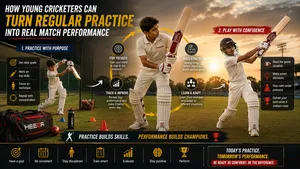 How Young Cricketers Can Turn Regular Practice Into Real Match Performance.Learn how young cricketers can turn regular practice into match performance through realistic drills, match simulations, decision-making, pressure training, and consistency.
 Cricket Batting Pads Explained: How Knee Protection, Shin Coverage and Strap Placement Affect Comfort and MobilityLearn how cricket batting pads, knee protection, shin coverage and strap placement affect comfort, mobility, impact protection and batting performance.
 Batting Gloves for Cricket: How Finger Design, Palm Materials and Grip Texture Affect Bat ControlDiscover how cricket batting gloves, finger design, palm materials and grip texture influence bat control, comfort, protection and batting performance.