How Cricket Players Learn to Read a Bowler Before the Ball Is Released
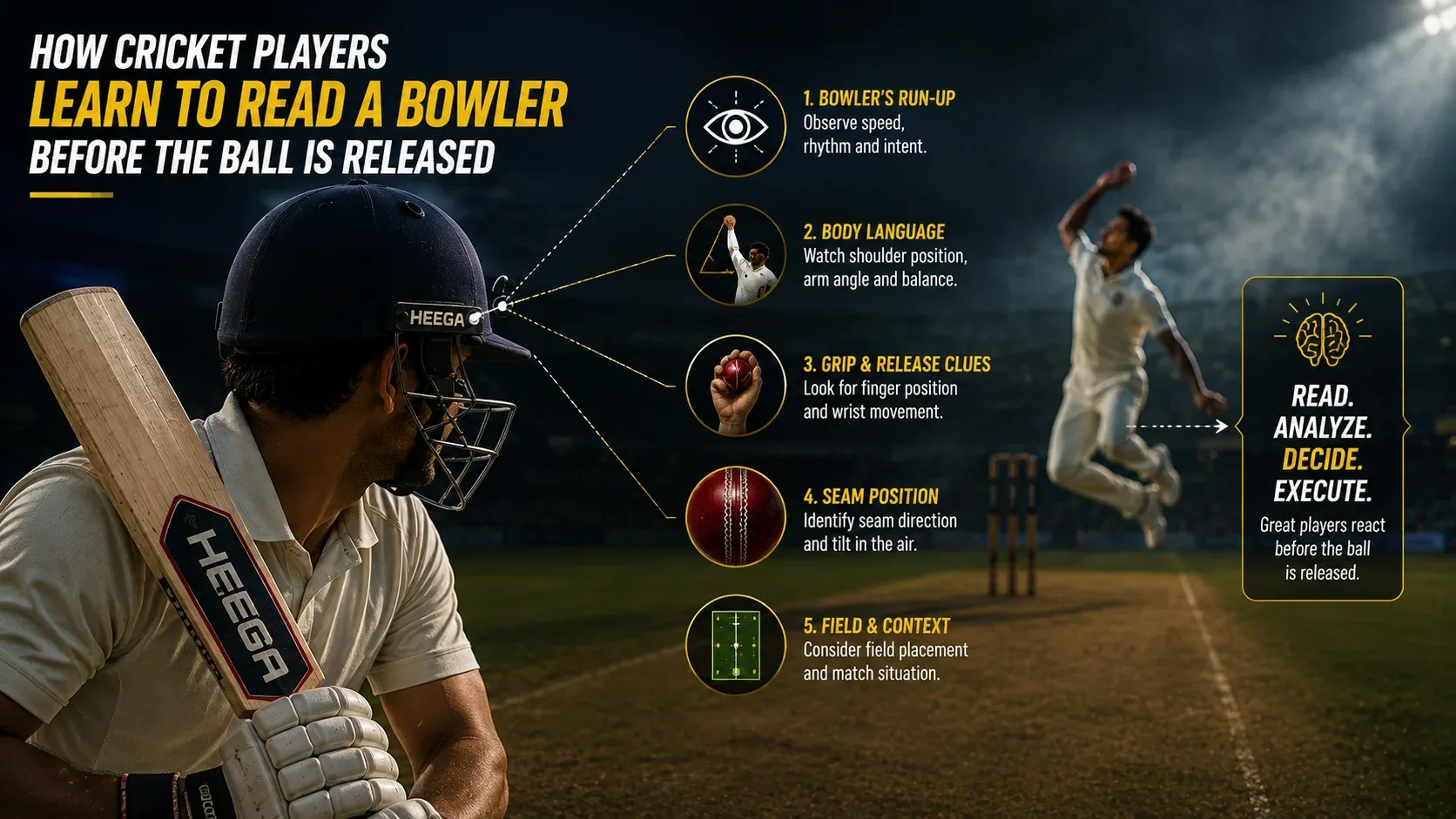
Introduction: Great Batters Start Reading the Bowler Early
A cricket batter has very little time to react once the ball leaves the bowler's hand.
A fast delivery can reach the batter in a fraction of a second.
Even against spin, the batter must quickly judge:
- Line
- Length
- Speed
- Flight
- Movement
- Bounce
- Spin
Yet experienced batters often appear to know what is coming before the ball has travelled very far.
This is not magic.
It is the result of observation, experience, repetition, and an ability to recognize small visual clues.
Elite batters learn to study the bowler from the beginning of the run-up and continue processing information until the exact moment of release.
The better they become at this process, the more time they effectively create for themselves.
What Does It Mean to Read a Bowler?
Reading a bowler means collecting visual and contextual information before and during the delivery.
A batter may observe:
- Run-up rhythm
- Bowling angle
- Arm position
- Wrist position
- Grip clues
- Release height
- Crease position
- Body alignment
- Changes in pace
- Previous deliveries
The batter then uses this information to prepare for the most likely type of delivery.
Batters Do Not Simply Watch the Ball
One of the biggest misconceptions about batting is that players only react after seeing the ball.
In reality, experienced players begin preparing much earlier.
They gather information from the bowler's movement.
By the time the ball is released, the batter may already have narrowed down the possible options.
The Bowler's Run-Up Can Provide Information
Fast bowlers often have highly repeatable run-ups.
Their rhythm, speed, and final movements can provide clues.
A batter may learn to recognize:
- Normal delivery rhythm
- Slower-ball variations
- Changes in approach
- Position around the wicket
Why Consistency Helps the Batter
Most bowlers repeat similar movements for their standard deliveries.
This creates a pattern.
Once a batter understands that pattern, unusual movements can become easier to notice.
But Good Bowlers Try to Hide Their Clues
Experienced bowlers understand that batters are watching them.
They may attempt to make different deliveries look identical.
This is particularly important when bowling:
- Yorkers
- Bouncers
- Slower balls
- Cutters
- Variations
- Spin deliveries
The closer the action looks across different deliveries, the harder the batter's job becomes.
The Bowling Arm Is a Major Visual Cue
The position and movement of the bowling arm can provide useful information.
Batters may observe:
- Arm speed
- Arm angle
- Release height
- Direction of the arm
However, these clues must be interpreted quickly.
Release Point Is Critical
The moment the ball leaves the bowler's hand is one of the most important moments in batting.
The batter wants to identify:
- Where the ball is being released
- Its initial direction
- Its apparent speed
- Whether the bowler is using a variation
Why Early Recognition Matters
The earlier a batter recognizes the delivery, the more time they have to move into position.
A batter who reads the ball late may be forced into a defensive reaction.
A batter who reads it early can often play a controlled shot.
Height of Release Can Matter
Different bowlers release the ball from different heights.
A tall fast bowler and a shorter bowler can create different visual angles.
Batters learn to adjust their expectations accordingly.
Bowling From Around the Wicket Changes the Picture
A bowler can change the angle by moving from:
- Over the wicket
- Around the wicket
This changes the ball's path toward the batter.
The batter must recognize the change before deciding how to respond.
Why Angles Can Be Difficult
A new angle can change:
- Swing direction
- Seam movement
- LBW possibilities
- Outside-edge possibilities
- Scoring options
This is why captains sometimes change the bowling angle during an innings.
The Crease Can Also Be Used
A bowler does not always release the ball from the same point on the crease.
They may move:
- Wider
- Closer to the stumps
This subtly changes the angle of delivery.
Batters Learn to Notice Crease Position
Experienced players can use the bowler's position to predict where the ball may travel.
This does not guarantee the outcome.
It simply provides another piece of information.
Wrist Position Can Reveal Spin
Against spin bowling, the wrist can provide valuable clues.
A batter may look for:
- Wrist orientation
- Arm position
- Finger position
- Release action
These clues can help distinguish different types of spin.
Reading a Leg-Spinner
Leg-spinners can use several variations.
A batter may need to identify whether the bowler is delivering:
- Leg-break
- Googly
- Top-spinner
- Flatter variation
The challenge is recognizing the difference quickly.
Why the Googly Is Difficult
A googly can appear similar to a normal leg-spin delivery until the ball is released.
If the batter misreads it, the ball can move in an unexpected direction after pitching.
Reading an Off-Spinner
Off-spinners also create variations through:
- Finger position
- Release angle
- Pace
- Flight
- Arm speed
The batter needs to combine these clues rather than relying on one signal.
Left-Arm Spin Creates Different Visual Angles
Left-arm bowlers can create different trajectories and angles depending on their position.
Batters must adapt their visual reference points.
Fast Bowlers Use Variations Too
Fast bowling is not only about speed.
Modern bowlers use:
- Slower balls
- Cutters
- Yorkers
- Bouncers
- Cross-seam deliveries
The challenge is making every variation look similar until the last possible moment.
How Batters Try to Identify Slower Balls
A batter may look for subtle differences in:
- Hand speed
- Wrist position
- Release
- Follow-through
- Run-up rhythm
However, these clues can be extremely difficult to detect consistently.
Why Great Bowlers Hide Their Variations
If a batter can immediately identify every slower ball or cutter, the bowler loses much of its surprise.
Therefore, bowlers often work on maintaining a similar action across different deliveries.
The Follow-Through Can Also Provide Information
Although the batter must react quickly, the bowler's follow-through can sometimes reinforce what happened during release.
This is particularly useful when studying a bowler through video analysis.
Batters Learn Through Repetition
The ability to read bowlers improves through exposure.
The more often a player faces a specific style, the more familiar it becomes.
Why Experience Matters
An experienced batter may have faced:
- Fast bowlers
- Swing bowlers
- Seam bowlers
- Wrist spinners
- Finger spinners
- Left-arm bowlers
This exposure creates a larger mental library of bowling actions.
The Brain Builds Patterns
A batter does not consciously think through every clue.
Instead, the brain gradually learns patterns.
A particular run-up may become associated with a particular delivery.
A particular release action may trigger an automatic response.
This Is Similar to Pattern Recognition
Cricket requires rapid recognition.
Players learn to connect visual information with likely outcomes.
This helps reduce reaction time.
Batters Also Study Bowlers Before Matches
Professional players often use video analysis to prepare.
They can review:
- Bowling actions
- Typical lengths
- Variations
- Field placements
- Preferred angles
- Dismissal patterns
Why Video Analysis Helps
A batter can pause and replay deliveries.
They can study a bowler frame by frame.
This allows them to identify clues that are almost impossible to notice at full speed.
Preparation Reduces Uncertainty
If a batter already understands a bowler's tendencies, they can enter the match with a clearer plan.
This can improve confidence.
But Preparation Is Not a Guarantee
Bowlers can change their strategy.
A batter who expects a certain delivery may receive something completely different.
Therefore, preparation must be combined with adaptability.
Reading the Field Is Part of Reading the Bowler
The bowler is not operating alone.
The field can reveal the bowling team's intention.
For example, a captain may place:
- Slip
- Gully
- Deep square leg
- Third man
- Long-off
These positions can provide clues about the intended bowling plan.
Field Placements Can Create Traps
A batter may notice an apparently open area.
But that gap may be deliberately left open.
The bowler may be trying to encourage a particular shot.
Why Smart Batters Look at the Entire Picture
Reading the bowler is not just about watching their hand.
A batter considers:
- Bowler
- Field
- Match situation
- Previous deliveries
- Pitch conditions
Together, these provide a much clearer picture.
Previous Deliveries Matter
The bowler's recent sequence can provide important information.
Suppose a bowler has delivered:
- Outswinger
- Outswinger
- Outswinger
The batter may expect another similar delivery.
The bowler can exploit that expectation with an inswinger.
Why Patterns Can Become Traps
A batter can become too confident in a pattern.
The bowler can then break it at exactly the right moment.
Good Batting Requires Controlled Expectation
The batter should have an expectation without becoming committed to it.
This distinction is extremely important.
The Batter Must Stay Adaptable
The player might expect an outswinger.
But if the ball comes in, the batter must adjust immediately.
Why Head Position Matters
A stable head helps the batter track the ball.
If the head moves too early, visual judgment can become less reliable.
Watching the Ball Means Watching Carefully
Good batters do not simply look at the ball.
They focus on the ball's movement and the information provided by the bowler's release.
Peripheral Vision Also Helps
A batter's awareness includes more than the ball itself.
They can remain aware of:
- Bowler position
- Field
- Crease
- Movement
while maintaining focus on the delivery.
Why Concentration Is Essential
Reading a bowler requires continuous attention.
A moment of distraction can mean missing a crucial clue.
Fatigue Can Reduce Visual Accuracy
Long innings can be mentally exhausting.
As concentration declines, reading subtle differences can become harder.
Why Experienced Players Use Routines
Between deliveries, batters often develop routines.
These may include:
- Adjusting gloves
- Looking around the field
- Checking the bowler
- Taking a breath
- Resetting their stance
These routines help maintain focus.
The Psychological Battle Begins Before Release
A batter and bowler are constantly trying to influence each other's expectations.
The bowler wants the batter to expect one thing.
The batter wants to remain prepared for another.
Why Bowlers Use Deception
Deception can force the batter into the wrong decision.
A slower ball may look like a fast delivery.
A googly may look like a leg-break.
A cutter may resemble a normal seam delivery.
Why Batters Need Discipline
The ability to read a bowler is only useful if the batter trusts the information.
Overthinking can create hesitation.
Instinct Comes From Practice
What looks like instinct at the highest level is often trained recognition.
Players have seen similar situations thousands of times.
Their reactions become faster because the brain already understands the pattern.
Young Players Can Develop This Skill
Reading bowlers is not limited to professionals.
Young cricketers can begin developing the habit early.
Coaches can encourage them to ask:
- Where does the bowler release the ball?
- What does their run-up look like?
- What changes when they bowl a variation?
- Where is the field positioned?
Training Drills Can Improve Recognition
Coaches can create exercises where batters must identify the delivery type before playing.
For example, they might practice against:
- Different bowling angles
- Different speeds
- Different release points
- Different spin variations
Reaction Drills Can Help
Simple reaction exercises can improve visual response.
These may include:
- Colored-ball drills
- Tennis-ball reactions
- Short-distance catches
- Random bounce exercises
Practice Under Realistic Conditions
Reading a bowler becomes more valuable when training resembles match conditions.
Players can practice against:
- New balls
- Worn balls
- Fast bowling
- Spin
- Different lighting
Why Nets Should Include Variety
Facing the same type of delivery repeatedly can create comfort.
Facing different bowling styles teaches adaptability.
The Role of a Bowling Machine
Bowling machines can provide consistent repetition.
They are useful for practicing:
- Specific lengths
- Speeds
- Swing
- Line
- Shot responses
However, machines do not fully reproduce the visual cues of a real bowler.
Why Real Bowlers Still Matter
A real bowler provides:
- Run-up
- Action
- Release
- Body movement
- Variations
These are essential parts of reading a delivery.
Video and Technology Work Together
Players can record their training sessions.
They can then analyze:
- Reaction timing
- Foot movement
- Head position
- Shot selection
How Analytics Can Help
Data can show whether a batter struggles against:
- Short deliveries
- Full deliveries
- Spin
- Swing
- Specific angles
This helps coaches design targeted practice.
Why Matchup Knowledge Matters
A batter may discover that they struggle against left-arm pace.
Instead of simply practicing more batting, they can specifically train against left-arm angles.
Building a Mental Library
Over time, players develop familiarity with different bowling actions.
They begin recognizing patterns almost automatically.
Why This Skill Improves With Competition
Competitive matches expose players to bowlers they may not regularly face in training.
Each new opponent adds experience.
Different Countries Offer Different Challenges
Cricket is played in different environments across Nepal, Germany, the United States, Canada, the Netherlands, and the United Kingdom.
Players can encounter different bowling styles and coaching approaches.
Nepal
Young players developing in Nepal can benefit from exposure to varied pace and spin bowling.
Learning to recognize different actions can strengthen adaptability.
Germany
As cricket continues growing in Germany, players may encounter a wide range of bowling backgrounds.
This variety can help develop stronger matchup awareness.
United States
The diverse cricket environment in the USA can expose players to different techniques and styles.
Adapting quickly can become a valuable skill.
Canada
Players can use indoor training environments to work on visual recognition during periods when outdoor cricket is limited.
Netherlands
Players can develop tactical awareness through structured coaching and repeated exposure to different bowling styles.
United Kingdom
The UK's broad cricket pathway provides players with opportunities to face different types of bowlers from junior cricket through professional levels.
How Coaches Can Teach Players to Read Bowlers
Coaches can encourage players to observe before every delivery.
Instead of simply asking:
“What shot should you play?”
they can ask:
“What did you see?”
This encourages players to understand the process behind their decision.
Learning From Mistakes
If a batter is dismissed, the useful question is not only:
“What shot did you play?”
It is also:
“What information did you miss before playing it?”
This can lead to better learning.
Why Overconfidence Can Be Dangerous
A batter who believes they have completely figured out a bowler may become predictable.
The bowler can then change their plan.
Underconfidence Creates a Different Problem
A batter who expects the bowler to dominate them may become too defensive.
This can make scoring difficult.
The Ideal Mindset
The best approach is confident but flexible.
The batter should think:
“I have a plan, but I am ready to change it.”
Reading the Bowler Is a Team Skill Too
Although the batter faces the delivery, other players can contribute information.
Coaches, teammates, and analysts can help identify patterns.
The Wicketkeeper Can Provide Useful Feedback
Wicketkeepers observe deliveries from directly behind the batter.
They may notice:
- Movement
- Bounce
- Batter reactions
- Bowler variations
Their feedback can be valuable between deliveries.
Why Senior Players Help Young Batters
Experienced teammates can explain what a bowler is trying to do.
This helps younger players learn the tactical side of batting.
The Goal Is Not to Predict Every Ball
Even the best batters cannot know exactly what every delivery will do.
The objective is to improve the quality and speed of decisions.
Reading Creates More Time
This is perhaps the biggest advantage.
If the batter recognizes the delivery early, they can move earlier.
That can make the difference between:
- A clean shot.
- A mistimed shot.
- A defensive block.
- A dismissal.
Why Great Batters Look Calm
Elite batters often appear relaxed because their decision-making process has become highly practiced.
They are not necessarily seeing the ball slowly.
They are processing information efficiently.
Preparation Turns Complexity Into Familiarity
A bowler can look intimidating before the first ball.
After repeated exposure, their action becomes easier to understand.
This is why preparation is so valuable.
The Role of the Right Equipment
Developing batting awareness requires regular practice.
Players need equipment that allows them to train against different situations.
Useful training equipment includes:
- Cricket bats
- Leather cricket balls
- Practice balls
- Practice nets
- Batting gloves
- Batting pads
- Training accessories
How Heega Sports Supports Cricket Training
At Heega Sports, we understand that players improve by combining quality coaching with consistent practice.
Our cricket range includes:
- Kashmir Willow cricket bats
- English Willow cricket bats
- Leather cricket balls
- Practice balls
- Batting gloves
- Batting pads
- Cricket helmets
- Cricket shoes
- Cricket kit bags
- Practice nets
- Training accessories
Reliable equipment helps players create realistic training sessions where they can work on technique, reaction speed, and decision-making.
Final Thoughts
Learning to read a bowler before the ball is released is one of the hidden skills behind high-level batting.
It involves much more than simply watching the cricket ball.
A batter observes:
- Run-up
- Bowling angle
- Crease position
- Arm movement
- Release point
- Wrist position
- Previous deliveries
- Field placement
- Match situation
Over time, these observations become patterns.
The brain learns to recognize them faster.
That allows the batter to make better decisions with less hesitation.
The best players do not necessarily predict every delivery correctly.
Instead, they prepare themselves to recognize information quickly and respond effectively.
That ability comes from experience, video analysis, coaching, repetition, and thousands of deliveries faced in training and competition.
Cricket is a game of milliseconds.
The bowler is trying to hide information.
The batter is trying to find it.
And sometimes, the biggest advantage begins before the ball has even left the bowler's hand.
🏏 Build Better Batting Awareness With Heega Sports
Explore quality cricket bats, leather balls, practice balls, batting gloves, pads, helmets, cricket shoes, kit bags, practice nets, and training accessories at Heega Sports.
Shop Now
Heega Sports – Helping Players Read the Game, React Faster, and Train Better.
Related posts
 How Kids Learn to Read a Cricket Ball: Understanding Line, Length, Bounce and Shot SelectionLearn how kids can read a cricket ball by understanding line, length, bounce and shot selection to develop better batting skills and confidence.
 Cricket Shoes for Fast Bowlers: How Ankle Support, Heel Stability and Traction Affect the Bowling ActionLearn how cricket shoes for fast bowlers affect ankle support, heel stability, traction, and landing control. Find the right fit for your bowling action.
 How Tennis Bats Help Beginners Learn Cricket: Understanding Weight, Size & Bat ControlLearn how tennis bats help beginners learn cricket by improving bat control, timing, balance, grip, confidence, and basic batting technique through simple practice.