How Cricket Scoreboards Work: Understanding Everything You See During a Match.

Introduction: A Cricket Scoreboard Tells the Story of the Match
When you watch cricket, one thing is almost always visible.
The scoreboard.
Whether it is displayed on a huge stadium screen, shown during a television broadcast, or followed through a mobile app, the scoreboard provides a quick summary of what is happening.
But for someone new to cricket, it can look confusing.
You may see something like:
156/4 (28.3 overs)
Then another number showing:
RR: 5.47
Nearby, there may be two batter scores, a bowler's figures, extras, partnerships, and other statistics.
What does it all mean?
A cricket scoreboard is essentially a compact record of the match.
It tells you:
- How many runs have been scored.
- How many wickets have fallen.
- How many overs have been bowled.
- Which batters are currently playing.
- Which bowler is bowling.
- How quickly the team is scoring.
- How individual players are performing.
Understanding these numbers makes watching cricket much more enjoyable.
Across Nepal, Germany, the United States, Canada, the Netherlands, and the United Kingdom, new fans are discovering cricket every year.
This guide explains the most important parts of a cricket scoreboard in simple terms.
The Most Important Number: Team Score
The first number most people look for is the team score.
For example:
156/4
This means the batting team has scored:
156 runs for the loss of 4 wickets.
The number before the slash represents runs.
The number after the slash represents wickets lost.
What Does "All Out" Mean?
A team can lose wickets until its innings ends.
In many formats, an innings ends when ten wickets have fallen because only one batting partnership remains.
A team can also be dismissed before completing its available overs.
The scoreboard may then show something like:
178 all out
This means the team scored 178 runs and lost all of its available wickets.
What Are Overs?
Overs measure how many legal deliveries have been bowled.
One over normally contains six legal deliveries.
So:
10 overs = 60 legal balls
20 overs = 120 legal balls
50 overs = 300 legal balls
However, the scoreboard does not always display overs as ordinary decimal numbers.
Why Does 10.4 Overs Not Mean 10.4?
This is one of the most common beginner mistakes.
If the scoreboard shows:
10.4 overs
It does not mean ten point four overs.
It means:
10 overs and 4 legal deliveries.
Since one over contains six balls, the next delivery after 10.5 is 11.0.
Understanding the Over Format
Here is how it works:
- 10.1 = first ball of the 11th over.
- 10.2 = second ball.
- 10.3 = third ball.
- 10.4 = fourth ball.
- 10.5 = fifth ball.
- 10.6 is not normally displayed because the sixth ball completes the over.
After the sixth legal delivery:
11.0 overs
The over count therefore works differently from standard decimal mathematics.
What Happens with a Wide or No-Ball?
Wides and no-balls do not count as legal deliveries.
For example, if a bowler delivers a wide, the scoreboard may still show:
10.4 overs
The ball has produced a run or more, but the legal-ball count has not advanced.
The bowler must deliver another legal ball.
This is why an over can contain more than six actual deliveries.
What Are Wickets?
A wicket represents a batter being dismissed.
Scoreboards usually display wickets after the team's run total.
For example:
92/3
means the team has scored 92 runs and lost three wickets.
The more wickets a team loses, the fewer established batting resources remain.
Why Wickets Matter So Much
A cricket innings is not only about scoring runs.
Teams must balance scoring with protecting wickets.
A batter may have the ability to hit boundaries, but an unnecessarily risky shot could result in dismissal.
This is why the scoreboard's wicket number is just as important as the run total.
The Current Batters
A scoreboard normally shows the two batters currently at the crease.
Their information may include:
- Runs scored.
- Balls faced.
- Fours.
- Sixes.
- Strike rate.
For example:
Batter A – 47 (35)
This means the batter has scored 47 runs from 35 balls.
What Does "Not Out" Mean?
If a batter remains at the crease when an innings ends, their score is recorded as not out.
For example:
82 (64)*
The star symbol usually indicates that the batter is not out.
This is an important part of a player's individual record.
What Are Fours?
A four occurs when the ball reaches the boundary after touching the ground, subject to the applicable laws and playing conditions.
A batter's scoreboard may show:
4s: 6
This means they have hit six fours.
What Are Sixes?
A six is awarded when the ball clears the boundary without first touching the ground, subject to the laws and playing conditions.
A batter with:
6s: 3
has hit three sixes.
Sixes can dramatically increase a team's scoring rate.
What Is Strike Rate?
Strike rate measures how quickly a batter scores.
The basic formula is:
Strike Rate = Runs ÷ Balls Faced × 100
For example, if a batter scores 50 runs from 40 balls:
50 ÷ 40 × 100 = 125
Their strike rate is therefore 125.
Strike rate is particularly important in limited-overs cricket.
Why Strike Rate Matters More in T20 Cricket
T20 teams have a limited number of deliveries available.
A batter who scores quickly can increase the team's total.
For example, a player scoring 50 from 30 balls contributes differently from someone scoring 50 from 50 balls.
The total runs are identical.
The scoring speed is not.
What Is the Run Rate?
Run rate shows how quickly the batting team is scoring.
The basic calculation is:
Runs Scored ÷ Overs Bowled
For example:
200 runs in 40 overs gives a run rate of:
5 runs per over
The scoreboard may display:
RR: 5.00
Current Run Rate vs Required Run Rate
During a chase, you may see two important numbers.
Current Run Rate
How quickly the team has scored so far.
Required Run Rate
How quickly the team needs to score to reach the target within the remaining overs.
These numbers help fans understand the pressure of a chase.
What Is Required Run Rate?
Suppose a team needs 100 runs from 15 overs.
The required rate is:
100 ÷ 15 = 6.67 runs per over
The scoreboard may show:
RRR: 6.67
If the batting team scores faster than that rate, the chase becomes easier.
What Are Extras?
Not every run belongs to the batter.
Some runs are awarded to the team through extras.
Common extras include:
- Wides.
- No-balls.
- Byes.
- Leg byes.
The scoreboard records these separately.
What Is a Wide?
A wide is a delivery that is judged too far from the batter to be considered a fair ball under the applicable laws and playing conditions.
The batting team receives an extra.
The delivery also does not count as a legal ball.
What Is a No-Ball?
A no-ball occurs when the bowler delivers illegally under the applicable laws or playing conditions.
The batting team receives an extra run in standard playing conditions, and the delivery does not count as a legal ball.
Additional runs may also result from what happens during the delivery.
What Is a Bye?
A bye occurs when the ball passes the batter without touching the bat or the batter's person and the batters complete runs.
These runs are credited to the team rather than the batter.
What Is a Leg Bye?
A leg bye occurs when the ball makes contact with the batter's person rather than the bat, and the batters complete runs under the applicable laws.
Again, these runs belong to the team rather than the batter.
Why Extras Matter
Extras can become extremely important.
A team that gives away too many extras gives the opposition free scoring opportunities.
In a close match, a few unnecessary extras can change the result.
The Bowler's Figures
The scoreboard also shows how individual bowlers are performing.
A bowling line might look like:
8 – 0 – 42 – 2
This normally means:
- 8 overs bowled.
- 0 maidens.
- 42 runs conceded.
- 2 wickets taken.
These figures help fans understand the bowler's contribution.
What Is a Maiden Over?
A maiden over is an over in which the bowler concedes no runs credited to the batting side.
Maidens can create pressure because the batting team fails to increase its score.
They are especially valuable in longer innings.
What Is Economy Rate?
Economy rate measures how many runs a bowler concedes per over.
The basic formula is:
Runs Conceded ÷ Overs Bowled
For example:
A bowler concedes 24 runs in 6 overs.
Their economy rate is:
4.00
A lower economy rate generally indicates tighter bowling.
Wickets Can Change the Meaning of Bowling Figures
A bowler who takes three wickets while conceding relatively few runs can have a major impact.
Therefore, fans should not judge a bowler only by runs conceded.
The combination of:
- Wickets.
- Economy.
- Overs.
- Match situation.
provides a more complete picture.
Partnership Scores
The scoreboard may also show the current partnership.
For example:
Partnership: 64 (78)
This means the current pair has added 64 runs from 78 deliveries.
Partnerships are important because cricket is built around batting pairs.
Why Partnerships Matter
A strong partnership can:
- Stabilize an innings.
- Recover from early wickets.
- Build a large total.
- Control the match.
A scoreboard makes these partnerships easy to track.
Fall of Wickets
Many detailed scoreboards include a section called:
Fall of Wickets
This records when each batter was dismissed and the team score at that moment.
For example:
- 1st wicket – 28 runs.
- 2nd wicket – 67 runs.
- 3rd wicket – 115 runs.
This helps explain how an innings developed.
Target and Runs Required
During a chase, the scoreboard normally shows the target.
For example:
Target: 245
If the batting team has scored 180, it needs:
65 more runs
This is one of the most important numbers for spectators following a close chase.
Balls Remaining Can Also Matter
In limited-overs cricket, fans often want to know how many deliveries remain.
For example:
36 runs needed from 24 balls
immediately communicates the pressure.
The required run rate can also be calculated from this information.
Powerplay Information
In limited-overs cricket, scoreboards may show powerplay information.
Powerplays place restrictions on fielding positions during particular phases.
The exact rules vary by format and competition.
Scoreboards may indicate:
- Powerplay overs.
- Current over.
- Runs scored during the phase.
This helps fans understand the tactical stage of the innings.
Why the Current Over Matters
The current over can tell you a lot about momentum.
A sequence such as:
4, 1, 0, 6, 2, 1
produces 14 runs.
Another over might produce:
0, 0, 1, 0, 0, 0
for just one run.
Looking at recent overs helps fans identify changes in momentum.
Ball-by-Ball Information
Modern digital scoreboards can provide even more detail.
A ball-by-ball display may show:
- Runs.
- Wickets.
- Wides.
- No-balls.
- Boundaries.
- Dot balls.
This allows fans to follow the match even when they cannot watch every delivery.
What Is a Dot Ball?
A dot ball is a legal delivery from which the batting team does not score a run.
Dot balls can be strategically valuable.
A sequence of dot balls can create pressure on the batter.
The batter may eventually attempt a risky shot to increase the scoring rate.
Why Scoreboards Help Captains and Coaches
The scoreboard is not only for spectators.
Teams use match data to make decisions.
They can monitor:
- Required run rate.
- Partnership progress.
- Bowler economy.
- Batter scoring patterns.
- Wickets remaining.
This information can influence tactical choices.
Scoreboards Have Become More Advanced
Traditional cricket scoreboards were relatively simple.
Modern systems can display:
- Live statistics.
- Player comparisons.
- Wagon wheels.
- Partnership data.
- Bowling speeds.
- Required rates.
- Historical records.
Technology has turned the scoreboard into a complete match-information system.
Scoreboards Help New Fans Learn Cricket
For someone learning the sport, the scoreboard acts like a guide.
It answers basic questions:
Who is batting?
How many runs have been scored?
How many wickets have fallen?
How many overs remain?
How quickly is the team scoring?
Once these numbers become familiar, watching cricket becomes much easier.
Nepal: Scoreboards Help Grow Cricket Knowledge
As cricket continues expanding in Nepal, better access to live scores and statistics can help new fans understand the game.
Digital scoreboards make matches easier to follow, even for spectators who are still learning cricket terminology.
Germany: Making Cricket Easier to Follow
As cricket grows in Germany, accessible score information can help introduce new audiences to the sport.
A clear scoreboard can explain the match without requiring viewers to understand every rule immediately.
United States: Data Is Helping New Fans Understand Cricket
Cricket's expansion in the USA brings many first-time viewers to the sport.
Modern scoreboards can make the game easier to understand by presenting key information clearly.
Canada: Scoreboards Connect Fans with the Match
Canadian cricket audiences can follow matches through stadium displays, broadcasts, and digital platforms.
Accurate scoring information helps fans stay connected throughout long games.
The Netherlands: Statistics Support Deeper Cricket Analysis
Dutch cricket has a strong connection with structured performance analysis.
Scoreboard statistics can provide useful information for fans, coaches, and players studying the game.
United Kingdom: From Traditional Boards to Digital Displays
The UK's cricket history includes everything from traditional manual scoreboards to modern digital systems.
The purpose remains the same:
Tell the story of the match.
How Heega Sports Supports the Cricket Journey
At Heega Sports, we believe understanding cricket is part of enjoying cricket.
Players need equipment that allows them to focus on improving their performance.
Our cricket range includes:
- Kashmir Willow cricket bats.
- Leather cricket balls.
- Practice cricket balls.
- Batting gloves.
- Batting pads.
- Cricket helmets.
- Cricket shoes.
- Cricket kit bags.
- Practice nets.
- Training accessories.
Whether you are learning cricket for the first time or preparing for competitive matches, the right equipment supports better training and better performance.
Final Thoughts
A cricket scoreboard is much more than a collection of numbers.
It tells you how the innings is progressing.
It shows runs and wickets.
It tracks overs.
It identifies the current batters and bowlers.
It records extras.
It reveals scoring rates.
It highlights partnerships.
And during a close chase, it can show exactly how much pressure remains.
Once you understand what those numbers mean, the game becomes much easier to follow.
The next time you see something like:
156/4 (28.3 overs)
you will know that it represents much more than a score.
It tells you that a team has scored 156 runs, lost four wickets, and completed 28 overs plus three legal deliveries.
Every number contributes another piece of the match's story.
From Nepal and Germany to the United States, Canada, the Netherlands, and the United Kingdom, cricket continues attracting new audiences.
And for every new fan, understanding the scoreboard is one of the simplest ways to understand the game itself.
🏏 Build Your Cricket Game with Heega Sports
Explore Kashmir Willow cricket bats, leather cricket balls, practice balls, batting gloves, batting pads, cricket helmets, cricket shoes, cricket kit bags, practice nets, and training accessories designed for players at every level.
Shop Now
Heega Sports – Helping Every Player Understand the Game, Prepare Better, and Play with Confidence.
Related posts
 Kashmir Willow Cricket Bats for Power Hitting: How Blade Shape, Sweet Spot and Edge Thickness Work TogetherLearn how Kashmir willow cricket bat blade shape, sweet spot position, and edge thickness work together to support powerful shots, control, and balance.
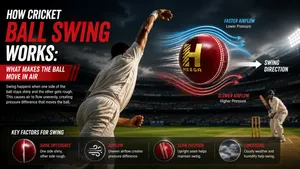 How Cricket Ball Swing Works: What Makes the Ball Move in Air.Learn how a cricket ball swings through the air, including conventional and reverse swing, seam position, airflow, shine, and bowling techniques.
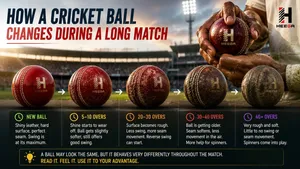 How a Cricket Ball Changes During a Long Match.Learn how a cricket ball changes during a long cricket match. Discover how wear, shine, moisture, rough surfaces, repeated impact, and ball condition influence its behavior.