How Long Does an English Willow Cricket Bat Last? Complete Guide to Its Life Cycle and Care
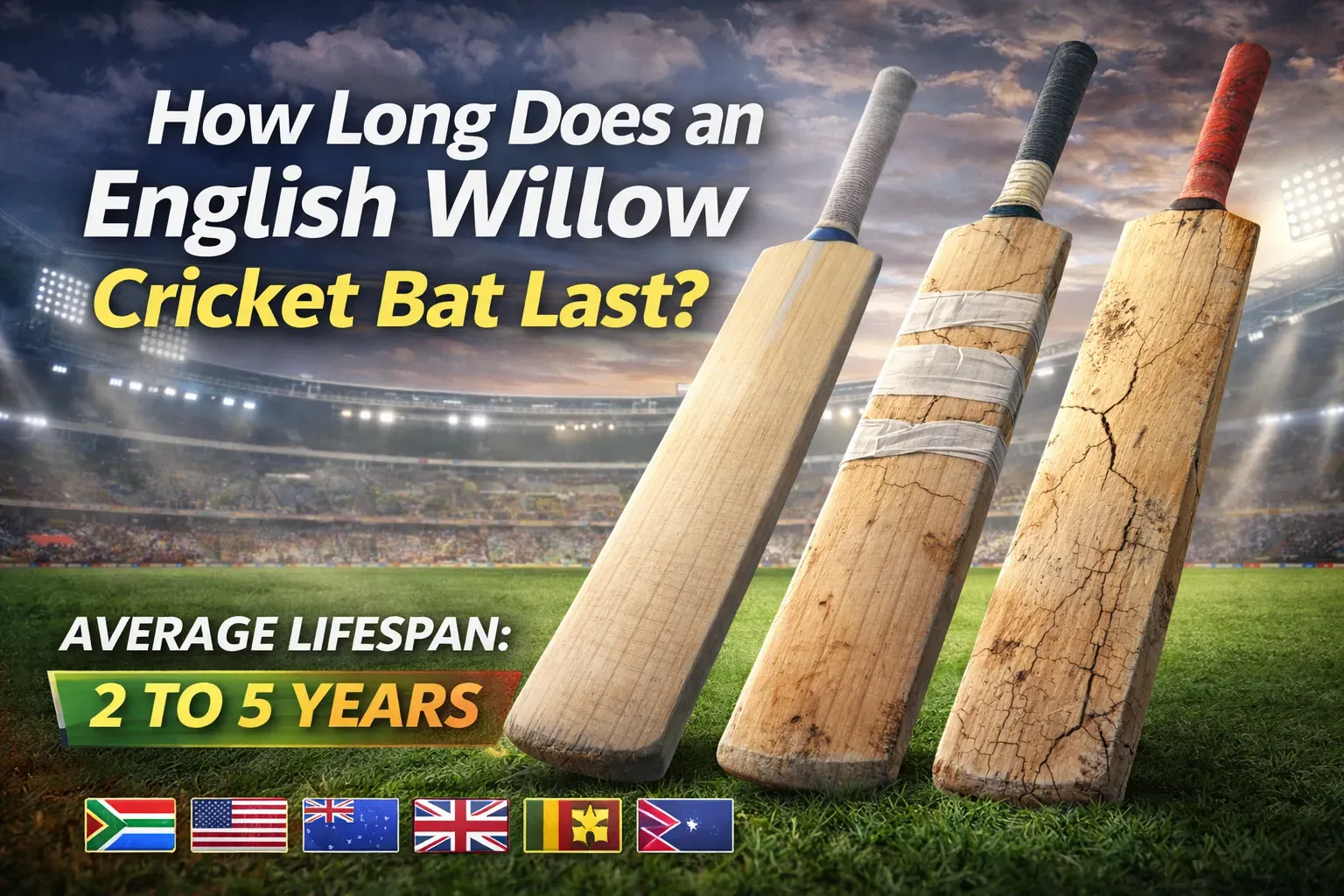
Introduction: How Long Can an English Willow Cricket Bat Last?
An English Willow cricket bat is a major investment for serious players.
Premium willow bats are designed to provide excellent performance, but they still require proper preparation, care, and maintenance.
So, how long does an English Willow cricket bat actually last?
There is no fixed answer.
A bat used occasionally may remain in good condition for several years, while a bat used heavily during regular training and competitive matches may experience significant wear much sooner.
The lifespan of an English Willow bat depends on several factors, including:
- Frequency of use
- Quality of willow
- Bat preparation
- Knocking-in
- Type of cricket ball
- Playing conditions
- Batting technique
- Storage
- Maintenance
- Repair
Understanding these factors can help players protect their investment and get more value from their cricket equipment.
What Is an English Willow Cricket Bat?
English Willow is a premium wood traditionally used to manufacture high-performance cricket bats.
It is valued for characteristics such as:
- Performance
- Pickup
- Feel
- Responsiveness
- Power
- Flexibility
English Willow bats are commonly selected by serious club players, academy cricketers, and professional players.
Because willow is a natural material, every bat can have slightly different characteristics.
The grain structure, weight distribution, profile, and pickup can all influence how a particular bat feels.
How Long Does an English Willow Bat Usually Last?
With appropriate care, an English Willow cricket bat can potentially remain usable for several seasons.
However, usage has a major effect on its practical lifespan.
Occasional Players
Players who use their bat occasionally may keep it for several years.
Regular Club Players
Players who train and play frequently place considerably more workload on the bat.
Regular inspection and maintenance become especially important.
Professional Players
Professional cricketers may train and compete almost every day.
They can face thousands of deliveries during a season, meaning their bats can experience considerably more impact than those of recreational players.
Therefore, professional players may replace bats more frequently.
The key point is simple:
A cricket bat does not have a guaranteed lifespan. Its useful life depends heavily on how it is used and maintained.
Understanding the Life Cycle of an English Willow Cricket Bat
Every bat goes through a practical life cycle.
Understanding each stage helps players recognize when the bat needs attention.
Stage 1: New Bat
A new bat should be prepared according to the manufacturer's recommendations.
Stage 2: Knocking-In
The willow is gradually prepared to handle repeated impacts.
Stage 3: Regular Use
The bat enters its primary performance period.
Stage 4: Maintenance
Normal wear begins to appear.
Players may notice ball marks, minor surface cracks, or compression.
Stage 5: Heavy Wear
After extensive use, the bat may develop more significant cracks, edge damage, toe damage, or handle problems.
At this stage, repair or replacement may be necessary.
Why Knocking-In Is Important
Knocking-in is one of the most important preparation steps for a new English Willow bat.
The process gradually compresses the willow fibers and helps prepare the blade for the repeated impact of a cricket ball.
A new bat should not normally be taken straight into high-speed competitive bowling without appropriate preparation.
Rushing this stage can increase the risk of:
- Cracking
- Edge damage
- Surface damage
- Toe damage
- Premature wear
Always follow the bat manufacturer's preparation instructions.
Can You Use a New English Willow Bat Immediately?
It is generally better to prepare a new bat before exposing it to regular hard-ball cricket.
A bat that has not been properly prepared may be more vulnerable to damage.
Players should gradually increase the intensity of use.
Start with suitable preparation and controlled practice before moving into regular match conditions.
This approach can help the willow adapt to repeated impact.
How Cricket Ball Type Affects Bat Lifespan
The type of cricket ball used has a significant effect on bat wear.
A hard leather cricket ball produces considerably more impact than a soft training ball.
Players who regularly face hard leather balls can therefore expect greater wear.
Training with softer balls may reduce the amount of impact placed on the blade, depending on the type of drill.
However, players should always make sure the ball is appropriate for the bat and the training activity.
English Willow Grade and Durability
English Willow is available in different grades.
Higher grades are often associated with desirable appearance and performance characteristics, but grade alone does not determine durability.
Two bats with the same grade can have very different lifespans.
This can happen because of differences in:
- Usage
- Ball impact
- Bat preparation
- Playing conditions
- Technique
- Maintenance
Therefore, players should not assume that a particular grade guarantees a specific number of seasons.
How Often Should You Use an English Willow Bat?
English Willow bats are made to be used.
Regular use is not automatically a problem.
The important thing is to avoid unnecessary abuse.
Players should:
- Use suitable cricket balls
- Maintain the bat properly
- Avoid rough surfaces
- Protect the toe
- Inspect the blade
- Repair damage early
A well-maintained bat can remain reliable for a long period even when used regularly.
Playing on Poor Surfaces Can Damage Your Bat
The playing environment can have a major effect on wooden equipment.
Stones, hard debris, and rough surfaces can damage the toe and edges.
Players should avoid dragging the bat across the ground unnecessarily.
When practicing outdoors, use a suitable playing area and keep the bat away from surfaces that can cause avoidable damage.
Why the Toe Needs Special Attention
The toe is one of the most vulnerable areas of a cricket bat.
It can be exposed to:
- Moisture
- Wet pitches
- Hard surfaces
- Yorker deliveries
- Ground debris
Wood can absorb water, so unnecessary exposure to wet conditions should be avoided.
If the bat becomes damp, allow it to dry naturally in a suitable environment.
Toe Protection Can Help
Depending on the manufacturer's recommendations, players may use appropriate toe protection.
A toe guard can help protect the bottom of the blade from contact with the ground.
However, players should use only suitable products and follow the manufacturer's instructions.
Incorrect application can potentially cause problems rather than solving them.
Why Bat Oil Is Important
Wooden cricket bats may require suitable bat oil during preparation and maintenance.
The purpose is to help maintain the condition of the willow.
Players should avoid excessive oiling.
Too much oil can affect the bat's condition and add unnecessary weight.
Always follow the manufacturer's instructions regarding the correct product and application process.
How to Store an English Willow Cricket Bat
Storage is often overlooked, but it can influence the condition of a wooden bat.
Keep It Dry
Store the bat in a clean and dry environment.
Avoid Extreme Heat
Do not leave the bat exposed to direct sunlight or excessive heat.
Use a Bat Cover
A suitable cover can protect the bat from dust and minor scratches.
Avoid Damp Areas
Avoid storing the bat in areas with excessive moisture or humidity.
Keep It Safe
Do not place heavy objects on top of the bat.
Can Humidity Affect an English Willow Bat?
Wood naturally responds to environmental conditions.
Very humid conditions can affect wooden equipment, while extremely dry environments may also influence the condition of the wood.
Players should therefore avoid unnecessary exposure to dramatic environmental changes.
A stable indoor storage environment is generally preferable.
Signs Your English Willow Bat Is Wearing Out
Regular inspection can help identify problems before they become serious.
Look for:
- Cracks
- Edge damage
- Toe damage
- Loose fibers
- Deep surface marks
- Handle movement
- Loose grip
- Excessive compression
Not every mark means that a bat needs to be replaced.
Cosmetic wear is normal.
Structural damage is more important.
Small Surface Marks Are Normal
Willow is a natural material.
After repeated use, a bat will naturally develop marks.
Ball marks, small dents, and minor cosmetic wear do not automatically mean the bat has reached the end of its life.
Players should learn to distinguish between normal usage marks and structural problems.
When Does a Crack Become a Serious Problem?
Cracks can vary considerably in severity.
A small surface crack may sometimes be repaired.
A deep crack or significant separation may indicate a structural problem.
If you are unsure about the seriousness of a crack, have the bat inspected by an experienced cricket bat repair professional.
Continuing to use a seriously damaged bat may cause the problem to become worse.
Handle Condition Is Extremely Important
The handle absorbs vibration every time the bat contacts the ball.
Repeated impact can eventually put stress on the handle.
Possible warning signs include:
- Excessive vibration
- Handle movement
- Unusual sounds
- Visible separation
- Reduced control
Handle problems should not be ignored.
A damaged handle can affect both performance and safety.
Why Bat Grip Maintenance Matters
The grip provides the connection between the player's hands and the bat.
A worn grip can become:
- Slippery
- Loose
- Uncomfortable
Replacing a worn grip is a simple maintenance step.
Players should check the grip regularly, especially during a busy cricket season.
Does Batting Technique Affect Lifespan?
Yes.
The way a player strikes the ball can influence how impact is distributed across the blade.
Consistently striking the ball in vulnerable areas can contribute to additional wear.
Good batting technique can help players control their shots while making more consistent contact with the intended hitting area.
Does Bat Weight Affect Durability?
Bat weight does not directly determine lifespan, but it can influence how a player uses the bat.
A bat that is too heavy may reduce swing control.
A bat that is too light may not provide the feel the player prefers.
Players should choose a comfortable weight that they can control effectively.
Good control can help reduce unnecessary mistimed impacts.
Why the Sweet Spot Matters
The sweet spot is the area of the blade where contact is generally most effective.
Consistent contact in this region can produce a strong combination of power and feel.
Players should not assume that one mistimed shot will damage a bat.
However, repeated heavy impacts on edges, toe areas, or other vulnerable locations can accelerate wear.
How Climate Can Affect Bat Performance
Cricket is played in many environments.
Players may use their bats in:
- Hot climates
- Humid regions
- Dry conditions
- Cooler environments
- Indoor facilities
Because wood responds to its surroundings, players should pay attention to storage and maintenance when moving between significantly different climates.
A Note About the Word "Cricket"
The word cricket has two common meanings.
It can refer to the bat-and-ball sport played around the world.
It can also refer to a small insect.
This distinction matters when searching online because terms associated with the insect can appear alongside cricket-related searches.
For this article, cricket refers to the sport and its equipment.
Crickets, Light Sources, and the Natural World
The insect known as a cricket is completely unrelated to an English Willow cricket bat.
Many cricket species are active during the evening or night and can be attracted to artificial light sources.
Their behavior depends on the species and environment.
This has nothing to do with the performance, maintenance, or lifespan of sporting equipment.
For cricket players, the relevant terms remain:
- Cricket bat
- Cricket ball
- English Willow
- Bat care
- Knocking-in
- Cricket equipment
- Bat maintenance
What Are Dead Crickets?
The phrase dead crickets refers to insects that have died, not damaged cricket equipment.
Dead insects may sometimes be found around outdoor lighting, gardens, grass, or other areas where crickets live.
This is completely separate from the cricket sport.
When discussing an English Willow cricket bat, players should focus on the condition of the wooden blade, handle, edges, toe, grip, and protective equipment.
Adults Cricket: Choosing an English Willow Bat
For adults cricket, players should consider several factors when choosing an English Willow bat.
These include:
- Bat weight
- Bat size
- Pickup
- Profile
- Handle
- Willow quality
- Playing level
- Frequency of use
A comfortable bat that suits the player's technique is generally more useful than simply choosing the most expensive model.
English Willow for Club Cricket
Club players can place considerable demands on their bats.
A player who trains several times per week and regularly plays matches will naturally put more workload on the bat than an occasional player.
Club cricketers should therefore:
- Prepare the bat properly
- Inspect it frequently
- Use suitable balls
- Maintain the grip
- Protect the toe
- Repair damage early
These simple habits can help extend useful bat life.
English Willow for Professional Cricket
Professional players can face a very high workload.
They may train daily, face fast bowling, play multiple matches, and practice with hard cricket balls.
This level of usage can significantly increase wear.
Professional players may therefore replace bats more often.
Replacement is not necessarily a sign that the bat was poor quality.
It can simply reflect the amount of cricket being played.
Can an English Willow Bat Last for Multiple Seasons?
Yes.
A well-maintained bat can potentially remain useful for multiple seasons.
However, its performance and appearance may change with use.
Some players eventually move an older match bat into a training role.
This can be a practical way to continue using equipment after it is no longer their preferred match bat.
Match Bat vs Training Bat
Players who own multiple bats can sometimes assign different roles to each one.
Match Bat
Reserved primarily for competitive matches.
Training Bat
Used for regular practice sessions.
This can reduce the workload placed on the main match bat.
It may be particularly useful for players who complete high-volume training sessions.
Should You Use Your Best Bat for Every Practice?
Not necessarily.
If you own a separate training bat, using it for some sessions can help reduce wear on your preferred match bat.
This can be useful during:
- Bowling machine sessions
- Repeated throwdowns
- High-volume net practice
- Technical drills
The bat should still be used according to its intended purpose.
How Bowling Machines Can Affect Bat Wear
Bowling machines can deliver repeated balls at consistent speeds.
They are useful for developing batting technique and practicing specific shots.
However, repeated impacts can place substantial workload on a cricket bat.
Players using bowling machines should:
- Use appropriate balls
- Monitor session volume
- Check the bat regularly
- Avoid unnecessary high-speed repetition
- Maintain proper technique
Frequent machine practice makes regular bat inspection particularly important.
How to Extend the Life of an English Willow Cricket Bat
Use these simple habits:
1. Prepare It Properly
Follow the recommended knocking-in process.
2. Use Suitable Cricket Balls
Match the ball type to the bat's intended use.
3. Protect the Toe
Avoid unnecessary contact with wet or rough surfaces.
4. Maintain the Grip
Replace worn grips when necessary.
5. Inspect the Blade
Look for cracks, loose fibers, and edge damage.
6. Store It Correctly
Keep the bat in a dry and stable environment.
7. Repair Damage Early
Minor issues are generally easier to address than major structural damage.
Common English Willow Bat Care Mistakes
Players can shorten the useful life of their bats by:
- Using a new bat without proper preparation
- Facing hard bowling immediately
- Using unsuitable cricket balls
- Leaving the bat in damp conditions
- Applying excessive oil
- Ignoring cracks
- Dragging the bat over rough ground
- Storing it in extreme heat
- Choosing a bat that is too heavy
Proper bat care does not have to be complicated.
It simply needs to be consistent.
How Often Should You Inspect Your Bat?
Regular users should inspect their bats frequently.
A quick check after training can reveal:
- New cracks
- Edge damage
- Toe problems
- Grip wear
- Handle movement
Finding damage early can make professional repair easier and may prevent further deterioration.
Can You Repair an English Willow Bat?
Many minor issues can potentially be repaired.
Depending on the problem, professional bat repair may include:
- Crack repair
- Edge repair
- Toe repair
- Handle replacement
- Grip replacement
- Surface maintenance
Not every bat is worth repairing.
The severity and location of the damage determine whether repair is practical.
When Should You Stop Using the Bat?
Players should stop using a bat if it develops serious structural problems.
Warning signs can include:
- Severely damaged handle
- Major blade separation
- Deep structural cracks
- Loose components
- Serious toe failure
When safety is uncertain, professional inspection is the best option.
How Heega Sports Supports Cricket Players
At Heega Sports, we understand that serious cricket players need dependable equipment for both training and competition.
Our cricket equipment range includes:
- English Willow cricket bats
- Kashmir Willow cricket bats
- Cricket balls
- Batting gloves
- Batting pads
- Cricket helmets
- Cricket shoes
- Cricket kit bags
- Practice nets
- Bat care products
- Training accessories
Whether you are an adults cricket player, academy cricketer, club player, or recreational player, the right equipment combined with proper maintenance can help you get more from every session.
A Simple English Willow Bat Care Routine
A consistent routine makes bat maintenance easier.
Before Training
Inspect the bat for visible damage.
During Practice
Use suitable cricket balls and avoid unsuitable surfaces.
After Training
Clean the bat and check for new marks or cracks.
During Storage
Keep it somewhere dry and away from extreme temperatures.
Throughout the Season
Replace worn grips and address minor problems promptly.
These simple habits can help maintain the condition of your bat.
English Willow Bat Lifespan: Quick Guide
Usage LevelGeneral Lifespan Consideration
Occasional cricket
May remain usable for several years
Regular club cricket
Requires consistent maintenance
Academy training
Higher workload can increase wear
Professional cricket
Heavy workload can shorten useful life
Training-only use
Depends on ball type and session volume
These are general guidelines rather than guaranteed lifespans.
Every bat is different.
Final Thoughts: How to Make Your English Willow Bat Last Longer
An English Willow cricket bat can provide excellent performance for a long time when it is prepared, used, and maintained correctly.
There is no universal number of years that every bat will last.
Instead, its useful life depends on:
- Quality
- Preparation
- Usage
- Cricket ball type
- Playing conditions
- Batting technique
- Storage
- Maintenance
- Repair
The best habits are straightforward.
Knock it in properly.
Use suitable cricket balls.
Protect the toe.
Keep it away from unnecessary moisture.
Maintain the grip.
Inspect the blade regularly.
Repair problems early.
Store the bat correctly.
For serious players, taking care of an English Willow bat is just as important as choosing the right one.
And remember, when researching cricket online, the word can have two meanings. Light sources, dead crickets, and insect behavior relate to the animal, while English Willow, cricket bats, cricket balls, and bat maintenance relate to the sport.
Keeping that distinction clear makes it easier to find useful information and avoid irrelevant search results.
Whether you play adults cricket, club cricket, academy cricket, or professional cricket, proper equipment care can help you enjoy your bat for longer.
Your bat does not need to look brand new forever.
It needs to remain safe, structurally sound, comfortable, and capable of doing its job.
With the right preparation and consistent care, your English Willow cricket bat can continue supporting your game season after season.
🏏 Find Quality Cricket Equipment at Heega Sports
Explore English Willow and Kashmir Willow cricket bats, cricket balls, batting gloves, batting pads, cricket helmets, cricket shoes, cricket kit bags, practice nets, bat care products, and training accessories at Heega Sports.
Shop Now
Heega Sports – Helping Cricket Players Choose Better Equipment and Get More From Every Match.
Related posts
 English Willow Cricket Bat Knocking-In Explained: Preparing the Blade Before Match UseLearn how to knock in an English Willow cricket bat, prepare the blade before match use, avoid common mistakes, and protect your bat from premature damage.
 English Willow Cricket Bats Explained: How Bat Pressing, Grain Structure and Blade Compression Influence PerformanceLearn how English willow bat pressing, grain structure, and blade compression influence performance, durability, shot response, and bat selection.
 English Willow Cricket Bats: How to Identify Quality, Check Bat Balance and Avoid Buying MistakesLearn how to identify a quality English willow cricket bat, check its balance and pickup, understand grain patterns, and avoid common buying mistakes.