How to Improve Your Cricket Batting Skills with Better Training

Introduction: Better Batting Starts with Better Training
Good cricket batting is not only about hitting the ball hard.
A successful batsman needs a combination of technique, timing, balance, footwork, concentration, shot selection, and confidence. These skills are developed through regular and structured practice rather than simply spending more time hitting cricket balls.
Whether you are a beginner learning the basics, an academy player working on technique, or a club cricketer preparing for competitive matches, the quality of your training can have a major effect on your batting development.
Many players spend hours in the nets but continue making the same mistakes because their practice lacks structure.
The solution is not always more training. It is better training.
This guide explains how to improve your cricket batting skills through practical drills, proper technique, equipment selection, fitness, and consistent practice.
What Makes a Good Cricket Batsman?
A good batsman is not simply someone who scores boundaries.
Strong batting is built around several important skills:
- Good stance
- Balanced movement
- Fast footwork
- Strong hand-eye coordination
- Proper bat swing
- Good timing
- Shot selection
- Concentration
- Running between the wickets
- Adaptability
Different batsmen have different styles.
Some players are aggressive stroke-makers, while others focus on building long innings. Some rely heavily on timing, while others use strength and power.
The goal of training should be to develop a reliable technique that works with your natural playing style.
Why Regular Cricket Training Is Important
Batting skills improve through repetition.
Regular training allows players to:
Develop Muscle Memory
Repeating correct movements helps make important batting actions more natural.
Improve Timing
Consistent practice helps players learn to meet the ball at the right moment.
Build Confidence
The more comfortable you become with different types of deliveries, the more confident you can feel during matches.
Identify Weaknesses
Training provides an opportunity to recognize problems with footwork, shot selection, balance, or technique.
Prepare for Match Situations
Structured practice can simulate different match conditions and situations.
Start with the Correct Batting Stance
Before working on advanced shots, players should develop a comfortable and balanced stance.
A good stance should allow you to:
- Watch the bowler clearly
- Move quickly
- Maintain balance
- Transfer weight effectively
- Play shots in different directions
Avoid copying another player's stance exactly.
Your body structure, flexibility, height, and batting style are different.
Instead, work with your coach to find a stance that feels natural and allows easy movement.
Improve Your Batting Footwork
Footwork is one of the foundations of cricket batting.
A batsman needs to move into the correct position before playing a shot.
Front-Foot Movement
Front-foot movement is important when playing fuller deliveries.
Practice:
- Moving the front foot toward the ball
- Keeping your head balanced
- Getting close to the line of the ball
- Playing through the correct position
Back-Foot Movement
Back-foot movement becomes important against shorter deliveries.
Practice moving:
- Back and across
- Into a balanced position
- Away from the line when required
- Toward the ball when playing controlled shots
Good footwork gives you more options.
How to Improve Batting Timing
Timing is often more effective than simply using strength.
To improve timing:
- Watch the ball closely.
- Keep your head still.
- Judge the length early.
- Move into position.
- Allow the bat to meet the ball naturally.
- Avoid unnecessary force.
One useful training method is to focus on controlled strokes rather than boundaries.
Try hitting the ball into gaps instead of trying to hit every delivery as far as possible.
This teaches control and encourages better contact.
Practice Straight Bat Shots
Straight-bat shots are fundamental to batting technique.
Useful shots to practice include:
- Forward defense
- Back-foot defense
- Straight drive
- On-drive
- Off-drive
Start slowly.
Focus on:
- Head position
- Foot movement
- Bat angle
- Balance
- Follow-through
Once the movement becomes comfortable, gradually increase the pace of the practice.
Improve Your Defensive Technique
Defense is an important part of batting, especially when building an innings.
A good defensive shot can help you:
- Protect your wicket
- Handle difficult deliveries
- Build confidence
- Rotate the strike
- Wait for scoring opportunities
Practice defensive batting against different lengths.
Do not think of defense as a passive shot.
Good defensive technique helps create a foundation for attacking strokes.
Learn to Judge the Length of the Ball
A batsman needs to identify the length of a delivery quickly.
Common lengths include:
Full Ball
Often allows front-foot shots and drives.
Good Length
Can require quick decision-making because the batsman has less time to commit.
Short Ball
May allow back-foot shots depending on height, pace, and bounce.
Yorker
Requires quick movement and a compact response.
The earlier you recognize the length, the more time you have to select the appropriate response.
Improve Your Shot Selection
Shot selection separates controlled batting from careless batting.
Before playing a shot, consider:
- Where is the ball?
- What is the length?
- Where are the fielders?
- What is the match situation?
- Is the shot worth the risk?
A good batsman does not try to hit every ball.
Sometimes the best decision is to leave the ball alone or defend it safely.
Cricket Batting Drills to Improve Your Skills
Structured drills can make training more effective.
1. Drop-Ball Drill
The drop-ball drill is useful for beginners.
Drop the ball from a short height and practice playing controlled shots.
Focus on:
- Head position
- Balance
- Bat path
- Timing
2. Front-Foot Drive Drill
Have a coach or partner feed fuller deliveries.
Practice:
- Moving forward
- Getting into position
- Keeping your head over the ball
- Playing through the shot
Do not focus on power initially.
3. Back-Foot Shot Drill
Practice against shorter deliveries.
Work on:
- Quick movement
- Getting into position
- Maintaining balance
- Playing controlled back-foot shots
4. Defense Drill
Ask a partner to feed balls at different lengths.
Your objective is simply to defend correctly.
This helps improve:
- Judgment
- Footwork
- Bat control
- Concentration
5. Gap-Hitting Drill
Place fielding markers or cones around the playing area.
Try to hit the ball into the spaces rather than directly at the markers.
This develops:
- Shot placement
- Timing
- Awareness
- Strike rotation
How to Improve Hand-Eye Coordination
Good hand-eye coordination helps batsmen react to the ball.
Useful exercises include:
- Catching drills
- Tennis-ball exercises
- Reaction drills
- Throw-and-catch exercises
- One-hand catching
- Close-range batting
Tennis balls can be useful for certain reaction and coordination exercises because they allow players to practice without always using a hard cricket ball.
Use Throwdowns in Batting Practice
Throwdowns are a practical way to repeat specific shots.
A coach or training partner can throw balls toward different areas.
You can use throwdowns to practice:
- Drives
- Defense
- Pull shots
- Cuts
- Flicks
- Straight shots
Throwdowns are especially useful when working on one particular technical movement.
Practice Against Different Bowling Styles
Do not practice against only one type of delivery.
A batsman should experience different challenges.
Fast Bowling
Practice judging:
- Pace
- Bounce
- Movement
- Length
Spin Bowling
Practice:
- Footwork
- Reading flight
- Playing with the turn
- Using the crease
Swing Bowling
Focus on:
- Watching the ball closely
- Playing late
- Maintaining a compact technique
Training against variety prepares you for real match situations.
How to Improve Batting Against Spin
Spin bowling requires patience and good footwork.
Practice:
- Moving forward
- Moving back
- Using the crease
- Playing with soft hands
- Rotating the strike
Avoid deciding on a shot too early.
Watch the ball and react according to its flight, length, and movement.
How to Improve Batting Against Fast Bowling
Fast bowling can be challenging because the batsman has less reaction time.
Focus on:
- Balanced stance
- Watching the bowler's release
- Quick decision-making
- Compact technique
- Controlled footwork
Do not rely only on strength.
A well-timed shot can be more effective than an uncontrolled powerful swing.
Improve Your Running Between the Wickets
Batting is not only about boundaries.
Good running can turn singles into twos and maintain pressure on the fielding team.
Practice:
- Quick first steps
- Calling clearly
- Turning efficiently
- Watching the ball
- Communication with your partner
Useful training drills can include running between two sets of stumps while practicing quick turns.
Improve Your Power Hitting
Power hitting should be developed after establishing good control.
Important factors include:
- Strong base
- Good balance
- Efficient bat swing
- Weight transfer
- Timing
- Wrist control
Do not try to generate power only with your arms.
The lower body, core, shoulders, and wrists all contribute to an efficient cricket shot.
Cricket Batting Training with a Cricket Bat
Your cricket bat is one of your most important training tools.
Use it to practice:
- Straight drives
- Defense
- Flicks
- Cuts
- Pulls
- Lofted shots
- Ground strokes
A bat should feel comfortable in your hands.
Avoid practicing with a bat that is too heavy because fatigue can affect your technique.
How Bat Weight Can Affect Training
Bat weight influences how quickly you can move the bat.
A lighter bat can make movement easier, while a heavier bat can provide more mass behind the shot.
However, the ideal weight depends on the individual player.
During training, choose a bat that allows you to maintain:
- Control
- Balance
- Bat speed
- Good technique
Do not choose bat weight based only on what another player uses.
Use Cricket Nets Effectively
Simply entering the nets and hitting every ball is not always productive.
Give every net session a purpose.
For example:
Session 1
Focus on defense and footwork.
Session 2
Work on drives and shot placement.
Session 3
Practice against spin.
Session 4
Practice against pace and short deliveries.
Session 5
Simulate a match situation.
This approach makes practice more structured.
How to Practice Match Situations
Match simulation is one of the best ways to connect training with real cricket.
Instead of simply facing random balls, create scenarios.
For example:
Scenario 1
You need 30 runs from 40 balls.
Focus on controlled scoring.
Scenario 2
Your team has lost early wickets.
Focus on rebuilding the innings.
Scenario 3
You need 10 runs from the final over.
Practice controlled attacking shots.
Scenario 4
You are facing a new ball bowler.
Focus on patience and shot selection.
These situations help develop decision-making.
Improve Your Cricket Batting Fitness
Fitness supports batting performance.
A batsman needs:
- Strength
- Speed
- Agility
- Mobility
- Endurance
- Core stability
Useful exercises can include:
- Running
- Short sprints
- Squats
- Lunges
- Core exercises
- Mobility work
- Reaction drills
Fitness training should complement cricket practice rather than replace technical training.
Improve Your Concentration at the Crease
Mental preparation is an important part of batting.
A batsman may face many deliveries during an innings, and concentration can change throughout the session.
Develop simple routines.
For example:
- Take a breath.
- Look around the field.
- Reset your stance.
- Watch the bowler.
- Focus on the next ball.
Try not to think too far ahead.
Focus on the delivery you are about to face.
Learn from Your Dismissals
Every dismissal can provide useful information.
After getting out, ask:
- What type of delivery was it?
- Was my shot selection correct?
- Was my footwork good?
- Was I balanced?
- Did I misread the length?
- Was I trying to hit too hard?
- Could I have left the ball?
This turns mistakes into training opportunities.
Common Cricket Batting Mistakes
Players often make similar technical mistakes.
Trying to Hit Every Ball
Not every delivery needs an attacking shot.
Watching the Bat Instead of the Ball
Your focus should remain on the ball.
Poor Head Position
An unstable head can affect balance and timing.
Standing Too Still
A batsman needs to be ready to move.
Using Only the Arms
Good batting involves coordinated movement throughout the body.
Practicing Without a Purpose
Unstructured practice can make it difficult to identify improvement.
How Often Should You Practice Batting?
The ideal training frequency depends on your age, fitness, playing level, and schedule.
A beginner may benefit from several shorter sessions each week.
An academy or club player may train more frequently.
The key is consistency.
A focused 60-minute session can be more useful than several hours of unfocused practice.
Cricket Batting Training Plan
A simple weekly structure can look like this:
DayTraining Focus
Monday
Batting technique and defense
Tuesday
Fitness and footwork
Wednesday
Shot selection and throwdowns
Thursday
Rest or light recovery
Friday
Pace and spin practice
Saturday
Match simulation
Sunday
Recovery and review
Players can adjust the schedule according to their commitments and coaching plan.
Beginner vs Advanced Batting Training
Different players should have different training priorities.
Beginners
Focus on:
- Basic stance
- Grip
- Footwork
- Defense
- Straight shots
- Ball watching
Intermediate Players
Focus on:
- Shot selection
- Timing
- Spin and pace
- Running between wickets
- Match awareness
Advanced Players
Focus on:
- Match scenarios
- Advanced shot selection
- Bowling-specific preparation
- Strike rotation
- Pressure situations
- Consistency
How Coaches Can Improve Your Batting
A coach can identify technical problems that may be difficult to notice yourself.
Coaches can help with:
- Stance
- Grip
- Footwork
- Bat swing
- Shot selection
- Training structure
- Match preparation
Video analysis can also be useful for identifying repeated movements and technical issues.
What Makes Effective Cricket Batting Training?
Effective training should be:
- Consistent
- Structured
- Progressive
- Role-specific
- Technically focused
- Match-oriented
Do not try to improve everything in one session.
Choose one or two key areas and work on them repeatedly.
Once those movements become more comfortable, gradually introduce more difficult challenges.
Build Your Batting Training Setup with Heega Sports
The right training equipment can make practice more productive.
Heega Sports provides cricket equipment for players who want to train, develop their skills, and prepare for matches.
Depending on your training needs, you can build your setup with:
- Cricket bats
- Cricket balls
- Training balls
- Cricket nets
- Batting equipment
- Protective equipment
- Kit bags
- Cricket accessories
A good training setup allows players to work on technique, timing, footwork, shot selection, and match preparation in a structured way.
Frequently Asked Questions
How can I improve my cricket batting skills?
Practice consistently and focus on technique, footwork, timing, shot selection, and match situations. Structured training is generally more useful than simply hitting as many balls as possible.
How can I improve my batting timing?
Watch the ball closely, maintain a stable head position, move into the correct position, and focus on meeting the ball naturally instead of trying to hit every shot with maximum power.
What are the best batting drills for beginners?
Beginners can start with drop-ball drills, defensive practice, straight drives, basic footwork drills, and controlled throwdowns.
How can I improve my batting against fast bowling?
Work on balance, watching the bowler's release, judging length quickly, maintaining compact technique, and practicing against different speeds and lengths.
How can I improve batting against spin?
Practice moving forward and back, using the crease, reading the ball's flight, and playing according to the delivery rather than committing to a shot too early.
How important is footwork in cricket batting?
Footwork is extremely important because it helps a batsman get into the correct position to play different deliveries.
Can fitness improve cricket batting?
Yes. Strength, agility, speed, mobility, endurance, and core stability can support batting performance and running between the wickets.
How long should a batting practice session be?
There is no single ideal duration. A focused session of around 45–90 minutes can be useful depending on the player's level, training goal, and overall schedule.
Should I practice with a heavy cricket bat?
Choose a bat that you can control comfortably. A bat that is too heavy can affect bat speed, timing, and technique.
How can I become more confident as a batsman?
Confidence develops through preparation and consistent practice. Training against different bowling styles and practicing match situations can help you become more comfortable under pressure.
Final Thoughts
Improving your cricket batting skills takes time, patience, and consistent practice.
There is no single drill that will transform your batting overnight.
Instead, focus on building strong fundamentals: a balanced stance, effective footwork, good timing, controlled bat movement, smart shot selection, and strong concentration.
Use cricket nets, throwdowns, training balls, and match simulations to create realistic practice situations.
Most importantly, make every training session purposeful.
Instead of simply asking how many balls you faced, ask what you improved.
With regular training and the right approach, small technical improvements can gradually become natural parts of your batting.
Train with purpose. Build better technique. Play with confidence.
Improve Your Cricket Training with Heega Sports
Ready to take your batting practice to the next level?
Choose cricket equipment that supports your training goals and playing style.
Explore Heega Sports Cricket Equipment:
- Cricket Bats
- Cricket Balls
- Training Balls
- Cricket Nets
- Batting Equipment
- Protective Equipment
- Cricket Kit Bags
- Cricket Accessories
Practice smarter. Improve your technique. Play better cricket.
Shop Now
Heega Sports – Helping Players Build Better Grip, Better Control, and Better Cricket.
Related posts
 Cricket Batting Pads Explained: How Knee Protection, Shin Coverage and Strap Placement Affect Comfort and MobilityLearn how cricket batting pads, knee protection, shin coverage and strap placement affect comfort, mobility, impact protection and batting performance.
 Batting Gloves for Cricket: How Finger Design, Palm Materials and Grip Texture Affect Bat ControlDiscover how cricket batting gloves, finger design, palm materials and grip texture influence bat control, comfort, protection and batting performance.
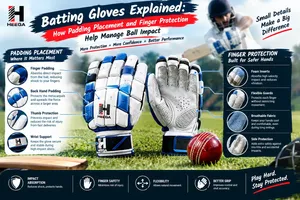 Batting Gloves Explained: How Padding Placement and Finger Protection Help Manage Ball ImpactLearn how batting glove padding placement, finger protection, and fit help manage ball impact. Find practical tips for choosing cricket batting gloves.