Red vs White Cricket Ball: Key Differences, Uses & Performance

Introduction: Red vs White Cricket Ball
If you have watched different formats of cricket, you have probably noticed that the ball is not always the same colour.
Test matches are traditionally played with a red cricket ball, while limited-overs formats such as ODI and T20 cricket generally use a white cricket ball.
At first glance, the main difference may seem obvious—the colour.
But there is more to the story.
The playing conditions, visibility, surface, maintenance, and way the ball behaves over time all matter when comparing a red ball with a white ball.
For a player who is just beginning to understand cricket equipment, these differences can be confusing.
Why does Test cricket use a red ball?
Why is a white cricket ball preferred for T20 matches?
Does a red ball swing more?
Does a white ball become difficult to see?
Why does the ball's condition matter so much?
And is one type of cricket ball better than the other?
The answer depends largely on the format and conditions in which the ball is being used.
In this guide, we will look at the major differences between red and white cricket balls, their construction, performance, durability, visibility, and practical uses.
Why Are Cricket Balls Different Colours?
The colour of a cricket ball is closely connected to the format of the game and the conditions in which it is played.
Traditionally, Test and first-class cricket have used red balls.
Limited-overs cricket moved toward white balls because many matches are played under floodlights or during the day with coloured clothing.
The colour needs to provide enough contrast for players to track the ball.
This is especially important for:
- Batters
- Bowlers
- Wicketkeepers
- Slip fielders
- Outfielders
- Spectators
A cricket ball travelling at high speed needs to remain visible throughout the delivery.
So, ball colour is not simply a matter of appearance.
It is a practical part of the game's equipment.
What Is a Red Cricket Ball?
A red cricket ball is traditionally associated with longer formats of cricket.
It is commonly used in:
- Test cricket
- First-class cricket
- Other traditional long-format competitions
The red colour has become an important part of cricket's identity.
When you picture a traditional Test match, you can probably imagine players wearing white clothing and a red ball moving between the bowler, batter, and wicketkeeper.
The combination has been part of the sport for generations.
But the red ball is not chosen only because of tradition.
It is also well suited to the conditions of daytime long-format cricket.
What Is a White Cricket Ball?
A white cricket ball is commonly used in limited-overs cricket.
It is strongly associated with:
- One Day Internationals
- T20 cricket
- Domestic limited-overs cricket
- Day-night limited-overs matches
The white colour provides strong visibility against coloured player clothing and many backgrounds encountered during modern limited-overs matches.
White cricket balls have become one of the defining visual features of modern cricket.
When you watch a T20 match under floodlights, the white ball is usually much easier to track than a traditional red ball would be.
Red Cricket Ball vs White Cricket Ball at a Glance
The simplest way to understand the difference is to look at the formats in which they are commonly used.
FeatureRed Cricket BallWhite Cricket Ball
Common format
Test and first-class cricket
ODI and T20 cricket
Typical clothing
White clothing
Coloured clothing
Common playing conditions
Daytime, long format
Daytime and floodlit conditions
Traditional use
Long-format cricket
Limited-overs cricket
Ball visibility
Strong against white clothing
Strong against coloured clothing
Ball condition
Changes over longer spells
Changes during shorter innings
Main purpose
Long-format performance
Limited-overs performance
The exact construction and specifications can vary between manufacturers and competitions.
How Is a Red or White Cricket Ball Made?
Both red and white cricket balls can be built around a similar basic concept.
A traditional leather cricket ball generally contains:
- A cork-based core
- Layers of wound yarn
- Leather outer panels
- Stitching
- A raised seam
- Surface finishing
The internal construction provides the basic structure.
The leather creates the external surface.
The stitching holds the panels together and forms the seam.
The final finishing process helps produce the ball's intended surface and appearance.
The colour is therefore only one part of the finished product.
The Cricket Ball Core
At the centre of a traditional leather cricket ball is a core that contributes to its overall structure.
The core helps determine:
- Weight
- Hardness
- Resilience
- Bounce
- Internal balance
Consistency is important.
If the internal construction varies significantly from one ball to another, players may notice differences in feel or performance.
This is why manufacturing quality matters for both red and white cricket balls.
The Leather Covering
The leather covering is the part players see and handle.
It protects the internal construction while providing the surface that interacts with the bat, pitch, field, and bowler's fingers.
The leather needs to withstand repeated impact.
During a cricket match, the ball can experience contact with:
- The bat
- The pitch
- The ground
- Fielders' hands
- Gloves
- Other surfaces
The leather therefore plays an important role in durability and ball condition.
Why the Seam Matters
Both red and white cricket balls have a seam.
The seam is created where the leather panels are stitched together.
For bowlers, the seam provides a useful grip and reference point.
Fast bowlers may use the seam while working on:
- Swing bowling
- Seam bowling
- Line and length
- Release
- Control
Spinners can also use the seam when positioning their fingers.
The seam is therefore not just decorative.
It is an important functional part of the cricket ball.
Red Ball and Seam Bowling
The red ball is closely associated with traditional seam and swing bowling.
In Test cricket, bowlers often work with the ball for long periods.
A fast bowler may try to keep the seam upright and use the ball's condition to create movement.
The pitch also plays a major role.
Conditions can vary from one venue to another.
A pitch with more grass may offer different seam movement from a dry, worn surface.
The ball, bowler, pitch, and weather all work together.
White Ball and Seam Bowling
The white cricket ball can also be used for seam and swing bowling.
In limited-overs cricket, bowlers often look for movement with the new ball.
The early overs can be particularly important because the ball has a relatively fresh surface and pronounced seam.
However, the ball's condition changes quickly because limited-overs cricket can involve aggressive batting and frequent boundary hitting.
Bowlers therefore have to adapt their approach.
Red Ball and Swing
Swing bowling is one of the most interesting aspects of cricket.
A bowler can attempt to move the ball through the air by controlling:
- Seam position
- Release
- Speed
- Wrist position
- Surface condition
Atmospheric conditions can also influence movement.
Humidity, wind, temperature, and the condition of the ball can all play a role.
The red ball has a long association with swing bowling in Test cricket.
However, the actual amount of movement depends on the conditions and the skill of the bowler.
White Ball and Swing
White cricket balls are also capable of swinging.
In fact, movement with the new white ball can be an important feature of limited-overs cricket.
Fast bowlers often look to attack early in an innings.
The ball's fresh surface and seam can provide opportunities for movement.
However, the ball can change relatively quickly as it becomes dirty and worn.
This creates a different type of tactical challenge from the long-format game.
Why White Cricket Balls Are Used in T20 Cricket
T20 cricket is fast.
The game is usually played over just 20 overs per side.
Many T20 matches are played under floodlights.
Players wear coloured clothing.
The white cricket ball works well in this environment because it provides strong visual contrast.
Batters need to pick up the ball quickly.
Fielders need to track it against the background.
Wicketkeepers need to react immediately.
In a format where every delivery matters, visibility is extremely important.
Why Red Balls Are Used in Test Cricket
Test cricket has a very different rhythm.
A match can last for several days.
Players traditionally wear white clothing.
Matches are generally played during daylight, although day-night Test matches use pink balls.
The red cricket ball provides strong contrast against white clothing and is deeply connected to the traditional appearance of Test cricket.
More importantly, the ball is designed for the demands of a longer format where ball condition can evolve over an extended period.
White Clothing and the Red Ball
The relationship between white clothing and the red cricket ball is one of the most recognizable images in cricket.
Traditional Test players wear white or light-coloured clothing.
A red ball provides strong contrast against this background.
This helps players track the ball visually during daytime play.
Limited-overs cricket changed the visual identity of the sport.
Coloured clothing became standard, and the white cricket ball became the natural choice for visibility.
Red Ball in Test Matches
In Test matches, the ball can remain in use for a significant amount of time.
This makes its condition particularly important.
During the innings, the ball experiences:
- Bat impact
- Pitch contact
- Ground contact
- Fielding
- Friction
- Dirt
- Weather exposure
The surface gradually changes.
The seam can wear.
The leather can become scuffed.
The ball can become softer.
Bowlers need to adapt as these changes happen.
This is one reason the condition of the ball is such an important part of Test cricket.
White Ball in Limited-Overs Cricket
A white cricket ball is used differently.
An ODI or T20 innings is much shorter than a Test innings.
The ball can still experience considerable wear because modern limited-overs cricket features powerful batting and frequent boundary shots.
The surface may become dirty or scuffed relatively quickly.
This can affect visibility and the way the ball feels.
Players and officials therefore pay close attention to ball condition.
Does a Red Ball Swing More Than a White Ball?
This is a common question.
It is tempting to say that one colour automatically swings more than the other.
In reality, swing depends on several factors.
These include:
- Surface condition
- Seam position
- Ball age
- Bowling speed
- Release technique
- Weather
- Wind
- Humidity
- Pitch conditions
The colour alone does not determine swing.
Both red and white cricket balls can move through the air when conditions and technique allow it.
Does the White Cricket Ball Become Dirty Faster?
The white surface makes dirt and grass marks easier to see.
During a limited-overs match, the ball can become visibly marked after repeated contact with the pitch and outfield.
This can affect its appearance and visibility.
Players may therefore pay particular attention to keeping the ball in good condition.
The ball's surface condition can also influence how bowlers approach their deliveries.
Red Ball vs White Ball Durability
Durability depends on the quality and construction of the ball, but the two types are used in different match environments.
A red ball in Test cricket may be expected to withstand long periods of play.
A white ball is generally used in shorter formats, but it can experience intense use during those overs.
The quality of:
- Leather
- Stitching
- Core
- Seam
- Finishing
all contributes to durability.
A top quality cricket ball should be built to suit its intended playing conditions.
How Ball Condition Changes During a Match
No cricket ball remains exactly the same throughout a match.
The surface gradually changes as the ball is used.
A new ball generally has:
- Fresh leather
- Strong seam
- Cleaner surface
- Firm feel
An older ball may have:
- Scuff marks
- Dirt
- A softer surface
- Less pronounced seam
- More visible wear
The rate of change depends on the playing conditions and how the ball is used.
Red Ball vs White Ball for Batting
Batters can experience different visual conditions depending on the ball.
A red cricket ball can provide strong contrast against traditional white clothing and a daytime background.
A white cricket ball works particularly well with coloured clothing and floodlit conditions.
For the batter, the most important thing is being able to pick up the ball early.
Good visibility allows the batter to judge:
- Line
- Length
- Speed
- Movement
- Bounce
This is particularly important when facing fast bowling.
Red Ball vs White Ball for Bowling
For bowlers, both types of cricket balls offer opportunities.
The red ball is traditionally associated with long-format swing and seam bowling.
The white ball is strongly associated with limited-overs bowling, where the new ball can offer movement and bowlers often have fewer overs to make an impact.
In both cases, the bowler's skill remains more important than the colour alone.
Red Ball vs White Ball for Spinners
Spin bowlers can use both red and white balls.
The ball's surface and seam provide useful grip points.
As the ball gets older, its surface changes.
In longer formats, spinners can have extended opportunities to work with an older ball.
In limited-overs cricket, the shorter innings creates a different tactical environment.
The bowler must often attack quickly rather than waiting for the conditions to develop over a long period.
Cricket Ball vs Tennis Balls
It is worth remembering that neither red nor white leather cricket balls should be confused with tennis balls used for recreational cricket.
Tennis balls are softer and lighter.
They can be useful for:
- Beginner practice
- Batting drills
- Reaction training
- Hand-eye coordination
- Casual games
However, tennis balls do not reproduce the same seam, hardness, weight, or movement as a traditional leather cricket ball.
Players preparing for serious cricket should eventually train with the type of ball they will face in matches.
Training Balls and Match Balls
Training balls can be useful when players want to practice regularly without using premium match equipment for every session.
Depending on their construction, training balls can include:
- Synthetic balls
- Practice leather balls
- Softer cricket balls
- Junior training balls
- Other practice options
A training ball can be a practical choice for nets and drills.
Match balls should be reserved for situations where competition-level equipment is required.
How to Choose Between a Red and White Cricket Ball
The choice is usually straightforward.
Ask yourself what format you are playing.
For Test or First-Class Cricket
A red cricket ball is generally the traditional choice.
For ODI Cricket
A white cricket ball is commonly used.
For T20 Cricket
A white cricket ball is generally used.
For Day-Night Test Cricket
Pink balls are used under the relevant competition regulations.
For Training
Choose according to the drill, player level, and training environment.
The right ball is the one that matches the purpose.
How to Check the Quality of a Cricket Ball
Before buying a cricket ball, inspect its construction.
Check the Leather
Look for an even and properly finished outer surface.
Check the Seam
The seam should be clearly formed and securely stitched.
Check the Shape
The ball should appear reasonably spherical.
Check the Weight
Use a suitable scale when accurate measurement is required.
Check the Size
Use an appropriate gauge or measuring method.
Check the Intended Use
Make sure the ball is designed for your format and playing level.
These simple checks can help you make a more informed purchase.
What Makes a Top Quality Cricket Ball?
A top quality cricket ball combines several characteristics rather than relying on one feature.
Important qualities include:
- Reliable core construction
- Suitable leather
- Consistent weight
- Proper size
- Spherical shape
- Secure stitching
- Defined seam
- Durable surface
- Consistent finishing
The best ball is not always the most expensive.
It is the ball that provides the right combination of quality and suitability for the player's needs.
Common Mistakes When Choosing a Cricket Ball
Choosing Only by Colour
Colour tells you about the intended format, but it does not tell you everything about quality.
Ignoring the Playing Format
A Test cricket ball and a T20 cricket ball serve different purposes.
Buying a Match Ball for Every Training Session
Regular nets can quickly wear out premium match equipment.
Ignoring Player Age
Younger players may need softer or lighter equipment.
Not Checking the Seam
The seam is an important functional part of a traditional cricket ball.
Choosing Without Considering the Pitch
Different playing surfaces can affect how the ball behaves.
How to Store a Cricket Ball Properly
Good storage helps protect the leather and seam.
Keep It Dry
Moisture can affect leather and stitching.
Avoid Excessive Heat
Do not leave leather balls in extreme heat for extended periods.
Store Away From Heavy Objects
Avoid putting heavy equipment on top of cricket balls.
Keep the Ball Clean
Remove dirt using suitable methods.
Protect the Seam
Avoid pulling at loose threads or handling the seam unnecessarily.
A little care can help maintain the ball between training sessions.
Cricket Ball Selection for Beginners
Beginners should focus on suitability rather than simply buying the most advanced equipment.
A softer training ball can make early practice more comfortable.
It can help players learn:
- Bat control
- Catching
- Throwing
- Basic bowling
- Footwork
- Reaction
As the player's skills develop, they can gradually move toward harder and more realistic cricket balls.
Cricket Ball Selection for Academy Players
Academy players usually train more frequently.
They may need several types of balls for different sessions.
For example:
- Soft balls for beginner groups
- Training balls for regular nets
- Leather balls for advanced players
- Match-style balls for simulation
Using the right ball for each session helps coaches manage equipment while keeping training realistic.
Cricket Ball Selection for Club Players
Club players often need both training and match equipment.
A durable training ball can be useful for regular nets.
Match-quality balls can be kept for competition and important practice sessions.
Clubs should also inspect balls regularly for:
- Damaged leather
- Loose stitching
- Deformation
- Worn seams
- Excessive surface damage
Cricket Ball Selection for Advanced Players
Advanced players often notice small differences in equipment.
They may pay close attention to:
- Ball weight
- Seam profile
- Leather feel
- Surface finish
- Hardness
- Shape
- Construction
This is especially important when preparing for competitive cricket.
The closer training equipment is to match conditions, the easier it can be for players to reproduce their skills under pressure.
Why Consistency Matters
Imagine a bowler practicing with several balls that all have different weights and seam profiles.
It becomes harder to judge whether a change in performance comes from the player's technique or the equipment.
Consistent cricket balls provide a more controlled practice environment.
This allows players to focus on:
- Accuracy
- Speed
- Swing
- Seam
- Spin
- Release
- Control
Consistency is particularly valuable for academies, clubs, and serious players.
How Heega Sports Supports Cricket Players
At Heega Sports, we understand that cricket equipment is part of the player's everyday routine.
A ball is used again and again during practice.
It is thrown, bowled, hit, caught, and carried from one session to another.
That is why choosing suitable equipment matters.
Whether you need a leather cricket ball for match preparation, training balls for regular nets, or other cricket equipment for your kit, the right choice can make your sessions more productive.
Heega Sports offers a range of cricket equipment, including:
- Leather cricket balls
- Training balls
- Practice cricket balls
- Kashmir Willow cricket bats
- English Willow cricket bats
- Batting gloves
- Batting pads
- Cricket helmets
- Cricket shoes
- Cricket socks
- Cricket kit bags
- Practice nets
- Cricket stumps
- Training accessories
Our goal is to help beginners, academy players, club cricketers, coaches, and competitive players find equipment that suits their game.
Cricket Ball Comparison Checklist
Before choosing a ball, consider these points.
Colour
Do you need a red, white, or pink ball?
Format
Is the ball for Test cricket, ODI, T20, or training?
Construction
Is it a leather or synthetic cricket ball?
Weight
Does it meet the requirements of your playing category?
Seam
Is the seam secure and properly formed?
Shape
Is the ball reasonably spherical?
Durability
Can it handle the level of use you expect?
Player Level
Is it suitable for a beginner, junior, academy player, club player, or advanced cricketer?
Training or Match
Are you buying it for regular practice or competitive cricket?
Frequently Asked Questions About Red and White Cricket Balls
What is the main difference between a red and white cricket ball?
The most obvious difference is colour, but the balls are also associated with different formats and playing conditions. Red balls are traditionally used in Test cricket, while white balls are commonly used in ODI and T20 cricket.
Why does Test cricket use a red ball?
The red ball is traditionally suited to daytime long-format cricket and provides good contrast against white clothing. It is also deeply established within the traditions of Test cricket.
Why is a white cricket ball used in T20 cricket?
T20 cricket is often played under floodlights and players wear coloured clothing. A white ball provides strong visibility in these conditions.
Does a red ball swing more than a white ball?
Not simply because of its colour. Swing depends on the ball's condition, seam, release, speed, weather, humidity, and other playing conditions.
Which ball is used in Test matches?
Red cricket balls are traditionally used in Test matches. Pink balls are used for day-night Test matches under the relevant playing regulations.
Is a white cricket ball harder than a red ball?
Colour alone does not determine hardness. Hardness and performance depend on the construction and specifications of the particular ball.
Can a white cricket ball be used for training?
Yes. White cricket balls can be used for training when players want to replicate limited-overs conditions. Training balls can also be used for regular practice.
Are tennis balls suitable for cricket practice?
Tennis balls can be useful for beginner drills, reaction exercises, and recreational cricket. However, they do not behave exactly like traditional leather cricket balls.
How long does a cricket ball last?
The lifespan depends on construction, quality, frequency of use, playing conditions, and how the ball is maintained.
What should I check before buying a cricket ball?
Check the ball's construction, leather, seam, stitching, shape, weight, size, and intended use. Always select a ball appropriate for your format and level.
Final Thoughts
The red versus white cricket ball debate is not really about which colour is better.
It is about which ball is better suited to the conditions and format in which you are playing.
The red ball has a special place in Test cricket.
It is connected with long days on the field, white clothing, swing bowling, seam movement, and the gradual changes that happen as the ball gets older.
The white cricket ball has become a defining part of limited-overs cricket.
It works particularly well with coloured clothing, daytime ODI matches, and T20 cricket under floodlights.
Both types of cricket balls have their own purpose.
Neither should automatically be considered better than the other.
For players, the most important thing is choosing the ball that matches the game they are preparing for.
If you are playing Test or first-class cricket, the red ball is the natural choice.
If you are preparing for ODI or T20 cricket, a white ball is more appropriate.
For beginners and everyday practice, training balls can offer a practical alternative.
And for recreational games, tennis balls can make cricket more accessible and enjoyable.
Whatever type you choose, pay attention to the basics: quality leather, secure stitching, a well-defined seam, consistent weight, proper shape, and suitable construction.
Because the colour may be the first thing you notice, but the real difference is in how the ball is made and how it performs when the game begins.
Choose the right cricket ball for the right format, prepare properly, and let your equipment become one less thing to worry about when you step onto the field.
🏏 Explore Quality Cricket Equipment at Heega Sports
Whether you are preparing for Test-style practice, working on your T20 skills, training at an academy, playing club cricket, or enjoying a casual game with friends, having the right equipment matters.
Explore Heega Sports for:
- Leather cricket balls
- Training balls
- Practice cricket balls
- English Willow cricket bats
- Kashmir Willow cricket bats
- Batting gloves
- Batting pads
- Cricket helmets
- Cricket shoes
- Cricket kit bags
- Practice nets
- Cricket stumps
- Training accessories
Shop Now
Heega Sports – Quality Cricket Equipment for Training, Matches, and Player Development.
Related posts
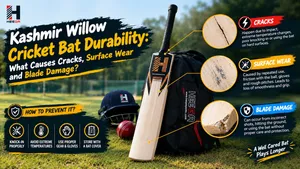 Kashmir Willow Cricket Bat Durability: What Causes Cracks, Surface Wear and Blade Damage?Discover what affects Kashmir Willow cricket bat durability, why cracks and surface damage occur, and how proper care can extend your bat's lifespan.
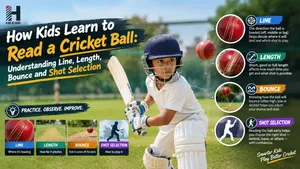 How Kids Learn to Read a Cricket Ball: Understanding Line, Length, Bounce and Shot SelectionLearn how kids can read a cricket ball by understanding line, length, bounce and shot selection to develop better batting skills and confidence.
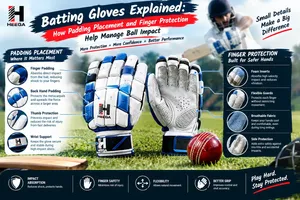 Batting Gloves Explained: How Padding Placement and Finger Protection Help Manage Ball ImpactLearn how batting glove padding placement, finger protection, and fit help manage ball impact. Find practical tips for choosing cricket batting gloves.