Introduction: Red vs White Cricket Ball
Cricket may look like a simple bat-and-ball sport, but the equipment used during a match can significantly influence how the game develops.
One of the most important pieces of equipment is the cricket ball.
Depending on the format and playing conditions, teams may use a traditional red ball, a white ball, or a pink cricket ball.
Although all of these balls are designed for cricket, they do not behave exactly the same way.
The differences become especially noticeable when bowlers try to generate swing, seam movement, bounce, or reverse swing.
Batters also experience differences in visibility, ball speed, and shot timing.
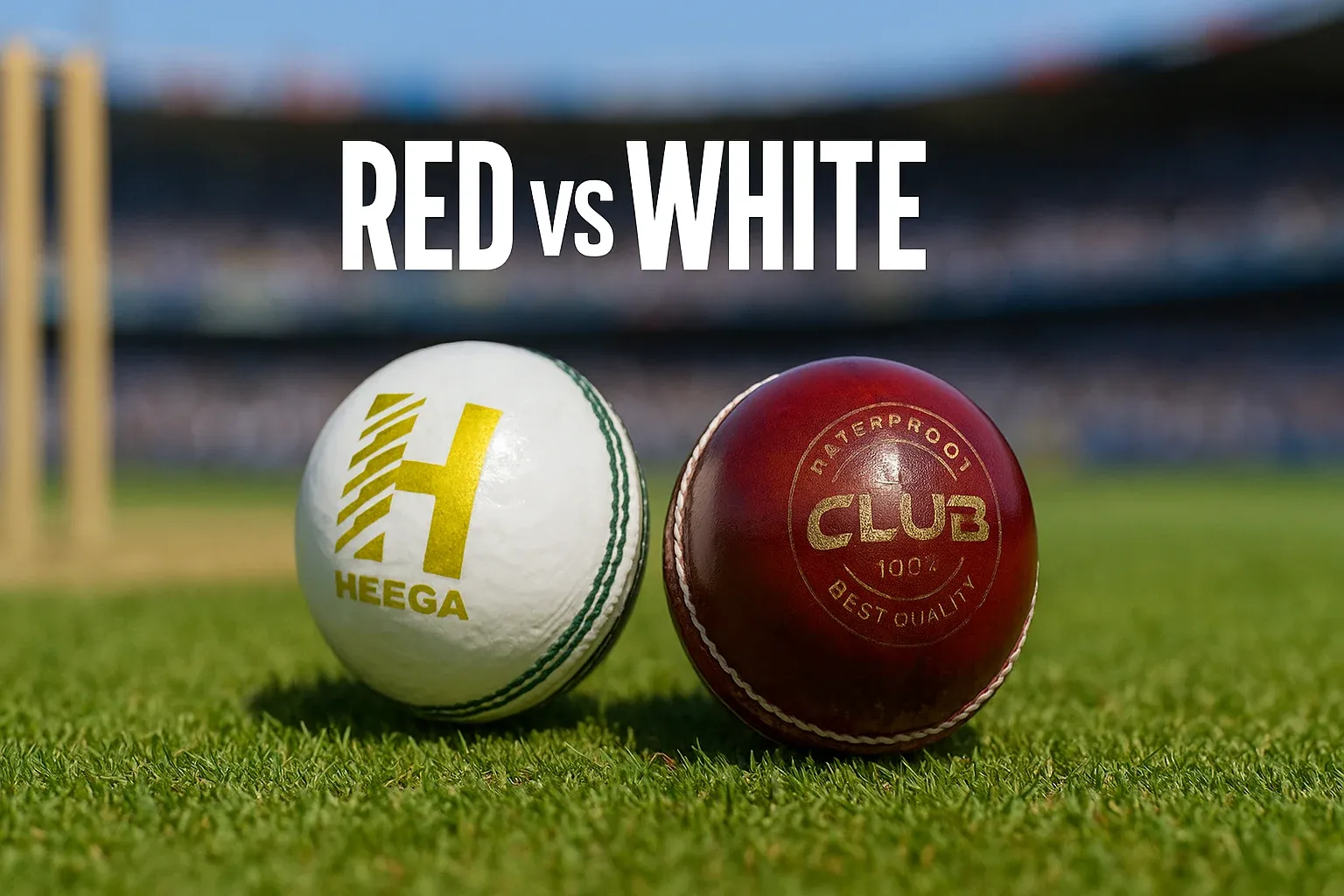
The red ball is strongly associated with Test cricket and longer-format matches.
The white ball is widely used in one-day and T20 cricket.
The pink cricket ball has become an important option for day-night Test matches.
So, which one performs better?
There is no universal winner.
Each ball is designed for a particular playing environment.
In this guide, we will compare red and white cricket balls, explain how they are manufactured, discuss swing and visibility, and explore why different formats require different ball designs.
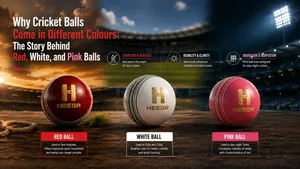
Why Cricket Balls Come in Different Colors
The color of a cricket ball is not simply a cosmetic choice.
Visibility is one of the biggest reasons different colors are used.
A traditional red ball is easy to see against a green pitch and daylight conditions.
However, visibility becomes more challenging as natural light decreases.
This is where the white ball becomes useful.
White provides stronger contrast against darker backgrounds and artificial lighting, making it suitable for matches played under floodlights.
The pink cricket ball offers another solution.
It is designed to remain visible during both daylight and night conditions, which makes it useful for day-night Test matches.
What Is a Red Cricket Ball?
A red cricket ball is the traditional ball used in Test matches and many first-class cricket competitions.
It has been part of the sport for generations.
The traditional red color works particularly well during daytime cricket.
Its construction is designed to allow the ball to remain useful over a long period.
This matters because Test cricket can involve many overs with the same ball.
Bowlers need the ball to retain its shape and surface characteristics for extended periods.
What Is a White Cricket Ball?
A white ball is primarily associated with limited-overs cricket.
It is commonly used in:
- One Day Internationals
- T20 internationals
- Domestic one-day matches
- T20 leagues
- Night matches
The white surface provides strong visibility under floodlights.
This makes it particularly useful when matches continue after sunset.
However, white balls can behave differently from red balls as they age.
The way the surface interacts with the pitch, bat, and air can change throughout an innings.
What Is a Pink Cricket Ball?
The pink cricket ball was developed to support day-night Test cricket.
A red ball can become difficult to see as daylight fades.
A white ball provides good visibility under lights but is not traditionally used for long-format Test cricket.
The pink ball offers a middle ground.
It provides better visibility than a traditional red ball during evening conditions while maintaining characteristics suitable for longer-format cricket.
Pink balls are therefore used in selected day-night Test matches.
How Cricket Balls Are Manufactured
Understanding how cricket balls are made helps explain why their behavior can differ.
Although manufacturing methods vary between brands and manufacturers, quality cricket balls generally contain several important components.
A typical ball includes:
- A central core
- Layers of wound material
- A leather outer covering
- Stitching
- Finishing treatments
The internal core provides the foundation of the ball.
Around this core, materials are tightly wound to create the required firmness and shape.
The outer leather covering protects the internal structure.
Finally, the panels are stitched together.
Different manufacturers can use different materials, construction methods, and finishing processes.
These details influence how the finished ball performs.
What Is Inside a Cricket Ball?
A cricket ball is more than a solid piece of leather.
Its internal construction is carefully engineered.
At the center is a core that provides weight and structural stability.
Around the core, layers of thread or similar materials are tightly wound.
The outer leather layer provides the surface that interacts with:
- The cricket bat
- Pitch
- Air
- Bowler's fingers
- Ground
The combination of these components determines how the ball behaves.
Why Ball Construction Matters
The way balls are manufactured affects their performance.
A well-constructed ball needs to maintain:
- Correct weight
- Spherical shape
- Suitable hardness
- Seam integrity
- Surface consistency
If the ball loses its shape, bowlers may struggle to control it.
If the seam becomes damaged, seam movement can change.
If the surface becomes excessively worn, swing characteristics may also change.
This is why quality control is essential.
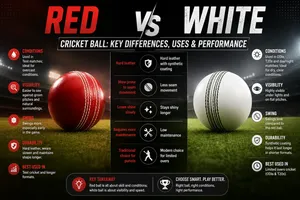
Red Ball vs White Ball: The Main Difference
The most obvious difference is color.
But the performance differences are more important.
FeatureRed BallWhite Ball
Main use
Test cricket
Limited-overs cricket
Visibility
Excellent in daylight
Excellent under lights
Typical format
Test matches
ODI and T20
Surface aging
Designed for long use
Changes during shorter innings
Swing
Can remain useful over long periods
Often prominent early
Long-format suitability
Excellent
Less common
Night visibility
Limited
Excellent
The exact behavior depends on the manufacturer, pitch, weather, and match conditions.
Red Ball Performance in Test Cricket
Test cricket places unique demands on the ball.
A single ball may be used for many overs.
That means bowlers need to extract different types of movement at different stages of the match.
Early in the innings, the ball may offer:
- Seam movement
- Conventional swing
- Pace
- Bounce
As the ball becomes older, its surface changes.
This can create opportunities for different bowling strategies.
Conventional Swing With the Red Ball
A newer red ball can swing through the air when the bowler delivers it with the correct seam position and surface orientation.
Several factors influence swing:
- Ball condition
- Seam position
- Bowling speed
- Atmospheric conditions
- Humidity
- Wind
- Bowler's technique
A skilled fast bowler can use these conditions to challenge batters.
Reverse Swing: Why the Older Ball Matters
One of the most fascinating aspects of Test cricket is reverse swing.
As a red ball becomes older, one side may become rougher while the other remains relatively smoother.
Under suitable conditions, the ball can begin moving through the air in a different direction from conventional swing.
Reverse swing can be particularly dangerous because it may occur at high bowling speeds.
Fast bowlers who master this skill can create serious problems for established batters.
White Ball Swings Differently
The white ball is also capable of swing.
In fact, white ball swings can be particularly noticeable during the early stages of an innings.
A new white ball may provide seamers with movement when the conditions are favorable.
This can make the opening overs challenging for batters.
However, the ball's behavior can change as the innings progresses.
Why White Ball Swing Is Important in T20 Cricket
T20 cricket provides bowlers with limited opportunities.
A bowler may have only a few overs to influence the match.
Early swing can therefore be extremely valuable.
A new white ball can help fast bowlers:
- Beat the outside edge
- Force mistimed shots
- Create wicket-taking opportunities
- Restrict scoring
- Build pressure
Because there are fewer overs, bowlers often need to attack immediately.
Red Ball and Seam Movement
The seam is another important part of cricket ball behavior.
A prominent seam can interact with the pitch after bouncing.
If the ball lands correctly, it can deviate from its expected path.
This is particularly useful for fast and medium-fast bowlers.
Red balls used in longer formats can retain their seam characteristics for a significant period when properly maintained.
The Importance of the Shine
Ball maintenance is a major part of Test cricket.
Fielders often polish one side of the ball.
The purpose is to maintain a smoother surface on one side while allowing the other side to become rougher.
This difference can contribute to swing behavior.
The ball's condition therefore becomes a tactical element.
Why White Balls Are Difficult to Maintain
White balls face different challenges.
The surface can become dirty during play.
Because the ball is white, grass stains, mud, and general wear are highly visible.
Players therefore need to keep the ball as clean as possible.
However, maintaining the same surface condition throughout a limited-overs innings can be challenging.
Visibility: Red vs White
Visibility can influence batting performance.
The red ball is highly visible in bright daylight.
However, it becomes harder to track as light levels decrease.
The white ball performs better under floodlights.
This makes it ideal for:
- Day-night matches
- ODI cricket
- T20 cricket
- Evening games
The choice of ball is therefore closely connected to the lighting environment.
White and Pink Balls for Day-Night Cricket
The development of white and pink balls reflects the changing needs of modern cricket.
White balls are excellent for limited-overs matches.
Pink balls were developed to make longer-format cricket more practical under lights.
The pink cricket ball can remain visible against changing light conditions while retaining many characteristics required for Test cricket.
Red and White Ball Behavior on Different Pitches
The playing surface can significantly influence ball behavior.
On a pitch with grass and moisture, seamers may receive additional movement.
On harder surfaces, the ball can bounce more quickly.
On dry surfaces, spin bowlers may become more influential.
Therefore, it is impossible to say that one ball always performs better.
Conditions matter.
Weather Can Change Ball Performance
Weather also plays a major role.
Factors such as:
- Humidity
- Temperature
- Wind
- Cloud cover
- Dew
can influence how the ball behaves.
Cloudy conditions may help seam bowlers.
Dew can affect grip and ball condition during night matches.
The same ball can therefore behave differently from one venue to another.
Why Red Balls Are Used in Test Matches
Test matches can last up to five days.
The format requires a ball that can survive extended use.
The traditional red ball is designed around this requirement.
It can develop different characteristics as it becomes older.
This creates a changing contest between batters and bowlers.
Early movement may favor seamers.
Later in the innings, the older ball can create opportunities for reverse swing.
Eventually, spin bowlers may become more influential as the pitch changes.
Why White Balls Are Used in Limited-Overs Cricket
Limited-overs cricket has different priorities.
The match needs to remain easy to follow for spectators throughout the day and night.
The white ball provides excellent visibility under artificial lighting.
It also supports the fast-paced nature of ODI and T20 cricket.
The objective is not to make one ball universally better.
The objective is to use the most suitable ball for the format.
How Ball Age Changes Performance
A cricket ball does not remain exactly the same throughout a match.
Its surface changes.
The seam wears down.
The leather can become rougher.
Its condition may influence movement through the air and off the pitch.
This is particularly important in Test cricket.
The changing condition of the ball creates different challenges as the match progresses.
New Ball vs Old Ball
A new ball can offer:
- Stronger seam
- Better surface condition
- Conventional swing
- Greater pace potential
An older ball may offer:
- Reverse swing
- Rougher surface
- Different grip
- Greater opportunities for spin
This progression is an important part of longer-format cricket.
Why Batters Notice the Difference
Batters have to adjust their approach depending on the ball.
Against a new ball, they may need to respect:
- Swing
- Seam
- Bounce
- Pace
Against an older ball, they may face:
- Reverse swing
- Different bounce
- Spin
- Rough surface conditions
Good batters adapt their technique throughout an innings.
Red Cricket Ball and Batting Technique
Facing a red cricket ball requires careful observation.
Batters need to track the seam and movement closely.
In Test cricket, the ball can move significantly after pitching.
Players often focus on:
- Leaving dangerous deliveries
- Playing late
- Maintaining balance
- Watching the seam
- Choosing safe scoring areas
Patience becomes an important part of batting.
White Ball and Aggressive Batting
Limited-overs cricket encourages a different batting approach.
Batters often need to score quickly.
They may use:
- Lofted drives
- Pull shots
- Cuts
- Sweeps
- Reverse sweeps
- Innovative strokes
Because the innings is shorter, scoring opportunities need to be taken.
The white ball therefore plays an important role in modern attacking cricket.
How the Ball Affects Fast Bowlers
Fast bowlers rely heavily on ball condition.
They may use the new ball to generate:
- Swing
- Seam movement
- Bounce
Later, an older red ball can become useful for reverse swing.
With a white ball, bowlers often focus on:
- Early movement
- Pace
- Variations
- Yorkers
- Slower balls
- Changes of angle
The format changes how the ball is used tactically.
How Spin Bowlers Use the Ball
Spin bowling is also affected by ball condition.
A rougher surface can help some spin bowlers generate additional grip and turn.
The condition of the pitch also becomes increasingly important in longer matches.
In Test cricket, the interaction between an aging ball and an aging pitch can create difficult conditions for batters.
Which Ball Lasts Longer?
There is no simple answer because durability depends on:
- Ball quality
- Match format
- Pitch surface
- Weather
- Fielding conditions
- Ball maintenance
However, Test cricket places particularly high demands on the red ball because it must remain usable over a much longer period.
Limited-overs cricket places different demands on the white ball.
Why Two Balls Are Sometimes Used in One-Day Cricket
Modern one-day cricket can involve the use of more than one new ball during an innings.
This helps maintain visibility and provides a relatively fresh ball from each end.
It also affects how the ball ages during the innings.
As a result, the behavior of the ball in modern ODI cricket differs from the traditional single-ball approach.
Red, White, and Pink: When Is Each Used?
Red Ball
Most commonly associated with:
- Test cricket
- First-class cricket
- Long-format matches
White Ball
Most commonly associated with:
- ODI cricket
- T20 cricket
- Limited-overs cricket
- Night matches
Pink Ball
Most commonly associated with:
- Day-night Test matches
Each color serves a specific purpose.
Does Color Alone Determine Performance?
No.
The color is only one part of the equation.
Performance also depends on:
- Construction
- Leather quality
- Core
- Stitching
- Seam
- Weight
- Pitch
- Weather
- Ball age
- Maintenance
This is why comparing only colors can be misleading.
A high-quality red ball and a high-quality white ball can both perform exceptionally well in the right environment.
What Does "Tightly Wound" Mean?
The phrase tightly wound refers to how the internal thread layers are wrapped around the ball's core.
These layers help create:
- Shape
- Firmness
- Structural stability
The winding needs to be consistent.
If the internal structure is uneven, the ball may not remain perfectly spherical.
Consistent construction is therefore important for predictable performance.
Why Rows of Stitching Matter
The rows of stitching around a cricket ball are not simply decorative.
The seam can influence:
- Grip
- Release
- Pitch interaction
- Movement
Bowlers can use the seam position to influence the ball's trajectory.
A well-defined seam can be particularly useful for seam bowling.
Hand-Stitched Cricket Balls
Many premium cricket balls are hand stitched.
Skilled workers carefully stitch the leather panels around the internal core.
Hand stitching requires precision.
The quality of stitching can influence the consistency and durability of the finished ball.
For competitive cricket, construction quality is extremely important.
How Ball Quality Affects Practice
Players should practice with balls that are appropriate for their level.
Training balls can be useful for:
- Net practice
- Beginner coaching
- Fielding drills
- Bowling practice
- Batting sessions
Match-quality balls are generally more demanding.
Players should select equipment according to the purpose of the session.
Choosing the Right Cricket Ball
Before purchasing a ball, consider:
Match Format
Are you playing Test-style cricket, ODI cricket, or T20 cricket?
Playing Conditions
Will the ball be used indoors, outdoors, during daylight, or at night?
Skill Level
Beginners may not need the same type of ball used in professional competition.
Construction
Check the quality of the leather, stitching, core, and seam.
Durability
Consider how frequently the ball will be used.
Red vs White Cricket Ball: Which One Should You Choose?
The answer depends on what you are playing.
Choose a red ball when you are preparing for:
- Test-style cricket
- First-class cricket
- Long-format matches
- Traditional daytime cricket
Choose a white ball when you are preparing for:
- ODI cricket
- T20 cricket
- Limited-overs matches
- Evening games
Choose a pink cricket ball when practicing for:
- Day-night Test cricket
- Longer-format matches under lights
The best ball is the one that matches your playing environment.
How Heega Sports Supports Cricket Players
At Heega Sports, we understand that the right cricket equipment can make training more effective.
Whether you are a beginner, club player, academy cricketer, or experienced competitor, choosing the right ball for your training environment matters.
Our cricket range includes equipment such as:
- Red cricket balls
- White cricket balls
- Practice cricket balls
- Kashmir Willow cricket bats
- English Willow cricket bats
- Batting gloves
- Batting pads
- Cricket helmets
- Cricket shoes
- Cricket kit bags
- Practice nets
- Training accessories
Our goal is to help players find dependable equipment for practice and match preparation.
Final Thoughts: There Is No Universal Winner
So, which performs better—the red or white cricket ball?
Neither is universally better.
The red ball is built around the demands of long-format cricket.
It can provide seam movement, conventional swing, and opportunities for reverse swing as it becomes older.
The white ball is designed for limited-overs cricket and offers excellent visibility under floodlights.
Its early movement can be particularly important in ODI and T20 cricket.
The pink cricket ball provides another solution for day-night Test matches, where visibility becomes a major consideration.
Ultimately, balls are manufactured for specific purposes.
Their construction, tightly wound internal layers, leather covering, stitching, seam, and finishing all influence how they perform.
Weather, pitch conditions, ball age, and maintenance then add another layer of complexity.
For players, understanding these differences can make training more effective.
It helps bowlers understand why the ball may move differently.
It helps batters prepare for different conditions.
And it helps coaches choose equipment that more closely reflects the type of cricket their players are preparing to play.
The cricket ball may be small, but its influence on the game is enormous.
From the traditional red ball used in Test matches to the white ball used in modern T20 cricket and the pink cricket ball used for day-night Tests, each version has an important role in the sport.
🏏 Find the Right Cricket Ball at Heega Sports
Prepare for your next match with quality red cricket balls, white cricket balls, practice balls, cricket bats, batting gloves, batting pads, helmets, cricket shoes, kit bags, practice nets, and training accessories.
Shop Now
Heega Sports – Quality Cricket Equipment for Every Format, Every Session, and Every Player.