The Cricket Bat Sweet Spot: How Bat Balance Affects Your Shots

A cricket bat can look perfect on paper.
The right weight.
Premium willow.
A professional-looking profile.
A thick edge.
But when you actually pick it up, something doesn't feel right.
Maybe it feels heavier than expected.
Maybe the bat is difficult to maneuver.
Maybe your drives feel effortless—but your pull shots don't.
This is where bat balance becomes important.
Many players focus almost entirely on the number written on the bat.
But two bats with the same listed weight can feel completely different because of how that weight is distributed.
Understanding balance, pickup, and the sweet spot can help you choose a bat that works with your technique rather than against it.
At Heega Sports, we believe the best cricket equipment isn't necessarily the most expensive. It's the equipment that suits your playing style, physical strength, technique, and match requirements.
Let's break down what really matters.
What Is the Sweet Spot?
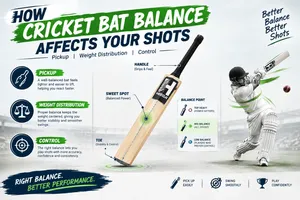
The sweet spot is the area of the bat where a well-timed contact can produce an efficient combination of power, control, and feel.
When you strike the ball near this area, the bat can transfer energy effectively while producing a satisfying response.
The exact location and characteristics of the sweet spot vary between bat designs.
Some bats are designed with a higher sweet spot.
Others have a more centrally positioned sweet spot.
Some are better suited to players who regularly play on slower or lower-bouncing surfaces.
The important point is:
The sweet spot isn't identical on every bat.
1. Why the Sweet Spot Matters
A well-positioned sweet spot can complement the way you play.
When the ball meets the bat in the right area, you may experience:
- Better timing
- Stronger ball response
- Greater control
- Less vibration
- More confidence in stroke play
But remember:
A sweet spot doesn't replace technique.
A poorly timed shot won't become perfect simply because the bat is high quality.
2. What Is Bat Balance?
Bat balance describes how the bat's weight is distributed along its length.
Two bats can weigh the same but feel completely different.
For example:
Bat A: 1.2 kg with more weight toward the blade.
Bat B: 1.2 kg with a more evenly distributed feel.
Both weigh the same.
But Bat A may feel more powerful while Bat B may feel easier to maneuver.
This is why pickup matters.
3. What Does "Pickup" Mean?
Pickup refers to how heavy or light a bat feels when you lift and move it.
A bat with good pickup may feel lighter than its actual weight.
A bat with less favorable pickup can feel heavy even when the scale says otherwise.
This matters because batting involves constant movement.
You need to:
- Lift the bat
- Prepare for the delivery
- Adjust your backlift
- Change direction
- Play different strokes
The easier the bat feels to control, the more naturally you may be able to move it.
4. Weight Isn't the Whole Story
A common mistake is choosing a bat purely by its listed weight.
Instead, consider:
Actual weight + weight distribution + pickup + your strength + your technique
That's a much better equation.
A bat that is technically "lighter" may not feel lighter.
A heavier bat with excellent balance may feel easier to use than a lighter bat with poor pickup.
5. Front-Foot Players May Prefer Different Balance
Players who rely heavily on front-foot strokes may have different preferences from aggressive back-foot players.
For example, a player who loves:
- Drives
- Straight shots
- Lofted front-foot strokes
may appreciate a bat whose balance complements those movements.
But there's no universal rule.
Your own technique should determine what feels best.
6. Back-Foot Players Need Maneuverability Too
Players who frequently play:
- Pulls
- Cuts
- Square drives
- Late cuts
may value maneuverability and a pickup that allows quick bat movement.
A bat that feels too bottom-heavy can be more demanding for some players during rapid changes in direction.
7. Handle Design Can Affect Feel
Bat balance isn't determined by the blade alone.
The handle contributes to how the bat feels in your hands.
Handle shape, construction, grip, and overall design can influence:
- Comfort
- Control
- Vibration
- Pickup
This is another reason two bats with similar specifications can feel completely different.
8. Bat Profile Changes the Balance
A bat's profile can affect how its weight is distributed.
Features such as:
- Spine height
- Edge thickness
- Toe shape
- Profile shape
- Sweet spot position
can influence how the bat feels.
A bat with large edges isn't automatically better.
What matters is whether the overall construction suits your game.
9. Higher Sweet Spots Have a Purpose
Some bats are designed with a higher sweet spot.
This can suit certain playing conditions and styles.
A higher sweet spot may be particularly relevant for players who often play on surfaces where bounce is more pronounced or who prefer certain stroke patterns.
However, don't choose a bat simply because its sweet spot is higher.
Consider the conditions you actually play in.
10. Lower Sweet Spots Have Their Own Advantages
Lower sweet spots can suit different playing environments and player preferences.
They may appeal to players who regularly play on lower-bouncing surfaces.
Again, there's no universally superior position.
The best sweet spot is the one that complements:
Your conditions + your technique + your scoring areas.
11. Middle Sweet Spots Offer Versatility
Some players prefer a more centrally positioned sweet spot because it can provide a balanced feel across a variety of strokes and conditions.
For club players who play on different grounds, versatility can be especially valuable.
12. Balance Can Affect Your Backlift
Your backlift is part of your batting rhythm.
If the bat feels comfortable, you may naturally develop a smoother preparation movement.
If it feels excessively heavy, your backlift may become slower or more deliberate.
That can affect timing.
The best bat should feel like an extension of your batting movement.
13. Balance Can Influence Shot Selection
Imagine facing a short delivery.
You need to react quickly.
If your bat feels easy to maneuver, you may be able to get into position more naturally.
Now imagine facing a full delivery.
You need to move forward and control the bat through the shot.
Different movements place different demands on the bat.
That's why balance matters.
14. Don't Chase Maximum Power
Many players assume:
Heavier bat = more power.
That's not always true.
Power comes from the combination of:
- Timing
- Bat speed
- Technique
- Strength
- Weight transfer
- Contact quality
- Equipment
A bat that is too heavy for you may actually reduce bat speed and timing.
A slightly lighter bat that you control well may produce better results.
15. Bat Speed Matters
A simple way to think about hitting is:
Efficient bat speed + clean contact = effective stroke
If the bat is too heavy or poorly balanced for you, generating efficient bat speed may become more difficult.
That's why you shouldn't choose a bat solely based on what looks impressive.
16. Your Playing Style Should Guide Your Choice
Ask yourself:
Are you an aggressive stroke-maker?
You may prioritize a balance that supports attacking shots.
Are you a timing-based batter?
Pickup and control may matter more than maximum mass.
Are you a defensive opener?
Comfort, maneuverability, and long-innings control may be important.
Are you a middle-order power hitter?
You may prefer a profile and balance that support your preferred attacking areas.
Your bat should match your cricket—not someone else's.
17. Don't Ignore Your Physical Strength
A bat should be manageable for you.
If you struggle to lift it repeatedly during practice, it's worth reconsidering.
You need enough strength and control to:
- Prepare quickly
- Play defensive shots
- Drive
- Pull
- Cut
- Rotate the bat
- Run between wickets
The right weight is personal.
18. Test the Bat With Your Normal Grip
When testing a bat, don't hold it casually.
Use your normal grip.
Take your batting stance.
Try your usual backlift.
Then play a few controlled movements.
Ask:
Does it feel natural?
That's more useful than simply swinging it once.
19. Try More Than One Bat
If possible, compare several bats.
You may discover that:
- One feels lighter
- Another feels more powerful
- Another has better pickup
- Another feels easier to maneuver
Don't assume specifications tell the complete story.
Your hands can reveal things that a product description cannot.
20. The Sweet Spot Isn't Everything
A bat can have an excellent sweet spot and still be wrong for you.
Why?
Because batting performance depends on more than the blade.
You also need:
- Suitable weight
- Comfortable pickup
- Correct handle feel
- Appropriate grip
- Good technique
- Confidence
Think of the sweet spot as one part of the complete bat design.
How to Choose the Right Bat Balance
Use this simple process:
Step 1 — Know Your Playing Style
Identify your most common scoring shots.
Step 2 — Consider Your Conditions
Think about the grounds and pitches where you normally play.
Step 3 — Choose a Manageable Weight
Don't select a bat that compromises your bat speed.
Step 4 — Test Pickup
Lift and move the bat naturally.
Step 5 — Check the Sweet Spot
Understand where the bat is designed to perform best.
Step 6 — Test Your Stroke Movement
Use your normal stance and backlift.
Step 7 — Compare
Try different models when possible.
Common Cricket Bat Buying Mistakes
Avoid:
❌ Choosing only by weight.
❌ Assuming heavier automatically means more powerful.
❌ Buying based purely on appearance.
❌ Ignoring pickup.
❌ Choosing a sweet-spot position without considering playing conditions.
❌ Copying a professional player's bat specifications.
❌ Using a bat that is too demanding for your strength.
❌ Forgetting to test the bat with your actual technique.
A Simple Bat Selection Checklist
Before choosing your next bat, consider:
☑ Bat weight
☑ Pickup
☑ Sweet-spot position
☑ Balance
☑ Spine and profile
☑ Edge thickness
☑ Handle feel
☑ Grip comfort
☑ Your batting style
☑ Your playing conditions
☑ Your physical strength
☑ Batting frequency
☑ Match format
The right combination matters more than any single specification.
Why the "Same Weight" Can Feel Completely Different
This is one of the most important lessons.
Suppose two bats both weigh 1.2 kg.
One feels easy to lift.
The other feels heavy.
How?
Because weight distribution isn't identical.
The first may have a balance that suits your grip and movement.
The second may place more perceived weight farther from your hands.
That's why pickup is personal.
How Bat Balance Can Influence Different Shots
ShotWhat You May Value
Straight drive
Stability and controlled bat movement
Cover drive
Pickup and smooth movement
Pull shot
Maneuverability and bat speed
Cut shot
Quick hands and control
Lofted shot
Balance, timing, and bat speed
Defensive stroke
Control and feel
Flick
Wrist movement and maneuverability
These are general considerations, not rules.
Your individual technique matters most.
The Bat Balance Formula
Think of your ideal bat as:
Suitable Weight + Good Pickup + Appropriate Sweet Spot + Your Technique = Better Bat Compatibility
The goal isn't to find the "best bat in the world."
It's to find the bat that works best with you.
How to Maintain Your Bat
Even the right bat needs care.
Follow the manufacturer's guidance for:
- Knocking-in
- Storage
- Moisture exposure
- Surface protection
- Grip replacement
- Toe protection
Avoid unnecessary exposure to extreme conditions.
A well-maintained bat can remain a valuable part of your cricket kit for longer.
When Should You Change Your Bat?
Consider a replacement when:
- The bat is significantly damaged
- The performance has deteriorated
- The weight no longer suits you
- Your technique has evolved
- Your strength and playing level have changed
Your ideal bat at 16 may not be your ideal bat at 21.
As your cricket develops, your equipment preferences can develop too.
Final Thoughts
The best cricket bat isn't necessarily the heaviest.
It isn't necessarily the most expensive.
It isn't necessarily the one with the biggest edges.
And it isn't automatically the bat used by a professional player.
The best bat is the one that gives you the right combination of:
Pickup.
Balance.
Sweet-spot location.
Control.
Bat speed.
Comfort.
Confidence.
At Heega Sports, we help cricketers find bats and other cricket equipment suited to serious training and competitive play, alongside helmets, batting gloves, pads, cricket shoes, bags, accessories, and sportswear.
Before choosing your next bat, don't just ask:
"How much does it weigh?"
Ask:
"How does it feel when I play my shots?"
That question can lead you toward a bat that truly suits your game.
Because the perfect cricket bat isn't the one with the biggest specifications. It's the one that feels right when the ball is coming at you.
Shop Now
Heega Sports – Helping Players Stay Ready From Daylight to Floodlights.
Related posts
 Kashmir Willow Cricket Bats for Power Hitting: How Blade Shape, Sweet Spot and Edge Thickness Work TogetherLearn how Kashmir willow cricket bat blade shape, sweet spot position, and edge thickness work together to support powerful shots, control, and balance.
 Understanding Cricket Bat Profiles: How Sweet Spot Placement & Spine Height Affect Your Shot-MakingDiscover how cricket bat profiles, sweet spot placement, spine height, and edge thickness impact your shot-making, pick-up, and power transmission on the pitch.
 How Cricket Bat Balance Affects Your Shots: Pickup, Weight Distribution, and ControlLearn how cricket bat balance affects pickup, shot control and batting comfort. Understand weight distribution, sweet spot, bat feel and choosing the right balance.