Understanding Cricket Bat Profiles: How Sweet Spot Placement & Spine Height Affect Your Shot-Making
Introduction
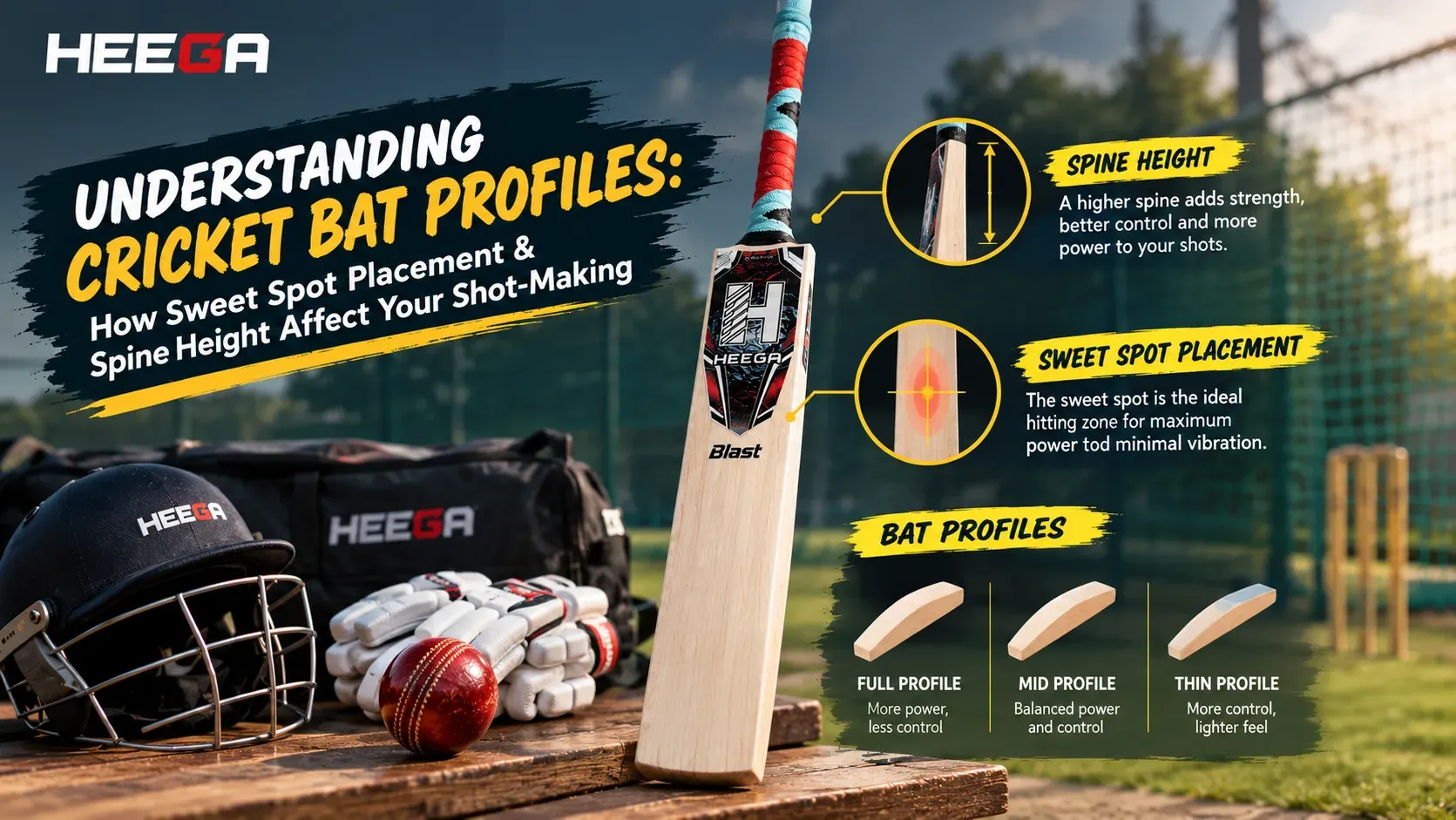
Every cricket bat has a distinct personality carved into its timber. When choosing a blade, players often focus on grain count, brand stickers, or total weight, but the true driver of performance is how wood mass is distributed across the face. Two bats of identical scale weight can feel radically different in motion based entirely on how their sweet spot, spine height, and edge thickness interact. This comprehensive guide breaks down the science of cricket bat profiles so you can select a blade perfectly aligned with your technique, pitch conditions, and shot-making goals.
Understanding Cricket Bat Profiles: How Sweet Spot Placement & Spine Height Affect Your Shot-Making
When you walk into a specialist cricket equipment shop or browse an online store, it is remarkably easy to get caught up counting vertical grain lines, admiring timber grades, or running your thumb over glossy brand stickers. However, the true performance persona of a cricket bat lies beneath its surface labels—carved directly into its physical geometry, mass distribution, and dimensional contours.
Consider a simple experiment: take two cricket bats made from identical Grade 1 English Willow (Salix alba var. caerulea) clefts, both pressed to the exact same density and both weighing an identical 2 lbs 9 oz (1,162 grams) on a digital scale. Pick them up back-to-back, settle into your batting stance, and go through a standard backlift motion.
In many cases, the two bats will feel completely different in your hands. One might feel feather-light, allowing you to flick fast bowling effortlessly off your pads or adjust late to a seam movement. The other might feel noticeably heavy towards the toe, demanding a firm bottom hand and strong forearms to clear the mid-on boundary.
The secret behind these contrasting playing characteristics is the bat profile: the strategic, deliberate distribution of wood mass across the blade, defined primarily by sweet spot placement, spine height, edge thickness, toe depth, and scalloping (concaving).
Whether you are a classical front-foot driver operating on low-bouncing wickets, an aggressive middle-order T20 finisher clearing long boundaries, or a back-foot player pulling short balls on fast surfaces, understanding how profile geometry affects performance is the key to selecting a blade that maximizes your shot-making potential.
1. Deconstructing the Anatomy of a Cricket Bat Profile
To understand how a cricket bat transfers kinetic energy into a 156-gram leather ball traveling at speeds upwards of 130 km/h, you must first deconstruct the primary geometric features that make up modern bat profiling.
The Sweet Spot (Center of Percussion)
In scientific terms, the sweet spot corresponds closely to the node of minimum vibration and the center of percussion along the blade. In practical cricketing terms, it is the precise area on the face where the wood mass, structural depth, and pressing density combine to produce maximum ball exit velocity (rebound power or ping) with minimal shock transmission returning through the handle to your hands. When a leather ball strikes this exact region, energy loss is minimized, resulting in that crisp, effortless rebound sound that every batter seeks.
The Spine (The Power Engine)
The spine is the central ridge running vertically down the back of the blade. It represents the thickest portion of the timber, providing the core structural depth and mass needed to back up the hitting face. The height, length, and tapering rate of the spine dictate how power is concentrated or spread across the blade. A tall, extended spine creates a deep backwall behind the hitting zone, allowing the bat to absorb high-velocity impacts without structural flexing.
The Edges (Off-Center Stability)
The edges represent the vertical side walls of the blade. Edge thickness plays a vital role in preventing the bat from twisting or torquing in a batter's hands when the ball hits outside the central spine area. Thicker edges increase the blade's rotational moment of inertia, ensuring that off-center strikes retain reasonable speed and directional stability rather than fluttering weakly to nearby fielders.
Scalloping / Concaving (Mass Management)
Concaving refers to the physical carving away or scooping out of timber on the back of the blade, situated between the central spine and the outer edges. It is a mass-management technique used by master bat makers to lower a bat's dead weight while retaining substantial edge and spine dimensions. By selectively shaving wood from low-impact regions, bat makers can produce large-looking blades that still hit manageable scale weights.
The Duckbill / Toe Taper
A "duckbill" profile occurs when the spine maintains its full height deep into the middle of the blade before steeply tapering off toward a rounded toe. This design pulls the center of gravity higher up the blade, drastically lightening the feeling of the backlift. It is a favorite profile among modern players who prioritize rapid hand speed and wrist flexibility against short-pitched bowling.
2. Sweet Spot Placement: Matching Wood Mass to Pitch Conditions
The vertical placement of the sweet spot along the blade's face is arguably the most decisive element in determining how a bat performs against specific bowling lengths and pitch conditions.
A. Low Sweet Spot Profile
- Vertical Positioning: Positioned roughly 7 to 9 inches (18 cm to 23 cm) from the toe of the bat.
- Mass Distribution: Wood mass is concentrated in the lower third of the blade, accompanied by a thick, full toe profile and minimal tapering near the base.
- Ideal Pitch Conditions: Low-bouncing turf wickets, worn synthetic pitches, and subcontinental conditions where the ball consistently stays below knee height.
- Target Shot-Making: Dominant front-foot strokeplay, including low cover drives, straight lofted hits, wristy flick shots off the pads, and digging out late yorkers in death-overs play.
- Pick-Up Trade-Off: Because significant wood mass is located far from the player's hands at the very bottom of the blade, low sweet spot bats inherently feel heavier in the backlift than their scale weight suggests. They demand strong wrists and forearms to generate rapid bat speed.
B. Mid Sweet Spot Profile (The All-Round Standard)
- Vertical Positioning: Positioned 8.5 to 11 inches (21 cm to 28 cm) from the toe, right in the traditional center of the hitting face.
- Mass Distribution: Wood is evenly distributed through the middle of the blade, featuring a smooth, balanced taper extending upwards toward the shoulders and downwards toward the toe.
- Ideal Pitch Conditions: Versatile for all playing surfaces, including standard club turf wickets, multi-day matches, and synthetic practice nets.
- Target Shot-Making: Supports a complete 360-degree shot repertoire, allowing smooth transitions between front-foot drives, mid-wicket whips, and back-foot cuts or pulls.
- Pick-Up Trade-Off: Delivers a neutral balance point. The pick-up feels true to the digital scale weight, offering predictable feedback during the swing and reducing muscle fatigue during long innings.
C. High Sweet Spot Profile
- Vertical Positioning: Positioned 10.5 to 13 inches (26 cm to 33 cm) from the toe, shifted upwards toward the upper-middle region near the splice.
- Mass Distribution: Wood mass is concentrated near the top and middle third of the blade, while the bottom third and toe are carved thin or shaped into a steep duckbill.
- Ideal Pitch Conditions: Hard, bouncy wickets, fast bouncy synthetic tracks, and surfaces where seam bowling consistently reaches waist height or higher.
- Target Shot-Making: Back-foot punches, cross-bat cuts, pulls, hooks, late steers, and rapid T20 upper-cuts over short third man.
- Pick-Up Trade-Off: Shifts the center of mass closer to the player's hands. This produces a feather-light pick-up, enabling rapid hand speed and quick adjustments against short-pitched bowling or unexpected pace.
3. The Power Dynamics of Spine Height and Edge Thickness
In modern cricket, where boundaries are larger and ball speeds are higher, bat carvers focus heavily on optimizing the relationship between spine height and edge thickness to maximize power transmission across the entire hitting face.
The Role of Spine Height
Spine height (typically ranging from 58mm to 68mm in contemporary cricket bats) determines the total depth of wood supporting the sweet spot.
- High Spine Profiles (64mm to 68mm): Create a concentrated power zone. When the ball hits the central spine area, the rebound energy is explosive, sending the ball traveling with high exit speed. However, if the spine is extremely high, the maker may have to scoop out wood elsewhere (concaving) to keep the overall weight manageable for the player.
- Moderate Spine Profiles (58mm to 63mm): Allow for a wider, flatter back distribution. While the central "peak" rebound might be slightly less explosive than a 68mm spine, the enlarged depth extends across a broader area, making the bat far more forgiving across off-center strikes.
The Role of Edge Thickness
Edge thickness (commonly between 36mm and 42mm) acts as the primary stabilizer against torsional twisting.
When a fast delivery strikes the outer edge of a bat, the kinetic impact attempts to twist the blade in the batter's hands, causing energy loss and weak off-center hits. Thick outer edges provide the rotational inertia needed to keep the blade face square upon impact. As a result, modern bats with 40mm+ edges can turn what would historically have been soft edge catches into boundaries over slips or gully.
4. Full Profiles vs. Concaved Backs: The Weight Distribution Debate
When sculpting a cleft, a master bat maker faces a constant balance: how to provide large edges and a tall spine without producing an unmanageably heavy piece of equipment. This balance leads directly to the choice between a full profile and a concaved profile.
The Full Profile (Un-Concaved)
A full profile means the wood on the back of the bat remains completely filled out between the spine and the edges, with no timber scooped away.
- Performance Advantages: A full profile creates a massive sweet spot that extends almost edge-to-edge. Energy transfer remains consistent even on off-center strikes, and the blade offers structural durability against hard leather ball impacts over many seasons.
- Pick-Up Considerations: Because no timber is removed, a full-profile bat requires naturally lightweight, low-density willow clefts to achieve a manageable match weight (e.g., 2 lbs 8 oz to 2 lbs 10 oz). If made from medium-density timber, a full profile can feel heavy during the backlift.
The Concaved / Scalloped Profile
Concaving involves carving away parabolic grooves on the back shoulders of the blade on either side of the central spine.
- Performance Advantages: Concaving allows the bat carver to create impressive visual dimensions—such as 40mm edges and a 65mm spine—on a bat weighing only 2 lbs 7 oz or 2 lbs 8 oz. It lightens the dead weight dramatically while maintaining an aggressive cosmetic profile.
- Performance Trade-Offs: Scooping timber away reduces the sweet spot's lateral width. Strikes that hit directly in the scalloped zones feel noticeably harsher and transfer less power than those on a full-profile blade.
5. Understanding the Mechanics of Pick-Up and Balance
Scale weight is a static measurement representing the total force of gravity acting on the bat when resting on a digital balance. Pick-up weight (or dynamic swing weight) is the felt resistance experienced by the player when executing a backlift and swinging through the ball path.
Two bats weighing identical scale numbers can feel completely different during a match due to three main design elements:
1. Center of Gravity (Balance Point)
The balance point is the physical location along the blade where the bat balances perfectly on a pivot point. Shifting the balance point just 1 inch closer to the handle dramatically reduces the rotational inertia required to lift the bat, making it feel 1 to 2 ounces lighter than its scale weight during play.
2. Handle Construction and Shape
- Oval Handles: Designed with a slightly oval cross-section through the lower hand grip. This shape aligns with the natural ergonomics of human hand joints, directing power through the top hand and preventing the bat from twisting in the grip during off-center hits.
- Round Handles: Provide a classic grip feel favored by bottom-hand dominant players who like to flick the ball wristily through the leg side or hit lofted shots over mid-wicket.
3. Toe Profile and Tapering
A square, thick toe provides power on low deliveries, but adds weight to the bottom of the blade. Conversely, a rounded, tapered, or semi-oval toe removes non-essential timber from the base, pulling the overall balance point upwards toward the hands and lightening the pick-up.
6. How to Choose the Optimal Profile for Your Batting Style
To match your individual playing style with the correct bat profile geometry, consider your primary batting role, shot preferences, and local pitch characteristics:
The Classical Top-Order Anchor
- Batting Characteristics: Plays predominantly on the front foot, values touch and placement, relies on timing rather than brute force, and faces quality seam bowling on bouncy or standard turf pitches.
- Ideal Profile Setup: Mid-to-high sweet spot, neutral balance point, moderate edge thickness (36mm to 38mm), oval handle, and light concaving or a tapered duckbill toe for rapid backlift reaction time.
The Aggressive Middle-Order Finisher / Power Hitter
- Batting Characteristics: Uses strong bottom-hand leverage, aims to clear boundary ropes, plays aggressive lofted drives, and frequently hits across the line in short-format T20 or One-Day cricket.
- Ideal Profile Setup: Full profile with minimal concaving, mid-to-low sweet spot, thick edges (40mm+), a prominent spine (65mm+), and a thick handle to absorb high-impact vibrations.
The Subcontinent / Low-Bounce Specialist
- Batting Characteristics: Plays on slow, low-bouncing turf or worn synthetic pitches where bowling frequently stays below knee height and yorkers are common in death overs.
- Ideal Profile Setup: Low sweet spot, full toe profile with minimal tapering, full edges running through the bottom third of the blade, and a round handle to facilitate wristy bottom-hand strokeplay.
7. Profile Maintenance and Long-Term Care
Regardless of the profile geometry you select, keeping your bat in peak condition requires proper preparation and ongoing maintenance:
Knocking-In and Edge Hardening
Bats with prominent edges (38mm to 42mm) and full profiles require thorough, patient knocking-in with a wooden mallet. Pay special attention to rounding off the edges at a 45-degree angle to compress the soft wood fibers and prevent seam splatters or toe cracking during match play. Spending 4 to 6 hours on manual mallet preparation ensures that the compressed willow face absorbs leather-ball impacts safely.
Oiling and Surface Moisture Balance
Apply a light coat of raw linseed oil (roughly a teaspoon) across the face, edges, and toe, taking care to keep oil away from the splice and handle. Proper oiling maintains internal moisture levels (ideal between 10% and 12%), keeping the timber flexible and resilient against high-velocity ball impacts.
Protective Facing and Edge Tape
Fitting a clear anti-scuff sheet across the face helps lock in natural oil, protects prominent edges against surface bruising, and extends the structural lifespan of your blade across multiple playing seasons. Combining an anti-scuff sheet with fiber-reinforced edge tape provides an extra layer of defence against mis-timed edge hits.
Final Summary
Understanding the engineering behind cricket bat profiles allows you to look past cosmetic features and select a tool truly customized to your batting style. Whether you require a high sweet spot for feather-light pick-up on fast, bouncy tracks or a low sweet spot with a full profile to clear boundaries on low-bouncing surfaces, aligning blade geometry with your game unlocks maximum ping, balance, and control. With proper knocking-in, oiling, and care, a tailored blade becomes a natural extension of your hands at the crease.
Visit us at- www.Heegasports.com
Related posts
 Why Cricket Bats Have Different Shapes: Understanding Profiles, Edges, and Sweet Spots.Discover why cricket bats have different shapes and profiles. Learn how edges, spine height, sweet spot position, weight distribution, and bat balance affect performance and playing style.
 Cricket Batting Pads Explained: How Knee Protection, Shin Coverage and Strap Placement Affect Comfort and MobilityLearn how cricket batting pads, knee protection, shin coverage and strap placement affect comfort, mobility, impact protection and batting performance.
 Kashmir Willow Cricket Bats for Power Hitting: How Blade Shape, Sweet Spot and Edge Thickness Work TogetherLearn how Kashmir willow cricket bat blade shape, sweet spot position, and edge thickness work together to support powerful shots, control, and balance.