The Cricket Development Blueprint: What Every Growing Cricket Nation Needs

Introduction: There Is No Overnight Success in Cricket
When a national cricket team suddenly begins winning matches, qualifying for major tournaments, or producing talented players, many people assume the success happened quickly.
The reality is very different.
Behind every successful cricket nation lies years—sometimes decades—of planning, investment, and development.
Strong cricket nations are not built by chance.
They are built through a combination of grassroots participation, quality coaching, modern facilities, organized competitions, youth programs, and long-term vision.
Today, countries such as Nepal, Germany, the United States, Canada, and the Netherlands are investing heavily in these areas. Their experiences provide valuable lessons for any nation hoping to grow cricket and compete on the global stage.
The question is simple:
What does a growing cricket nation actually need to succeed?
The answer lies in a development blueprint that has proven effective across multiple regions of the world.
Step One: Build a Strong Grassroots Foundation
Every successful cricket nation begins with participation.
Before producing elite players, a country must first encourage large numbers of people to play the game.
Grassroots cricket serves as the entry point for future players, coaches, umpires, and fans.
Without widespread participation, long-term growth becomes difficult.
Grassroots development includes:
- Community cricket programs
- School cricket initiatives
- Local tournaments
- Beginner coaching sessions
- Public awareness campaigns
The larger the player base, the greater the chances of discovering future talent.
Nepal's Grassroots Success Story
Nepal demonstrates the power of grassroots passion.
Across cities, towns, and villages, young people play cricket whenever opportunities arise.
Local clubs and school competitions have helped create a strong cricket culture that extends far beyond professional competition.
The popularity of:
- Cricket in Nepal
- Nepal domestic cricket
- Kathmandu cricket clubs
- Youth tournaments
has contributed significantly to player development.
Passion alone is not enough, but it provides an important starting point.
Step Two: Invest in Youth Development
A cricket nation cannot grow without focusing on young players.
Youth development ensures that talent continues flowing through the system.
Successful youth programs typically include:
- Age-group competitions
- Coaching academies
- School partnerships
- Talent identification systems
- Player development pathways
Countries that invest heavily in youth cricket often experience sustainable long-term growth.
Why Schools Are Critical
Schools play a unique role because they introduce cricket to children who might never otherwise encounter the sport.
School cricket helps:
- Increase participation
- Develop basic skills
- Build interest
- Identify talent early
The United Kingdom has benefited from strong school cricket traditions for generations.
Emerging cricket nations are increasingly adopting similar approaches.
Step Three: Develop Qualified Coaches
Even talented players need proper guidance.
Coaches influence:
- Technical development
- Tactical understanding
- Mental preparation
- Physical conditioning
Without qualified coaches, player development becomes inconsistent.
Modern cricket nations invest heavily in coach education programs.
These programs ensure that young players receive high-quality instruction from the beginning of their cricket journeys.
Germany's Coaching Evolution
Cricket in Germany has expanded rapidly, but growth alone is not enough.
To sustain progress, German cricket organizations have prioritized coaching development.
The expansion of:
- German Cricket Federation programs
- Berlin cricket clubs
- Munich cricket clubs
has created increased demand for qualified coaches.
As coaching standards improve, player development naturally follows.
Step Four: Create Competitive Domestic Structures
Practice is important.
Competition is essential.
Players improve fastest when they regularly face meaningful challenges.
Strong domestic competitions provide:
- Match experience
- Skill development
- Pressure situations
- Talent evaluation opportunities
Every successful cricket nation possesses organized competitive structures.
These competitions create environments where players can test and improve their abilities.
Why Domestic Cricket Matters
Domestic competitions serve as bridges between grassroots participation and elite performance.
They allow selectors and coaches to identify players who consistently perform under pressure.
Without strong domestic structures, player progression becomes difficult.
This is why countries worldwide are investing in leagues and organized competitions.
Step Five: Build Modern Cricket Infrastructure
Facilities directly influence player development.
A nation cannot maximize its cricket potential without adequate infrastructure.
Essential facilities include:
- Practice nets
- Turf wickets
- Training centers
- Indoor facilities
- Stadiums
Quality infrastructure allows players to train consistently and safely.
It also creates professional environments that inspire participation.
The USA's Infrastructure Revolution
The United States provides an excellent example of infrastructure-driven growth.
Over the past several years, investment has increased in:
- Cricket stadiums
- Academy facilities
- Training centers
- Community grounds
These developments support both grassroots participation and professional competition.
As facilities continue improving, American cricket gains stronger foundations for future success.
Step Six: Create Clear Player Pathways
Young athletes need to understand how they can progress.
A successful cricket nation provides clear pathways from beginner participation to elite competition.
Typical pathways include:
School Cricket → Club Cricket → Academy Development → Regional Teams → National Teams
When players understand these pathways, motivation and retention improve.
Clear progression systems encourage long-term commitment.
Canada's Growing Cricket Ecosystem
Canada's cricket community has developed increasingly structured pathways for young players.
Opportunities now exist through:
- Club cricket
- Academy programs
- Youth tournaments
- High-performance development systems
These pathways help talented players move through different levels of competition more effectively.
Step Seven: Use Technology to Accelerate Development
Modern cricket increasingly relies on technology.
Today's players and coaches benefit from:
- Video analysis
- Performance tracking
- Fitness monitoring
- Online coaching resources
Technology allows developing cricket nations to learn faster and close gaps with more established programs.
A young player in Nepal or Germany can now access many of the same learning resources used by international professionals.
The Netherlands: Combining Technology and Structure
The Netherlands has long been admired for its organized approach to cricket development.
Dutch cricket combines:
- Strong club systems
- Effective coaching
- Youth pathways
- Modern training methods
This balanced approach has helped the country consistently compete above expectations on the international stage.
Their success demonstrates the value of efficient systems rather than simply relying on large player populations.
Step Eight: Build a Sustainable Cricket Culture
Facilities and competitions are important, but long-term success also requires culture.
A strong cricket culture creates:
- Passionate supporters
- Dedicated volunteers
- Active clubs
- Lifelong participation
The strongest cricket nations are often those where cricket becomes part of community identity.
This cultural connection helps sustain growth over generations.
The UK's Blueprint for Long-Term Success
The United Kingdom offers one of cricket's most established development models.
The country's success is built upon:
- Strong club systems
- School cricket traditions
- County competitions
- Professional pathways
- Community involvement
Although emerging nations cannot replicate every aspect of the British system, many of its principles remain highly relevant.
Step Nine: Support Women's Cricket
No modern cricket development strategy is complete without investing in women's cricket.
Growing participation among girls and women creates:
- Larger player pools
- Increased fan engagement
- Greater commercial opportunities
- Stronger cricket communities
Countries that prioritize inclusive development often experience broader growth across the sport.
Step Ten: Ensure Access to Quality Equipment
Talent develops more effectively when players have access to reliable equipment.
Young cricketers need:
- Cricket bats
- Balls
- Protective gear
- Practice nets
- Training equipment
Quality equipment helps create positive learning experiences and supports skill development.
At Heega Sports, we believe access to dependable cricket gear plays an important role in helping players, clubs, schools, and academies grow the game.
As cricket expands into new regions, equipment accessibility becomes increasingly important.
Common Mistakes Growing Cricket Nations Should Avoid
Many developing cricket markets face similar challenges.
Common mistakes include:
- Focusing only on elite players
- Neglecting grassroots participation
- Underinvesting in coaching
- Building facilities without development programs
- Prioritizing short-term success over long-term planning
Sustainable growth requires patience and balance.
The strongest cricket systems are built gradually.
What Will Successful Cricket Nations Look Like in 2035?
The nations that thrive over the next decade will likely share several characteristics:
- Strong youth participation
- Modern coaching systems
- Accessible facilities
- Effective domestic competitions
- Clear player pathways
- Inclusive development programs
Countries investing in these areas today will be better positioned for future success.
Final Thoughts
Building a successful cricket nation requires much more than talented players.
It requires vision, structure, investment, and commitment.
The experiences of Nepal, Germany, USA, Canada, Netherlands, and the UK demonstrate that sustainable cricket growth follows a recognizable blueprint.
Grassroots participation, youth development, coaching, infrastructure, competition, technology, and community support all play critical roles.
No single element guarantees success.
But together, they create environments where cricket can flourish.
As more countries embrace this blueprint, the future of cricket will become increasingly global, competitive, and exciting.
🏏 Build Better Cricket Programs with Heega Sports
From schools and academies to clubs and community programs, Heega Sports provides quality cricket equipment designed to support player development at every level.
Shop Now
Heega Sports – Supporting Cricket Development Around the World.
Related posts
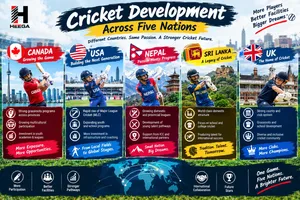 Cricket Development in Canada, USA, Nepal, Sri Lanka and UKExplore cricket development in Canada, USA, Nepal, Sri Lanka and UK, including grassroots growth, youth pathways, professional leagues and future opportunities.
 How Cricket Practice Can Help Kids Develop Stronger Coordination and Body Control.Discover how cricket practice helps kids develop coordination and body control through batting, bowling, catching, throwing, running, balance drills, and movement exercises.
 Beyond Talent: The Real Blueprint for Becoming a Better CricketerDiscover the real blueprint for becoming a better cricketer beyond natural talent. Learn how purposeful training, pressure practice, mental strength, fitness, recovery, match analysis, and consistency can transform your game.